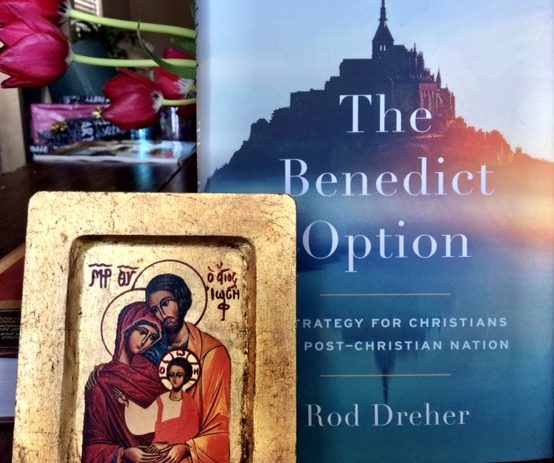
Since I already have some pretty definite opinions about the book, I thought maybe I ought to read it. My preliminary thoughts about Rod Dreher‘s The Benedict Option is that it offers a good analysis of the present states of both culture and Church, but Dreher’s solution seems more imposed than necessary or biblical. In other words, Dreher seems to have a fascination with the Rule of Benedict, and uses the current social climate as an excuse to encourage others to embrace it.
It’s not that I think there is no benefit from Benedictine practices. On the contrary, I was intrigued a few years ago when reading Dennis Okholm’s Monk Habits for Everyday People with a group of pastors with whom I would meet monthly or so. What I appreciated from Okholm’s work, and expect to appreciate from Dreher, are the categories of thought the Benedictine’s have developed. I appreciate many of their disciplines, and I can see that many of their practices could help cultivate a disciplined and rich spiritual vitality. However, the notion of withdrawal from the world at the root of Benedictine discipline, is not only an impractical option for most people, I am convinced that it violates Jesus’ command to his disciples found in John 20.21:
“Peace be with you. As the Father has sent me, even so I am sending you.”
And it is out of line with God’s expressed instruction to his people who were living in Babylonian exile, as recorded in Jeremiah 29.7:
“But seek the welfare of the city where I have sent you into exile, and pray to the Lord on its behalf, for in its welfare you will find your welfare.”
In other words, despite some – even many – ideas worthy of serious consideration, and that might be appropriate to be adopted with some adjustments, it seems to me that The Benedict Option is not really an option for those who want to be faithful followers of Jesus Christ. And Dreher himself seems to understand this since, despite the provocative title, he spends much energy explaining that what he is encouraging is the employment of some of Benedict’s principles without necessarily actually withdrawing into monastic communities.
See also:
- The Benedict Option: A Conversation with Rod Dreher (Al Mohler)
- Exploring the Benedict Option (John Stonestreet)
- The Benedict Option: Good As Strategy, Bad As a Posture (Trevin Wax)
- The Benedict Option (Q Ideas)
- Benedict Option (First Things)
- Benedict Option (American Conservative)

 GRACE & PEACE