Culture Shaping Power of the Church

Potter's Hands

Os Guinness, in his excellent book, Renaissance, concerning the church in midst of the present challenges unprecedented in Western Culture, notes the culture changing and culture shaping power of the gospel, when the gospel is both declared by God’s People and is actively shaping God’s People.  When many of our churches are caving in pursuit of “relevance”, which is hoped will cause people to “like” the church, so we can keep our numbers up, I think Guinness offers a both prophetic and strategic word:

What we have here in the teaching of Jesus and the Scriptures, and amplified in Augustine, is the very heart of the secret of the culture-shaping power of the gospel in the church. When the church goes to either of two extremes, and is so “in the world” that it is of the world and worldly, or so “not of the world” that it is otherworldly and might as well be out of the world altogether, it is powerless and utterly irrelevant.  But when the church, through its faithfulness and its discernment of the times, lives truly “in” but “not of” the world, and is therefore the City of God engaging the City of Man, it touches off the secret of its culture-shaping power. For the intellectual and social tension of being “in” but “not of” the world provides the engagement-with-the-critical-distance that is the source of the church’s culture-shaping power.

In short, the decisive power is always God’s, through his Word and Spirit. But on her side the church contributes three distinct human factors to the equation: engagement, discernment, and refusal.

First, the church is called to engage and to stay engaged, to be faithful and obedient in that it puts aside all other preferences of its own and engages purposefully with the world as the Lord commands.

Second, the church is called to discern, to exercise its spiritual and cultural discernment of the best and worst of the world of its day, in order to see clearly where it is to be “in” and where it is to be “not of” that world.

Third, the church is called to refuse, a grand refusal to conform to or comply with anything and everything in the world that is against the way of Jesus and his kingdom.

Symbol of a New Day Dawning

Rooster Colors

From time to time I am asked why I have a rooster for a profile picture, both on my blog and on Facebook.  What’s more, the rooster is also the screensaver on my phone.  I use these images for more reason than just the bucolic tranquility they depict.  The rooster has a long history as an interesting symbol.

While Celtic and Norse cultures saw the rooster as a creature of the underworld – a messenger screeching warnings of danger, and calling for the souls of those killed in battles; most have viewed the rooster in a more positive light.

In art, the rooster has long symbolized the fanning out of brilliance – i.e. showing the world the shimmering facets of ones personality.  As one  scholar has noted, the rooster is used in art to display courage, strength, pride,  honesty, vigilance, watchfulness, as well as flamboyance.  Most of these are excellent qualities. And flamboyance is not entirely bad, though too much of it may be somewhat obnoxious.

In Christianity the rooster is associated with Peter’s denial of Christ on the night of betrayal, leading up to the crucifixion.  So the rooster is associated with Christ’s death – which while tragic, was also God’s intention, the reason for which Jesus was born.  And while not lessening the tragedy, it is important to remember that Jesus himself says of the crucifixion: “I lay down my life, no one takes it from me.”  (John 10.11-18) Jesus laid down his life that those who believe would have life. Yet the effect of his substitutionary death only reached its full effect upon his resurrection – which Jesus hinted at in John 10.17.  In that sense the rooster, which symbolizes betrayal and death, cannot be separated from the purpose of Jesus’ death, and thus cannot be separated from the resurrection.  Therefore, the rooster is an appropriate symbol of the gospel itself.

What the rooster most symbolizes, at least to me, is the dawning of a new day. This is the reason I use it so freely.   The rooster crows at the first hints of new light.  This was a primary reason the rooster was used as a symbol of the Reformation – it was a reminder that the Reformation itself signaled a new day.  Of course the resurrection of Jesus is the ultimate sign of a new day.  And God himself tells us, through his prophet Jeremiah, that “his mercies are new every morning”.  (Lamentations 3.22-23)

So to me, the rooster is a constant reminder of the gospel, and that today is a new day – every day is a new day.  This being New Years Day, the rooster seems to me to be an especially appropriate symbol.

Seasons of Revival

Holy Spirit

No matter how many times I have seen them, my bemusement has never seemed to wane.  I appreciate the zeal, yet marvel at the naivete’.  Signs and banners adorning church doors and properties: “Revival Tonight!” “Revival This Week!”

Don’t get me wrong, I long to experience revival – a genuine work of God, an outpouring of the Holy Spirit in ways that bring widespread renewal.  But whenever I see such signs I am reminded of something I heard long ago: “Just because you put up a sign does not mean there is a revival; and if there is a true revival, you won’t need to put up a sign.”

Again, while I appreciate the zeal, I suspect many people are confused about what a revival is and is not.  A genuine revival is beyond human control. It is a work of God.  A Reformation, on the other hand, is something that we – the Church – should continually labor toward.  A Reformation is the conforming of our practices to the ways of God expressed in the Word.  There is always need for us to be at work to this end, since we are prone to drift toward fads and to our own devices.  But where we work toward Reformation, we can only – and must! – pray for Revival.

As we embark on a new year, a time when many of us pause and press the mental reset button, I am praying that perhaps in this coming year I might see and experience a genuine revival.  But I wonder if what I pray for is the same as what those who place signs on their doors are hoping to see.  As I consider the possible differences of opinion I may have from others on this subject, I appreciate the insights of Tim Keller describing one of the points of confusion – the difference between Seasons of Revival and mere Revivalism:

How do seasons of revival come? One set of answers comes from Charles Finney, who turned revivals into a “science.” Finney insisted that any group could have a revival any time or place, as long as they applied the right methods in the right way. Finney’s distortions, I think, led to much of the weakness in modern evangelicalism today, as has been well argued by Michael Horton over the years. Especially under Finney’s influence, revivalism undermined the more traditional way of doing Christian formation. That traditional way of Christian growth was gradual – whole family catechetical instruction – and church-centric. Revivalism under Finney, however, shifted the emphasis to seasons of crisis. Preaching became less oriented to long-term teaching and more directed to stirring up the affections of the heart toward decision. Not surprisingly, these emphases demoted the importance of the church in general and of careful, sound doctrine and put all the weight on an individual’s personal, subjective experience. And this is one of the reasons (though not the only reason) that we have the highly individualistic, consumerist evangelicalism of today.

Read the rest of Keller’s article: Revival: Ways & Means

Inebriated by the Gospel

Smoky Mountain Moonshine

Great grace laced imagery from Robert Capon:

The Reformation was a time when men went blind, staggering drunk because they had discovered, in the dusty basement of late medievilism, a whole cellarful of fifteen-hundred-year-old, two-hundred-proof grace – of bottle after bottle of pure distillate of Scripture, one sip of which would convince anyone that God saves us single-handedly. The word of the gospel – after all those centuries of trying to lift yourself into heaven by worrying about the perfection of your bootstraps – suddenly turned out to be a flat announcement that the saved were home before they started… Grace has to be drunk straight: no water, no ice, and certainly no ginger ale; neither goodness, nor badness, nor the flowers that bloom in the spring of super-spirituality could be allowed to enter into the case.

Reformation Essentials

On October 31, 1517 a young college professor, heavy of heart, wanted to discuss some of the things he was thinking.  Posting his thoughts on the front doors of the church in the center of town – the 16th Century version of Facebook or blogging – a flame ignited that  still burns today.  In fact, with the recent resurgence of the Reformed tradition that flame is burning bright.

On this 494th anniversary of Martin Luther’s simple act, I thought I would post a piece that reminds us of the essence of the movement that rocked the world.

***

by Michael Horton

In May, 1989, a conference jointly sponsored by the National Association of Evangelicals and Trinity Evangelical Divinity School was held at the Trinity campus in Illinois. Dubbed a consultation on Evangelical Affirmations, the meeting revealed more than it settled. In the published addresses (Zondervan, 1990), Carl F. H. Henry, the dean of American evangelicalism, sets the tone for book with his opening line: “The term ‘evangelical’ has taken on conflicting nuances in the twentieth century. Wittingly or unwittingly, evangelical constituencies no less than their critics have contributed to this confusion and misunderstanding.” He warned that “evangelical” was being understood, not according to Scriptural teaching and “the theological ‘ought,'” but according to the sociological and empirical “is.” In other words, Henry was disturbed that evangelicalism is increasingly being defined by its most recent trends rather than by its normative theological identity. Author after author (presumably, speaker after speaker) echoed the same fears that before long “evangelical” will be useless as any meaningful identification.

The term itself derives from the Greek word euangelion, translated “Gospel,” and it became a noun when the Protestant reformers began their work of bringing the “one holy, catholic and apostolic church” back to that message by which and for which it was created. People still used other labels, too, like “Lutheran,” “Reformed,” and later, “Puritans,” “Pietists,” and “Wesleyans.” Nevertheless, the belief was that the same Gospel that had united the “evangelicals” against Rome’s errors could also unite them against the creeping naturalism and secularism of the Enlightenment in the eighteenth century. The so-called “Evangelical Awakening” in Britain coincided with America’s own “Great Awakening,” as Wesley, Whitefield, Edwards, Tennant, and so many others centered their preaching on the atonement. Later, of course, Wesley’s zeal for Arminian emphases divided the work in Britain, but the Reformation emphases were clearly and unambiguously articulated in the Great Awakening.

Out of this heritage, those today who call themselves “evangelicals” (or who are in these churches, but might not know that they are in this tradition) are heirs also to the Second Great Awakening. Radically altering the “evangel” from a concern with the object of faith, the Second Great Awakening and the revivalism that emerged from it focused on the act and experience of faith, in dependence on the proper “excitements”, as Finney and others expressed it, to trigger the right response. In our estimation, this Second Great Awakening was the most important seismic shift in American religious history. Although the Reformation emphases of sin and grace continued to exercise some influence, they were being constantly revised to make the “Gospel” more acceptable to those who thought they could pull themselves up by their own bootstraps.

Only in the last decade of this century have many of the movement’s mainstream leaders considered the loss of an evangelical substance. No longer is the evangel the focus of the movement’s identity, but it is now known more by a sub-culture, a collection of political, moral and social causes, and an acute interest in rather exotic notions about the end-times. At a loss for words, one friend answered a man’s question, “Who are the evangelicals?” with the reply, “They’re people who like Billy Graham.”

It is at this point that those of us who are heirs to the Reformation–which bequeathed to evangelicalism a distinct theological identity that has been since lost–call attention once more to the solas (only or alone) that framed the entire sixteenth-century debate: “Only Scripture,” “Only Christ,” “Only Grace,” “Only Faith,” and “To God Alone Be Glory.”

Continue reading

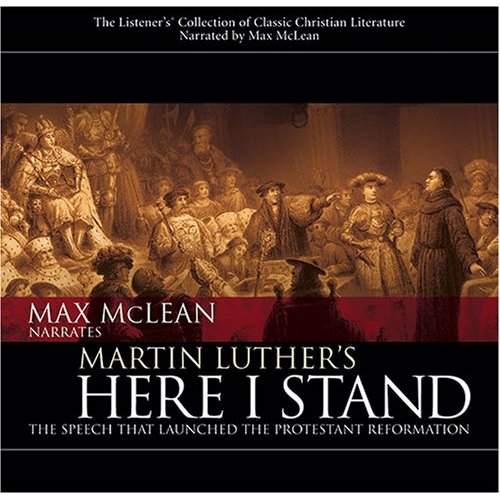
Here I Stand

Today being Reformation Sunday, the day on the ecclesiastical calender commemorating the anniversary of Martin Luther posting his 95 Theses on the doors of the church at Wittenburg, which inadvertantly set into motion a radical transformation of both the church and Western Culture, I thought it might be appropriate to review the roots of what we celebrate.

The standard for Luther biography is set by historian Roland Bainton in his seminal work, Here I Stand.  Taking his cue from Bainton’s work, acclaimed narrator Max McLean introduces the events leading up to the Diet of Worms:

  • Martin Luther’s prayer the night before he delivered his speech
  • Luther’s stirring defense
  • the Catholic church’s rebuttal
  • Luther’s final heartfelt response

The entire audio is available below:

Total run time is 24 minutes.

McLeans cd and mp3 can be purchased by clicking: Here I Stand

Radical Reformission

under-the-half-moon

Long ago I shamelessly pilferred the word “Reformissional” from Mark Driscoll of Mars Hill Church and Acts 29 Network.  The word seemed to encapsulate what I was about.  The word is a hybrid of both Reformed and Missional, two parallel tracks that both decribe and shape my philosophy of ministry – and even, to a large degree, my philopsophy of life. 

It was sometime later that it dawned on me that the word Reformation was also part of this equation. That, too, was an important discovery.  By Reformation I am not just referring to a point in time and history, but also the goal of my mission and life. I long to see a new reformation take place in my church, my community, and across this nation.  I long to see it spread throughout the world.  I am in regular need of one in my own life.

Now, when I say such things, I understand that there are many who may become reasonably uncomfortable. It is easy to misunderstand my hope and intent, and perhaps conjure up mental images of a time when people lived under religious oppression.  Afterall, many of our history books seem to suggest that this was the inevitable outcome resulting from the Reformation of the 16th Century.  But what I have in mind should evoke no such horrid.  (Besides, many of our history books are woefully in error about the Reformation, and especially the Puritan outgrowth of it.  But that is a topic for some other day.)

What I have in mind, when I say I long for a new reformation, is that I desire to see our churches constantly reshaping themselves to become more in accord with what the Scripture says they ought be. And corresponding to that, that the lives of Believers would be shaped and formed more and more by Christ, and less and less by culture, or tradition, or by anything else.  Rather than being oppressive, I belive that would be liberating. 

In his book, Radical Reformission, Mark Driscoll shares some keen insights.  I don’t embrace all of Driscoll’s views, but I did appreciate the book.  In particular, I felt the Introduction offers some important ideas that could stand alone as a challenging essay for todays churches, church leaders, and Christians.  For that reason, I am posting the following edited version of that Intro:


Since the mid-1990s, the conversation among young pastors has evolved from reaching Generation X, to ministering in a postmodern culture, to a more mature and profitable investigation of what a movement of missionaries would look like, missionaries sent not from America to another nation but from America to America. This “reformission” is a radical call to reform the church’s traditionally flawed view of missions as something carried out only in foreign lands and to focus instead on the urgent need in our own neighborhoods, which are filled with diverse cultures of Americans who desperately need the gospel of Jesus and life in his church. Most significant, they need a gospel and a church that are faithful both to the scriptural texts and to the cultural contexts of America. The timing of this reformission is critical. George Barna has said, “The first and most important statistic is that there are a lot of Americans who don’t go to church—and their numbers are increasing. The figure has jumped from just 21 percent of the population in 1991 to 33 percent today. In fact, if all the unchurched people in the U.S. were to establish their own country, they would form the eleventh most populated nation on the planet.”

What I am advocating is not an abandonment of missions across the globe but rather an emphasis on missions that begin across the street, like Jesus commanded (Acts 1:8).

Meanwhile, the churches in our neighborhoods may be more akin to museums memorializing a yesterday when God showed up in glory to transform people, than to the pivot points of a movement working to reform the culture of the present day. Reformission requires that we all learn the principles handed down to us from mentors who are seasoned cross-cultural missionary pioneers, such as Lesslie Newbigin, Hudson Taylor, and Roland Allen. These missionaries are most adept at helping us to cross from our church subcultures into the dominant cultures that surround us. Subsequently, at the heart of reformission are clear distinctions between the gospel, the culture, and the church.

First, the gospel of Jesus Christ is the heart of the Scriptures.  To put it succinctly, Paul said that the gospel is of primary importance and consists of Jesus’ death, burial, and resurrection to save sinners, in accordance with the Scriptures (1 Cor. 15:1-8).

Second, we have the various cultures in which people live their lives (for example, ancient Jews and Gentiles; modern, urban homosexual artists; modern, rural heterosexual farmers). Our lives shape, and are shaped by, the culture we live in, and the gospel must be fitted to (not altered for) particular people, times, and circumstances so that evangelism will be effective.

Third, we have the church, or the gathering of God’s people— which includes those who are not Christians (Matt. 13:24-30) — where people are built up in their faith and knitted together in loving community. They can then faithfully engage those in the culture with the gospel, while experiencing its transforming power in their own lives.

Reformission is a radical call for Christians and Christian churches to recommit to living and speaking the gospel, and to doing so regardless of the pressures to compromise the truth of the gospel or to conceal its power within the safety of the church. The goal of reformission is to continually unleash the gospel to do its work of reforming dominant cultures and church subcultures.

Reformission therefore begins with a simple return to Jesus, who by grace saves us and sends us into mission. Jesus has called us to (1) the gospel (loving our Lord), (2) the culture (loving our neighbor), and (3) the church (loving our brother). But one of the causes of our failure to fulfill our mission in the American church is that the various Christian traditions are faithful on only one or two of these counts. When we fail to love our Lord, neighbor, and brother simultaneously, we bury our mission in one of three holes: the parachurch, liberalism, or fundamentalism.

Gospel + Culture – Church = Parachurch

First, many Christians become so frustrated with the church that they try to bring the gospel into the culture without it. This is commonly referred to as the parachurch, which includes evangelistic ministries such as Young Life and Campus Crusade for Christ. The success of these ministries is due in large part to their involvement in culture and in loving people, whereas the church often functions as an irrelevant subculture. But the failure of such ministries is that they are often disconnected from the local church, connecting unchurched people to Jesus without connecting them to the rest of Jesus’ people. This can lead to theological immaturity. Once someone is saved, he or she is encouraged to do little more than get other people saved.

Also, since parachurch ministries are often age-specific, they lack the benefits of a church culture in which all generations are integrated to help people navigate the transitions of life. This further separates families from each other if mom, dad, and kids are each involved in disconnected life-stage ministries outside of their church, rather than in integrated ministries within it.

The parachurch tends to love the Lord and love its neighbors, but not to love its brothers.

Culture + Church – Gospel = Liberalism

Second, some churches are so concerned with being culturally relevant that, though they are deeply involved in the culture, they neglect the gospel. They convert people to the church and to good works, but not to Jesus. This is classic liberal Christianity, and it exists largely in the dying mainline churches. The success of these ministries lies in that they are involved in the social and political fabric of their culture, loving people and doing good works. Their failure is that they bring to the culture a false gospel of accommodation, rather than confrontation, by seeking to bless people as they are rather than calling them to a repentant faith that transforms them. Often the motive for this is timidity because, as Paul says, the gospel is foolish and a stumbling block to the unrepentant. Liberal Christians are happy to speak of institutional sin but are reticent to speak of personal sin because they will find themselves at odds with sinners in the culture.

Liberal Christians run the risk of loving their neighbors and their brothers at the expense of loving their Lord.

Church + Gospel – Culture = Fundamentalism

Third, some churches are more into their church and its traditions, buildings, and politics than the gospel. Though they know the gospel theologically, they rarely take it out of their church. This is classic fundamentalist Christianity, which flourishes most widely in more independent-minded, Bible-believing churches. The success of these churches lies in that they love the church and often love the people in the church. Their failure is that it is debatable whether they love Jesus and lost people in the culture as much as they love their own church. Pastors at these churches are prone to speak about the needs of the church, focusing on building up its people and keeping them from sinning. These churches exist to bring other Christians in, more than to send them out into the culture with the gospel. Over time, they can become so inwardly focused that the gospel is replaced with rules, legalism, and morality supported with mere proof texts from the Bible.

Fundamentalist Christians are commonly found to love their Lord and their brothers, but not their neighbors.

Reformission is a gathering of the best aspects of each of these types of Christianity: living in the tension of being Christians and churches who are culturally liberal yet theologically conservative and who are driven by the gospel of grace to love their Lord, brothers, and neighbors.

Antithesis Manifesto


Several years ago a now defunct web-based organization, Antithesis or ChristianCounterCulture.com, published a manifesto that prophetically challenges contemporary Evanglicalism.  It resonated with me then and, with the exception of the dating in the opening paragraph, it remains timely. 

From time to time I re-read, what I call, the Antithesis Manifesto to refresh my thoughts. As I reflect on it this afternoon I want to sumarize some of the assertions:

1. Today’s Christian Culture is destroying Christianity

While we are prone to lament the “world” and the decaying values, the truth is that we Evangelicals bear much responsibility for this.  We want so desperately to be accepted by the world (for the sake of evangelism) that we have largely become indistinguishable from it.  We mimic whatever is popular, and many seem to be driven by the same values systems.  (Think about it, How do we guage a “successful” church?  Often by size, money, fame, and political clout.) 

This value shift has not escaped notice. Not from those outside the Church. And not from a generation inside the church that has grown weary of our impotence, if not our outright hypocrissy.  

I recall John Stott saying that if the culture is decaying it is the fault of the church not being the preserving “Salt” it is supposed to be. (See Matthew 5:13)  Stott said you can no more blame the culture for decaying than you can a piece of meat. It is the salt that bears the responsibility to the work of preserving.

If we think the world is having a negative influence on the church it is only because the church has chosen to be like the world.  It is not the world that is destroying us. We are doing it to ourselves. And collectively, I’m afraid, we Westerners are doing little toward our mandate to preserve our culture. (See Jeremiah 29:7)

2. We must Practice Truth

It is not enough to claim the Bible is truth. We must live that truth.  This requires a serious assessment of all of our practices – ecclesiastical as well as personal – and an intentional submission of them to Biblical standards.  We need to be “formed” by the Word, not merely familiar with it.  And there is no sphere of our lives that is exempt from constant need of re-formation.

3. Our Fellowships must be REAL Communities.

The Gospel not only forms us as “new creations”, but it forms a New Community.  As the Manifesto correctly observes: “Too many of our churches are really teaching stations and activity generators. The ‘sharing of life’ in community has had little place.” 

The Gospel formed community is an open, inviting, honest place, where participants are interdependent.  This runs contrary to our individualism (another value we have assumed from the culture), but it is the Biblical model, and the environment in which Gospel Transformation really takes place. 

Conclusion

The whole manifesto reveals a definite touch of Francis Schaeffer’s influence.  Perhaps that’s why it resonates with me.  But a simple periodic review is not enough. We need to make the appropriate changes.  Without them this whole thing is rather ominous.  But if there is change there is also reason for great hope.

The Antithesis Manifesto itself concludes with these words:

If Christians take these factors into account, then we may hope for the stirring of a revolution in our day. And, should our Lord delay his return, the century before us may be marked as a time when radical Christian proclamation went forth yet again – in the power of the Holy Spirit – turning the world upside down, forever altering the cultural landscape.

(To read the original document click: Antithesis Manifesto.pdf)