A Prayer for the New Year

I launch my ship into the unknown waters of this year,
   with you, O Father, as my harbor,
     you, O Son, at my helm, and
     you, O Holy Spirit, filling my sails.

Guide me to heaven with
   my lamp burning,
   my ear open to your calls,
   my heart full of love,
   my soul free.

Give me your grace to sanctify me,
      your comforts to cheer,
      your wisdom to teach,
      your right hand to guide,
      your counsel to instruct,
      your law to judge,
      your presence to stabilize.

May your fear be my awe, your triumphs my joy.

~ adapted from Valley of Vision

Symbol of a New Day Dawning

Rooster Colors

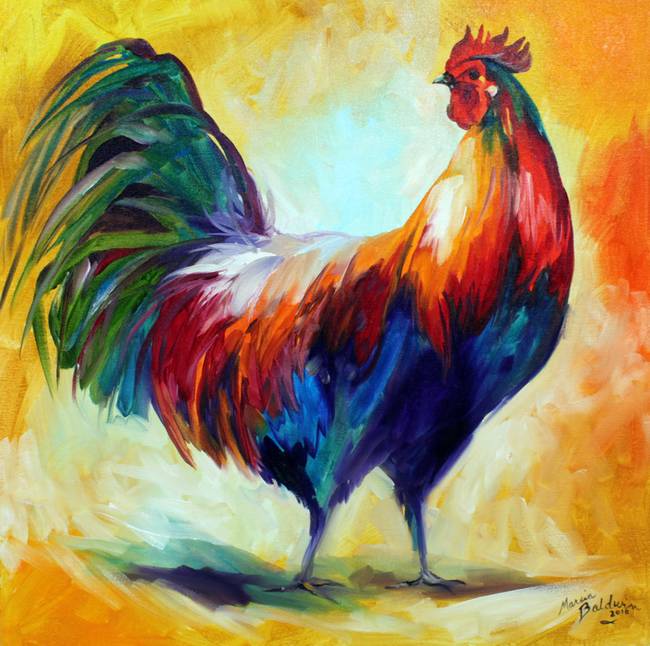
From time to time I am asked why I have a rooster for a profile picture, both on my blog and on Facebook.  What’s more, the rooster is also the screensaver on my phone.  I use these images for more reason than just the bucolic tranquility they depict.  The rooster has a long history as an interesting symbol.

While Celtic and Norse cultures saw the rooster as a creature of the underworld – a messenger screeching warnings of danger, and calling for the souls of those killed in battles; most have viewed the rooster in a more positive light.

In art, the rooster has long symbolized the fanning out of brilliance – i.e. showing the world the shimmering facets of ones personality.  As one  scholar has noted, the rooster is used in art to display courage, strength, pride,  honesty, vigilance, watchfulness, as well as flamboyance.  Most of these are excellent qualities. And flamboyance is not entirely bad, though too much of it may be somewhat obnoxious.

In Christianity the rooster is associated with Peter’s denial of Christ on the night of betrayal, leading up to the crucifixion.  So the rooster is associated with Christ’s death – which while tragic, was also God’s intention, the reason for which Jesus was born.  And while not lessening the tragedy, it is important to remember that Jesus himself says of the crucifixion: “I lay down my life, no one takes it from me.”  (John 10.11-18) Jesus laid down his life that those who believe would have life. Yet the effect of his substitutionary death only reached its full effect upon his resurrection – which Jesus hinted at in John 10.17.  In that sense the rooster, which symbolizes betrayal and death, cannot be separated from the purpose of Jesus’ death, and thus cannot be separated from the resurrection.  Therefore, the rooster is an appropriate symbol of the gospel itself.

What the rooster most symbolizes, at least to me, is the dawning of a new day. This is the reason I use it so freely.   The rooster crows at the first hints of new light.  This was a primary reason the rooster was used as a symbol of the Reformation – it was a reminder that the Reformation itself signaled a new day.  Of course the resurrection of Jesus is the ultimate sign of a new day.  And God himself tells us, through his prophet Jeremiah, that “his mercies are new every morning”.  (Lamentations 3.22-23)

So to me, the rooster is a constant reminder of the gospel, and that today is a new day – every day is a new day.  This being New Years Day, the rooster seems to me to be an especially appropriate symbol.

Devotional for the New Year: The Good News We Almost Forgot

Good News

For anyone looking for a good devotional book to use in the new year, whether for personal or family, I would recommend Kevin DeYoung‘s The Good News We Almost Forgot.  Insightfully written, this book follows the pattern of the Heidelberg Catechism, quite possibly the most devotional of all historic catechisms.  As the Heidelberg has been broken into 52 units by the Dutch church, one for each Lord’s Day of the year, so DeYoung has penned 52 short, two to three page, chapters, each digging into the truths of the respective catechism questions for that week, and then winsomely applying the truths to day to day life.  This book helps the readers go deeper while at the same time broadening the scope of the historic faith.

Another 10+ Questions for the New Year

Proverbs 20.5 says:

The purpose in a man’s heart is like deep water,
but a man of understanding will draw it out.

In short what Solomon explains is that everyone has desires and designs, but often we may not be conscious  even of our own.  Our purposes are deep down.  But the wise person, the “Man of Understanding” will take the time and make the effort to discern his/her own heart.

Here in the first week of the New Year I have posted a series of questions that can help us be men and women of understanding.  These questions can help us realize our own deep desires. My hope is that in discovering what may be hidden in the depths we can consequently make wise steps.

Take some time to contemplate these questions:

  1. What one thing do you most regret about last year, and what will you do about it this year?
  2. What single blessing from God do you want to seek most earnestly this year?
  3. In what area of your life do you most need growth, and what will you do about it this year?
  4. What’s the most important trip you want to take this year?
  5. What skill do you most want to learn or improve this year?
  6. To what need or ministry will you try to give an unprecedented amount this year?
  7. What’s the single most important thing you could do to improve the quality of your commute this year?
  8. What one biblical doctrine do you most want to understand better this year, and what will you do about it?
  9. If those who know you best gave you one piece of advice, what would they say? Would they be right? What will you do about it?
  10. What’s the most important new item you want to buy this year?
  11. In what area of your life do you most need change, and what will you do about it this year?

10 Questions for the New Year

Donald Whitney has a knack for asking pertinent probing questions.  His questions could be used for getting to know one another in a new small group.  But I think they might best be used for personal reflection.  Whitney’s questions penetrate into the recesses of our hearts. And if we take the time to reflect upon them and answer honestly, they reveal to us our own motives and deep desires – sometimes, perhaps, even in ways we may not have previously been conscious.

As we embark in the New Year take some time to contemplate these 10 questions:

  1. What’s one thing you could do this year to increase your enjoyment of God?
  2. What’s the most humanly impossible thing you will ask God to do this year?
  3. What’s the single most important thing you could do to improve the quality of your family life this year?
  4. In which spiritual discipline do you most want to make progress this year, and what will you do about it?
  5. What is the single biggest time-waster in your life, and what will you do about it this year?
  6. What is the most helpful new way you could strengthen your church?
  7. For whose salvation will you pray most fervently this year?
  8. What’s the most important way you will, by God’s grace, try to make this year different from last year?
  9. What one thing could you do to improve your prayer life this year?
  10. What single thing that you plan to do this year will matter most in ten years? In eternity?

Signs of Living to Please God

In Galatians 1:10, the Apostle Paul asks a semi-rhetorical question: “Am I now trying to win the approval of men, or of God?”   

 At this time of the year most of us see the opportunity for a new start. Whether you are one who makes New Year’s Resolutions or not, there seems to be a sense of a“Do Over” that comes almost as soon as that ball drops in Times Square, and the Bowl season begins to make way for the roundball & puck.   

The Apostle’s question raises another, more fundamental question: Who is it that we are to live to please?  

I want that to be a question that will be given consideration for this new year (… and every year).  

It would not be appropriate to suppose Paul suggests affirmation from the people around us is a bad thing. On many occasions Paul expressed his thankfulness for having been well received, for the friendships he enjoyed with many among whom he had lived and labored.  Yet his question should remind us: “The primary purpose of man is to glorify and enjoy God”. (Westminster Shorter Catechism, Q. 1)

While earning esteem at work, in your neighborhood, or among family members may often be a good thing, Paul reminds us that it is when this is our driving motivation that we may be out of accord with the very purpose for which we are created, and for which we are redeemed.   

So how do we know when we are falling into this? (Yes, when, not if.)   

The great English Puritan, Richard Baxter, provides us with some thoughts, and exhorts us: “See therefore that you live for God’s approval as that which you chiefly seek, and as that will suffice you.”

You may discover yourself by these signs: 

  1. You will be careful to understand the Scripture, to know what pleases and displeases God
  2. You will be more careful in the doing of every task, to fit it to the pleasure of God rather than men.
  3. You will look to your hearts, and not only to your actions; to your goals, and thoughts, and the inward manner and degree.
  4. You will look to secret duties as well as public, and to that which men do not see as well as those which they see.
  5. You will revere your conscience, paying close attention to it, and not slighting it; when it tells you of God’s displeasure, it will disquiet you; when it tells you of His approval, it will comfort you.
  6. Your pleasing men will be charitable for their good, and pious (holy) in order to please God, not proud and ambitious for your honor among men, nor impious against the pleasing of God.

Baxter Goes on to say:

Whether men are pleased or displeased, how they judge you or what they call you, will seem a small matter to you, as their own interests, in comparison to God’s judgment. You don’t live for them. You can bear their displeasure, and comments, if God is pleased.