Are some Christmas hymns better than others? Consider what Martin Luther says to his Anglican friends in this imaginary discussion, from Lutheran Satire.
Martin Luther
What Of It?
Martyn Lloyd-Jones, in his book Spiritual Depression, poignantly asserts:
“Have you realized that most of your unhappiness in life is due to the fact that you are listening to yourself instead of talking to yourself? Take those thoughts that come to you the moment you wake up in the morning. You have not originated them but they are talking to you, they bring back the problems of yesterday, etc. Somebody is talking. Who is talking to you? Your self is talking to you.”
We all have this experience. For some it is nearly debilitating. The weight of guilt from past transgressions or inactions drains the emotional bank account. The result, as Lloyd-Jones says, is “unhappiness”. Discouragement. And whenever discouragement is left untreated, there is always the risk that it metastasizes into full blown depression.
The issue is not that these thoughts are necessarily wrong. We all have regrets of things we have done and of things we have left undone. What is wrong is how these feelings warp our sense of identity, and consequently our emotional health. What is wrong is how these things rob us of our connection with the greater truths of God’s Promises, often making the one “listening” to these mental accusations feel unworthy, and therefore disconnected from God himself.
The answer is not to simply ignore these mental accusations. There is a very real sense that we are “guilty”, and that we are “unworthy” to enjoy God’s presence. As Paul reminds us in Romans 3.23, “…all have sinned and fall short of the glory of God…”. John concurs with Paul, reminding us in 1 John 1.8, “If we say we have no sin, we deceive ourselves, and the truth is not in us.” and again in v. 10, “If we say we have not sinned, we make God a liar, and God’s word is not in us.”
The solution to our unhappiness is found in what John writes in between, in v. 9: “If we confess our sins, he is faithful and just to forgive us our sins and to cleanse us from all unrighteousness.” In other words, the remedy to our unhappiness begins by owning whatever part of the accusations are true. We own it, then “confess it” to God. (NOTE: However, we must take care to not embrace what is untrue.)
Lloyd-Jones, who was a medical doctor before entering into pastoral ministry, prescribes that we “talk to ourselves” as medicine for our souls. After “confession”, which is talking to God, we are to “talk to ourselves.” We are to remind ourselves of the promises of the gospel, such as the promises of 1 John 1.9, or any of the many similar promises that are laced throughout the Scriptures. These promises are “greater truths” than whatever is true of our guilt; greater because they are God’s truths, God’s promises to those who rest in his grace, through faith in Christ.
What would such a conversation look like? What might we say to “ourselves” when our minds feel flooded with accusation? The video above provides a powerful example. In this video, actor Joseph Fiennes plays Martin Luther in the 2003 biopic, Luther. In the scene, Luther declares:
“So when the devil throws your sins in your face and declares that you deserve death and hell, tell him this: “I admit that I deserve death and hell, what of it? For I know One who suffered and made satisfaction on my behalf. His name is Jesus Christ, Son of God, and where He is there I shall be also!”
This is what is called “preaching the gospel to yourself”!
As Luther ostensibly said at another time:
“Be a sinner and sin boldly, but believe and rejoice in Christ even more boldly.”
Spiritual Chrysalis

In preparation for this past Sunday message from Galatians, I again marveled at the insight and passion of Martin Luther concerning our Union with Christ:
“So far as justification is concerned, Christ and I must be so closely attached that He lives in me and I in Him. What a marvelous way of speaking!
Because He lives in me, whatever grace, righteousness, life, peace, and salvation there is in me is all Christ’s; nevertheless, it is mine as well, by the cementing and attachment that are through faith, by which we become as one body in the Spirit.
Since Christ lives in me, grace, righteousness, life, and eternal salvation must be present with Him; and the Law, sin, and death must be absent. Indeed, the Law must be crucified, devoured, and abolished by the Law—and sin by sin, death by death, the devil by the devil.
In this way Paul seeks to withdraw us completely from ourselves, from the Law, and from works, and to transplant us into Christ and faith in Christ, so that in the area of justification we look only at grace, and separate it far from the Law and from works, which belong far away…
But faith must be taught correctly, namely, that by it you are so cemented to Christ that He and you are as one person, which cannot be separated but remains attached to Him forever and declares: ‘I am as Christ.’
And Christ, in turn, says: ‘I am as that sinner who is attached to Me, and I to him. For by faith we are joined together into one flesh and one bone.’
Thus Ephesians 5.30 says: ‘We are members of the body of Christ, of His flesh and of His bones,’ in such a way that this faith couples Christ and me more intimately than a husband is coupled to his wife.”
~ from Luther’s Works, Vol. 26: Lectures on Galatians, 1535, Chapters 1-4
The Glory of God’s Incarnation

Martin Luther expresses his appreciation of Christmas, not just that Jesus was born, but how and to whom he was born:
If Christ had arrived with trumpets and lain in a cradle of gold, His birth would have been a splendid affair. But it would not be a comfort to me. He was, rather, to lie in the lap of a poor maiden and be thought to be of little significance in the eyes of the world. Now I can come to Him. Now He reveals Himself to the miserable in order not to give any impression that He arrives with great power, splendor, wisdom, and aristocratic manners. But upon His return, on that Day when He will oppose the high and the mighty, it will be different. Now He comes to the poor, who need a Savior; but then He will come as a Judge against those who are persecuting Him now. ~ from a sermon from 1530
Remember Christ dwelt with us in humility so that we might approach him receiving the covenant of peace which he secured for us by the blood of his cross. (Colossians 1.19-20)
Here I Stand

Today being Reformation Sunday, the day on the ecclesiastical calender commemorating the anniversary of Martin Luther posting his 95 Theses on the doors of the church at Wittenburg, which inadvertantly set into motion a radical transformation of both the church and Western Culture, I thought it might be appropriate to review the roots of what we celebrate.
The standard for Luther biography is set by historian Roland Bainton in his seminal work, Here I Stand. Taking his cue from Bainton’s work, acclaimed narrator Max McLean introduces the events leading up to the Diet of Worms:
- Martin Luther’s prayer the night before he delivered his speech
- Luther’s stirring defense
- the Catholic church’s rebuttal
- Luther’s final heartfelt response
The entire audio is available below:
Total run time is 24 minutes.
McLeans cd and mp3 can be purchased by clicking: Here I Stand
Difference Between Faith and Hope

The question may occur to us: What difference is there between faith and hope? We find it difficult to see any difference. Faith and hope are so closely linked that they cannot be separated. Still there is a difference between them.
Consider the following distinctions offered by Martin Luther, from his commentary on Galatians:
First, hope and faith differ in regard to their sources. Faith originates in the understanding, while hope rises in the will.
Secondly, they differ in regard to their functions. Faith says what is to be done. Faith teaches, describes, directs. Hope exhorts the mind to be strong and courageous.
Thirdly, they differ in regard to their objectives. Faith concentrates on the truth. Hope looks to the goodness of God.
Fourthly, they differ in sequence. Faith is the beginning of life before tribulation (Hebrews 11). Hope comes later and is born of tribulation (Romans 5).
Fifthly, they differ in regard to their effects. Faith is a judge. It judges errors. Hope is a soldier. It fights against tribulations, the Cross, despondency, despair, and waits for better things to come in the midst of evil.
Without hope faith cannot endure. On the other hand, hope without faith is blind rashness and arrogance because it lacks knowledge. Before anything else a Christian must have the insight of faith, so that the intellect may know its directions in the day of trouble and the heart may hope for better things. By faith we begin, by hope we continue.
7 Maxims of Repentance

Jesus said:
“This is what is written: The Christ will suffer and rise from the dead on the third day, and repentance and forgiveness of sins will be preached in his name to all nations, beginning at Jerusalem.” (Luke 26.46-47)
Seemingly few recognize that repentance is part of the message of the Great Commission. But that is clearly what Luke records Jesus as saying. Not only is a call to repentance connected to the forgiveness of our sin, but I am convinced that repentance is one of the ways in which we express “obedience” to everything Jesus commanded us. As Martin Luther postulated in the first of his 95 Theses:
When our Lord and Master, Jesus Christ, said “Repent”, He willed that the whole life of believers be lived out in repentance.
Yet, just as seemingly few are aware that repentace is part of the Great Commisson, seemingly fewer realize repentance should be a way of life for the Christian. Building upon Luther’s observation, contemporary pastor/theologian Sinclair Ferguson declares:
“According to Scripture, the Christian Life is repentance from beginning to end! So long as the believer is at the same time righteous and yet a sinner, it can be no other way.”
In his masterful book on the subject, Repentance: The First Word of the Gospel, Richard Owen Roberts offers a series of lists, including 7 Maxims of Repentance:
- True Repentance is a Gift of God
- True Repentance is NOT a Single Act but an Ongoing and Continual Attitude
- True Repentance is NOT Merely Turning From What You Have Done but From What You ARE
- True Repentance is Not What you Do for yourself but What You do for God
- True Repentance is Not Merely of the Fruits of Sin but of the Very Roots
- True Repentance is Not Secret but Open
- True Repentance is Both Negative and Positive
While I would wholeheartedly commend the reading of Roberts’ book, merely pondering this list will itself offer some rewarding insights as to the nature and benefits of repentance. While some maxims are more immediately understood than others, all are discernable.
Natural Born Skeptics
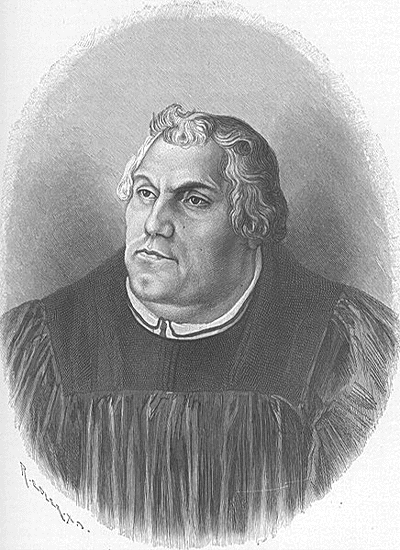
To doubt the good will of God is an inborn suspicion of God with all of us.
Besides, the devil…goes about seeking to devour us by roaring: ‘God is angry at you and is going to destroy you forever.’
In all these difficulties we have only one support, the Gospel of Christ. To hold on to it, that is the trick.
Christ cannot be perceived with the senses…
The heart does not feel His helpful presence…
Especially in times of trials a Christian feels the power of sin, the infirmity of his flesh, the goading darts of the devil…the scowl and judgment of God. All these things cry out against us, death thunders at us, the devil roars at us.
In the midst of the clamor the Spirit of Christ cries in our hearts, ‘Abba, Father.’
And this little cry of the Spirit transcends the hullabaloo of the Law, sin, death, and the devil, and finds a hearing with God. The Spirit cries because of our weakness…(and) is sent forth into our hearts…to assure us of the grace of God.”
– Martin Luther, Commentary on Galatians
Grace of Repentance

Today is Ash Wednesday. That does not mean much to many in my theological circles. But for many other Christians it is a day that launches the Season leading to Easter – the Season of Lent. This day is designated Ash Wednesday because of an ancient practice of marking believers with ashes as a symbol of repentance.
Hopefully it is more than symblolic, but is also a reminder that, as Martin Luther said, “When Christ said ‘Repent’ he called for the entire lives of Believers to be lived out in repentance.”
Repentance is a lost art. Repentance is also a neglected practice. I suspect that many assume repentance is someting to be avoided; that repentance is what we must do if we have sinned; but if we can avoid sin we have no need of repentance.
Seems logical. Except it mischaracterizes the nature of sin. Sin is not what we do, sin is the condition we have, whether we are aware of it or not. I find helpful the old saying: “We are not sinners because we sin. We sin because we are sinners.” Thus, as Luther suggested, the necessity of life lived out in repentance.
Perhaps a better way of putting it might be that our lives should include repentance. I say that because repentance never stands alone. Repentance should always accompany Faith; and Faith should always accompany Repentance. They are two sides of the same coin of Gospel Christianity.
I like the way the old Puritan Thomas Watson says it:
“Faith and Repentance are the two wings by which we fly toward heaven.”
I love the imagery. It shows us that our salvation involves not only our conversions (which, by the way, requires both Faith & Repentance), but is a sanctifying journey which requires us to grow in our awarenss of both our ungodliness and the greatness of the Gospel. To have one wing longer than the other; or worse, to have only one wing, would be disastrous. Try it for yourself. Try flying one of those balsa wood planes, with one wing longer than the other and see how it flies. But this is life without both Faith & Repentance.
Three books I have found helpful in shaping my understanding and appreciation of the need of ongoing repentance:
Repentance & 21st Century Man by C. John Miller
The Doctrine of Repentance by Thomas Watson
Repentance: The First Word of the Gospel by Richard Owen Roberts
Enduring Aroma of the Gospel
People don’t earn God’s approval or receive life and salvation because of anything they’ve done. Rather, the only reason they receive life and salvation is because of God’s kindness through Christ. There is no other way.
Many Christians are tired of hearing this teaching over and over. They think that they learned it all long ago. However, they barely understand how important it really is. If it continues to be taught as truth, the Christian church will remain united and pure — free from decay. This truth alone makes and sustains Christianity. You might hear an immature Christian brag about how well he knows that we receive God’s approval through God’s kindness and not because of anything we do to earn it. But if he goes on to say that this is easy to put into practice, then have no doubt he doesn’t know what he’s talking about, and he probably never will. We can never learn this truth completely or brag that we understand it fully. Learning this truth is an art. We will always remain students of it, and it will always be our teacher.
The people who truly understand that they receive God’s approval by faith and put this into practice don’t brag that they have fully mastered it. Rather, they think of it as a pleasant taste or aroma that they are always pursuing. These people are astonished that they can’t comprehend it as fully as they would like. They hunger and thirst for it. They yearn for it more and more. They never get tired of hearing about this truth.
– Martin Luther

Hard Grace
 “Even though we are now in faith, the heart is always ready to boast itself before God and say: ‘After all, I have preached the law, and lived so well and done so much that surely He will take this into account ‘.
We even want to haggle with God to make Him regard our life, but it cannot be done. With men you may boast: ‘I have done the best I could… If anything is lacking, I will still try to make recompense.’ But when you come before God, leave all that boasting at home. Remember to appeal from justice into grace.
But let anybody try this and he will see and experience how exceedingly hard and bitter a thing it is for a man who, all his life, has been marred and has worked righteousness to pull himself out of it with all his heart, to rise up through faith in the one mediator.
I myself have been preaching and cultivating it through reading and writing for almost twenty years and still feel the old clinging dirt of wanting to deal so with God that I may contribute something so that He will give me His grace in exchange for my holiness. Still I cannot get it into my head that I should surrender myself completely to sheer grace.
Yet I know that this is what I should and must do.”
– Excerpted and edited from Martin Luther, Commentary on Galatians
Faith & Hope

The question occurs to us, What difference is there between faith and hope? We find it difficult to see any difference. Faith and hope are so closely linked that they cannot be separated. Still there is a difference between them.
First, hope and faith differ in regard to their sources. Faith originates in the understanding, while hope rises in the will.
Secondly, they differ in regard to their functions. Faith says what is to be done. Faith teaches, describes, directs. Hope exhorts the mind to be strong and courageous.
Thirdly, they differ in regard to their objectives. Faith concentrates on the truth. Hope looks to the goodness of God.
Fourthly, they differ in sequence. Faith is the beginning of life before tribulation (Hebrews 11). Hope comes later and is born of tribulation (Romans 5).
Fifthly, they differ in regard to their effects. Faith is a judge. It judges errors. Hope is a soldier. It fights against tribulations, the Cross, despondency, despair, and waits for better things to come in the midst of evil.
Without hope faith cannot endure. On the other hand, hope without faith is blind rashness and arrogance because it lacks knowledge. Before anything else a Christian must have the insight of faith, so that the intellect may know its directions in the day of trouble and the heart may hope for better things. By faith we begin, by hope we continue.
– from Martin Luther’s commentary on Galatians
Sin Boldly
 I’m going to start a new category: Graffiti. This categtory will offer some great quotes. I don’t know many that would top the following from Luther:
“If you are a preacher of grace, then preach a true and not a fictitious grace; if grace is true, you must bear a true and not a fictitious sin. God does not save people who are only fictitious sinners. Be a sinner and sin boldly, but believe and rejoice in Christ even more boldly, for he is victorious over sin, death, and the world.
As long as we are here [in this world] we have to sin. This life is not the dwelling place of righteousness, but, as Peter says, we look for new heavens and a new earth in which righteousness dwells. It is enough that by the riches of God’s glory we have come to know the Lamb that takes away the sin of the world. No sin will separate us from the Lamb, even though we commit fornication and murder a thousand times a day. Do you think that the purchase price that was paid for the redemption of our sins by so great a Lamb is too small? Pray boldly—you too are a mighty sinner.”
-Martin Luther, in a letter to Phillip Melancthon
 GRACE & PEACE