Balance of Faith

Balance Act

A true, vibrant Christian faith is someting akin to a balancing act.

In a post this morning, Tim Keller suggested:

If we are going to grow in grace, we must stay aware of being both sinners and also loved children in Christ.

Keller’s paradigm reminded me of something Edward Payson – “Praying Payson of Portland” – wrote long ago:

True Christianity consists of a proper mixture of fear of God, and of hope in his mercy; and wherever either of these is entirely wanting, there can be no true Faith. God has joined these things, and we ought by no means to put them asunder.

He cannot take pleasure in those who fear him with a slavish fear, without hoping in his mercy, because they seem to consider him a cruel and tyrannical being, who has no mercy or goodness in his nature. And, besides, they implicitly charge him with falsehood, by refusing to believe and hope in his invitations and offers of mercy.

On the other hand, he cannot be pleased with those who pretend to hope in his mercy without fearing him. For they insult him by supposing there is nothing in him which ought to be feared. And in addition to this, they make him a liar, by disbelieving his awful threatenings denounced against sinners, and call in question his authority, by refusing to obey him.

Those only who both fear him and hope in his mercy, give him the honor that is due to his name.

Both Payson and Keller give credence to thw wisdom of Puritan Thomas Watson:

The two great graces essential to a saint in this life are faith and repentance. These are the two wings by which he flies to heaven.
Difference Between Faith and Hope

The question may occur to us: What difference is there between faith and hope? We find it difficult to see any difference. Faith and hope are so closely linked that they cannot be separated. Still there is a difference between them.

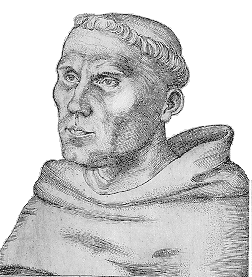
Consider the following distinctions offered by Martin Luther, from his commentary on Galatians:

First, hope and faith differ in regard to their sources. Faith originates in the understanding, while hope rises in the will.

Secondly, they differ in regard to their functions. Faith says what is to be done. Faith teaches, describes, directs. Hope exhorts the mind to be strong and courageous.

Thirdly, they differ in regard to their objectives. Faith concentrates on the truth. Hope looks to the goodness of God.

Fourthly, they differ in sequence. Faith is the beginning of life before tribulation (Hebrews 11). Hope comes later and is born of tribulation (Romans 5).

Fifthly, they differ in regard to their effects. Faith is a judge. It judges errors. Hope is a soldier. It fights against tribulations, the Cross, despondency, despair, and waits for better things to come in the midst of evil.

Without hope faith cannot endure. On the other hand, hope without faith is blind rashness and arrogance because it lacks knowledge. Before anything else a Christian must have the insight of faith, so that the intellect may know its directions in the day of trouble and the heart may hope for better things. By faith we begin, by hope we continue.

Lord Dissolve My Frozen Heart

Lord, dissolve my frozen heart/ By the beams of Love Divine;/ This alone can warmth impart/ To dissolve a heart like mine.

O that love, how vast it is!/ Vast, it seems, though known in part;/ Strange indeed, if love like this/ Should not melt the frozen heart.

Chorus: The love of Christ passes knowledge./ The Love of Christ eases fear./ The love of Christ hits a man’s heart;/ It pierces him like a spear.

Savior, let thy love be felt,/ Let it’s power be felt by me,/ Then my frozen heart shall melt,/ Melt in love, o Lord to thee.

Source: Red Mountain Music

Faith & Hope

The question occurs to us, What difference is there between faith and hope? We find it difficult to see any difference. Faith and hope are so closely linked that they cannot be separated. Still there is a difference between them.

First, hope and faith differ in regard to their sources. Faith originates in the understanding, while hope rises in the will.

Secondly, they differ in regard to their functions. Faith says what is to be done. Faith teaches, describes, directs. Hope exhorts the mind to be strong and courageous.

Thirdly, they differ in regard to their objectives. Faith concentrates on the truth. Hope looks to the goodness of God.

Fourthly, they differ in sequence. Faith is the beginning of life before tribulation (Hebrews 11). Hope comes later and is born of tribulation (Romans 5).

Fifthly, they differ in regard to their effects. Faith is a judge. It judges errors. Hope is a soldier. It fights against tribulations, the Cross, despondency, despair, and waits for better things to come in the midst of evil.

Without hope faith cannot endure. On the other hand, hope without faith is blind rashness and arrogance because it lacks knowledge. Before anything else a Christian must have the insight of faith, so that the intellect may know its directions in the day of trouble and the heart may hope for better things. By faith we begin, by hope we continue.

– from Martin Luther’s commentary on Galatians

Balance of Truth

True Christianity consists of a proper mixture of fear of God, and of hope in his mercy; and wherever either of these is entirely wanting, there can be no true Faith. God has joined these things, and we ought by no means to put them asunder.   

He cannot take pleasure in those who fear him with a slavish fear, without hoping in his mercy, because they seem to consider him a cruel and tyrannical being, who has no mercy or goodness in his nature. And, besides, they implicitly charge him with falsehood, by refusing to believe and hope in his invitations and offers of mercy. 

On the other hand, he cannot be pleased with those who pretend to hope in his mercy without fearing him. For they insult him by supposing there is nothing in him which ought to be feared. And in addition to this, they make him a liar, by disbelieving his awful threatenings denounced against sinners, and call in question his authority, by refusing to obey him.  

Those only who both fear him and hope in his mercy, give him the honor that is due to his name.   

Edward Payson, D.D. 1783-1827