Effect of Coming Empty Handed

“As we come to Christ…empty-handed, claiming no merit of our own, but clinging by faith to His blood and righteousness, we are justified. We pass immediately from a state of condemnation and spiritual death to a state of pardon, acceptance, and the sure hope of eternal life. Our sins are blotted out, and we are “clothed” with the righteousness of Jesus Christ.

In our standing before God, we will never be more righteous, even in heaven, than we were the day we trusted Christ, or we are now.

Obviously in our daily experience we fall far short of the perfect righteousness God requires. But because He has imputed to us the perfect righteousness of His Son, He now sees us as being just as righteous as Christ Himself,”

 ~ Jerry Bridges, The Gospel for Real Life

Gospel-Driven Sanctification

The first thing to remember is that we must never separate the benefits (regeneration, justification, sanctification) from the Benefactor (Jesus Christ). The Christians who are most focused on their own spirituality may give the impression of being the most spiritual but from the New Testament’s point of view, those who have almost forgotten about their own spirituality because their focus is so exclusively on their union with Jesus Christ and what He has accomplished are those who are growing and exhibiting fruitfulness. Historically speaking, whenever the piety of a particular group is focused on OUR spirituality, that piety will eventually exhaust itself on its own resources. Only where our piety forgets about us and focuses on Jesus Christ will our piety be nourished by the ongoing resources the Spirit brings to us from the source of all true piety, our Lord Jesus Christ.

~ Sinclair Ferguson

Offensive Grace

Why does not the faith of the average Christian seem to bring about the change we would hope? Could it be that many have a faulty understanding of the Gospel?

Dan Allender, in his book Bold Love, offers the following:

“If our sin is mere failure to conform – simply a mistake to do what is right – forgiveness is really the granting of an opportunity to try again.  In that light, it is like forgetting to finish one’s homework.  We deserve a low grace, and grace becomes merely the privilege of doing it over to get a higher mark.  Such a view of grace might generate appreciation, but it would never drive us to worship.  If, in fact, sin is not only failure to hit the mark of God’s perfection, but also a deep, insidious energy that desires to eradicate from our existence an affronting God who demands perfection, then forgiveness becomes breathtaking, incredible, and wonderfully insulting.”

It seems we underestimate our sin. Consequently we undervalue God’s grace.

Currents of Repentance


 “If all we do in our meditations is to repent of a few petty acts called sins that have accumulated over the last day (and this is not to belittle the importance of doing that), we have not known the deep power of purifying grace that repentance is supposed to offer.  Israel and its stories help me to understand the deep underlying currents of evil response and intent, the tragic aquifers far beneath my conscious life that will continually feed my daily life with impurity unless they are identified and replaced with alternatives of the kind of character God built into Abraham.”    

Gordon MacDonald

Growth in Grace


by Archibald Alexander

The following essay by Archibald Alexander, first president of Princeton Theological Seminary, is a masterpiece integrating sound doctrine, practice, and personal experience. I have appreciated Archibald Alexander’s insights for more than a decade now, perhaps none more than this classic. Christians in this generation would find great refreshment if only we would, at least occasionally, drink from the fountain that springs from the writings of Alexander and others of his day.   – WDG

***

WHEN there is no growth, there is no life. We have taken it for granted that among the regenerate, at the moment of their conversion, there is a difference in the vigour of the principle of spiritual life, analogous to what we observe in the natural world; and no doubt the analogy holds as it relates to growth. As some children who were weak and sickly in the first days of their existence become healthy and strong, and greatly outgrow others who commenced life with far greater advantages, so it is with the ‘new man’. Some who enter on the spiritual life with a weak and wavering faith, by the blessing of God on a diligent use of means, far outstrip others who in the beginning were greatly before them.

It is often observed that there are professors who never appear to grow, but rather decline perpetually, until they become in spirit and conduct entirely conformed to the world, from whence they professed to come out. The result in regard to them is one of two things; they either retain their standing in the Church and become dead formalists, ‘having a name to live while they are dead’—‘a form of godliness, while they deny the power thereof’—or they renounce their profession and abandon their connection with the Church, and openly take their stand with the enemies of Christ, and not infrequently go beyond them all in daring impiety. Of all such we may confidently say, ‘They were not of us, or undoubtedly they would have continued with us.’ But of such I mean not now to speak further, as the case of back-sliders will be considered hereafter.

That growth in grace is gradual and progressive is very evident from Scripture; as in all those passages where believers are exhorted to mortify sin and crucify the flesh, and to increase and abound in all the exercises of piety and good works. One text on this subject will be sufficient: ‘Grow in grace and in the knowledge of our Lord and Saviour Jesus Christ.’ (2 Peter 3.18) And this passage furnishes us with information as to the origin and nature of this growth. It is knowledge, even the knowledge of our Lord and Saviour Jesus Christ. Just so far as any soul increases in spiritual knowledge, in the same degree it grows in grace. Persons may advance rapidly in other kinds of knowledge, and yet make no advances in piety, but the contrary. They may even have their minds filled with correct theoretical knowledge of divine truth, and yet its effect may not be to humble, but to ‘puff up’. Many an accurate and profound theologian has lived and died without a ray of saving light. The natural man, however gifted with talent or enriched with speculative knowledge, has no spiritual discernment. After all his acquisitions, he is destitute of the knowledge of Jesus Christ. But it should not be forgotten that divine illumination is not independent of the Word, but accompanies it. Those Christians, therefore, who are most diligent in attending upon the Word in public and private, will be most likely to make progress in piety.

Continue reading

The Connection of the Law With the Gospel

There is a common question about how the Law of God and the Grace of God relate to one another. Some seem to wonder how they even co-exist. 

Spurgeon, though, when once asked how he reconciled the Law and the Gospel, replied:

“There is no need to reconcile friends.”

Granted, there is some tension between these two great Biblical themes. But there is an answer – a wonderful, glorious answer. 

Charles Bridges, a 19th Century Anglican pastor-theologian, takes up this  issue and offers some profound and practical answers in an essay titled: The Connection of the Law With the Gospel. 

Bridges’ language is a bit archaic, but with some effort most people should be able to grasp the richness of his insights. Having found it nowhere else on the web, I post his essay below for the benefit those willing to work through it.

But I have been thinking: Perhaps one day I will edit and translate this essay to language for our day… and post it again.

Continue reading

Scandalous Freedom


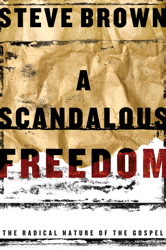
In his book A Scandalous Freedom, Steve Brown provocatively writes:

They lied to you about being a Christian. When you first “joined the club,” they promised you’d be set free. But let’s get honest, you’re not free. In fact, you’re religious, afraid, guilty, and bound. What’s worse, now that you’ve been in the club awhile, you’re stuck pretending you’re better than you are. And worse than that, you prefer the security and rules of your self-imposed boundaries. It’s time for a change. You need Scandalous Freedom.

There is no question in my mind that Steve Brown is correct.

So many Christians are imprisioned by their own consciences.  What I think is startling about this is that most don’t even seem to be aware of their spiritual and emotional bondage.  In fact, since most people they know are in the same condition, they assume this is the norm, and that THIS is the freedom for which Christ came to set us free!  And even more perplexing is that, when faced with the radical nature of the gospel, many seem to prefer this state of existence to the freedom offered and secured by the gospel!

I see it all the time. I do it all the time.

But Steve Brown winsomely, humorously, and profoundly, calls it like it is.  And he offers us a path to freedom. It is not a path Steve has blazed. He is one, of many, who has simply labored to uncover the path for us that Jesus laid out. Sadly much of what Jesus paved seems to have been covered over by the garbage of religious tradition and fundamentalism.

Listen Steve Brown’s related podcast series: Scandalous Freedom.

Measuring Up?

Do you ever feel that you have to measure up? 

Do you wonder sometimes how  you are grading out in God’s eyes?  I suspect the answer for most people is “Yes”.    Our theology may tell us otherwise, but I think most people struggle with this from time to time – especially when we feel emotionally tired and as if we are coasting in neutral gear spiritually.   

I’m not sure many people are even aware they feel this way. We know our theology well enough, and so we remind ourselves of the truth of the Gospel: That we are declared righteous in Christ.  This is a wonderful truth.  But sometimes we don’t really live in the light of this truth.  This is the difference between our confessional theology and our functional theology.   

In other words there is sometimes (often?) a gap between what we know to be the facts and the way we allow those facts to impact our heart and emotions.  Put mathmatically, the difference between our confessional theology and our functional theology equals frustration.  (F – C = Frus)

A few months ago I posted an excellent article by Paula Rinehart, that had originally been written for The Navigators’ Discipleship Journal.  Because I know the tendency we have toward wandering onto what Jerry Bridges calls a Performance Treadmill, I wanted to post it again.   

If you ever find yourself tired of trying to measure up, or if know others around you who seem to fall into that trap, you will appreciate: 

Good Enough!

Happy Birthday, ‘Ho’!

OK. I know. A lot of people don’t like Tony Campolo. A lot of my friends don’t like Tony Campolo. I know he’s  “too liberal”.  I know John MacArthur flatly states that Campolo “misses the central teaching of the Bible“.  I know he was once tried in ecclesaistical court for heresy. 

But still, you must admit, he can tell a great story!  And sometimes he makes a great point.

Watch the video above. Then tell me:

  1. Is there anything overtly theologically wrong in what he says?
  2. How does his example move you?
  3. Is this something you see would meet with Jesus’ approval?  How about the approval of the Aposte Paul, who, in Galatians 5.6, wrote: “…the only thing counts is Faith expressing itself through love.”?
  4. Would you want to be part of a chuch that does things like this?
  5. Ask yourself: How would the community around you respond to a church that does things like this?

 “When the righteous prosper, the city rejoices.”

Lord Dissolve My Frozen Heart

Lord, dissolve my frozen heart/ By the beams of Love Divine;/ This alone can warmth impart/ To dissolve a heart like mine.

O that love, how vast it is!/ Vast, it seems, though known in part;/ Strange indeed, if love like this/ Should not melt the frozen heart.

Chorus: The love of Christ passes knowledge./ The Love of Christ eases fear./ The love of Christ hits a man’s heart;/ It pierces him like a spear.

Savior, let thy love be felt,/ Let it’s power be felt by me,/ Then my frozen heart shall melt,/ Melt in love, o Lord to thee.

Source: Red Mountain Music

Graceful Break-in

“The Bible’s purpose is not so much to show you how to live a good life. The Bible’s purpose is to show you how God’s grace breaks into your life against your will and saves you from the sin and brokenness otherwise you would never be able to overcome…”

-Tim Keller