Some Thoughts After the Supreme Court Ruling on Marriage

Star Gazing

With a landmark decision, and a monumental example of judicial overreach, the U.S. Supreme Court this morning announced their decision regarding same-sex-Marriage. By the awesome power vested in just five people, marriage has been redefined in our land.  This decision will continue to shake our cultural landscape for years to come, with the aftershocks of both unintended consequences (by some) and intentional-but-hidden agendas (of others).

While some who know me, or who read this blog, may assume my chagrin is in the validation of same-sex-marriage, it is actually far greater regarding the other implications related to this decision.  I am opposed to same-sex-marriage, on the grounds that it is clearly not in line with the design and decree of the Lord of Heaven and Earth.  So I am disappointed, though not surprised, by this decision.  But if this is the law of the land where I live, I can live with it being the law – as long as I am not compelled to comply. It is no greater difficulty than the first century apostles, and other Christians, faced in Rome, Corinth, Ephesus, and other ancient pagan territories.  What concerns me more is that I now live in a land where we officially believe that “Rights” are not endowed by our Creator, but rather bestowed by the government.  This is a very treacherous problem – especially in this case where it was not even by a democratic process; and where there is no court of appeal.

Think about it for a moment.  In Nazi Germany the government decided that those who were Jewish had no rights, and that the government had the right to exterminate them simply because they were Jews.  In the Antebellum South, those of African decent had no rights – with relative few exceptions – and were thus allowed to be held enslaved.  Some may argue that this example, especially the latter one, illustrates why the court decision this morning is a corrective, granting freedom to a group of people to marry who were previously denied that “right”.  But look at the root. Both illustrations are similar to the court ruling, all assuming that “rights” are bestowed by the government.  Yet if this is correct, that rights do come from the government, then why would one argue that the institution of slavery was so reprehensible?  Was it not the law of the land? Government dictating who had rights an who did not?  If one argues that the government has the inherent authority to determine rights, then what makes it appropriate to decry the decisions they make about who has rights and who has not?  If a government has the authority to determine who has rights and who does not, then what makes it morally wrong for a government to decide to eradicate some group it determines undesirable?

No, I have no sympathy for the institution of slavery, nor do I support any practice of genocide.  My point is not that the government should not be the protector of rights, but rather that it is not government that is the originator of any rights.  All good governments must protect the rights of all its citizens!  But what a “right” is is not ultimately determined by the government.  As Jefferson (with help from Franklin) wisely assessed and asserted, “rights are endowed by the Creator”, not by the throne of government.

In April, Justice Anthony Kennedy seemed to grasp the weightiness:

“This definition [of marriage] has been with us for millennia, and it’s very difficult for the court to say, ‘Well, we know better’”.

In the end Kennedy must not have found it all that difficult.  By siding with the majority, Kennedy essentially declares: “Well, we do know better.”

In response to the decision, in his published dissent, Chief Justice John Roberts writes:

If you are among the many Americans – of whatever sexual orientation – who favor expanding same-sex marriage, by all means celebrate today’s decision. Celebrate the achievement of a desired goal. Celebrate the opportunity for a new expression of commitment to a partner. Celebrate the availability of new benefits. But do not celebrate the Constitution. It had nothing to do with it.

While there is a sense that I appreciate these words, it still leaves me  – and others like me – with a practical dilemma: How should those of us who disagree with this decision – whether on its own merits, or because of the ripple effects that it will engender in days ahead, or both – how should we respond?  Especially as a Christian, how ought I respond?  Roberts’ words are merely philosophical and political.  They offer nothing practical to the question: So What Now?

My sincere hope is that I will, now and eventually, act faithfully to God, and lovingly to my neighbors (whether I am in agreement with them or not). In short, I hope in time to gain both perspective and wisdom – and wise perspective.  One thing I keep reminding myself is that God is still in control.  And while I mull over the realities of the day, I am also finding some food for thought in the counsel of some others:

Continue reading

Is Bigger Really Better?

Big Fish Small Pond, Small Fish Big Pond

No matter how much I have grown to despise the discussion, it seems I cannot avoid it entirely.  Almost any conversation about church, it seems, inevitably gravitates in some form toward the Bigger is Better or Great Things Come in Small Packages debate.

It is not always an actual debate. In fact it is probably more often than not simply an expression of personal preference. But I have come to loathe the whole subject, having come to believe that the comparisons are largely irrelevant. There are some great large churches, and there are some great small churches; There are some horrendous large churches, and there are some pathetic small churches. And there are good and bad churches of all sizes in between.  The issue is not which size is best, but rather: Is your particular church – and my particular church – healthy, God-honoring, and fruitful?

That said, and with no desire to encourage debate, I found an observation by Neil Cole to be interesting:

There are millions of people in smaller congregations across the country who live with a feeling that they are failures because their church isn’t as big as the megaplex congregation down the street. This is sad and should not be the case.

A global survey conducted by Christian Schwartz found that smaller churches consistently scored higher than large churches in seven out of eight qualitative characteristics of a healthy church. A more recent study of churches in America, conducted by Ed Stetzer and Life Way Research, revealed that churches of two hundred or less are four times more likely to plant a daughter church than churches of one thousand or more. The research seems to even indicate that the pattern continues—the smaller the size of the church the more fertile they are in planting churches.

It pains me that so many churches and leaders suffer from an inferiority complex when in fact they could very well be more healthy and fruitful than the big-box church down the street.

I am not suggesting that the mega church is something we need to end, I am simply saying that we need other kinds of churches to truly transform our world. I also do not want people in huge churches to think that just because they have more people and more money that they are more blessed by God. The stats tell us that ten smaller churches of 100 people will accomplish much more than one church of 1000.

Read the rest of  Cole’s article: Is Bigger Really Better?

And again, while not wanting to prompt debate, I do welcome any comments about Cole’s observations.

Good News From the Front in the War on Christmas

War on Christmas

With all the War on Christmas rhetoric that has seemingly spewed these past few years, LifeWay Research has some good news from the front lines.  While I am not certain any full fledged war has actually existed, it seems there have certainly been a variety of insurgences erupting.  Such things have probably almost always existed but, as the culture wars rage, reporting of instances opposing Christmas – some quite ludicrous – seemed more numerous than ever.  But now a recent study offers some calm.

LifeWay Research data now shows that most Americans favor more traditional expressions of Christmas, and want more emphasis on Jesus during this season of the year. In fact, even most of those with no faith affiliations, dubbed by some as the “Nones”, say they have no problems with expressions celebrating Christ.

Over on his blog at Christianity Today, The Exchange, Ed Stetzer analyzes the research data, and provides a link to the downloadable research report.  Click: Americans Want to Keep Christ in Christmas.

Happier Elsewhere: Singing ‘Happy Trails’ to … Some

On a Soap Box

I appreciate the practical wisdom Ed Stetzer provides in a post titled: Why I Have No Difficulty Helping “Issue Christians” to Move On.  Few seem to think this way in our consumerist church culture, where numbers are the only measuring stick of success, and faithfulness is but a tool to… well, numerical success – so long as it works.  Pastors are under so much pressure to produce measurable “progress” that it is difficult for many to watch any living, breathing, potentially financial supporting body depart.  Not so much for me – anymore.  I’ve learned, through the pain of many mistakes, some folks just cost too much to keep around.

Does that sound heartless?  Sometimes it still feels that way.  But nevertheless, it is true. Not just for my sanity as a pastor, but for the unity and the peace, and the health of the church,,, some people should move on.

The people I mean are not the poor, or the unkempt, or the socially awkward or even outcastes.  It is not my place to shew them from Christ’s church.  Though the world may see no benefit of having such people around, these are exactly the kind of folks Jesus expressly instructs us he wants to be made at home in any church that belongs to him. The ones I have in mind are not the outcastes, but the self righteous: those who have stumbled upon the one “key” to resolve the worlds problems – and the churches – if only enough people would buy into their one key.  What is the key? Who knows.  I’ve seen all sorts of different sure-fire “answers”.  Sadly, for such folks, “Christ and him crucified”, is never the key.  (See 1 Corinthians 2.2)  Their issue, whatever it may be, is their substitute for the gospel – or at the very least a supplement to the gospel.  (See Romans 1.16; Galatians 1.6-8)

My one caveat about encouraging folks to move on is when the gospel is at stake.  Like Stetzer, if it appears evident that person does not understand the gospel, I am hesitant to have them move on before I (or someone) has opportunity to explain it to them.  Whether the person is not a Christian or a professing Christian who seems to have adopted some issue(s) in addition to or instead of Christ as their identity, their passion, their assurance, I want to make sure the gospel has been made clear.  Once the gospel has been clearly presented, then I go on to explain that our church is passionate about the gospel, and living out the implications and demands of the gospel, that we want no other issue to drive our church.  I invite them to stay IF, now that they understand, they want to grow in this understanding and expression of the Christian faith; but tell them if that is not their desire that they’d be “happier elsewhere”.  (That “happier elsewhere” phrase is one I used to mock when I was in college, when learned that sororities – including the one my wife was in – used this as a polite “line” to cut less-than-desired pledges.  And now I have adopted it. Except… I mean it as no mere polite line.)

Stetzer provides sage advice that I encourage young pastors, and all church leaders to consider, and to appropriately apply.  You will find that in the end you gain from it far more than you lose – both in numbers and in peace.

Prop 8, DOMA, and the Unchanging God

Astonished

In light of the two U.S. Supreme Court decisions today, I was reminded of something my friend Mike Milton wrote that is pertinent to the issues related to these rulings.  Here is what Mike wrote:

When the rats begin to scramble on board the ship, it is a sure sign that the boat is sinking.

Self-described freedom-loving libertarians, and now Karl Rove, believe that Conservatives can embrace same sex marriage, or just leave it to the State as it is a personal “liberty” matter. The defense seems to be “Let the State allow whoever wants to be married to be married. It is a legal contract, not a religious ceremony, for goodness sake.”

Nonsense.

The nation we live in is grounded in “inalienable rights” that come from God, not from government. Our government was designed to guard and defend these rights, not dispense or arbitrate them, because they are based upon “inviolable” laws which must not be transgressed, dishonored, or broken.

This is not a so-called “religious” matter, but a matter of “natural law” that transcends government and social trends and attitudes. One of those inviolable laws is the law of marriage. It is a “Creation Ordinance” in that it extends to the very beginning of humankind. It is embedded in our species as surely as murdering another person is or stealing from another is.

Jesus, when questioned about divorce, appealed to this Creation ordinance when he said, “It was not so in the beginning.” He went on to describe marriage as between a man and a woman and in that union, spiritually, physically, and socially, they become one. Biology itself defends the arrangement, and without ever appealing to St. Paul, I could appeal the universal law that is placed in man’s heart to defend heterosexual marriage.

The Church did not invent marriage; however, the Church (and the Synagogue) must seek to bless what God has placed in the very nature of mankind and the order of His universe.

To give in to libertarian or muddleheaded notions and cries for transforming what is encoded into the very law of life is to not only go down with the ship, but share in the culpability of destroying it.

Marriage between a man and a woman is an inviolable law that cannot be tampered with by man. It is lunacy and suicidal to think and act otherwise. And that is just what the Republicans are doing if they join the ranks of conscience-seared and sadly mistaken people who so cavalierly dislodge the veritable cornerstone of human civilization.

Be certain of this: a nation which denies the inalienable rights of nature and of nature’s God cannot stand and will eventually perish. Freedom cannot be shackled in the human soul.

I wholeheartedly agree with what Mike wrote.  And I am disappointed with the decisions of the Supreme Court.

Continue reading

Mormonism vs. Christianity

With the hubbub surrounding Baptist pastor Robert Jeffress’ endorsement of Gov. Rick Perry with a denouncement of Mitt Romney and his Mormanism, the bigger, more important point may be easily overlooked.

It is easy to get caught up with the politically related issues. I for one wonder what the opponents of California’s Proposition 8 think about Jeffress’ statement.  They vilified the Mormons after that referendum in defense of marriage was passed, accusing LDS activist of mobilizing a force that distorted the views of the population. (Click: here and here).  Those who protested this proposition will certainly not find Jeffress’ Consevative Southern Baptist ideals a viable alternative. Jeffiress’ morality views will be nearly identical (as are mine).  But as much  entertainment and intrigue as this political dilemma may offer, there is a question far more important to me:  Are Mormons Christians?

Despite the commendable moral values of the LDS, the answer is unequivocally “No”.  Morality is a by-product of Christianity, a demonstration of it, not the substance of it.  It is what one believes about Jesus Christ that makes one a Christian. And the Mormons have a dramatically different view of Jesus than do Christians.

Two respected Evangelical leaders recently expressed their own thoughts:

I think what Mohler &  Stetzer have to say should be considered.  It is far more foundational than the simplistic pragmatic question whether an Evangelical should vote for a Mormon.  The question of whether Mormons are a form of Christian will likely linger,  lasting long beyond the outcomes of the Republican Primaries next year.

The Baker’s Dirty Dozen Stagnant Church Types


At a time when potential epidemics may be on the horizon the wise person is on the lookout for the signs of disease. The hope is that early detection will enable more effective and less severe treatment.

Such a time surrounds the American church. It is widely reported that 85% of all churches are in a state of stagnation, if not serious decline. 

Jeff Gauss, of Rurality Bytes, summarizes the Baker’s-Dirty-Dozen stagnant church types.  At least one of these 13 types, taken from Ed Stetzer’s Comeback Churches, probably characterizes almost any struggling & stagnant church:

  1. Institutionalized Church – More committed to the forms and programs of ministry than to the work of God; activity has choked out productivity and “good enough” has become the enemy of great.
  2. Voluntary Association Church – This church models itself after democratic government rather than New Testament principles. It is a church for the people, rather than for God. “Whenever one group seeks to make a positive change in the church in one direction, the opposing factions begin to whine, complain, and gossip… This type of church will not change until they change their value system.”
  3. “Us Four and No More” Church – This church doesn’t want to get any larger for fear that it will lose its family feel.
  4. “We Can’t Compete” Church – This church has simply given up, deciding that it can’t compete with other churches so they’re not even going to try.
  5. “Decently and in Order” Church – High regard for process, but lack passion. “They run everything by the book; unfortunately, it’s not the Bible.” All matters great and small must meet the approval of various committees.
  6. “Square Peg in a Round Hole” Church – People are enlisted for service, not based on passion and gifts, but because of need. The mindset is “We’ve got to fill this position. Whose turn is it?”
  7. “Time-Warp” Church – This church has managed to preserve the positions, practices, and appearances of days long gone. They expect others to accept and adapt to what they’ve grown comfortable doing over the years, and give no thought to change. “If it’s good enough for me, it should be good enough for them,” is the prevailing attitude.
  8. “My Way or the Highway” Church – This is usually a vocal minority who, no matter the issue, won’t be satisfied unless it’s done their way.
  9. “Chaplaincy” Church – The church views its pastor as a hired hand and expects him to meet all of their needs. They want a chaplain, not a leader.
  10. “Play-it-Safe” Church – Has little faith that God will provide. Instead of enabling ministry and evangelism, it hinders them by safeguarding what it has. “As much money as possible is placed in a certificate of deposit” for safekeeping.
  11. Unintentional Church – Good intentions, but little action. Rarely follow through on what they hope to do.
  12. “Tidy” Church – Members take pride in the church building and make sure that everything is well-kept and meticulously organized. New growth – especially children – is seen as a threat because they are messy. 
  13. The “Company” Church – The church is more focused on the denomination than the community. They fill up the calendar with denominations meetings and things at the expense of ministering to their community. 

I suspect traces of most of these traits can be seen in almost any church, ailing or healthy.  But a good prelimnay self diagnosis may hold the ecclesiastical undertaker at bay.

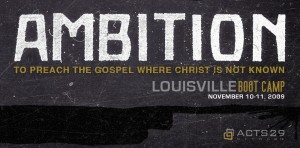
Ambition

I’ve been listening to the audio of sessions from Acts 29 Network’s 2009 Bootcamp: Ambition. While not everyone will find these talks of interest, I think they are challenging and stimulating for those of us in ministry and church leadership.

Ministry for the Long Haul & Ambition (Matt Chandler)

Decoding Your City & Ambition (Kevin Cawley)

Discipleship & Ambition (Bob Thune)

Preaching as Expository Exorcism (Russell Moore)

Leadership & Ambition (Darrin Patrick)

The Church & Ambition (Steve Timmis)

Church Planting & Ambition (Ed Stetzer)

The Gospel & Ambition (Dave Harvey)

My thanks to the folks at Sojourn Community Church, who have made all the above sessions available to be listened to online and/or downloaded. Click: Ambition Conference.

Acts 29 is a missional church planting network of Reformed Evangelicals.  Each year they hold Boot Camps to train and re-energize like minded church planters and church leaders.  Many of these, and other, talks are available on the Resource section of thier web page.