Counterfeit Gospels

Having begun a new series of messages at our church, Freedom: A Study of Galatians, I am struck anew by the passion with which the Apostle Paul uncompromisingly declares: “There is NO OTHER Gospel!”  What Paul does throughout his letter to the Galatians, and vividly in the opening verses, is to impress that claim upon his readers as he points out and combats the counterfeit gospels – philosophies which purport themselves to be good news, but which are in reality fraudulent teachings dressed in Christianese garb.  Paul’s response to these philosophies is to declare: “Even if we (Apostles, including he himself), or an angel from heaven comes and teaches you something other than the gospel you originally received, let them be eternally cursed!.” The essence of what he says is: “Anyone who tries to teach a fraudulent gospel can just go to hell!”  He is obviously serious about this to offer such a severe retort.

Counterfeit gospels are not just something from the Apostolic age.  They are all too prevalent today – and not only in heterodox churches.  They are present in the best of churches, and in the hearts of some of the most sincere followers of Christ. I suspect it is in our spiritual DNA, part of our broken nature. Are hearts are deceitful. (Jeremiah 17.9)  We are susceptible to gospel distortions – which Paul reminds us “are no gospel at all”.

Some time ago I picked up and read a book by Trevin Wax, Counterfiet Gospels.  I found it to be among the most helpful books I have read.Counterfeit Gospels

In one sense, nothing in the book was new for me.  Still, Trevin does an excellent job of explaining the gospel in it’s various aspects:

  • Gospel Story: Creation, Fall, Redemption, Restoration
  • Gospel Announcement: Life, Death, Resurrection, and Exaltation of Jesus
  • Gospel Community: The Church

Just as important, he takes some commonly held notions and connects them to the different dimensions of the gospel. Included among the categories he connects with and compares to the gospel:

  • Activist Gospel
  • Moralistic Gospel
  • Pietistic or Quietistic Gospel
  • Therapeutic Gospel
  • Judgmentlessness Gospel
  • Churchless Gospel

In exploring these ideas, he shows that while at root they are in may respects good, yet how when misunderstood or misapplied they are contributing to an erosion of  the Faith.

What I don’t think I had ever before adequately considered was the connection of the categories Trevin identifies with the gospel. And what I think I appreciated most is that he identifies and examines not only the negatives of these  ideas, but he also explains their positives points as well.  He astutely points out that it is the very real positive aspects that make these points popular and palatable, and yet which also make them easily confused and dangerous.

In the short video above Trevin Wax provides a quick overview of his book, and briefly explains the categories he identifies.  So even if you find my description of his book a little fuzzy or confusing, take a moment to watch the video so Trevin can clarify what I am trying to convey.

Gospel Warning Signs

Lighthouse Crown

Noted 19th Century Anglican Bishop J.C. Ryle offers a handful of warnings about counterfeiting the gospel:

1. Substitute anything for Christ, and the Gospel is totally spoiled!

2. Add anything to Christ, and the Gospel ceases to be a pure Gospel!

3. Put anything between a person and Christ, and that person will neglect Christ for that very thing!

4. Spoil the proportions of Christ’s Gospel, and you spoil its effectiveness!

5. Evangelical religion must be the Gospel, the whole Gospel and nothing but the Gospel!

“I am astonished that you are so quickly deserting him who called you in the grace of Christ and are turning to a different gospel – not that there is another one…  But even if we or an angel from heaven should preach to you a gospel contrary to the one we preached to you, let him be accursed.  As we have said before, so now I say again: If anyone is preaching to you a gospel contrary to the one you received, let him be accursed.”

~ Paul, the Apostle, from Galatians 1

Cotton Candy Christianity Scorecard

I don’t want to become one of those bloggers who becomes known for what he is against, or for pointing out how wrong other guys are, but this was just too funny to pass up.  It is also important to distinguish the gospel from all its counterfeits. For as Paul warns in Galatians 1.6-7:

I am astonished that you are so quickly deserting the one who called you by the grace of Christ and are turning to a different gospel – which is really no gospel at all. Evidently some people are throwing you into confusion and are trying to pervert the gospel of Christ.

Upon further thought, it might not be as funny as I thought.  It would be funny, if it were not so serious & sad.

Thanks to the folks at Modern Reformation & White Horse Inn for the scorecard. As they said:

“It’s like Bingo… Only better.”

The Therapeutic Gospel

What may be the most famous chapter in all of western literature portrays the appeal of a “therapeutic gospel.”

In his chapter entitled “The Grand Inquisitor,” Fyodor Dostoevsky imagines Jesus returning to sixteenth century Spain (The Brothers Karamazov, II:5:v). But Jesus is not welcomed by church authorities. The cardinal of Seville, head of the Inquisition, arrests and imprisons Jesus, condemning him to die. Why? The church has shifted course. It has decided to meet instinctual human cravings, rather than calling men to repentance. It has decided to bend its message to felt needs, rather than calling forth the high, holy, and difficult freedom of faith working through love. Jesus’ biblical example and message are deemed too hard for weak souls, and the church has decided to make it easy.

The Grand Inquisitor, representing the voice of this misguided church, interrogates Jesus in his prison cell. He sides with the tempter and the three questions the tempter put to Jesus in the wilderness centuries before. He says that the church will give earthly bread instead of the bread of heaven. It will offer religious magic and miracles instead of faith in the Word of God. It will exert temporal power and authority instead of serving the call to freedom. “We have corrected Your work,” the inquisitor says to Jesus.

The inquisitor’s gospel is a therapeutic gospel. It’s structured to give people what they want, not to change what they want. It centers exclusively around the welfare of man and temporal happiness. It discards the glory of God in Christ. It forfeits the narrow, difficult road that brings deep human flourishing and eternal joy. This therapeutic gospel accepts and covers for human weaknesses, seeking to ameliorate the most obvious symptoms of distress. It makes people feel better. It takes human nature as a given, because human nature is too hard to change. It does not want the King of Heaven to come down. It does not attempt to change people into lovers of God, given the truth of who Jesus is, what he is like, what he does.

THE CONTEMPORARY THERAPEUTIC GOSPEL

The most obvious, instinctual felt needs of twenty-first century, middle-class Americans are different from the felt needs that Dostoevsky tapped into. We take food supply and political stability for granted. We find our miracle-substitute in the wonders of technology. Middle-class felt needs are less primal. They express a more luxurious, more refined sense of self-interest:

  • I want to feel loved for who I am, to be pitied for what I’ve gone through, to feel intimately understood, to be accepted unconditionally;
  • I want to experience a sense of personal significance and meaningfulness, to be successful in my career, to know my life matters, to have an impact;
  • I want to gain self-esteem, to affirm that I am okay, to be able to assert my opinions and desires;
  • I want to be entertained, to feel pleasure in the endless stream of performances that delight my eyes and tickle my ears;
  • I want a sense of adventure, excitement, action, and passion so that I experience life as thrilling and moving.

The modern, middle-class version of therapeutic gospel takes its cues from this particular family of desires. We might say that the target audience consists of psychological felt needs, rather than the physical felt needs that typically arise in difficult social conditions. (The contemporary “health and wealth” gospel and obsession with “miracles” express something more like the Grand Inquisitor’s older version of therapeutic gospel.)

In this new gospel, the great “evils” to be redressed do not call for any fundamental change of direction in the human heart. Instead, the problem lies in my sense of rejection from others; in my corrosive experience of life’s vanity; in my nervous sense of self-condemnation and diffidence; in the imminent threat of boredom if my music is turned off; in my fussy complaints when a long, hard road lies ahead. These are today’s significant felt needs that the gospel is bent to serve. Jesus and the church exist to make you feel loved, significant, validated, entertained, and charged up. This gospel ameliorates distressing symptoms. It makes you feel better. The logic of this therapeutic gospel is a jesus-for-Me who meets individual desires and assuages psychic aches.

The therapeutic outlook is not a bad thing in its proper place. By definition, a medical-therapeutic gaze holds in view problems of physical suffering and breakdown. In literal medical intervention, a therapy treats an illness, trauma, or deficiency. You don’t call someone to repentance for their colon cancer, broken leg, or beriberi. You seek to heal. So far, so good.

But in today’s therapeutic gospel the medical way of looking at the world is metaphorically extended to these psychological desires. These are defined just like a medical problem. You feel bad; the therapy makes you feel better. The definition of the disease bypasses the sinful human heart. You are not the agent of your deepest problems, but merely a sufferer and victim of unmet needs. The offer of a cure skips over the sin-bearing Savior. Repentance from unbelief, willfulness, and wickedness is not the issue. Sinners are not called to a U-turn and to a new life that is life indeed. Such a gospel massages self-love. There is nothing in its inner logic to make you love God and love any other person besides yourself. This therapeutic gospel may often mention the word “Jesus,” but he has morphed into the meeter-of-your-needs, not the Savior from your sins. It corrects Jesus’ work. The therapeutic gospel unhinges the gospel.

Continue reading

Gospel Greater Than Conservatism & Liberalism

The gospel is neither conservative nor liberal; and at the same time the gospel is both liberal and conservative.  This causes a lot of confusion to folks both inside and outside of the Church.

On the one hand, the gospel is conservative because it declares that there is such a thing as right and wrong, and that there are benefits from choosing right and consequences that accompany wrong.   Each person is responsible for his or her own actions and attitudes.  These are very conservative principles.

On the other hand, the gospel is the free gift that is given to those who have not earned it and cannot afford it.  In fact, we are told the gospel is the riches of Christ redistributed to those who admit their spiritual poverty.  Isaiah says it is like being invited to a party, but the only ones who can come are those who cannot pay, or who are humble enough to admit whatever riches they think they might have are not valid currency.  (Isaiah 55.1-2) These seem to be very liberal ideas and images.

Both are true. Equally true. Both are essential. Leave out one side or the other and you create a “different gospel” – which, as Paul says, is really no gospel at all.  In fact, Paul tells us that anyone trying to pass a counterfeit gospel should be ( and will be) anathema – repeatedly destroyed over and over for all eternity.  (Galatians 1.6-9)

I would suggest, even insist, that both Conservatism and Liberalism are false worldviews and offer counterfeit gospels.  The gospel is not a compromise of liberalism and conservatism, nor is it merely a middle way. The gospel is the expression of God’s very nature and plan.  It is therefore, THE Truth, because God himself – and God alone – is Truth.  And it is eternal Truth because God, who is Truth, is eternally God.

What both Conservatives and Liberals have done, at least those who operate as if these philosophies are the supreme ideologies, is to carve off portions of the Truth that meet their personal preferences at the expense of the valid point of the other.  Both begin with as a reduction of the gospel  Each then proceeds to build their respective worldview upon these faulty foundations of a corrupted gospel.

We begin to escape the confusion when we recognize our own propensity toward either Conservatism or Liberalism, at the expense of the other.  We begin to overcome our limitations when we recognize the whole gospel alone is the Truth, and then commit to a lifelong pursuit of excavating the depths and complexities of the gospel, while at the same time venturing to live out all the implications of the gospel in every aspect of our lives.

Whether theologically or politically, conservatism and liberalism are impotent to effect real, enduring, or godly change. But the gospel, undiluted and undistorted,  is the power of God. (1 Corinthians 1.20-25)

What is the Gospel?

Gospel means “good news.” The good news is: you (and I) are more sinful and flawed than you (or I) ever dared believe, yet you (and I) can be more accepted and loved than you (or I) ever dared hope at the same time, because Jesus Christ lived and died in our place. As the apostle Paul said, “God made him who had no sin to be sin for us, so that in him we might become the righteousness of God.” (2 Corinthians 5.21)

That paradoxical statement is a simple formulation of the gospel.

More thoroughly we could say that the whole Bible is the gospel. It is a book about the God who rescues people from their moral and spiritual rebellion against him. The teaching of the Bible can be summarized under four headings: God, Man, Jesus Christ, and Our Response. 

Firstly, the gospel teaches that God is our creator. Thus he has the right to rule and command us as he does in his law. God is also holy, that is, he is absolutely pure morally, and he hates and punishes rebellion on the part of his creatures. He is more holy than anyone would ever imagine. 

Secondly, the gospel teaches us about human beings. We are creatures made by God and for God. We were originally created to live in relationship with God and we were morally pure. But because our first parents rebelled against God (just as we also all have done), human beings are now cut off from relationship with God and are subject to his condemnation. We are more sinful than we ever dared believe.  

Thirdly, the gospel teaches us what Jesus Christ has done for sinners like you and me. Jesus became a man and lived a life of perfect obedience to God’s law, and then died as a sacrifice in our place under the judgment of God. He was raised from the dead and now reigns in heaven. The condemnation that he suffered takes away the necessity that we suffer judgment for our own sins- “God made him who had no sin to be sin for us.” The righteous life he lived is credited to us, not because we are actually righteous, but because of God’s mercy and grace- “in him we might become the righteousness of God.” 

Fourthly, the gospel teaches us how to respond to the good news. We turn away from our rebellion and put our trust in Jesus Christ. Despairing of our own worthiness to stand before God, we believe the promise that those who trust in Jesus Christ will be forgiven and declared righteous. Those who put their faith in Jesus Christ are accepted as loved sons and daughters of God, and God sends his Spirit to live in them. 

Counterfeit Gospels

 Martin Luther said that “a sinner trying to believe the gospel was like a drunk man trying to ride a horse; he will always be falling off on one side or the other”. The two errors that the sides of the horse represent are

  • legalism or moralism, and
  • pragmatism or relativism or antinomianism.  

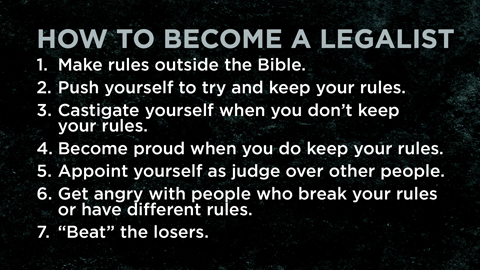
Moralism is the view that a person is made acceptable to God through his own attainments. Moralists are usually very religious, and often very conservative in their religion. Legalism tends to stress truth without grace. Moralists are usually very rules oriented, and depending on their success in keeping the rules they will be either arrogantly self-righteous or depressed and morose. If they go to Jesus for forgiveness, it is just to ask him to fill in the gaps they have left in their own religious performance. For the moralist, the cross is not the only basis for acceptance by God, but is an adjunct to our performance. 

Pragmatists are often irreligious, or prefer more liberal religion. They tend to stress grace over truth, assuming everyone is accepted by God and that we each have to decide what we think is true for us. Often relativists will talk about God’s love, but since they do not see them selves as deeply sinful people, God’s love for them costs him nothing. For them the cross is not the necessary condition of our acceptance by God. 

The gospel holds out to us a whole new system of approach to God. It rejects our attempts to justify ourselves before God, to be our own saviors and lords. It rejects both our pragmatic presumption and our religious attempts to earn our way into God’s favor. It destroys the perception that Christianity is just an invitation to become more religious. The gospel will not let us think Jesus is just a coach to help us get stronger where we are weak. To be a Christian is to turn from self-justification of all sorts and to rely exclusively on Jesus’ record for a relationship with God. 

Christians and non-Christians both stumble over the two counterfeits of the gospel. Many Churches are deeply moralistic or deeply relativistic. Christians who understand the gospel very clearly still look like the drunk man on the horse, as the desire to justify ourselves and trust in our own performance continually reappears. 

The gospel tells the pragmatist that he is more flawed and sinful than he ever dared believe. The gospel tells the moralist that he is more loved and accepted than he ever dared hope.