In Spirit Produced Corporateness

Naval Academy Rowing Team

As I reflect upon the need of our church to constantly cultivate community among those within our congregation, as well as between those already part of the congregation and those who have newly arrived, I am pondering the poignancy of this statement by Stanley Grenz, from his book Theology for the Community of God:

“Only in our Spirit-produced corporateness do we truly reflect to all creation the grand dynamic that lies at the heart of the triune God. As we share together in the Holy Spirit, therefore, we participate in relationship with the living God and become the community of Christ our Lord.”

Leading in the Construction of Christ’s Church

Blue Construction

As one who has benefited from reading Jim Collins, John Kotter, Stephen Covey, and several other leadership gurus from the business world, I found this quote from Tony Morgan‘s Developing a Theology of Leadership  to be a very helpful reminder and convicting corrective:

It is true that we church leaders can learn from business leaders, but the corporate world should not set the foundation from which we lead. We can also learn from fellow church leaders, but they are also human and don’t provide a perfect model for Biblical leadership. When we look to other leaders, we are essentially holding on to our traditions rather than embracing the truth about leadership found in God’s Word. The Bible needs to become our filter for truth in every area of our life and ministry just because we see others doing it doesn’t mean that’s how God designed it.

Like Morgan, I still believe there is much to be learned from those who are effective in business, government, coaching, and other spheres. But as a pastor of a church – an under-Shepherd of part of the Church that Jesus is building – it is essential that I not fall for the notion that I will or can gain the most wisdom from these sources. I must never neglect or assume what the bible has to say about Leadership. Instead I must constantly submit all ideas of leadership, from whatever sources, to the scrutiny of the Scripture.

Matthew 16.18 reminds me that I am but a foreman, and that it is Jesus who is the architect, developer, and contractor. My job is to follow his design, and his lead.

Fellowship of Jesus’ Followers

Community Collage

Stanley Grenz wrote, in Theology for the Community of God:

“The fellowship of Jesus’ followers is not merely a loose coalition of individuals who acknowledge Jesus. Rather, it is a community of disciples who seek to walk together in accordance with the principles of the kingdom. As Christ’s church, we desire to live out in the present the final reality that will come at the end of history, namely, the reconciled community. This forms the ultimate reason why the goal of evangelism is disciple making. The Spirit directs his great creative work toward establishing the eschatological community, a people who are bonded together by their mutual obedience to the God revealed in Jesus. It is their commitment to living as Jesus’ disciples which facilitates the mutuality that characterizes the community they form”

Is Bigger Really Better?

Big Fish Small Pond, Small Fish Big Pond

No matter how much I have grown to despise the discussion, it seems I cannot avoid it entirely.  Almost any conversation about church, it seems, inevitably gravitates in some form toward the Bigger is Better or Great Things Come in Small Packages debate.

It is not always an actual debate. In fact it is probably more often than not simply an expression of personal preference. But I have come to loathe the whole subject, having come to believe that the comparisons are largely irrelevant. There are some great large churches, and there are some great small churches; There are some horrendous large churches, and there are some pathetic small churches. And there are good and bad churches of all sizes in between.  The issue is not which size is best, but rather: Is your particular church – and my particular church – healthy, God-honoring, and fruitful?

That said, and with no desire to encourage debate, I found an observation by Neil Cole to be interesting:

There are millions of people in smaller congregations across the country who live with a feeling that they are failures because their church isn’t as big as the megaplex congregation down the street. This is sad and should not be the case.

A global survey conducted by Christian Schwartz found that smaller churches consistently scored higher than large churches in seven out of eight qualitative characteristics of a healthy church. A more recent study of churches in America, conducted by Ed Stetzer and Life Way Research, revealed that churches of two hundred or less are four times more likely to plant a daughter church than churches of one thousand or more. The research seems to even indicate that the pattern continues—the smaller the size of the church the more fertile they are in planting churches.

It pains me that so many churches and leaders suffer from an inferiority complex when in fact they could very well be more healthy and fruitful than the big-box church down the street.

I am not suggesting that the mega church is something we need to end, I am simply saying that we need other kinds of churches to truly transform our world. I also do not want people in huge churches to think that just because they have more people and more money that they are more blessed by God. The stats tell us that ten smaller churches of 100 people will accomplish much more than one church of 1000.

Read the rest of  Cole’s article: Is Bigger Really Better?

And again, while not wanting to prompt debate, I do welcome any comments about Cole’s observations.

Messy Christian Communities

Missional Communities

As our church makes the slow but intentional shift toward Missional Communities, I found this illustration to be a good picture of the contrast between common perception and ideal reality of what such communities, or small groups, and even church is like.

On the left side, “What People Think It Looks Like“, we see the idea that the Christian life is one that should be free of ugliness.  It makes sense, right?  If all the people in the group are saved by Jesus, forgiven of sin, and empowered to overcome their sin, then a gathering of Christians should be pretty clean, and always leading us upaward.  Isn’t this what Paul calls for in Ephesians 4?

I therefore, a prisoner for the Lord, urge you to walk in a manner worthy of the calling to which you have been called,with all humility and gentleness, with patience, bearing with one another in love, eager to maintain the unity of the Spirit in the bond of peace.  (v. 1-3 ESV)

11 So Christ himself gave the apostles, the prophets, the evangelists, the pastors and teachers, 12 to equip his people for works of service, so that the body of Christ may be built up 13 until we all reach unity in the faith and in the knowledge of the Son of God and become mature, attaining to the whole measure of the fullness of Christ. (v. 11-13 NIV)

It is the picture God calls for, through Paul, in these verses.  But it is the ideal; the objective. It is not the complete picture, at least not at present.  It is sort of a Norman Rockwell version of the Christian life lived in community.  It is true.  But it does not show the complexity, and the brokenness that is all around us, nor the baggage that we all carry in varying degree.

But we have hope to experience it.  Afterall, God has promised it. He has said that he is at work in us, and he would finish what he started. (Philippians 1.6)  And we get a taste of it, if we have the privilege of engaging in a genuine Christian community.

The picture on the right, however, “What It Really Looks Like“, is a reflection of the present reality of Christian community.  It is often messy.  And if it is done right, it should get messier. This is OK, though, because this is God’s means of achieving the picturesque image we may have in our minds when reading Ephesians 4.  It is the sharing of life, the freedom and safety to unload our baggage in the presence of others who, rather than judging and comdeming, help us to sort through it, to own our part, and to see ourselves – and our messes – as God sees: through the lenses of the gospel.

Because each of us has our own mess, it only makes sense that a collection of people would look like a bigger mess.  But there is a beauty in that mess!  Because in the midst of that mess, love is shown.  Love leads to freedom and honesty.  Honesty leads us to the gospel, the power of which transforms us, cleanses us, and frees us from the bondage of all that is aweful and ugly.

Neil Cole has rightly said:

“Life is messy. If someone doesn’t break your heart, you’re not doing it right.”

Likewise, if we are living in community with other Christians, and it never gets messier, it may be a sign that we are not doing it right. Thank God for the messes!  Thank God that he cares about our messes! Thanks to God, he has promised to clean our messes, and use other messed up people in the process.

Please note that while the picture on the right is messy, it does go up.  It is not that there is no evidence of change, of improvement.  There certainly is!  It is just not always a pretty picture on the way.  But it is beautiful – to God and to us – both in process and as a result. This is the beautiful reality of the Christian community – the church.

Being the Church in the World: Distinctiveness

In this video John Stott discusses what he calls one of the most neglected themes in the Bible: Distinctiveness.

With all the clamoring for church to be seen as relevant in our culture, perhaps we – the Church – have lost sight of the call to be different.  Not different for the sake of being different, but different nevertheless.  Christians are to be different because, rather than being conformed to the principles of this world, we are more-and-more to be conformed to the likeness of Christ – in character, in passions, and in perspective.  We are to be formed by the Word, and consequently we become different from those around us.

Relevance has it’s place.  There is no merit in being irrelevant – and even less in just being weird.  But relevance must be considered as only one item, and it must be understood alongside with how we are also to be different from the world around us, and distinct in the communities where we live.

Thoughts on Easter Giveaways

Field of Eggs

I was stunned the first time I read about the plan of a church in the area where we then lived to give away prizes at an Easter gathering.  And they were not just going to give stuff away, they were planning to create a frenzy.  A helicopter was leased, piloted by some guy in an Easter Bunny costume (which alone raises questions).  With people gathered at a rented junior high school soccer field, the Easter Bunny would drop plastic Easter Eggs each filled with either candy, cash, or with redeemable certificates for such items as i-pods, cell phones, etc. And they did this on Easter Sunday right after their services.  It just seemed wrong, but I held my tongue.

For two weeks leading up to the “drop” the local newspaper contained a full page ad promoting this “celebration”. But it was not until I read an interview with the pastor the day after Easter that I could stand it no longer.  His statement that set me off?  He said:  “We’re just loving on our neighbors.”

While that statement may seem benign enough, I felt compelled to respond. So I shot him an e-mail.  I had met the guy before, though did not know him well.  But I hoped he would at least consider his actions, or the potential effects of them.  So I wrote him a note challenging his notion of “loving his neighbors”.

I told him that he was not so much loving his neighbors as he was buying them, or bribing them.  True, he had gathered a large group to an Easter event, but it was not because of the proclamation of Christ crucified and resurrected (- though I assume that was mentioned at the actual church service).  How many in attendance were actually members of other congregations who were enticed only by the promise of goodies? (No, no one from the church I served attended their event.)  I conceded that perhaps such a giveaway would have been an expression of love had they chosen to hold it at one of the local public housing projects, and limited the participation to those with minimal incomes.  After all, that would have given to those who are without, and given to those who can give no more to the church than their presence.  But they had been advertising for weeks to the whole city – wealthy, middle-class, and poor alike.  They were merely buying potential “customers” – just like Wal-Mart, Best Buy, or any other consumer-driven business does.

Perhaps not surprising, I did not get a response to my e-mail.  The next year the church added a giveaway at the worship service – a new car to some lucky person with the correct number on their Easter Sunday worship bulletin.  I did not bother to send another e-mail.  I just mused in disappointment about what seems to be replacing the gospel in too many churches.

Apparently I am not alone in my distaste for this practice.  I recently read a post by Jared Wilson, who also has some concerns about it.  In his post Wilson gives ten spot-on-right reasons why he thinks luring people in with cash and prizes is not a good idea:

1. It creates buzz about cash and prizes, not the Easter event. When the media takes notice, nobody wants to interview these pastors about the resurrection. They want them to talk about the loot.

2. It identifies the church not with the resurrection, but with giving toys away. It makes us look like entertainment centers or providers of goods and services, not people of the Way who are centered on Christ.

3. Contrary to some offered justifications, giving prizes away is not parallel to Jesus’ providing for the crowds. Jesus healed people and fed them. This is not the same as giving un-poor people an iPod.

4. It appeals to greed and consumerism. There is no biblical precedent for appealing to one’s sin before telling them to repent of it. This is a nonsensical appeal.

5. Yes, Jesus said he would make us fishers of men, but extrapolating from this to devise all means of bait is not only unwarranted, it’s exegetically ignorant. The metaphor Jesus is offering here is just of people moving from the business of fishing to the business of the kingdom. There is no methodology being demonstrated here. (But the most common one would have been throwing out nets anyway, not baiting a hook.)

6. It is dishonest “bait and switch” methodology. Sure, the people coming for the goodies know they’re coming to church. But it’s still a disingenuous offer. The message of the gospel is not made for Trojan horses.

7. It demonstrates distrust in the compelling news that a man came back from the dead!! I mean, if nobody’s buying that amazing news, we can’t sell it to them with cheap gadgets.

8. It demonstrates distrust in the power of the gospel when we think we have to put it inside something more appealing to be effective. What the giveaways really communicate is that we think the gospel needs our help, and that our own community is not attractive enough in our living out of the implications of the gospel.

9. The emerging data from years of research into this kind of practice of marketing/evangelism attractional church stuff shows the kind of disciples it produces are not strong. I have no doubt these churches are going to see decisions Easter weekend. They’ll herald them on Twitter and on the blogs. As questionable a practice as that can be, I’d be extra interested in how discipled these folks are in a year or two years or three. Hype has always produced “decisions.” Would anyone argue that after 30 years or so of the attractional approach to evangelism the evangelical church is better off, more Christ-centered, more biblically mature?

10. What you win them with is what you win them to.

Numbering the Sheep on the Ranch

Counting Sheep

Blogger Tim Challies is at the Together for the Gospel Conference, surrounded by other church leaders.  No surprise then that he is hearing this common question all around him: “How many people go to your church?”  And apparently Challies, whose primary vocation is writer not pastor, has some concerns about this question:

I’d like to make the same two-part proposal I made a few years back: Let’s stop asking, “How many people go to your church?” And when someone asks us that question, let’s not feel obliged to give a direct answer.

Challies understands the heart challenge for the pastor in those moments when that question is posed:

For the pastor this can be a moment of pride or humility, freedom or shame…

While not presently prone to the tugs toward embellishment, I am not sure whether it is because of personal growth or just that my external circumstances have changed.  I serve a good-sized congregation, with an excellent staff, in a desirable locale.  But I know those feelings well.  On occasions in the past I’ve felt the temptation to exaggerate, such as to cite Easter attendance as if that were the norm. (I know others who have also considered that one.)  The obvious reason for the temptation is embarrassment about the reality, as if the number in attendance is somehow a precise indicator of the abilities or worth of a pastor or congregation, or of God’s pleasure in either.

Challies writes:

We all pay lip service to the reality that we cannot necessarily measure the health of a church by its size. We all know that some of the biggest churches in the world are also some of the unhealthiest churches in the world. The history of Christianity has long-since shown that it is not all that difficult to fill a building with unbelievers by just tickling their ears with what they want to hear. We also know that the Lord is sovereign and that he determines how big each church should be and we know that in some areas even a very small church is an absolute triumph of light over darkness. And yet “How big is your church?” is one of the first questions we ask.

Why is this?

I don’t know all the reasons but I’d suggest at least two. First, I think our question betrays us and shows that in the back of our minds we equate size and health. Somewhere we make the connection between big and healthy, between big and blessing. We exacerbate the problem when we ask and answer this too-easy question. Second, we just haven’t taken the time and made the effort to form better questions. Instead, we gravitate to the easy one.

So what might be some better questions to ask?  I appreciate Challies’ suggestions:

  • How have you seen the Lord working in the lives of the people in your church?
  • What evidences of the Lord’s grace has your church experienced in the last few months?
  • What are you excited about in your church right now?
  • Who are you excited about in your church right now?
  • What has the Lord been teaching you?
  • Who have you been discipling recently?
  • Tell me about some of the future leaders at your church.

These are much better to get a sense of the story in any congregation.

And inevitably when asked: “How many people go to your church?” Challies suggests answering something like this:

  • As many as the Lord has determined we can care for at this time.
  • Enough that we are actively working toward planting a church.
  • I don’t know, but let me tell you about a few of them…

Interest in numbers is not wrong.  Numbers tell us things.  But just what numbers tell us is not always readily clear.  Numbers are not wrong, it is the fascination with numbers that is problematic.  Numbers just do not tell a story.  Much more valuable is the number of stories of how God is at work in any congregation.

To read Challies’ post, click: How Many People?

Is Church Membership Really Required?

Concepts

by Ricky Jones

This month we will be inducting new members into the most honored body the world has ever known: the church of Jesus Christ. The initiation fee for this club is so high that no human could have ever paid it; God himself had to pick up the tab. The benefits of the club never expire. The fellowship of the club is unmatched; you receive intimate access to the Lord himself (John 17:23).

With such benefits, you’d think church membership would be held in infinitely high esteem. But for many reasons, Christians seem to think less of it than ever before. If you’re one who looks upon church membership lightly, then I invite you to reconsider.

When we hear the word membership, we immediately think of a club. A member pays dues, comes to meetings, and fulfills the obligations of a club member. When you move, or no longer have time for the club, you simply withdraw your membership and move on.

The Bible says membership is much more intimate. “For no one ever hated his own flesh, but nourishes and cherishes it, just as Christ does the church, because we are members of his body” (Eph. 5:29-30).

To be a church member means we are a member of Christ’s body—just like your finger is a member of your body. His blood runs through us. His Spirit animates us. His will moves us. He feels our pain, cleanses us when we get dirty, nurses our wounds, and cherishes us with pride.

Leaving the church is not simply leaving a club. When you walk away, you dismember yourself from the body. Jesus and the rest of the body sorely miss you, and bleed after your departure. You cut yourself off from your only source of life and nourishment. Like an amputated hand, you will slowly bleed out, wither, and die.

Not Possible, Biblical, or Healthy

I hear you complaining already. My, he’s being a bit dramatic. I’m a member of Christ; I just can’t find a local church I like. I’m a member of the universal church, just not of any one in particular.

I want you to understand that being a part of the universal church without submitting to a local church is not possible, biblical, or healthy.

First, it’s simply not possible. To imply you can be part of the greater community without first being 
part of the smaller is not logical. You cannot be part of Rotary International without also being part of a local chapter. You cannot be part of the universal human family without first being part of a small
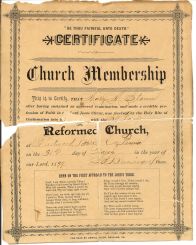
immediate family.Membership Certificate

Second, it’s not biblical. Every letter in the New Testament assumes Christians are members of local churches. The letters themselves are addressed to local churches. They teach us how to get along with other members, how to encourage the weak within the church, how to conduct ourselves at church, and what to do with unrepentant sinners in the church. They command us to submit to our elders, and encourage us to go to our elders to pray. All these things are impossible if you aren’t a member of a local church. (See 1 and 2 Corinthians, James, Ephesians, 1 and 2 Timothy, and 1 Peter for references.)

Asking where the Bible commands you to be a church member is like asking where the USGA rulebook for golf insists you be a human. The whole book is addressed to the church.

Finally, living without church membership is not healthy. Independence—the desire to choose for yourself what’s right and wrong—is at the heart of sin. You need the humility lesson of submitting to flawed elders. You need the encouragement of sharing victories with your church. You need the fellowship of sharing sufferings with your church.

You need to know we’re all in this life together, and we won’t walk away from you just because you let us down or we disagree. Together we build each other up into the image of Christ; no one can make it alone. I encourage you to rethink the importance of church membership. Our fellowship may be an affliction, but we are a glorious affliction. And we will walk into glory together.

***

NOTE: This article originally appeared at the RiverOaks Presbyterian Church blog; and also on The Gospel Coalition.

Ricky Jones is lead pastor of RiverOaks Presbyterian Church in Tulsa, Oklahoma. You can follow him on Twitter

Qualities of Christian Community

Quality Community

Dietrich Bonhoeffer, in his classic book, Life Together, makes this observation that should be pondered by many in the church, especially those discontented with the relational dynamic in their particular congregation:

“The people most in love with community are in danger of destroying community.”

In other words, there are people who have made such an ideal of “Christian Community” that they are easily dissatisfied with the real thing.

No doubt there is much room for relational improvement in many churches – perhaps even most of them.  But Bonhoeffer’s point is still valid.  Sometimes it may be a “You” problem, or a “Me” problem, more than it is a “Them” problem.

Yet, as Brad Watson points out in an excellent short article for Gospel-Centered Discipleship, titled Our Hunger For Community:

“Broken families, broken relationships, and an epidemic of loneliness has created a ravenous hunger for community in this generation.”

This is true.  And our churches and Christian communities must be aware of this hunger, and need to be prepared to provide such a haven for all who are seeking it.  But Watson also points out a problem common to both those hungering for community and those who are anxious to provide it:

 “But our flesh can seek our idea of community more than we seek Jesus. Our souls, it seems, are ready to settle for a sit-com style of friendship instead of striving for the spirit-led family of God purchased and created by his son’s death and resurrection.”

I think this is a very real issue. And I suspect this mindst feeds the discontent that Bonhoeffer warned about.  When we put so too much weight on friendships, when our expectations of others is as heavy as what we should only expect of God, stress fractures are almost certain to eventually occur – and with them, emotional pain, and senses of disappointment and alienation, which often leads to difficulty of trusting others, with the ultimate consequence of inability to cultivate and sustain healthy relationships.

Bonhoeffer warns:

Those who want more than what Christ has established between us do not want Christian community. They are looking for some extraordinary experiences of community that were denied them elsewhere…Those who love their dream of a Christian community more than the Christian community itself become destroyers of that Christian community even though their personal intentions may be ever so honest, earnest, and sacrificial…Christian community is not an ideal we have to realize, but rather a reality created by God in Christ in which we may participate.

In response to this common concern about Christian community, Watson has noted 6 Misunderstanding of Community and suggests 7 Components of Gospel-centered Community.

6 Misunderstadnings of Commuinity

  1. Community is NOT “Everyone is My Best Friend”
  2. Community is NOY a Spiritual/Morality Club
  3. Community is NOT a Book Club
  4. Community is NOT a Meeting or Event
  5. Community is NOT Easy
  6. Community is NOT “Everyone Gets Along”

7 Components of Gospel-centered Community

  1. Generous Hospitality
  2. Influence Earned thru Serving
  3. Accountable & Repentant
  4. Led by Qualified Leaders
  5. On Mission
  6. Active in Culture
  7. Diverse

Whether you are one who is hungering for community that seems lacking, or one who is committed to cultivating community within your group or church, I hope you will give some thought to these premises; and benefit from Watson’s article:  Our Hunger for Community

24 Tips for Preachers

Walnut Street Bridge - Chattanooga

My friend and once-upon-a-time informal mentor, Randy Nabors,  has posted a score of tips for preachers on his blog, Randy’s Rag.   I learned a lot from Randy just by hanging out and watching when I was a young pastor living and serving in the Chattanooga area.  I post Randy’s Tips here because they are worthy of consideration by anyone who preaches.  If you are a pastor, enjoy.  If you are not, feel free to share them with your pastor – as long as you do it out of loving encouragement, and not just because you think you should try to improve him.  That motivation will tank almost every time.

Anyway, here are Randy’s Tips for Preachers, gleaned during decades of transformational pastoral ministry and active mission engagement:

  1. Your aim is to have people see more of Christ and less of you.
  2. Make sure you love Christ more than you love preaching.  You should love to preach, but it is only a means to talk about the One worth loving.
  3. Try to make sure your life is at all times qualified to represent God, your character worthy to stand at the holy desk at a sudden moment.  It is better to give the responsibility to someone else, even for the moment, than to hurt your conscience by pretending to be something you are not.
  4. Don’t wait for perfection before you preach. The only perfect man who preached was also God.  Holiness is a covering we have of the righteousness of Christ as well as the faith to pursue it, along with an honest and broken heart.
  5. Prepare to preach by marinating in the Word of God.  Beware the pale substitute of commentaries.
  6. Read the text, translate the text, think through the text, dream the text, read the text.
  7. Pray for the text to minister to your own heart, hear the sermon for yourself, but remember your task is more important than waiting for your own blessing before you preach.
  8. While you are preaching, if you feel you are failing, pray in your heart for God to uphold you.  If you feel you are doing well, pray that you will not preach in your own strength.  Pray even as you speak.
  9. Beware of ruts, hobby horses, and anything that seems to regularly appear in your preaching that is in competition with the Gospel of grace and the glory of God.  Anything, especially good things, can be a poor substitute for preaching Jesus.  We are not called to preach theology but Christ, and all good theology leads to Him.
  10. If you preach the Old Testament without seeing Jesus or grace in it you don’t yet understand it.
  11. You have not been called to be intellectually esoteric, erudite, funny, or even comprehensive in your explanation of the text.  All of those things have their place, but if people can’t see Christ you have failed.
  12. Illustrations should lead to something, don’t presume on abstract reasoning from the congregation, connect the dots.
  13. Be careful with your introduction.  Don’t let it be too long, raise the issue (the main direction, question, or argument of your sermon) fairly soon.  Don’t wander too far from your text, or simply read it at the beginning and fail to preach it.  To not preach the text which you yourself have chosen is like telling the people that your ideas are more important than the Bible.
  14. Application is essential, simply reading and even explaining the text is not preaching.
  15. Self-disclose, confess your own faults, and use your life as an illustration with wisdom and a measure of restraint.  Too little and you are hiding, too much and you are an exhibitionist.
  16. If you make a mistake in preaching (misinterpret, forgot the balance, were too flippant, too angry, insulted someone(s)), apologize publicly the next time you are up.  Humility will win you favor.
  17. Never belittle, ridicule, or embarrass your wife and children as illustrations in your sermons. The congregation will take their side and miss the spiritual point you were trying to make. Once your daughter(s) reach middle school avoid mentioning them like the plague.
  18. Listen to your wife’s reactions, watch her face, she is probably the most loyal critic you will have.
  19. Sermon criticism is a good thing if you seek it from those who want to help you but don’t indulge in it immediately after you preach; let your ego heal from its vulnerability.
  20. Avoid arguments or being defensive right after a sermon, give yourself and others time to think things over.
  21. Don’t believe all the compliments nor all the complaints, though it is impossible to ignore them.  So, try to learn from them in order to do better and not simply use them for your pride or your self-pity.  Preaching is and ought to be a spiritual event, but it is also a craft that can be improved with skill.
  22. Get over it quickly, both euphoria and despair.  Fire and forget, leave the results to God, and remount the horse to ride again.
  23. Attribute, cite, and give credit where you can or at least admit it is not original with you if it isn’t.  Borrow and steal ideas ruthlessly, just admit it.
  24. As to the length of sermons, as my friend John Perkins said, (and he was quoting from someone else); “when you are done preaching, stop talking!”

Here AND There

Church Scattered

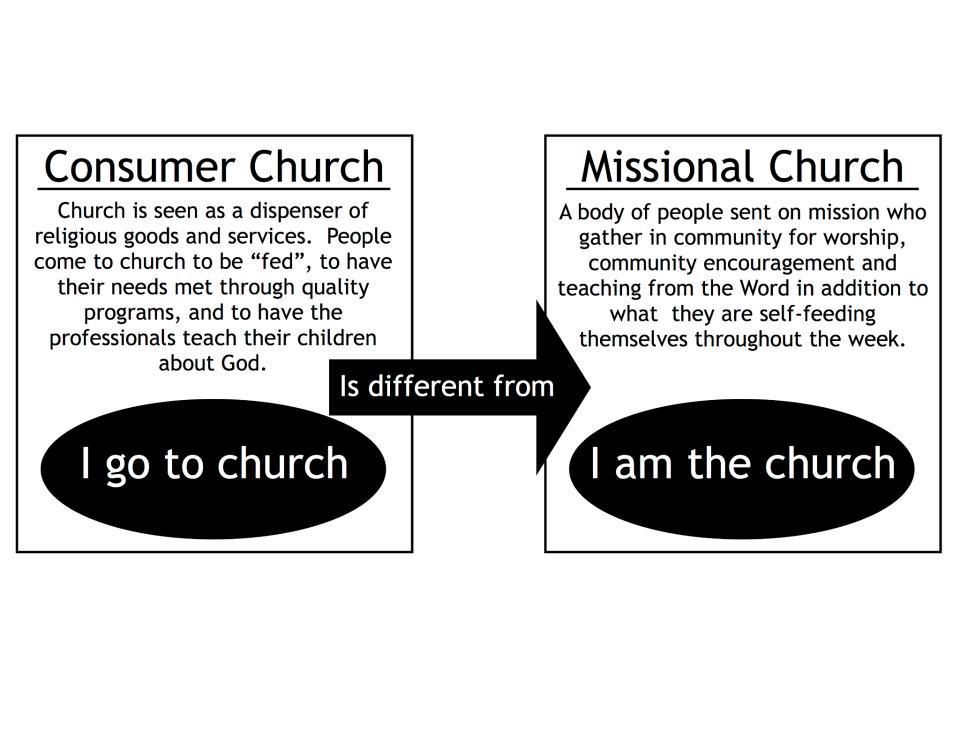
We don’t just go to church, we ARE the church …sent out by the power of the Spirit to BE the church.

This illustration above represents two aspects of being a faithful church:

Attractional – those elements of a particular congregation that draw people into the church community. Among these would be the quality of music, the substance and winsomeness  of the teaching, the variety and sufficiency of programs offered, and the friendliness of the members.

Missional – this is the sending of the church members into the community, and to the Nations, in order to make a positive and kingdom impact.  While this is often neglected, missional is not optional.

  • The mission of the church, and her members, is rooted in the nature of God who seeks and sends. (Isaiah 55.5; Isaiah 60.3; John 4.23; John 20.21)
  • Intentionally serving the community is faithfulness to the Covenant God cut with Abraham.  (i.e. Genesis 12.2)  If you look carefully at the Covenants of Scripture you will notice that there are always two dimensions, what I call a Top Line and Bottom Line.  the top line is God’s promise to bless those with whom he has entered into Covenant, evidenced by such promises as “I will be your God and you will be my people”.   The Bottom Line is is consistent with such expectant promises as “You will be a blessing”.   Both dimensions are reflected in every covenant.  Therefore, intentional mission to our community and world is not optional, or part of some deluxe package of being a Christian. If one follows Jesus, he or she does not have the option to choose the arrangement that does not require mission.
  • Mission is a is a clear mandate.  (Matthew 28.18-20; Luke 24.46-49; John 20.21; Acts 1.8; Jeremiah 29.7)

BOTH Attractional and Missional are necessary to be a healthy church. If we are not going, we are not faithful. And if no one is coming, well… the implications are pretty obvious.

10 Principles for Worship

The highest calling and greatest privilege of all Christians is to love and worship God.  In worship we encounter God with increasing awareness of who he is.  In worship we together magnify God’s glory.

The following are 10 principles, developed over a number of years, and influenced by a variety of sources, that not only express my philosophy of worship, but shape my practice of worship.  By no means is this exhaustive, nor is it unchangeable. But I do hope it might be helpful.

1. God-centeredness:

A high priority must be placed on the vertical focus in our Sunday morning service.  The ultimate aim is to so experience God that he is glorified in our affections.  (Deuteronomy 6.4-5, 13-15; Isaiah 42.8; Matthew 4.10)

2. Bible Based:

The content of God’s Word will be our ground of authority for all elements & appeal, and will be woven through all we do in worship. The content of our singing, our praying, our teaching, and our activity will always conform to the truth of Scripture.  (Isaiah 29.13; Deuteronomy 12.32; Matthew 15.9)

3. Trinitarian:

God has existed from all eternity in three persons: the Father, the Son, and the Holy Spirit. These three are one God, the same in substance, and equal in power and glory.  Our worship ought to reflect this truth, and recognize all three persons   (1 John 5.7; Matthew 28.9)

4. Expecting the Powerful Presence of God:

Worship is not a memorial service, nor merely our offering of ourselves toward God.  True worship earnestly seeks to experience the present reality of Christ, by the work of the Holy Spirit, particularly through the Word & Sacraments.  We believe that in worship God draws near to us in power, and makes himself known & felt for his glory, our good, and the salvation of unbelievers in our midst.  (Psalm 139.7-10; Genesis 28.16; Matthew 28.20; Acts 2; Psalm 89.15; Ezekiel 46.3; Acts 10.33)

5. Aiming for Head & Heart:

Worship should aim at kindling & carrying deep, strong, real emotions toward God, but should not manipulate people’s emotions by failing to appeal to clear thinking about spiritual things.     (Isaiah 29.13; Matthew 15.8)

6. Participatory:

Worship is an active expression of the corporate body.  It is not performance by a few to be viewed by spectators. Therefore our worship shall be ordered to give the greatest opportunity for all to participate in song, prayer, testimony & confession.  All choirs, singers, musicians, speakers & liturgists are to be used in such a way that they stimulate & facilitate participatory worship throughout the congregation.   (1 Peter 2.9)

7. Freedom & Form:

Knowing that God has given us differing personalities, heritage & experiences we desire to allow people to express themselves in worship as they are led by the Spirit.  Therefore we will not discourage the raising of hands in praise, bowing for prayer & repentance, or other such activities done decently & in order.  Yet, neither will we seek to artificially stimulate such demonstrative expression within the congregation.

8. Undistracting Excellence:

Worship is to be focused on God. Therefore we will strive to sing, pray, teach & act in such a way that people’s attention will not be diverted from the substance of worship by shoddy performance, nor excessive finesse, elegance or refinement. (1 Corinthians 10.31; 2 Samuel 24.24)

9. Convergent:

Many wonderful & beautiful traditions of the church have been passed down through the ages. They are varied from culture to culture, and from generation to generation.   Nevertheless, the best of these traditions convey the same love, reverence & adoration for God as we seek to experience & express. Therefore, in order to draw from the wealth of our forefathers, we will implement many of these songs, confessions & liturgies in ways & forms which are sensitive, meaningful & appropriate for the contemporary church.  To be convergent means to bring the best resources of the present together with the past.   (Proverbs 22.28; Hebrews 11.4c)

10. Contempory Blend:

It is a common mistake to assume that contemporary means “that which has been composed in this generation”, and traditional is a label for things composed in times past.  For timeless hymns such as Amazing Grace, Be Thou My Vision, and the Gloria Patri speak to us today as clearly as they did to the Church at the time of their composition.  Yet, our worship should always be contemporary in that it should speak to us clearly & faithfully of eternal truth, while being reflective of our current age & culture. Therefore, our worship should not reflect just our own age, for that would be to exclude those of the corporate body of Christ in the past. Nor should it reflect a limited scope from the past, for that would be to exclude the godly creative expressions of our own age. But in all things we seek the honor & glory of God, and we will transform traditions to to involve the truth of his Church from all ages.  (Proverbs 22.28; Psalm 149.1)

4 Tips That Change the Taste of the Sermon

As a pastor I have come to understand that some people have difficulty concentrating throughout the Sunday message.  Sometimes it’s just me people have trouble following. But sometimes it is something within them.  It may be a short attention span. It may be external distractions.  Or maybe it is the overwhelming wealth of insight being offered throughout the message that leaves some still pondering the previous point when the next gem is thrown at them.  (That last one is my favorite.)

If you’ve ever found yourself to be one who even occasionally experiences a problem concentrating throughout the sermon, let me offer a few practical tips. These are far from perfect, and certainly not exhaustive. But still, I think you will find they are helpful:

1. Write It Down

Many educators will tell you to write things down because it helps you focus and remember.  Often, after writing something down, you’ll find you don’t even need to go back to your notes to recall what you wrote.

I find it interesting that in Deuteronomy 17.18 we learn that every time a new king was installed in Israel he was to write the entire Law of God out by hand. He had to write it himself. He could not delegate it to anyone else.  He could not dictate to his secretary.  But taking pen in hand, the new king had to transcribe the whole thing himself.  The expected result, we learn in v. 19, was that the new king would revere the Lord and follow the law carefully.  I suspect that what is also true, but has no need to be stated, is that the king would remember the Law.

2. Pray It In

When you hear something that strikes you, if the Lord impresses something on you, during the course of the message, stop and pray right then.  Whether it is something that challenges you, encourages you, or even convicts you, ask the Lord right then to apply it to your life.  (This is also true during other parts of the service.  You may be struck by something in a hymn, or during a prayer.  Pray it in.)

A church service is supposed to be more relational than academic.  The Lord promises his presence among his people.  It should be a time of interaction between you and God.  As he speaks to you, deal with it at that moment.

3. Give It Out

After you write it down and pray it in, don’t neglect to give it out. Tell someone about it. If you are married, share your insight with you spouse on the way home: “Honey, do you know what struck me today?”

When you give it out it becomes part of your life.  Your insight may also prove beneficial to the one you share it with.  And giving it out also promotes unity, a oneness, because you are opening up and sharing what God is doing in your heart and life.

4. Move Around

No, I don’t mean you should get up in the middle of the message.  I mean, don’t always sit in the same place.

While the first three are pretty simple, and probably will not receive much of a negative response, this  suggestion poses some risks. It may not only seem strange, but the very notion violates some long standing personal traditions.  I’m convinced that whole sanctuaries must have been built around some people – probably built while they were sitting in one particular spot! Construction crews just worked around them.  God have mercy on the visitor who sits in what he/she consider to be ”MY” place.

But this suggestion is not as silly as it may at first seem.

Studies have shown a direct correlation between academic success levels and where a student sits in the classroom. (I usually sat in the back, which probably says a lot.)  Perhaps it could also have some effect spiritually.

Now, I am not suggesting that those who sit up front are actually more spiritually mature than those in the back.  Spirituality has nothing to do with geographic location.  But there is an attitude that can creep in. Sitting in the same spot, week after week, year after year, things can become a little stale.

Moving around every once in a while offers a new, refreshing perspective.  You see things from a different angle, which seems to stimulate the attention span. You are surrounded by different people, which not only creates a different worship environment, it is also a great way to expand unity within the church.

It’s amazing, but sitting in a different place almost makes it seem like a whole different church, regardless of the size of the sanctuary.  So move around, and mix it up.

Anyway, these are a few of my simple suggestions. Let me know if you try any of them out, and how they worked out for you.