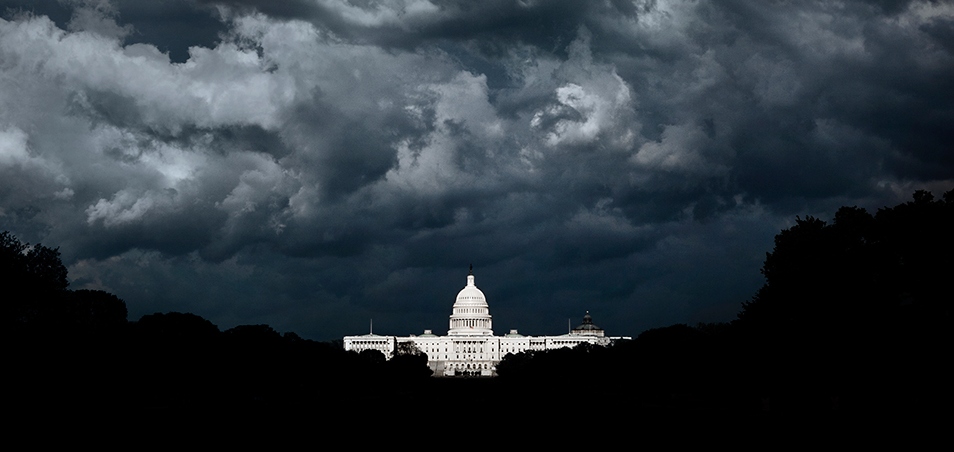
On this Election Day, wearied by the rancor that too much permeates our culture – and that has infested the Church – these words from slave-trader-turned-pastor/poet John Newton are at the forefront of my mind:
I meddle not with the disputes of party, nor concern myself with any political maxims, but such as are laid down in Scripture.
There is one political maxim which comforts me: ‘The Lord reigns.’ His hand guides the storm; and He knows them that are His, how to protect, support, and deliver them.
It is a comfort to my soul and to my mind to remember that “The Lord Reigns”. I regularly need to remind myself that it is not just that the Lord will reign someday – though that is certainty God’s promise. The Lord Reigns NOW! – Today. When Jesus came on the scene he declared: “The Kingdom of God is at hand!” This means that in his first advent – his first appearance – he began to reclaim all that belongs to him – (which is everything). He reigns today in the hearts and lives of his people throughout the World. And he is sovereign over all creation, so that whether people bow to Him and honor Him as Lord or not, he is still working out his purposes. (see Psalm 2) He cannot be stopped. He Reigns. He will Reign. And with the mess I see all around me, or whenever I turn on the news, “the Lord Reigns ” is a comfort to me, no matter what the election results are tonight, and in the coming days.
As a fan of John Newton, I also began my day today by re-reading this short letter from Newton to a friend, from which the quotes above are taken. The context of this letter is a call to his fellow Englishmen to pray for the renewal of his homeland, prompted by news of “hostilities” in the American colonies. Though this letter was written in August 1775, the wisdom and the tone are timeless. (From The Works of John Newton, v. 2)
“O what a Shepherd! Let us love, and sing, and wonder.
I hope the good people at Bristol, and everywhere else, are praying for our sinful, distracted land, in this dark day. The Lord is angry, the sword is drawn, and I am afraid nothing but the spirit of wrestling prayer can prevail for the returning it into the scabbard.
Could things have proceeded to these extremities, except the Lord had withdrawn His salutary blessing from both sides? It is a time of prayer.
We see the beginning of trouble, but who can foresee the possible consequences? The fire is kindled; but how far it may spread, those who are above may perhaps know better than we.
I meddle not with the disputes of party, nor concern myself with any political maxims, but such as are laid down in Scripture. There I read that righteousness exalteth a nation, and that sin is the reproach, and, if persisted in, the ruin of any people.
Some people are startled at the enormous sum of our national debt: they who understand spiritual arithmetic may be well startled if they sit down and compute the debt of national sin.
Imprimis, Infidelity: Item, Contempt of the Gospel: Item, The profligacy of manners: Item, Perjury: Item, The cry of blood, the blood of thousands, perhaps millions, from the East Indies.
It would take sheets, yea quires (i.e. 25 sheets of paper), to draw out the particulars under each of these heads, and then much would remain untold. What can we answer, when the Lord saith, ‘Shall not I visit for these things? Shall not My soul be avenged on such a nation as this?’
Since we received the news of the first hostilities in America, we have had an additional prayer-meeting. Could I hear that professors in general, instead of wasting their breath in censuring men and measures, were plying the Throne of Grace, I should still hope for a respite.
Poor New England! Once the glory of the earth, now likely to be visited with fire and sword. They have left their first love, and the Lord is sorely contending with them.
Yet surely their sins as a people are not to be compared with ours. I am just so much affected with these things as to know, that I am not affected enough.
Oh! My spirit is sadly cold and insensible, or I should lay them to heart in a different manner: yet I endeavour to give the alarm as far as I can.
There is one political maxim which comforts me: ‘The Lord reigns.’ His hand guides the storm; and He knows them that are His, how to protect, support, and deliver them.
He will take care of His own cause; yea, He will extend His kingdom, even by these formidable methods.
Men have one thing in view; He has another, and His counsel shall stand.”

 GRACE & PEACE