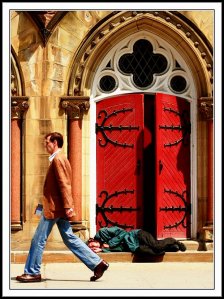
Infection of Complacency

Indifferent

Here is a thought from J.C. Ryle that transcends the gulf between 19th Century Britain to speak to 21st Century American Evangelicals:

The times require distinct and decided views of Christian doctrine. I cannot withhold my conviction that the professing Church is as much damaged by laxity and indistinctness about matters of doctrine within, as it is by skeptics and unbelievers without. Myriads of professing Christians nowadays seem utterly unable to distinguish things that differ. Like people afflicted with color–blindness, they are incapable of discerning what is true and what is false, what is sound and what is unsound. If a preacher of religion is only clever and eloquent and earnest, they appear to think he is all right, however strange and heterogeneous his sermons may be. They are destitute of spiritual sense, apparently, and cannot detect error. The only positive thing about them is that they dislike distinctiveness and think all extreme and decided and positive views are very naughty and very wrong!

These people live in a kind of mist or fog. They see things unclearly, and do not know what they believe. They have not made up their minds about any great point in the Gospel, and seem content to be honorary members of all schools of thought. For their lives they could not tell you what they think is truth about justification, or regeneration, or sanctification, or the Lord’s Supper, or baptism, or faith or conversion, or inspiration, or the future state. They are eaten up with a morbid dread of controversy and an ignorant dislike of party spirit; and yet they really cannot define what they mean by these phrases. And so they live on undecided; and too often undecided; they drift down to the grave, without comfort in their religion, and, I am afraid, often without hope.

The explanation of this boneless, nerveless, jelly–fish condition of soul is not difficult to find. To begin with, the heart of man is naturally in the dark about religion – has no intuitive sense of truth – and really needs instruction and illumination. Besides this, the natural heart in most men hates exertion in religion, and cordially dislikes patient, painstaking inquiry. Above all, the natural heart generally likes the praise of others, shrinks from collision, and loves to be thought charitable and liberal. The whole result is that a kind of broad religious “agnosticism” just suits an immense number of people, and specially suits young persons. They are content to shovel aside all disputed points as rubbish, and if you charge them with indecision, they will tell you: “I do not pretend to understand controversy; I decline to examine controverted points. I dare say it is all the same in the long run” – Who does not know that such people swarm and abound everywhere?

Now I do beseech all to beware of this undecided state of mind in religion. It is a pestilence which walks in darkness, and a destruction that wastes at noonday. It is a lazy, idle frame of soul which, doubtless, saves man the trouble of thought and investigation but it is a frame of soul for which there is no warrant in the Bible. For your own soul’s sake, dare to make up your mind what you believe, and dare to have positive, distinct views of truth and error. Never, never be afraid to hold decided doctrinal opinions; and let no fear of man and no morbid dread of being thought party–spirited, narrow, or controversial, make you rest contented with a bloodless, boneless, tasteless, colorless, lukewarm, undogmatic Christianity.

Mark what I say. If you want to do good in these times, you must throw aside indecision, and take up a distinct, sharply–cut, doctrinal religion. If you believe little, those to whom you try to do good will believe nothing. The victories of Christianity, wherever they have been won, have been won by distinct doctrinal theology; by telling men roundly of Christ’s vicarious death and sacrifice; by showing them Christ’s substitution on the cross, and His precious blood; by teaching them justification by faith, and bidding them believe on a crucified Savior; by preaching ruin by sin, redemption by Christ, regeneration by the Spirit; by lifting up the brazen serpent; by telling them to look and live – to believe, repent, and be converted. This – this is the only teaching which for centuries God had honored with success, and is honoring at the present day both at home and abroad.

It is doctrine – doctrine, clear, ringing doctrine which, like the ram’s horn at Jericho casts down the opposition of the devil and sin. Let us cling to decided doctrinal views, whatever some may please to say in these times, and we shall do well for ourselves, well for others, and well for Christ’s cause in the world.

Easy Chairs & Hard Words – Part 6

by Douglas Wilson 

 We join a conservation in progress; it is between a young theological questioner who grew up in a typical Evangelical church, and an older pastor from a more historical theological tradition.  

 “Look,” I said, “I have heard you mention that many Christians don’t study their Bibles. Were you saying that anyone who disagrees with you on this question of God’s sovereignty hasn’t done his homework?”   

 Pastor Spenser shook his head. “No, I’m not saying that at all. I’m saying that, in my experience, most of them have not.”   

 “But you would agree that there are fine Bible scholars who differ with you on this?”   

“That depends on what you mean.”   

 “What do you mean?”   

 “There are men who are fine Christians who do not understand this truth. There are men who are fine scholars who differ with it. But when they dispute this truth, in certain key passages, there is an unfortunate lapse of their scholarship.”   

 “May I play the devil’s advocate?”   

“Certainly.”   

“Who are you to say what the correct interpretation is? Isn’t it arrogant of you to say that you are right and all the others are wrong?”   

 “It is not a question of whether I am right. It is a question of whether God revealed this truth in his Word, or not.”   

 “I don’t get your point.”   

 “We must not, as Christians, determine whether or not God has revealed something by how many men acknowledge the revelation. The content of the revelation is determined by the careful and laborious study of the text. It is not determined by counting noses. Not even scholarly noses.”   

 “Are you saying that you cannot make a mistake when you go to the text?”   

 “No, certainly not. I have made many mistakes. But I may only acknowledge my error when someone shows me the mistake from the text.”   

 “Now how does this relate to the question of God’s exhaustive sovereignty?”   

 “I have had many Christians tell me I am wrong about all this predestination business. But only a handful of them have ever endeavored to demonstrate the error I am supposed to be making from the text.”   

 “What do the rest of them do?”   

 “They break down into two basic categories. The first group talks just long enough to establish where the disagreement lies; after that, they avoid any discussion of the issue. Thinking about it discomfits them. The second group will talk about it; indeed, many times they enjoy talking about it. But the authority to which they appeal makes any resolution of the question impossible. Their authority, their court of appeals, is reason, common sense, and armchair philosophy. They will say that reason requires us to acknowledge that we have ‘free will’. Otherwise, how could God blame us? For who resists His will? This group acknowledges the authority of the Bible – on paper – but does not submit to the arbitration of Scripture.”   

 “Why do you think this is?”   

 “I cannot say; I merely see the results of it. Only God sees the heart. I am not competent to say what obstacles may exist in their hearts, although I do not doubt they are there. It is my business to see to it that there is no obstacle to their understanding in my heart.”   

 “What do you mean?”   

“I mean any kind of pride, haughtiness, impatience…whatever. If there is any of this on my part, it may well be used by God to keep fellow Christians from these wonderful truths. In the providence of God, matters are arranged in the church in such a way that it is possible to stumble your brother.”   

 “Can you give me an example of this from Scripture?”   

 “Sure. In 2 Timothy 2:25, it assumes that God is the Giver of repentance. When a man repents, he is the recipient of a gift.”   

 I had looked the passage up. “Well, it sure looks that way.”   

 “Now many Christians deny that repentance is a gift of God. In a discussion with such a person, what do you think the temptation is?”   

 I grinned. “To beat them over the head with this verse?”   

 “Exactly. Now back up and read the previous verse, this verse, and the verse after.”   

 I looked down. And a servant of the Lord must not quarrel but be gentle to all, able to teach, patient, in humility correcting those who are in opposition, if God perhaps will grant them repentance, so that they may know the truth, and that they may come to their senses and escape the snare of the devil, having been taken captive by him to do his will.”   

 I glanced up again. “But isn’t this talking about a debate with a non-Christian?”   

“Yes, it is. And if we ought to correct unbelievers with such humility, what should our demeanor be toward brothers?”   

 “Got it.” I said.   

 “Now notice that the behavior of the one who knows the truth is connected with the possible change of heart of the one listening, if God is gracious and so wills it.”   

 “So how do you tie this in with our discussion? If all this is so clear in the Scriptures, why do Christians deny what you say the Bible teaches?”   

 “I would suggest that the problem is not with those who don’t believe it, but with those who do.”   

 “How so?”   

 “Some Christians deny God’s exhaustive sovereignty, and they live in a manner consistent with that denial. Other Christians affirm it, but then go on to deny it with their lives. The second group has more to answer for.”   

 “You can’t be saying that the church is in this sad condition because this is the way God has willed it?”   

 “Well, yes, I am. If God controls everything, then He certainly controls this.”   

 “But why? That seems so contrary to everything I have ever learned about God and His relationship to the church.”   

 “I don’t know why either. I am not sure a creature could understand why. But I do know that I am not going to water down clear statements of Scripture just because I want to worship a God who meets with my approval!”   

 “Is there any passage of Scripture that teaches that God controls backslidings?”   

 “Yes. Isaiah 63:17. `O Lord, why have You made us stray from Your ways, and hardened our heart from Your fear? Return for Your servants’ sake, the tribes of Your inheritance.’”   

“So you are also saying that the reason so many Christians deny this truth is…”   

“…is that God has willed it. Yes. He has hardened our hearts. And, anticipating the question, it does not lessen our responsibility in the slightest.”   

“Is it wrong to ask why God does this?”   

“No. Isaiah asks why. I believe that when Christians acknowledge that God has done this, and begin tearfully asking why He has done it, we will be on the edge of true revival. True revival is something He gives.”   

I was shaking my head. “I don’t know…”   

Pastor Spenser went on. “The modern evangelical church is drowning in an ocean of theological stupidity. Here and there are handfuls of the `orthodox’ clinging to the wreckage of what was once a great ship. In such a condition, it is impertinent to even be tempted to pride.” 

“But why would God do that to His own ship?”   

“He has done it, and He is God. That is enough. By all that Scripture teaches, His reasons were good, just, and holy. And when we consider the glorious future that is promised for the gospel in the world, we should take courage as we pray for revival. It will be clear to us later.”   

“And in the meantime…?”   

“In the meantime, those Christians who have been given an understanding of this should not puff themselves up. We know that what Job says in Job 42:2 is true. `I know that You can do everything, and that no purpose of Yours can be withheld from you.’ But they must also respond to this truth the way Job did in vv. 5-6. `I have heard of You by the hearing of the ear, but now my eye sees You. Therefore I abhor myself, and repent in dust and ashes.’”   

“How are you applying this?”   

“It is one thing to hear truth, and agree with it. Many have come to believe these things simply because they are attracted to a system which is logically consistent. Or perhaps they are repelled by the shallowness of so much of our preaching and teaching today. Or they are the studious type, and like to read books by the Puritans.”   

Pastor Spenser went on. “But it is quite another thing to be given a vision of the glory of God and to be, like Job, undone by it.”   

“Are you saying it is bad to be studious, or systematic?”   

“No, not at all. Hard study is required by God, as well as to compare carefully one portion of Scripture with another. Over many years, many people have told me that I study too much, but the Holy Spirit convicts me regularly that I study too little.”   

“What are you saying then?”   

“Hard study can be compared to chopping wood, assembling the kindling, and putting all the wood together for the fire. There are churches that have a good idea of where the wood should go, but they have forgotten there is supposed to be a fire.”   

“And others…?”   

“Others, theologically shallow, know there is supposed to be a fire. But they use grass, thorns, paper, and a lot of lighter fluid.”   

“How do you see your work?”   

“I have chopped a lot of good wood – although less than I should have – and I have assembled it. Now I am waiting, and praying to God.”   

“Praying for what?”  Pastor Spenser thought for a moment. 

“Praying for the fire to fall.” 

****

  This is Part 6 in a series of 6.

Easy Chairs & Hard Words – Part 2


by Douglas Wilson

I had thought of a question during the week which I thought would bring our conversation back to some evangelical “basics.” My sessions with Pastor Spencer were unsettling and fascinating both; on the one hand I was attracted by his approach to the Scriptures, but on the other I was concerned about the danger of “too much theology” getting in the way of basic Christianity. After we had settled in our chairs, I presented my concern.  

“Why should Christians discuss the sorts of doctrines we have been discussing? Shouldn’t we just stick to the gospel? Sinful men need to be told that they must be born again, and here we sit, week after week, splitting theological hairs.”  

Pastor Spencer chuckled. “To be sure, sinful men need to be told that they must be born again. What would you say if one of them asked you what on earth that meant?”  

I stared at him. “Isn’t that obvious? It means that men must become Christians.”  

Pastor Spencer took a sip of his coffee. “How does one do that?”  

I thought for a moment. “Well, the person must repent of his sins, and must put his faith in Jesus Christ, who died on the cross for sinners.”  

Pastor Spenser smiled. “Very good–so far. Most Christians would leave the cross out of it altogether–they would say something like `ask Jesus into your heart,’ or `make a commitment to Christ.’ Now what happens after he repents and believes?”  

“He is born again.”  

“Now are you aware that this order–`Repent, believe, and then you will be born again’–is not in the Bible?  

I was actually aware of no such thing, so I shook my head. “What do you mean?”  

“How do you know that the biblical order is not, `You must be born again, in order to repent and believe?’”  

I think my mouth was hanging open. I had never heard anything like this before.  

“You mean that the new birth is first?”  

Pastor Spencer nodded.  

“In the order you have assumed, man makes a choice, and then he is born again. But the Bible places the choice regarding the new birth in God’s hands, not man’s.”  

“Where?” I asked.  

“There are three basic arguments from Scripture for this. The first is how the Spirit’s work is described; the second is the nature of birth; and the third would be express statements of Scripture to this effect.  

I nodded. “OK, let’s start with the first.”  

He had me turn to John 3:7-8, and I read. “Do not marvel that I said to you, `You must be born again.’ The wind blows where it wishes, and you hear the sound of it, but cannot tell where it comes from and where it goes. So is everyone who is born of the Spirit.” I looked up.  

Pastor Spencer said, “Would you agree that it is fairly common for Christians to evangelize by telling people how to be born again?”  

“Certainly. Isn’t that what evangelism is?”  

“No. Evangelism is preaching the death of Christ for sinners, and the necessity of repentance and belief. Telling people how to be born again is like telling people how to understand where the wind comes from, and where it is going. The new birth is mysterious – it is the work of the Spirit of God, not the work of man.”  

“So you are saying that the new birth cannot be controlled by men.”  

“Yes. I am saying that the wind blows where He pleases.”  

“What must men do then?”  

“They must repent and believe on the Lord Jesus Christ.”  

“So repentance and belief are what the man contributes?”  

“In a way. It is the man who repents and believes, but the Spirit has made that repentance and belief possible by giving the sinner a new heart through regeneration. So, for example, repentance is described as something men do (Acts 26:20), but it is also seen as a gift from God (2 Tim. 2:25). In contrast, the new birth is never described as anything done by man. It is always shown as the imperial work of God.”  

“You mentioned the nature of birth. What did you mean by that?”  

“Jesus taught that the new birth is necessary. From this, many have falsely concluded that it is a command to be obeyed by us. But `be born’ is a passive verb, not active. `Repent’ and `believe’ are active.”  

“What does that mean?”  

“It means that those who are born again are recipients. A birth is not something one volunteers for; it is something that happens to him.”  

“Can you illustrate?”  

“Sure. I was in the Navy for four years, and I am a Spencer. I joined the Navy (voluntarily) and my family (not voluntarily). When Jesus compared the start of the Christian life to a birth, which type of `joining’ did He have in mind?”  

“The second, I guess,” I said reluctantly.  

“And which type of joining is presented in most modern evangelism?”  

“The first.” I didn’t know why I felt so miserable.  

“Exactly. One of the major problems we have in the church today is the result of well-meaning but unbiblical recruiters, instead of biblical evangelists. We have even fallen to the point where we have borrowed, on a large scale, techniques of recruitment from the world.”  

“How would you summarize this point about the verb `be born’?”  

“By saying that if the new birth is what many describe it to be, there is no way to express in the language of birth what is happening. Birth would be an extremely clumsy metaphor for what is happening. How does one birth himself?”  

I turned to the next point. “You said that there were several verses that make your point about the new birth.”  

Pastor Spencer nodded. “Turn to James 1:18. Why don’t you read it out loud?”  

“Of His own will He brought us forth by the word of truth, that we might be a kind of first-fruits of His creatures.”  

“Notice it does not say, `Of our own will He brought us forth by the word of truth. . . .”  

“Where is the other passage you had in mind?”  

John 1:12-13.”  

I turned the pages slowly, thinking hard.  

“But as many as received Him, to them He gave the right to become children of God, even to those who believe in His name: who were born, not of blood, nor of the will of the flesh, nor of the will of man, but of God.”  

I looked at Pastor Spencer. “Do you believe there are no legitimate questions about what you are saying?”  

He laughed. “I would have to be an insufferable coxcomb to say something like that. Someone could say, for example, that some passive verbs can be obeyed by us–`be filled with the Spirit’–and he could point out that God gives the right to become His children to those who received Him because they received Him. But of course I believe such objections, while valid, can still be answered.”  

“There is one thing I still don’t understand,” I said. “I began by asking whether or not we are splitting theological hairs in our discussions. What practical difference does this all make? I mean, an average non-Christian isn’t going to know whether the man preaching to him believes what you are saying or not. So why bother with it? Why don’t we just preach the gospel?”  

“To say that the non-Christian could not tell the difference is not to say there is no difference.”  

“What does that mean?”  

“Does this make any difference to the evangelist? How he prays, prepares, preaches?”  

“What difference could it make?”  

“The two preachers have a completely different understanding of their respective tasks. The one believes himself to be going to the sick, supplied by God with the proper medicine, and his task is to persuade the patients to take the medicine. The other man is going, like Ezekiel, to preach in a graveyard.”  

“Ezekiel?”  

“The Lord told him to prophesy to a valley full of dry bones. I dare say that Ezekiel did so with the full knowledge that if something were to happen it would have to be the result of the Spirit’s work. It certainly would not be because of anything Ezekiel did in his own power.”  

“But all evangelists know that God must empower them. . . .”  

“Yes, but to do what? The one seeks to raise consciousness, while the other seeks to raise the dead. All godly evangelists seek to be dependent upon God in the performance of their task; but their respective theologies will determine their understanding of that task. Believe me, I have preached the gospel both ways, and I know the difference it makes.”  

I scratched my chin thoughtfully. “So you are saying that Calvinism will result in powerful evangelism..”  

“No. And please don’t call it Calvinism.”  

I laughed. “I can’t talk about it without words. What do you want me to call it?”  

“Well, we are talking about the new birth. Let’s call it the new birth.”  

“OK, OK. Why did you say `No’?”  

“There have been many Christians with an accurate understanding of the gospel who have done little or nothing with it. There have been others who, like Apollos, have done a lot with a deficient understanding.”  

“So this means. . . .”  

“It means that if a man is empowered by the Spirit of God, more use will be made of him if he has an accurate understanding of the new birth.” Pastor Spencer grinned. “People who compare George Whitefield with John Wesley are being, shall we say, unscientific? The real question is whether Wesley would have been more powerful had he understood this, and whether Whitefield would have been less powerful had he not. And these questions cannot be answered through historical study; half of the comparison you must make didn’t happen. Consequently we are driven to the Scriptures to settle the matter.”  

“Right,” I said, “Back to the Scriptures.”

****

This post is Part 2 in a series of 6. It originally appeared as part of a series in Credenda Agenda.