Directions for Reading Christian Books

Trinity College Library (Ireland)

[Adapted from Richard Baxter’s Christian Directory of 1673]

Because God has made available the excellent, holy writings of his servants; and many may have a good book, on any day or at any hour of the week, even those who have no access to a good preacher – I advise all God’s servants to be thankful for so great a gift as books, and to make use of them, and to read much. For reading can be more conducive to knowledge than hearing is, because you may choose what subjects, and the best treatises, you please; and you may read as often as you please; and you may peruse again and again whatever you forget; and you may take your time as you go, to fix it in your mind. And as is the case with very many, reading does more than hearing to move the heart – because lively books may be more easily accessed than lively preachers.

Especially these sorts of men and women should be much in reading:

  1. Mothers and Fathers, or heads of households, who have more souls to care for than just their own.
  2. People who live where there is no preaching; or, where there is only bad preaching. (Bad preaching is even worse than none!)
  3. Infirmed people, servants, and children, who are forced on many Lord’s Days to stay at home, while others have the opportunity to hear the Word preached.
  4. And non-working persons, since they have more leisure than others have.

To all these, but especially to parents, I shall here give a few directions.

Direction 1 – I presuppose that you keep the devil’s books out of your hands and house. I mean graphic romance novels or “love-books”, and the false, bewitching and seducing books of all false teachers; and the railing books by various factions written against each other, on purpose, to teach men to hate one another. For where these are allowed to corrupt the mind, other useful writings are forestalled in their benefits. It is an awful wonder to see how powerfully these kinds of writings poison the minds of children, and of many other empty heads.

Also refrain from books that are written by contemporary “sons of Korah“; those written to breed distastes and discontents in the minds of the people against their governors – both magistrates and ministers. For there is always something, even in the best leaders, for the tongues of seditious men to fasten on, and then to aggravate in the people’s ears and minds; and there is something even in godly people, which tempts them all too easily to become ill-tempered,  then to take aim and take fire, before they are aware of what they are doing. Rarely do most people, even godly people, foresee the evil to which such treachery leads.

Direction 2 – When you read to your family, or to others, let it be seasonably and timely – at a time when silence and participation are most likely to bear fruit; not when children are crying or talking, or servants bustling to disturb you. Distraction is worst in the greatest businesses.

Direction 3 – Choose such books as are most suitable to your condition, or to the spiritual condition of those you read to. It is worse than unprofitable to read books designed for comforting troubled minds to those that are block-headedly self-secure, and who have hardened, obstinate, un-humbled hearts. It is just as bad as a physician giving medicines or remedies that are contrary to a patient’s need, and that would actually nourish the disease! So it is to read books that are too high-a-style, or subject too deep, to dull or ignorant hearers. We use to say: “That which is one man’s meat, is another man’s poison.” It is not enough that the substance is good – but it must be agreeable to the situation for which it is used.

Direction 4 – In a common family, begin with those books which both, and at once, inform the understanding about the fundamentals of the faith and awaken the affections of the heart, such as treatises about regeneration, conversion, or repentance.

Remember that they are not the most learned, who read most – but those who read that which is most necessary and profitable.

“Remember that they are not the most learned, who read most – but those who read that which is most necessary and profitable.”

Direction 5 – Next, read over those books which are most suited to the state of young Christians for their growth in grace, and for their exercise of faith, and love, and obedience, and for the mortifying of selfishness, pride, sensuality, worldliness, and other of the most dangerous sins.

Direction 6 – At the same time labor to methodize your knowledge; and to that end read first and learn some short catechism, and then some larger catechism. And let the catechism be kept in memory while you live, and the rest be thoroughly understood.

Direction 7 – Next read (to yourselves or or to your families) some larger expositions of the Apostles’ Creed, Lord’s Prayer, and Ten Commandments; such as Thomas Watson on the Commandments; that your understanding may be more full, particular, and distinct, and your families may not be limited to a mere general knowledge, which, in truth, is not as valuable as genuine understanding.

Direction 8 – Read often and much those books that direct you in a course of daily communion with God, and a holy ordering of your daily life.

Lord, Make Me Like You

Dr Odd (Picasso)

I don’t recall where or when I first heard following story, but it has often caused me to stop and ask myself about my attitude and motivations:  Prayer

A man prayed to the Lord: “Lord, make me like you; may my words & thoughts be like yours; may my actions produce great fruit…”

This was his regular prayer.

Then one day a voice from within – perhaps the Holy Spirit, perhaps his own mind – simply said one word: “Why?”

“What do you mean, ‘Why?’  Lord, it’s a standard prayer!”

But why did he want to be like the Lord?  Why do I want to be like Jesus?

1.     So people will think highly of us?

-or-

2.     For God’s Glory

-and/or –

3.     Because the Lord is pleased with Jesus

How we answer makes a world of difference.

Jesus Material Measure of Spiritual Maturity

In 2 Corinthians 8.7 the Apostle Paul challenges us to grow in the grace of generosity through giving:

“But as you excel in everything -in faith, in speech, in knowledge, in all earnestness, and in our love for you – see that you excel in this act of grace also.”

Within his textbook, Biblical Ethics, Robertson McQuilkin, formerly President and then President Emeritus of Columbia International University, likens personal giving patterns to personal maturation stages, as a metaphorical expression of spiritual maturity.   McQuilken says the Bible teaches us that our giving patterns are “Jesus’ material yardstick for measuring spiritual maturity”.

In sum, here is the “yardstick”:

  • Infancy: Non-giving
  • Kindergarten: Impulse Giving
  • Elementary: Legalistic Giving
  • Secondary: Honest Managership
  • Higher: Love Giving
  • Graduate: Faith Giving

Sasse Speaks to The Gospel Coalition

Senator Ben Sasse (R – Nebraska) addresses The Gospel Coalition 2017 Conference, with an address titled: What Has Washington to Do With Jerusalem?.

Sasse, a vocal opponent of Donald Trump as his party’s presidential nominee during the 2016 election, speaks refreshingly and intentionally non-partisan about the distorted role politics plays in the American psyche.  Sasse’s thoughts are well worth the 36 minutes this video runs.

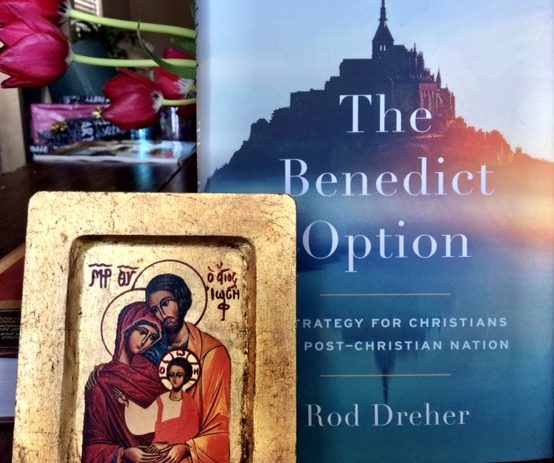
The Benedict Option is Not Really an Option

Benedict Option collage

Since I already have some pretty definite opinions about the book, I thought maybe I ought to read it.  My preliminary thoughts about Rod Dreher‘s The Benedict Option is that it offers a good analysis of the present states of both culture and Church, but Dreher’s solution seems more imposed than necessary or biblical. In other words, Dreher seems to have a fascination with the Rule of Benedict, and uses the current social climate as an excuse to encourage others to embrace it.

It’s not that I think there is no benefit from Benedictine practices. On the contrary, I was intrigued a few years ago when reading Dennis Okholm’s Monk Habits for Everyday People with a group of pastors with whom I would meet monthly or so.  What I appreciated from Okholm’s work, and expect to appreciate from Dreher, are the categories of thought the Benedictine’s have developed.  I appreciate many of their disciplines, and I can see that many of their practices could help cultivate a disciplined and rich spiritual vitality.  However, the notion of withdrawal from the world at the root of Benedictine discipline, is not only an impractical option for most people, I am convinced that it violates Jesus’ command to his disciples found in John 20.21:

“Peace be with you. As the Father has sent me, even so I am sending you.”

And it is out of line with God’s expressed instruction to his people who were living in Babylonian exile, as recorded in Jeremiah 29.7:

“But seek the welfare of the city where I have sent you into exile, and pray to the Lord on its behalf, for in its welfare you will find your welfare.”

In other words, despite some – even many – ideas worthy of serious consideration, and that might be appropriate to be adopted with some adjustments, it seems to me that The Benedict Option is not really an option for those who want to be faithful followers of Jesus Christ.  And Dreher himself seems to understand this since, despite the provocative title, he spends much energy explaining that what he is encouraging is the employment of some of Benedict’s principles without necessarily actually withdrawing into monastic communities.

See also:

Race & the Church RVA: Walking the Path of Love

The sixth and final gathering of Race and the Church took place in Richmond, Virginia on Saturday November 19. The first of two sessions that morning featured Dr. George Robertson, Senior Pastor of the historic First Presbyterian Church of August, Georgia, and Moderator for the 44th General Assembly of the Presbyterian Church in America.  Dr. Robertson’s message was Walking the Path of Love.

Buyers Remorse: Election Edition

vote-by-post

I have never been a fan of early voting, especially not in something as significant as a presidential election.  I am of the opinion that there are some things important enough that people ought to order their lives around them in order to participate.

As a Christian, and a pastor, I would consider the Lord’s Day to be the ultimate example of such a thing.  God created the world in a span of six day then, essentially and metaphorically, “rested” the 7th Day.  God then decreed that people – especially those who claim to be devoted to God – should follow the same pattern; that we ought to set one-day-in-seven as a Sabbath, where we rest from our labors, and commit the day to God in a way unique from the others (which also actually belong to God).  The Sabbath is a gift, if we understand it correctly. The 4th Commandment, that requires humanity to observe this day in no way mitigates the gift God has given us in the form of a day of rest. My point in this post is not to make a case for a specific day of Sabbath, nor to consider appropriate vs. inappropriate activities for this day, but only to offer it as an example. A Sabbath day, commanded by God, as a gift of God, is intended to be, and is important enough to be, a day set aside, around which we build our weekly schedules.

While less important cosmically than a Sabbath, in the civil sense Election Day is monumental enough that people ought to set the day aside, and vote on the appointed day, whenever possible. In other words, Election Day is too important to subordinate it to the idol of convenience.

Granted, some exceptions can, and should, be made.  For instance, the case for our daughter who, as a student at a college in another part of the state, would find it quite difficult to appear at our home precinct. She needs some accommodations.  I am not sure that an absentee ballot would not be a sufficient accommodation, but in Virginia an early voting option is offered. And students are not alone in their need for some accommodation.  Some whose business travel requires them to be out of town, others who may be in the midst of various types of long-term infirmities, are examples of those I believe should also be afforded some sort of accommodation.  But the thing is, in Virginia early voting requires a good reason. Simply avoiding lines, or whatever motive for convenience, is not sufficient reason.  But not all states are as much sticklers as Virginia is.  in Tennessee, for example, which I consider to be my adopted home state, early voting is just one option among many, offered for convenience.  As I understand, far more states are akin to Tennessee than to Virginia in this respect.

I appreciate those who are concerned about restriction that make voting prohibitive for some segments of our society. In no way would I want to endorse practices and policies that would suppress legitimate opportunities for any citizen to vote.  But I fear that by making convenience a chief factor in our national elections, we have devalued the importance and downplayed the privilege extended to every citizen of the United States.  I can’t help wondering if this – along with an unappetizing roster of candidates – has not played some part in declines in voter turnout.

Having expressed some of my philosophical aversion to allowing early voting as a common option, I want to turn my attention to the more pragmatic reasons for my oppostion.

About a month ago – 6 weeks before Election Day 2016 – some political analysts expressed their concerns about early voting.  Their concern: simple regret.

“Some people have estimated, and this may be way too large, that one third of the electorate will already have a voted early by November 8 of this year. One-third!”

“And somebody could say, ‘Well I wouldn’t have voted for that person if I would’ve known that that happened 24 hours ago’,”

I am not a fan of October Surprise as a political strategy. It seems to me, if a candidate is worthy of my vote he or she ought to show me why they deserve it; not keep pointing out to me why the other candidate does not deserve it.  Someone else’s disqualifying characteristics do not necessarily qualify me.  But sometimes, like this year, what comes to light in the final days of the election season are not mere sleazy revelations from the opposition camp, but legitimate news of criminal or disqualifying facts from legitimate sources.  And as some political analysts predicted a month ago – weeks before revelation that the FBI was re-opening its investigation of Hillary Clinton – once certain facts come to light, conscientious people are likely to have regret.  But their vote has already been irreversibly cast.

In our present election cycle, it is difficult for me to believe that if the one about whom these potentially criminal revelations have surfaced is elected, that the citizens of the USA will have any reason to believe real justice will ever be carried out.  Whether the possible allegations are legitimately criminal or not, I do not know.  But if a candidate with a reputation for and  history of cover up is elected, unless impeached, can we ever know if justice is done?

If early vote were not such an easy option, those who are already experiencing buyers remorse would not be able to send the nation in such a regrettable direction.

Two Sides of Holiness

east-knox-reflections

Jerry Bridges offered a powerful insight and challenge to Christians about the nature and focus of the Christian life:

“Scripture speaks of both a holiness which we have in Christ before God, and a holiness which we are to strive after. God has made provision for us to live holy, but He has also given us definite responsibilities to pursue holiness. Only as we accept our responsibility and appropriate God’s provisions will we make any progress in our pursuit of holiness.”

Race & the Church RVA: The Church’s Commission

The third gathering of Race and the Church in Richmond, Virginia took place on Saturday May 14.  Featured speaker Leonce Crump addressed the diverse crowd on the subject of The Church’s Commission.

Leonce Crump’s bio, from the Race and the Church RVA web page:

Originally from Louisiana and raised Catholic, Léonce began following Jesus at age 16. Always an athlete and a talker, Léonce outran his first mall security guard (and pregnant mother) at age 3, and spent most of his grade school years talking with his principals on the subject of public speaking during class. He has been in ordained ministry for 9 years, is a graduate of the University of Oklahoma; and holds Masters degrees in Criminal Justice, with a focus on Case Law, from the University of Tennessee, Missional Leadership from the now defunct Resurgence Theological Training Center, an; is currently finishing his Masters of Divinity at Reformed Theological Seminary.

At Oklahoma he was an All-American wrestler and played a short while on the Sooner football team. He experienced an extended time of rebellion and running from God during college, but after 22 months of living as though he were not a Christian he surrendered to Jesus and ultimately to God’s calling into ministry. After college Léonce competed to make the world team in wrestling, played professional football for the New Orleans Saints and coached collegiate wrestling.

Prior to planting his present church, Léonce had served in 3 churches, starting and leading 3 college and young adult ministries. In 2006 he felt called to plant a church and settled on the under-served area of downtown Atlanta; and in early 2008 he and his wife began the process of planting Renovation Church, in partnership with  Acts 29 and Perimeter Church.

A prodigious reader and engaging speaker, Léonce regularly speaks and preaches across the country at conferences and churches of all denominations. Léonce enjoys boxing and MMA, studying theology, history, leadership, church structure and poetry. He likes Soul music, jazz/standards, and Bossaniva. He also loves to lift, keep up with wrestling, football, and rugby, playing with his kids, hanging with the homeless dudes.

To view the first two gatherings of Race and the Church RVA:

Race & the Church RVA: Why Do We All Look the Same?

The second gathering of Race and the Church in Richmond, Virginia took place on Saturday morning March 12. The theme was: Why Do We All Look the Same? A Cultural & Theological Analysis of Underlying Church Dynamics; featuring speaker Dr. Alexander Jun.

Alexander Jun is a professor at Azusa Pacific University, a TED Talk speaker, and author. He has published extensively on issues of post-secondary access for historically underrepresented students in under-served areas. Jun is also a respected Ruling Elder in the Presbyterian Church in America.

To view the message from the first gathering, with featured speaker Sean Lucas, click: Race and the Church: Telling the Truth.