Some Thoughts After the Supreme Court Ruling on Marriage

Star Gazing

With a landmark decision, and a monumental example of judicial overreach, the U.S. Supreme Court this morning announced their decision regarding same-sex-Marriage. By the awesome power vested in just five people, marriage has been redefined in our land.  This decision will continue to shake our cultural landscape for years to come, with the aftershocks of both unintended consequences (by some) and intentional-but-hidden agendas (of others).

While some who know me, or who read this blog, may assume my chagrin is in the validation of same-sex-marriage, it is actually far greater regarding the other implications related to this decision.  I am opposed to same-sex-marriage, on the grounds that it is clearly not in line with the design and decree of the Lord of Heaven and Earth.  So I am disappointed, though not surprised, by this decision.  But if this is the law of the land where I live, I can live with it being the law – as long as I am not compelled to comply. It is no greater difficulty than the first century apostles, and other Christians, faced in Rome, Corinth, Ephesus, and other ancient pagan territories.  What concerns me more is that I now live in a land where we officially believe that “Rights” are not endowed by our Creator, but rather bestowed by the government.  This is a very treacherous problem – especially in this case where it was not even by a democratic process; and where there is no court of appeal.

Think about it for a moment.  In Nazi Germany the government decided that those who were Jewish had no rights, and that the government had the right to exterminate them simply because they were Jews.  In the Antebellum South, those of African decent had no rights – with relative few exceptions – and were thus allowed to be held enslaved.  Some may argue that this example, especially the latter one, illustrates why the court decision this morning is a corrective, granting freedom to a group of people to marry who were previously denied that “right”.  But look at the root. Both illustrations are similar to the court ruling, all assuming that “rights” are bestowed by the government.  Yet if this is correct, that rights do come from the government, then why would one argue that the institution of slavery was so reprehensible?  Was it not the law of the land? Government dictating who had rights an who did not?  If one argues that the government has the inherent authority to determine rights, then what makes it appropriate to decry the decisions they make about who has rights and who has not?  If a government has the authority to determine who has rights and who does not, then what makes it morally wrong for a government to decide to eradicate some group it determines undesirable?

No, I have no sympathy for the institution of slavery, nor do I support any practice of genocide.  My point is not that the government should not be the protector of rights, but rather that it is not government that is the originator of any rights.  All good governments must protect the rights of all its citizens!  But what a “right” is is not ultimately determined by the government.  As Jefferson (with help from Franklin) wisely assessed and asserted, “rights are endowed by the Creator”, not by the throne of government.

In April, Justice Anthony Kennedy seemed to grasp the weightiness:

“This definition [of marriage] has been with us for millennia, and it’s very difficult for the court to say, ‘Well, we know better’”.

In the end Kennedy must not have found it all that difficult.  By siding with the majority, Kennedy essentially declares: “Well, we do know better.”

In response to the decision, in his published dissent, Chief Justice John Roberts writes:

If you are among the many Americans – of whatever sexual orientation – who favor expanding same-sex marriage, by all means celebrate today’s decision. Celebrate the achievement of a desired goal. Celebrate the opportunity for a new expression of commitment to a partner. Celebrate the availability of new benefits. But do not celebrate the Constitution. It had nothing to do with it.

While there is a sense that I appreciate these words, it still leaves me  – and others like me – with a practical dilemma: How should those of us who disagree with this decision – whether on its own merits, or because of the ripple effects that it will engender in days ahead, or both – how should we respond?  Especially as a Christian, how ought I respond?  Roberts’ words are merely philosophical and political.  They offer nothing practical to the question: So What Now?

My sincere hope is that I will, now and eventually, act faithfully to God, and lovingly to my neighbors (whether I am in agreement with them or not). In short, I hope in time to gain both perspective and wisdom – and wise perspective.  One thing I keep reminding myself is that God is still in control.  And while I mull over the realities of the day, I am also finding some food for thought in the counsel of some others:

Continue reading

Bounded-Set vs Centered-Set

Bounded-vs-Centered-Set

Some time back I posted a piece titled Numbering Those On the Ranch, exploring the concept of what missiologist Alan Hirsch refers to as a “centered-set” metric for evaluating a church.  More recently I stumbled across a post by Bob Thune, of Coram Deo Church in Omaha, explaining his understanding of Centered-Set verses the more traditional Bounded-Set metric. I appreciated what Thune had to say, so I wanted to post it, even if primarily for my own benefit, as a resource for future use.

***

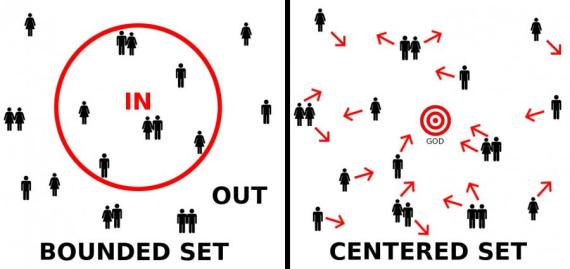
There are two ways of thinking about social groupings: centered-set and bounded-set. These terms come to us from the field of mathematics (set theory). In recent years they’ve been applied more broadly by sociologists and missiologists. The fountainhead of most of this thinking in the Christian church was Paul Hiebert, a missiologist at Fuller Seminary.

Hiebert suggested that our minds categorize people according to either “bounded set” or “centered set” thinking:

Bounded Sets

  •  are formed by defining the boundaries – the essential qualities which separate something inside the set from something outside. Heibert’s classic example is “apples.” Either a fruit is an apple, or it isn’t.
  • Maintaining the boundary is crucial to maintaining the category.
  • Bounded sets are static sets – they don’t change, they only add or lose members.
  • The important thing is to “cross the boundary” to be part of the set.

Centered Sets

  •  are formed by defining a center. The set is made up of all objects moving toward that center. As an everyday example: “bald men.”
  • While a centered set does not focus on the boundary, a boundary does indeed exist. The boundary is clear so long as the center is clear.
  • The objects within a centered set are not categorically uniform. Some may be near the center and others far from it, even though all are moving towards the center.

Hiebert asserts that Americans tend to think almost exclusively in bounded-set categories. And this affects our understanding of Christian discipleship. We tend to “stress evangelism as the major task — getting people into the category. Moreover, we… see conversion as a single dramatic event — crossing the boundary between being a ‘non-Christian’ and being a ‘Christian’” (Hiebert, 1978).

Hiebert argues instead for a “centered-set” way of thinking about Christian conversion:

A Christian would be defined in terms of a center—in terms of who is God. The critical question is, to whom does the person offer his worship and allegiance? …Two important dynamics are recognized. First there is conversion, which in a centered set means that the person has turned around. He has left another center or god and has made Christ his center. This is a definite event—a change in the God in whom he places his faith. But, by definition, growth is an equally essential part of being a Christian. Having turned around, one must continue to move towards the center. There is no static state. Conversion is not the end, it is the beginning. We need evangelism to bring people to Christ, but we must also think about the rest of their lives. We must think in terms of bringing them to Christian maturity in terms of their knowledge of Christ and their growth in Christlikeness.

Theologically, I find some aspects of Hiebert’s argument poorly nuanced. He would do well to differentiate regeneration (the invisible, immediate work of the Holy Spirit on the soul, which is in fact a decisive event) from conversion (our experience of that event, which often feels more like a “process” than like a decisive moment). Those who have applied Hiebert’s set theory to individual salvation (Brian McLaren, for instance) have tended to drift in fuzzy doctrinal directions.

But I find Hiebert’s insights immensely helpful when applied to ecclesiology. This is where I first encountered the set-theory rubric, as applied by Alan Hirsch and Michael Frost in their 2003 book The Shaping of Things to Come. Frost and Hirsch argued for viewing the church as a centered set rather than a bounded set. Why not build a church by defining the center rather than patrolling the boundaries? Why not place the gospel of Jesus Christ at the center of the church’s life and practice, inviting everyone to reorient their lives around Him? In this way, we continually invite Christians into deeper and deeper discipleship, while also inviting non-Christians to deal with the claims of Jesus on their lives. As Hiebert himself acknowledges, this does not mean there is no boundary; there is just “less need to play boundary games and to institutionally exclude those who are not truly Christian. Rather, the focus is on the center and pointing people to that center” (Hiebert, 1978).

It is my personal conviction that: a) this is what the New Testament church did (see, for example, Galatians 1:6-9; Colossians 1:6; Romans 1:13-15); b) this is what it truly means to be a “gospel-centered” church; and c) this is the only way to have a truly missional church, where non-Christians are treated with true Christian hospitality AND are regularly being converted to faith in Jesus.

Grace Found at a Theme Park: An Open Letter to Kennywood

Kenywood

My friend, Jay Mitlo, has written An Open Letter to Kennywood, to thank the workers at a Pittsburgh area amusement park for the simple kindnesses that meant much more than most realize. The post was so well received, and so re-posted, that it effectively broke Facebook – Facebook flagged it, shut it down, until they were able to confirm it was not a virus laden spam.

In his post, Jay writes:

I write this letter to you on the eve or your opening for the season so that you may share it with your wonderful staff. Working at an amusement park cannot be an easy job. The hours are long and the people not always so nice. However, in the midst of the line cutters and helicopter moms who insist that their child is in fact tall enough to ride a given ride, a warrior angel may be in their midst. Each one of your staff had a hand in giving a kid with terminal cancer (and his family) a day of rest, a day of joy, a day of memories (which are all we have of him now) that will last many a lifetime.

What you need to know, if you do not know Jay (which most of you do not), is that Jay was writing only months after the passing of his young son, who had suffered for four years with a neuroblastoma cancer.

Jay concludes:

So when your staff is down, tired, and bitter, when they measure their desire to work on their paycheck alone, please remind them that another warrior angel may be the next one in line.

Take a moment to read Jay’s letter.  You might want to get some tissues.  And then pass it on to someone who may need some encouragement. I share it because it deserves to be read.  I share it because it is a reminder that how we do our jobs, and live our lives, makes a difference whether we are aware or not. I share it because your work matters, whatever you do.

Christian’s Cultural Assessment Toolbox

Tool Chest

Here’s an astute observation from Os Guinness:

“Christians simply haven’t developed Christian tools of analysis to examine culture properly. Or rather, the tools the church once had have grown rusty or been mislaid. What often happens is that Christians wake up to some incident or issue and suddenly realize they need to analyze what’s going on. Then, having no tools of their own, they lean across and borrow the tools nearest them.

They don’t realize that, in their haste, they are borrowing not an isolated tool but a whole philosophical toolbox laden with tools which have their own particular bias to every problem (a Trojan horse in the toolbox, if you like). The toolbox may be Freudian, Hindu or Marxist. Occasionally, the toolbox is right-wing; more often today it is liberal or left-wing (the former mainly in North America, the latter mainly in Europe). Rarely – and this is all that matters to us – is it consistently or coherently Christian.

When Christians use tools for analysis (or bandy certain terms of description) which have non-Christian assumptions embedded within them, these tools (and terms) eventually act back on them like wearing someone else’s glasses or walking in someone else’s shoes. The tools shape the user. Their recent failure to think critically about culture has made Christians uniquely susceptible to this.”

Jesus Outside the Lines

This afternoon I started reading Scott Sauls‘ refreshing new book, Jesus Outside the Lines: A Way Forward for Those Who Are Tired of Taking Sides. It seems timely – at least for me.

I for one am growing weary of a culture in which increasingly polemic debates seem never ending.  And while I was at first skeptical of the phrase, considering it a bit exaggerated and overblown, I am more-and-more inclined to agree that the United States is appropriately labeled a “post-truth society” – where what matters are not the facts, but rather striking a blow for your political side. That’s what it seems to me, as I read and watch the news regarding the Riots of Ferguson, Missouri, the RFRA in Indiana, among other items.

There is truth. There is wisdom. And what’s more, there are effective ways of finding the wisdom without sacrificing truth.That’s what I long for.  I want to engage in intelligent discussion, both with those with whom I agree and with those with whom I do not agree.  I want to understand, so I can process things from perspectives I may not presently possess. I want to be heard, without being demonized as either a bigot or a half-hearted traitor.  I want to align myself to truth and wisdom, and I want to see truth and wisdom win the day.  I get that most things are more complex than we may want to make them.  I get that we can act wrongly even in those times when we are in the right.  But call me naive, or utopian, but that is what I want.

That is what Scott Sauls advocates in these pages.  Having not yet finished the book, I cannot say that everything Sauls writes will be as music to my ears.  But I can say is, having read a couple of related interviews, what Sauls endeavors to do resonates with my sensibilities.

It is not compromise I desire, but something transcendent: I want to remember that God is truth, for his truth to reign. I want for God’s people to be the champions for the good of all humanity – which is, after all, created after God’s image.  And I want these truths and values brought wisely, winsomely, and effectively into the Public Square.  The fact that some – maybe many – don’t want these ideas in the Public Square is no reason to stop taking them there.  And the fact that some seem to despise these ideas is no excuse for Christians to act in a manner unworthy of the Gospel, as we engage those who oppose and even hate us.

So far, Scott Sauls is not disappointing.

Related articles:

Greatest Ever Fictional Basketball Player

Fictional B-ball

Over at Grantland.com a discussion has been started to occupy the few down-time moments of sports fans during the NCAA March Madness.  The discussion: Who is the greatest ever fictional basketball player?

Here are the rules:

Rule 1: The Blue Chips Rule

The film Blue Chips was loaded with actual NBA stars playing fictional characters. It would be too easy to just pick the guys from this movie, or to simply add in another guy or two. So the Blue Chips Rule is: You can’t pick more than two players from any one movie.

Rule 2:  Split Personality Rule

If someone has played a basketball player in more than one movie, you can pick only one of his or her roles.

Rule 3: The Earl Manigault Rule

You can’t pick anyone who was portraying a real-life basketball player.

Rule 4: The Fletch Rule

There is no restriction on the type of movie referenced. It doesn’t have to be billed as a basketball movie; it only needs to contain some basketball scenes.

Rule 5: Fiction Rule

This is not a “Who Was the Best Basketball Player” to ever play in a movie thing, this is a “Who Was the Best Fictional Basketball Player” thing. In other words, while Shaq may have been the best player to ever play a fictional basketball character, it is not actual basketball skills this contest measures. (NOTE: Michael Jordan is disqualified from this contest because he played himself in Space Jam.) Rather who is the best fictional basketball player, which may include not only skills shown in the film, but the character he plays.

With those rules in mind, here is my team:

Bench:

Coaches:

St. Patrick’s Day Prayer

Shamrock

This famous prayer, widely known as Saint Patrick’s Breastplate, is one of the earliest known European vernacular poems. While it has been attributed to Patrick, some scholars say a few of the words indicate a later period. Regardless of who wrote it, or when, there is no question that this poetic prayer oozes the spirit and substance we see in Patrick’s Confession. And these words reverberate with the power of Christianity that Patrick gave to his adopted land – Ireland.

Some Christians today find great value in memorizing this classic prayer and repeating it each morning upon arising. But even if that is not something you think you might want to try, at least take some time to read through the words, and reflect on the awesome truths expressed in this poetic prayer.

***

I arise today through a mighty strength, the invocation of the Trinity. Through belief in the threeness, through confession of the oneness Of the Creator of Creation.

I arise today through the strength of Christ’s birth with his baptism, Through the strength of his crucifixion with his burial, Through the strength of his resurrection with his ascension, Through the strength of his descent for the judgment of Doom…

I arise today through God’s strength to pilot me: God’s might to uphold me, God’s wisdom to guide me, God’s eye to look before me, God’s ear to hear me, God’s word to speak for me, God’s hand to guard me, God’s way to lie before me, God’s shield to protect me, God’s host to save me from snare of devils, from temptations of vices, from everyone who shall wish me ill, Afar and anear, alone and in multitude.

I summon today all these powers between me and those evils, Against every cruel and merciless power that may oppose my body and soul Against incantations of false prophets,against black laws of pagandom, Against false laws of heretics, against craft of idolatry, Against spells of witches and smiths and wizards, Against every knowledge that corrupts man’s body and soul.

Christ to shield me today against poison, against burning, Against drowning, against wounding, So that there may come to me abundance of reward.

Christ with me, Christ before me, Christ behind me, Christ in me, Christ beneath me, Christ above me, Christ on my right, Christ on my left, Christ when I lie down, Christ when I sit down, Christ when I arise, Christ in the heart of every man who thinks of me, Christ in the mouth of everyone who speaks of me, Christ in every eye that sees me, Christ in every ear that hears me.

I arise today through a mighty strength, the invocation of the Trinity, Through belief in the threeness, through confession of the oneness, Of the Creator of Creation.

***

Happy St. Patrick’s Day!

Celtic Trinity Knot (Small)

Roots & Wings: Indelible Grace

Kevin Twit and Indelible Grace have helped, directly or indirectly, shape and deepen worship for hundreds and thousands of congregations.  Indelibile Grace was at the forefront of the movement to renew old hymns by setting the rich lyrics to newer music. While, no doubt, this had been tried before, it was Indelible Grace music that seems to have been widely used.  Others followed, also seeing thier songs used in congregational worship throughout the USA, and the Church at large has been blessed by it. at least that is my take on it.

What was, and is, significant about Indelible Grace music, whether the re-written hymns or the newly composed songs, is that they are substantive – they bring to bear deep theological themes and truths and apply them to the emotion, without being emotionally manipulative.  They simply give vioce to deep gospel truth experienced.

This video tells the story of Indelible Grace.  And the featured concert held at the historic Ryman Auditorium in Nashville… I had the privilege to be there – sitting with my wife and several of our closest friends.  Great night; great memories.

In Spirit Produced Corporateness

Naval Academy Rowing Team

As I reflect upon the need of our church to constantly cultivate community among those within our congregation, as well as between those already part of the congregation and those who have newly arrived, I am pondering the poignancy of this statement by Stanley Grenz, from his book Theology for the Community of God:

“Only in our Spirit-produced corporateness do we truly reflect to all creation the grand dynamic that lies at the heart of the triune God. As we share together in the Holy Spirit, therefore, we participate in relationship with the living God and become the community of Christ our Lord.”

Desiring Truth

An Evening Walk (Besnard)

by Wesley Hurd

At the end of one of his films, Deconstructing Harry, writer/actor Woody Allen delivers a movie-ending confession that offers a perverted coherence to the film:

“All people know the truth. Our lives consist of how we choose to distort it.”

For believers, though, desiring truth – undistorted – is central to the process and experience of our salvation. Nothing is more fundamental in our striving for sanctification – our striving to be good as God is good – than our embracing the truth at every level at which it confronts us.

One of the most common names for the presence of God in our lives is the Spirit of Truth. He is the author and source of all that is valuable, good, pure, and true. It follows, then, that believers in the true Gospel – a work the Spirit of Truth authors in our hearts – will seek what is true. Our commitment to living according to what is true is a “litmus test” for whether we are authentically interested in knowing God and learning to love what He loves – truth, justice, and mercy. Are we interested in knowing God? Then, in the end, we will be open to following the truth wherever it leads us. This will be a lifelong process for us, however, because, like our distant ancestors Adam and Eve, we are more inclined to hide from truth than to seek it or to embrace its consequences. Our fallen, darkened hearts do not naturally respond well to truth, especially when it surprises and inconveniences us, when believing and acting upon the truth costs us something.

In his gospel narrative (John 18.28ff), the Apostle John portrays a powerful scene in which Jesus and his captor, Pontius Pilate, engage in a profound exchange over this issue of truth. Their conversation shows two levels at which truth confronts all humans. Both levels can potentially reflect a person’s moral disposition, but the second level proves to be spiritually crucial. Let me explain.

The first level of discovering truth involves whether or not a person believes truth exists at all in a practical and philosophical sense. Is there truth? If so, how do I know it? How can I be confident in what appears to me to be true? In the John passage, Pilate interrogates Jesus and his accusers, attempting to ascertain the true circumstances that led to Jesus’ arrest. At this level of truth seeking, Pilate assumes the truth can be known and assessed. His inquiry proves he believes truth is objectively available and can be sought and found. Having received adequate firsthand testimony, Pilate determines that Jesus is innocent of the allegations against him. The truth made itself plain to Pilate. Pilate then attempts political maneuvers to free Jesus, but he fails when Jesus’ accusers threaten anarchy that would put Pilate himself in political jeopardy.

Yet Jesus intrigues Pilate, who engages Jesus further, asking Him questions that lead Jesus to claim, “For this I have been born…to bear witness to the truth. Every one who is of the truth hears My voice.” Now the second level of our relationship to truth appears. Once we believe we know what is true, are we willing to embrace it and to act accordingly? Pilate was not willing. His reply to Jesus, “What is truth?”, enables Pilate to keep the conversation at the philosophical level rather than going to the second level of personal, existential response.

Jesus identified himself with the vital truths about a person’s relationship to God and eternal destiny. Jesus spoke the truth about God — who He is, what His will is, and how human creatures can align themselves with those truths. Jesus was concerned not only about the factual truthfulness of what one believes (truth at level one), but also about the deeply personal moral posture of one’s heart toward factual truthfulness. Does one’s heart lean toward or away from letting the truth have its way in one’s thought, choices, and behavior? For example, I can know and agree with the theological truthfulness of man’s sin and fallenness, while simultaneously refusing to allow its factual truthfulness to penetrate my personal conscience and thereby own the truth of my guilt and need for repentance.

Continue reading

Role of the Holy Spirit

Holy Spirit (Blue, Yellow, Red)

The Holy Spirit is mysterious to many, perhaps especially to those in more intellectually inclined traditions. Most Christians probably understand that historic orthodoxy recognizes the Holy Spirit to be part of the Trinity, and therefore God, but I suspect many are somewhat less certain about what that means.  Often the Holy Spirit is referred to as a depersonalized “it” despite being the third person of the Trinity. Maybe even more questions surround what exactly the Holy Spirit does.

Some time ago I ran across a satirical confession of faith, one that ostensibly reflects the functional beliefs of a typcical American evanglical. Mimicking the pattern of the Apostle’s Creed, the clause regarding the the Holy Spirit declares:

And I believe in the Holy Ghost, who did some weird stuff at Pentecost, but doesn’t do much more anymore except speak to the hearts of individual believers.

How close to the experience or belief of most, I cannot say. But I suspect, and fear, that it is discomfortingly close to the functional belief of too many.

Recently I have enjoyed a four-part series of posts by Jon Payne from Sovereign Grace Ministries blog, titled: The Role of Holy Spirit. I commend them for a thoughtful introduction and overview:

  • Part 1 – Introduction
  • Part 2 – The Trouble With Nicodemus
  • Part 3 – Who is the Holy Spirit? and What Does He Do?
  • Part 4 – Transaction at the Fountain

I believe this series provides a good Introduction and/or refresher about this one who is often referred to as “The Shy Member of the Trinity”.  Hopefully it will whet your appetite to look further, and to study more deeply.

For those who are interested in digging into this subject, into this Person of the Holy Spirit, I would suggest two things:

First, stay away from some of the more bizarre claims by the likes of Benny Hinn, Perry Stone, Lester Summerall, and others from the Name-It-Claim-It camp, who refer to themselves as “Full Gospel” Christians.  More often than not, there is little gospel reflected in the writings of these folks – at least not the gospel of the Bible.  (See Galatians 1.6-9)  These, at best, offer fascinations that lead away from the Cross.

Second, delve into a copy of one or more of the following books.  This list is hardly exhaustive, but I think all of these provide substantive and sound insights about the Holy Spirit:

9 Reasons People Are Not Singing in Worship

Lift Your Voice II

Charles Spurgeon once quipped: “God is to be praised with the voice, and the heart should go therewith in holy exultation.”

While Spurgeon is right, the problem is that in many congregations the people are not “praising God with the voice”.  If the folks at Renewing Worship are to be believed, part of the reason is that many churches are turning worship into a spectator sport – where attendees watch and listen to a concert as well as a message.  As Kenny Lamm expresses it:

Simply put, we are breeding a culture of spectators in our churches, changing what should be a participative worship environment to a concert event. Worship is moving to its pre-Reformation mess.

Lamm goes on to say he sees nine reasons congregations aren’t singing anymore:

  1. They don’t know the songs.
  2. We are singing songs not suitable for congregational singing.
  3. We are singing in keys too high for the average singer.
  4. The congregation can’t hear people around them singing.
  5. We have created worship services which are spectator events, building a performance environment.
  6. The congregation feels they are not expected to sing.
  7. We fail to have a common body of hymnody.
  8. Worship leaders ad lib too much.
  9. Worship leaders are not connecting with the congregation.

In his article titled 9 Reasons People Aren’t Singing in Worship, Lamm elaborates on each of these observations. His thoughts are worth exploring, and comparing to our own church worship practices.

It may be that your church, like ours, defies this trend. In our church people do sing out, and at times, when the sancturay is full of people, and the voices seem to overflow the sanctuary, it feels majestic. Not only do we encourage singing, but we also usually offer a liturgy that invites the participants to praise God with their voices, even if not in song.  So, if you have a singing congregation, GREAT! Lamm’s observations can serve as a great affirmation. They can also serve as a wise of caution, things to look out for, to minimize the possibility of drifiting.

On the other hand, if your church has been moving more toward the spectator… I hope Lamm’s concerns will challenge you to re-examine what worship is and how it really ought to be done.

Mom Enough

There should be little debate that the most influential group of people in the world are Moms.  While not necessarily true in every individual situation, collectively it is difficult to image any group running even a close second.  With this in mind, John Piper plugs a new book, Mom Enough, written by a collection of godly women who are also gifted writers:

  • Carolyn McCulley
  • Rachel Jankovic
  • Gloria Furman
  • Rachel Pieh Jones
  • Christine Hoover
  • Trillia Newbell
  • Christina Fox

On a personal note, Christina Fox, and her now husband George, were members of the church I had the privilege to pastor in Chattanooga while they were both attending Covenant College.  It has been exciting to see how God has worked in Christina, and how he is now working through her writing and her speaking.  Check out Christina’s blog: To Show Them Jesus

If you are a Mom, know a mom, or have a mom, this book is written for you.

5 Reasons Church Should Not Be the Primary Place Where Children Learn About God

It Takes a Village

I agree with those who suggest that a vibrant children’s ministry is one of the five core programs essential to a healthy church or church plant.  We are fortunate at the church where I serve to have a very capable godly Children’s Ministry Coordinator on our staff.  But even having the best Children’s Ministry Coordinator or the best Children’s Ministry program is no substitute for God’s design.

In a post found on Relevant Children’s Ministry, titled: 5 Reasons Church Should Not Be the Primary Place Where Children Learn About God, we are reminded of what I consider to be the God-given pattern for raising children to grow in the Christian faith. While the church plays an important, even a vital, supplemental role, the church should never usurp the authority or the primacy of the parents.

Here are the five reasons:

  1. God has Called Parents to be the Primary Spiritual Leaders of Their Children
  2. No One Has More Influence in a Child’s Life Than His or Her Parents
  3. Kids Spend Much More Time at Home than They Do at Church
  4. The Church Compliments What Parents Are Teaching Their Kids at Home, but Cannot Replace It
  5. The Church’s Job is to Equip Parents to Lead Their Kids Spiritually

These principles are reflective of what I (and many others) would call a Covenantal Children’s Ministry.

Interesting that while studies have been conducted to discover why so many leave the church upon emerging adulthood (after high school graduation) most of those studies are revealing that in homes and churches where the principles of Covenantal Children’s Ministry are followed, not only do the kids not end up leaving church as often as they do from churches where kids are segregated and entertained, but the vast majority of Covenantal Kids don’t leave the church at all.