Does Doctrine REALLY Matter?

In the first chapter of his excellent book, Dug Down Deep, Joshua Harris writes:

I know the idea of “studying” God often rubs people the wrong way. It sounds cold and theoretical, as if God were a frog carcass to dissect in a lab or a set of ideas that we memorize like math proofs.

I know  many professing Christians who personify what Josh describes, including some within our church. There are a number of reasons they find theology – study of God – distasteful.  One reason is that it is difficult. Another reason is that doctrine has been a point of contention between Christians for ages, and no one with any sanity enjoys being at odds with others. And for many, previous exposure to theology has been just plain boring.

Harris goes on in his observation, and addresses the concern about doctrine being boring:

But studying God doesn’t have to be like that. You can study him the way you study a sunset that leaves you speechless. You can study him the way a man studies the wife he passionately loves. Does anyone fault him for noting her every like and dislike? Is it clinical for him to desire to know the thoughts and longings of her heart? Or to want to hear her speak?

Knowledge doesn’t have to be dry and lifeless. And when you think about it, exactly what is our alternative? Ignorance? Falsehood?

We’re either building our lives on the reality of what God is truly like and what he’s about, or we’re basing our lives on our own imagination and misconceptions.

We’re all theologians. The question is whether what we know about God true.

I think Josh is correct: The study of theology does not have to be boring.

My own motive for studying and teaching theology is not to put myself above anyone else, nor to find grounds to debate and prove others wrong.  My motive is that I have found what Josh describes to be true – I have found beauty in the nature of God.  I have found joy through the discovery of his amazing grace.  I have experienced – and I am experiencing – the transforming power of his promises and principles in the gospel. And while I have found points where I disagree with others, those disagreements do not diminish my friendships with anyone.  So I engage in the study of theology to enhance my own life. And I endeavor to teach theology to offer those same benefits to others who are willing to enjoy them.

As for the study of theology being difficult, well that might be true. Especially when dealing with some important complex issues, such as our Union with Christ.  However, in his book, Josh describes an epiphany he had while vacationing in Florida.  One morning, while at the beach, it dawned on him that in order to “build a house on rock not sand” requires that we dig until we find the rock.  (Matthew 7.24-27) And digging takes work.  But in the end the benefits are worth the work.

Pure Puritan

What is your view of the Puritans?  If you are like many people you may not think much of them.

Tim Keller maintains that the Puritans offer us great practical insights. In an article for CCEF, titled Puritan Resources for Biblical Counseling, Keller elaborates on these insights:

  1. The Puritans were committed to the functional authority of the Scripture. For them it was the comprehensive manual for dealing with all problems of the heart.
  2. The Puritans developed a sophisticated and sensitive system of diagnosis for personal problems, distinguishing a variety of physical, spiritual, tempermental and demonic causes.
  3. The Puritans developed a remarkable balance in their treatment because they were not invested in any one ‘personality theory’ other than biblical teaching about the heart.
  4. The Puritans were realistic about difficulties of the Christian life, especially conflicts with remaining, indwelling sin.
  5. The Puritans looked not just at behavior but at underlying root motives and desires. Man is a worshipper; all problems grow out of ‘sinful imagination’ or idol manufacturing.
  6. The Puritans considered the essential spiritual remedy to be belief in the gospel, used in both repentance and the development of proper self-understanding.

Reading the Puritans is not always easy. But thanks to Banner of Truth Trust there are number of Puritan materials offered in revised editions. Many of them are abridged. Most, if not all of them, are translated into more contemporary English. Check out Puritan Paperbacks. These are rich resources for spiritual formation.

Don’t Waste Your Sports

There are seemingly few resources that help the athlete and the fan channel an enthusiasm for sports to the glory of God.  Many misapply Philippians 4.13, taking it out of context, disconnecting it from it’s gospel purpose, and using it as if it is merely a self-help positive thinking slogan.  Others assume that sports are just “worldly” banality that, while enjoyable, have no redeeming spiritual value, except perhaps for the platform provided to accomplished Christian athletes in this sport idolatrous culture.

As a life-long sports enthusiast, and former coach and athlete, I have longed for a substantive bridge that connects athletic endeavors with spiritual formation, yet that avoids the shallowness usually exhibited.

Two relatively recent resources provide the connection and substance I have long looked for:

Both these resources help show us how we can redeem our involvement with sports to God’s Glory and our spiritual development, whether an athlete or a fan.

Two related audio resources:

Bible Reading Plans for 2011

New Years Day has come and gone, and 2011 is trudging along.  You want to do some things different this year.  You’ve always wanted to read through the Bible, but you’ve never been quite sure how to do it.  Or, you have read through the Bible before but you are looking for a different approach.

If one of your Resolutions for 2011 is to make Bible reading a regular part of your daily disciplines, you are in luck (err, you are in Providence)!  It is not too late to get started. (It’s never too late.) There are several plans available from the publishers of the ESV.

Click: Bible Reading Plans

Difference Between Faith and Hope

The question may occur to us: What difference is there between faith and hope? We find it difficult to see any difference. Faith and hope are so closely linked that they cannot be separated. Still there is a difference between them.

Consider the following distinctions offered by Martin Luther, from his commentary on Galatians:

First, hope and faith differ in regard to their sources. Faith originates in the understanding, while hope rises in the will.

Secondly, they differ in regard to their functions. Faith says what is to be done. Faith teaches, describes, directs. Hope exhorts the mind to be strong and courageous.

Thirdly, they differ in regard to their objectives. Faith concentrates on the truth. Hope looks to the goodness of God.

Fourthly, they differ in sequence. Faith is the beginning of life before tribulation (Hebrews 11). Hope comes later and is born of tribulation (Romans 5).

Fifthly, they differ in regard to their effects. Faith is a judge. It judges errors. Hope is a soldier. It fights against tribulations, the Cross, despondency, despair, and waits for better things to come in the midst of evil.

Without hope faith cannot endure. On the other hand, hope without faith is blind rashness and arrogance because it lacks knowledge. Before anything else a Christian must have the insight of faith, so that the intellect may know its directions in the day of trouble and the heart may hope for better things. By faith we begin, by hope we continue.

Counterfeit Gods

In his reletively recent book, Counterfeit Gods, Tim Keller explains what a counterfeit god is and describes how to make one – as we are so prone to do:

A counterfeit god is anything so central and essential to your life that, should you lose it, your life would feel hardly worth living.  And idol has such a controlling position in your heart that you can spend most of your passion and energy, your emotional and financial resources, on it without a second thought.  It can be family and children, or career and making money, or achievement and critical acclaim, or saving “face” and social standing.  It can be a romantic relationship, peer approval, competence and skill, secure and comfortable circumstances, your beauty or your brains, a great political or social cause, your morality and virtue, or even sucess in the  Christian ministry.

Keller also asserts:

When your meaning in life is to fix someone else’s life, we may call it “codependency” but it is really idolatry.  An idol is whatever you look at and say, in your heart of hearts, “If I have that, then I’ll feel significant and secure.”  Introduction, p. xviii)

I greatly apprecialte Keller delving into this subject. While few people are likely to identify themselves as Idolotors, it is an affliction that plagues us all.  

John Calvin was correct when he declared: “Our hearts are little idol factories”.  Understanding how we each make our individual idols, and identifying how they influence our actions and thoughts, is a major step toward diplacing them.

Praying for Forgiveness

In the title song of Toby Keith‘s  movie and soundtrack, Broken Bridges, the first line of the chorus is:

Here I am, prayin’ for forgiveness… 

If you’ve seen the movie on CMT it makes sense. It is a story of a guy facing up to his past mistakes and the people he has hurt.  It is a process of reconciling broken relationships.

But this line also begs a question: Why “pray” for forgiveness?

Puritan Pastor Richard Sibbes considered this issue. Sibbes posed the question, then proposed a profound and practical response:

Q. Why do we pray for forgiveness?

A. We pray for clear evidence of what we have.

I don’t know if you have ever wondered about this, but Sibbes’ question is a good one.  If, as we profess, Jesus’ death and resurrection secured forgiveness of sin past, present, and future for all who Believe, then what is the point in asking for it if forgiveness is already granted.  Is this merely a politeness – somewhat like saying “Excuse me” after a burp?

What Sibbes answers makes great sense. The issue is not what we do or do not have. The issue is what we experience.  We do not need to pray to get forgiveness.  Those who are trusting Christ already have it.  What we need is the renewed experience, the realization, of that forgiveness already granted.

Our perspective is limited. Our feeling of assurance is often fleeting.  Like a child momentarily separated from his parents may feel lost, abandoned, and even alienated, the Christian may experience a twinge of anxiety when we realize all over again that, though we have been justified, we are still sinners.  (To not have this “uh-oh” feeling would make me wonder if someone has a conscience.)  

We know the child is not abandoned just because the parents are out of his/her line of sight. And the believer should know that God is faithful to his promise without condition. As   we are told in 2 Timothy:

[Even] if we are faithless, he remains faithful, for he cannot disown himself.

What is in view inthis verse is not the person who is not a Believer, but the Christian who is not appropriating faith at a particular moment. In such moments we are functionally like the child who fears the parents are “lost” or gone.  And unless we seriously deceive ourselves, we must admit that we all have these moments – many of them. This is especially true at moments when we are aware of and grieved by our sin and disobedience.

What Sibbes points out at those moments – moments when we reflexively cry out for forgiveness – what we are really asking for is not so much for forgiveness, but a new dose of evidence of our forgiveness that we cling to for comfort and to dry our tears. 

Let me finish with this: All the evidence we need is found at the Cross.  The evidence is the same today as it was yesterday; and it will be the same tomorrow as it is today.

Romans 5.8 reminds us:

But God demonstrates his own love for us in this: While we were still sinners, Christ died for us.

And John practically applies this to us in 1 John 1:

If we confess our sins, he is faithful and just and will forgive us our sins and purify us from all unrighteousness.

I Want Change

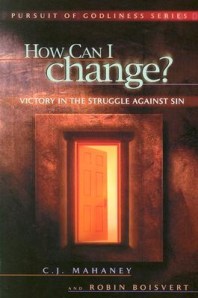
Change is inevitable, but it is not always pleasant.  But perhaps even less pleasant than unexpected change is the lack of change when it is desired and needed – particularly change in ourselves and in our spiritual development.  The questions are common: How Can I Change? When Will I Change? 

C.J. Mahaney & Robin Boisvert have written a helpful little book that addresses these very questions.  Here is an excperpt from the Foreword:

“In a day when quick solutions to longstanding problems are too easily offered, we wish to recommend the old paths, having found them tried and true. There is no short course to Christian maturity. There is no cross-less way to follow Christ, no instant secret to the Christian life. But like distance running, if the way of the cross is not easy, neither is it complicated. God presents us with a pathway that is narrow yet straight. He makes his ways plain to those who are sincerely interested in following him, and he will show himself strong on behalf of all whose hearts are fully his.

Although our vigorous effort is required, all growth is by his grace. With that wonderful truth as our starting block, let us press on toward the mark, each confident that ‘he who began a good work in you will carry it on to completion until the day of Christ Jesus.’ (Philippians 1:6).”

Thanks to Sovereign Grace Ministrires, this little book is available in .pdf for FREE.  Click on the Chapter Titles to read or download:

Introduction

  1. Caught in the Gap Trap
  2. Where It All Begins
  3. United With Christ
  4. The Battle Against Sin
  5. Tools of the Trade – Part 1
  6. Tools of the Trade – Part 2
  7. Living for That Final Day

Appendices

  • Appendix A – Different Roads to Holiness
  • Appendix B – The Old Man and the Flesh 

Benefitting in the Benefactor

Sinclair Ferguson offers this wise insight about the gospel-centered life:

“…we must never separate the benefits (regeneration, justification, sanctification) from the Benefactor (Jesus Christ). The Christians who are most focused on their own spirituality may give the impression of being the most spiritual … but from the New Testament’s point of view, those who have almost forgotten about their own spirtuality because their focus is so exclusively on their union with Jesus Christ and what He has accomplished are those who are growing and exhibiting fruitfulness. Historically speaking, whenever the piety of a particular group is focused on OUR spirituality that piety will eventually exhaust itself on its own resources. Only where our piety forgets about ourself and focuses on Jesus Christ will our piety nourished by the ongoing resources the Spirit brings to us from the source of all true piety, our Lord Jesus Christ.”

Spiritual Pride

Here is a great insight from Jonathan Edwards as relevant today as it was in his Colonial American culture:

The first and worst cause of error that prevails in our day is spiritual pride. This is the main door by which the devil comes into the hearts of those who are zealous for the advancement of Christ. It is the chief inlet of smoke from the bottomless pit to darken the mind and mislead the judgment, and the main handle by which Satan takes hold of Christians to hinder a work of God. Until this disease is cured, medicines are applied in vain to heal all other diseases.

Pride is much more difficult to discern than any other corruption because, by nature, pride is a person having too high a thought of himself. Is it any surprise, then, that a person who has too high a thought of himself is unaware of it? He thinks the opinion he has of himself has just grounds and therefore is not too high. As a result, there is no other matter in which the heart is more deceitful and unsearchable. The very nature of it is to work self-confidence and drive away any suspicion of evil respecting itself.

Pride takes many forms and shapes and encompasses the heart like the layers of an onion- when you pull off one layer, there is another underneath. Therefore, we need to have the greatest watch imaginable over our hearts with respect to this matter and to cry most earnestly to the great searcher of hearts for His help. He who trusts his own heart is a fool.

Since spiritual pride in its own nature is secretive, it cannot be well discerned by immediate intuition of the thing itself. It is best identified by its fruits and effects, some of which I will mention together with the contrary fruits of Christian humility.

The spiritually proud person is full of light already and feels that he does not need instruction, so he is ready to despise the offer of it. On the other hand, the humble person is like a little child who easily receives instruction. He is cautious in his estimate of himself, sensitive as to how liable he is to go astray. If it is suggested to him that he does go astray, he is most ready to inquire into the matter.

Proud people tend to speak of other’s sins, the miserable delusion of hypocrites, the deadness of some saints with bitterness, or the opposition to holiness of many believers. Pure Christian humility, however, is silent about the sins of others, or speaks of them with grief and pity. The spiritually proud person finds fault with other saints for their lack of progress in grace, while the humble Christian sees so much evil in his own heart, and is so concerned about it, that he is not apt to be very busy with other hearts. He complains most of himself and his own spiritual coldness and readily hopes that most everybody has more love and thankfulness to God than he.

Spiritually proud people often speak of almost everything they see in others in the harshest, most severe language. Commonly, their criticism is directed against not only wicked men but also toward true children of God and those who are their superiors. The humble, however, even when they have extraordinary discoveries of God’s glory, are overwhelmed with their own vileness and sinfulness. Their exhortations to fellow Christians are given in a loving and humble manner, and they treat others with as much humility and gentleness as Christ, who is infinitely above them, treats them.

Spiritual pride often disposes people to act different in external appearance, to assume a different way of speaking, countenance, or behavior. However, the humble Christian, though he will be firm in his duty; going the way of heaven alone even if all the world forsake him; yet he does not delight in being different for difference’s sake. He does not try to set himself up to be viewed and observed as one distinguished, but on the contrary, is disposed to become all things to all men, to yield to others, to conform to them, and to please them in all but sin.

Proud people take great notice of opposition and injuries, and are prone to speak often about them with an air of bitterness or contempt. Christian humility, on the other hand, disposes a person to be more like his blessed Lord, who when reviled did not open His mouth but committed Himself in silence to Him who judges righteously. For the humble Christian, the more clamorous and furious the world is against him, the more silent and still he will be.

Another pattern of spiritually proud people is to behave in ways that make them the focus of others. It is natural for a person under the influence of pride to take all the respect that is paid to him. If others show a disposition to submit to him and yield in deference to him, he is open to it and freely receives it. In fact, they come to expect such treatment and to form an ill opinion of those who do not give them what they feel they deserve.

***

Adapted from Jonathan Edwards’ Some Thoughts Concerning the Present Revival of Religion in New England. This article previously appeared in Banner of Truth.

God’s Workmanship

One of the glories of Christianity is the assurance that we are God’s workmanship, created in Christ Jesus to do good works, which God prepared in advance for us to do” (Ephesians 2.10). 

This statement by Paul that we are “created” does not simply refer to our physical formation, as God has, of course, created all human beings (see Genesis1.26-27). Rather, Paul is talking about being “created in Christ.” It means that every person who believes in Christ does so because she or he is the object of a process of God’s “spiritual creation.”
 
The word workmanship is very important; it is the Greek word poema from which we get our word “poem.” It means that every believer is essentially a work of art – God’s art!
 
Consider how artists work, whether they are writers, musicians, painters, sculptors, etc. They labor long and hard and with the utmost care and detailed attention. Sometimes they do very little, only a stroke here or there. Other times they make massive changes. But always they seek to bring the raw material into line with an artistic vision. Thus Paul is telling us that God labors over all believers throughout our entire lives, intervening and guiding and shaping us to bring us into line with a vision he has for us. This is mentioned also in Ephesians 2.10 -“created to… good works,  which God prepared in advance for us to do.” Thus, God has a particular set of “good works” for us to do, for which he prepares us our whole lives.
 
Looking at Our Lives
  
It is therefore of utmost importance to look back on our lives and see everything that has happened through this grid, namely that:
  • God has been at work through the various influences of our lives – “created in Christ.” All of our experiences and troubles and our family and friends must be seen as the instruments of an artist used to mold and shape us. He has been at work all of our lives!
  • God has been at work to make us something beautiful – “workmanship.” God is out to make our beings something great—to give us characters of love, joy, peace, patience, kindness, integrity, humility and self-control.
  • God has been at work to make us something useful – “good works… prepared beforehand.” God is also out to make our doings something great – to make us helpful and able to serve others in special ways.
Paul uses this “doctrine of workmanship” like a pair of spectacles through which to view his entire life.
 
First, in Galatians 1.13-23, he shows us that he now sees God at work throughout his whole life (“God, who set me apart from birth and called me,” v.15).
 
Secondly, he now sees that God used the gospel to make him something beautiful. He had been a fanatically intense person who felt superior in his self-righteousness and only criticized others (“intensely I persecuted… extremely zealous for the traditions,” v.14). But God humbled him and showed him he was nothing apart from undeserved grace (“called me by his grace and was pleased to reveal his Son in me”) so that now he loves to lead people to praise and thanks (“they praised God because of me,” v.24). 
 
Thirdly, he realizes that though his obsessive study of the Bible and theology (“the traditions”) was originally motivated by self-righteousness and the need to feel superior, he was now, as a Christian, uniquely equipped to be a preacher, teacher and evangelist (“so that I might preach him among the Gentiles”). His scholarship and knowledge of the Bible enabled him to bridge the gap between Christianity and various pagan philosophies and religions.

-Taken from Tim Keller’s A Gospel Changed Life

10 Gospel-centered Questions


Here are 10 questions to ask yourself – and maybe those few closest to you – that help uncover rivals of Christ as the functional savior of your heart:

  1. What are you desiring more than anything else?
  2. What do you find yourself day dreaming or fantasizing about?
  3. What lies are you subtly believing that undermine the truth of the gospel?
  4. Are you astonished with the gospel?
  5. In what ways have you recently made much of yourself and little of God?
  6. Is technology stealing attention from your family?
  7. Is work replacing your spouse’s place in your heart?
  8. Where do your thoughts drift to when you enter a social setting?
  9. What fears are paralyzing your heart from enjoying God?
  10. What consumes your thoughts when you have alone time?

Notice that many of these questions assumes some level of guilt. Others are simply good guages of our priorities.  That’s what makes them good gospel-centered questions – questions that continually keep our hearts centered on the gospel.  

Remember the gospel has two aspects – one positive, one negative.  Paraprasing Jack Miller, the gospel reminds us:

  • You are much greater sinner than you would ever dare admit, even to yourself.
  • You are loved far more by God than you would ever dare dream.

Believing the gospel frees us to admit our flaws, and drives us to explore the love of God demonstrated in the Cross of Christ. So go ahead, ask yourself the above questions.

Measuring Up?

Do you ever feel that you have to measure up? 

Do you wonder sometimes how  you are grading out in God’s eyes?  I suspect the answer for most people is “Yes”.    Our theology may tell us otherwise, but I think most people struggle with this from time to time – especially when we feel emotionally tired and as if we are coasting in neutral gear spiritually.   

I’m not sure many people are even aware they feel this way. We know our theology well enough, and so we remind ourselves of the truth of the Gospel: That we are declared righteous in Christ.  This is a wonderful truth.  But sometimes we don’t really live in the light of this truth.  This is the difference between our confessional theology and our functional theology.   

In other words there is sometimes (often?) a gap between what we know to be the facts and the way we allow those facts to impact our heart and emotions.  Put mathmatically, the difference between our confessional theology and our functional theology equals frustration.  (F – C = Frus)

A few months ago I posted an excellent article by Paula Rinehart, that had originally been written for The Navigators’ Discipleship Journal.  Because I know the tendency we have toward wandering onto what Jerry Bridges calls a Performance Treadmill, I wanted to post it again.   

If you ever find yourself tired of trying to measure up, or if know others around you who seem to fall into that trap, you will appreciate: 

Good Enough!

Worship and/or Counseling pt. 2

Several years ago an article in Journal of Biblical Counseling opened my eyes to see that counseling is a Ministry of the Word.  True Christian Counseling often involves helping people discern their bestting sin, personal idols, and functional unbelief, and then helping them apply the gospel to their lives.  This is what the Ministry of the Word does, whether it comes in the form of preaching, teaching, or counseling.  With that understanding, then, it should be no surprise that Worship can also carry a function of Counseling. 

In this video David Powlison of CCEF and Bob Kauflin of Sovereign Grace Ministries continue their discussion about how worship can effect personal transformation in the participant and the worship leaders’ responsibilty to lead people to fully enter into worship in a way that opens the participant to experience what God will do in them.

[This is Part 2 of 2]