Your Will Be Done in My Life

This prayer from Thomas a Kempis has really touched me where I am today:

O Lord, blessed be your name forever, for it is your will that this temptation and trouble come to me. I cannot escape it, but must run to you so that you can help me and turn it to my good.  Lord, I am now being afflicted, and my heart is troubled by my present suffering and not at peace.

And now, Dear Father, what shall I say? I am caught in the middle of trouble,  “Save me from this hour”.  Yet I come to this hour so you may might be glorified when I am deeply humbled and delivered by you.   Therefore, may it please you, Lord, to deliver me, for what can a poor wretch like I am do, or where can I go, without you?

Give me patience, O Lord, even now in this emergency. Help me, my God, and I will not be afraid of how much I may be afflicted.

~ From Imitation of Christ III.29

Prayer a Priority?

Sometimes the truth hurts, doesn’t it?  Such is the case in a recent article by Jonathan Graf for Prayer Connect.  In the article titled Living Up to a Core Value Graf writes:

I was recently at a denominational gathering for a group that I know values prayer tremendously. In one of its core values it states: “Prayer is the primary work of God’s people.” I have no doubt that this group believes that. But when I look at what is emphasized in the group’s magazine, website, and materials that come out of its national office to churches, prayer is not placed in a position to make one think it was as important as other things – certainly not enough emphasis to show they believed it was the primary work of God’s people.

One of the primary reasons prayer is so weak in churches and in believers lives these days has to do with this “lip service” given to the importance of prayer. It seems enough for a church to say “we believe in prayer,” or “we want to be a praying church.” Our actions don’t seem to matter as much as simply saying that. The Apostle James (who was affectionately known as “Camel Knees” because of the callouses on his knees from kneeling in prayer) says, “faith by itself, if it is not accompanied by action, is dead” (James 2:17). If we apply that truth to prayer, he is saying, if you say you believe in prayer, but that belief is not accompanied by activity and actions that prove that, then you don’t really believe it!

What Graf is getting at could be – and should be – applied to any Core Value of a church or organization. After all, if something is not put into practice is it really a value at all?  And the same could probably be said regarding many of our supposed spiritual disciplines.  But about prayer many  especially seem to be prone to pontification without participation.

By the way, Prayer Connect is a new magazine and e-journal well worth reading.

Praying for Forgiveness

In the title song of Toby Keith‘s  movie and soundtrack, Broken Bridges, the first line of the chorus is:

Here I am, prayin’ for forgiveness… 

If you’ve seen the movie on CMT it makes sense. It is a story of a guy facing up to his past mistakes and the people he has hurt.  It is a process of reconciling broken relationships.

But this line also begs a question: Why “pray” for forgiveness?

Puritan Pastor Richard Sibbes considered this issue. Sibbes posed the question, then proposed a profound and practical response:

Q. Why do we pray for forgiveness?

A. We pray for clear evidence of what we have.

I don’t know if you have ever wondered about this, but Sibbes’ question is a good one.  If, as we profess, Jesus’ death and resurrection secured forgiveness of sin past, present, and future for all who Believe, then what is the point in asking for it if forgiveness is already granted.  Is this merely a politeness – somewhat like saying “Excuse me” after a burp?

What Sibbes answers makes great sense. The issue is not what we do or do not have. The issue is what we experience.  We do not need to pray to get forgiveness.  Those who are trusting Christ already have it.  What we need is the renewed experience, the realization, of that forgiveness already granted.

Our perspective is limited. Our feeling of assurance is often fleeting.  Like a child momentarily separated from his parents may feel lost, abandoned, and even alienated, the Christian may experience a twinge of anxiety when we realize all over again that, though we have been justified, we are still sinners.  (To not have this “uh-oh” feeling would make me wonder if someone has a conscience.)  

We know the child is not abandoned just because the parents are out of his/her line of sight. And the believer should know that God is faithful to his promise without condition. As   we are told in 2 Timothy:

[Even] if we are faithless, he remains faithful, for he cannot disown himself.

What is in view inthis verse is not the person who is not a Believer, but the Christian who is not appropriating faith at a particular moment. In such moments we are functionally like the child who fears the parents are “lost” or gone.  And unless we seriously deceive ourselves, we must admit that we all have these moments – many of them. This is especially true at moments when we are aware of and grieved by our sin and disobedience.

What Sibbes points out at those moments – moments when we reflexively cry out for forgiveness – what we are really asking for is not so much for forgiveness, but a new dose of evidence of our forgiveness that we cling to for comfort and to dry our tears. 

Let me finish with this: All the evidence we need is found at the Cross.  The evidence is the same today as it was yesterday; and it will be the same tomorrow as it is today.

Romans 5.8 reminds us:

But God demonstrates his own love for us in this: While we were still sinners, Christ died for us.

And John practically applies this to us in 1 John 1:

If we confess our sins, he is faithful and just and will forgive us our sins and purify us from all unrighteousness.

Ancient Prayer

Here is a beautiful description of prayer from my friend John Smed:

“In believing prayer, we learn to connect our present troubles to the good and perfect will of God.  We refuse to believe that chance rules our lives.  We withstand the temptation to imagine that God is capricious or malicious.  We know he has a higher purpose and that he is not dealing with us as our sins deserve. As we bring our troubles to Jesus in prayer—asking his will to be done—we approve the will of our Father in heaven. We see our sufferings in the greater reality of his good, acceptable, and perfect will.  In prayer we “turn crisis to Christ.”  Our heart becomes tuned to his heart and we sing the song of grace.”

– John Smed is Senior Pastor of Grace – Vancouver. He is also a Consultant/Trainer with Global Church Advancement (GCA). 

Ways We Can Pray for Christ’s Church

J.E. Eubanks, Jr writes:

“One of Jesus’ most frequent teachings was His desire for the unity of His followers. In fact, Jesus and the apostles make it clear that the primary way that the world will know the truth of the gospel of Christ is through our unity and love for one another. We should therefore make praying for the union of the church a priority and one of our most frequent petitions.” 

Jesus did. ( John 17:22–23)

This is the theme of the second in a three part series by Eubanks, in ByFaith magazine. And it is a theme that resonates with me. I have often wished (and prayed) that our church would develop a  more conscientious effort to pray for the health of the church, and not just focus primarily on the health of the individual members and a few peripheral friends.

In this article Eubanks both encourages and cautions his readers about praying for Christ’s Church:

  • Unity

“When we pray for unification, we must first look in the mirror and ask, “What must I pray for regarding my own failure to strive for unity with my brothers and sisters in Christ? How have I made it difficult for others to be united with me? How ought my union with Christ change my attitude, actions and heart toward others?”

  • Oneness

“As we pray for the church to grow in oneness, we should consider our tendency to prioritize minor issues and our failure to allow major agreements to be places where we find singularity. We should pray that our hearts—and the hearts of believers everywhere—would be broken about our discord, that Christ would give us a capacity for love that would overcome minor distinctions and disagreements, and that He would reveal opportunities for unification and give us the necessary humility and bravery to pursue them.”

  • Solidarity

“We must pray for the solidarity of our leaders because they will lead us into either greater harmony or dissonance. Pray that they too would overcome pettiness and seek to be bound together more fully rather than highlight their distinctions. Pray that even their disagreements would be handled with love and humility and that unity might be preserved. Pray that Christ will use them as ambassadors throughout the worldwide church to cultivate togetherness as His return approaches.”

I appreciate Eubanks’ thoughts. I also suspect that incorporating these things in our local congregations would strengthen us immensely.

To read the entire article click: Ways We Can Pray for Christ’s Church

To read Part 1 in this series click: Partnering Thru Prayer

Partnering Thru Prayer

“We must pray.”

This is the opening phrase of a worthwile post: Ways We Can Pray for Christ’s Church by J.E. Eubanks Jr.  The post is first in a series that appears in ByFaith magazine.

The opening paragraph reads:

We must pray.  Whether it be in public and in concert with other believers, or privately and even silently, we pray. Even when we lack the words, our hearts and minds offer wordless utterances before the Lord.

Eubanks goes on:

And we must pray for the church. As no Christian has his or her true identity apart from God (which is why we unite ourselves to Him in prayer), so no believer has his or her true identity as a Christian apart from His Body. Therefore, we both unite ourselves to one another, and to our Savior, in praying for Christ’s church.

But how do we pray for Christ’s Church? 

Beyond a few “Bless our [Insert Name of Particular Ministry Here]”, people seem to get bogged down when praying for the Church.

Eubanks offers a few helpful suggestions:

1. How to Pray for God’s Glory

2. How to Pray for the Church using four metaphors used in Scripture:

  • God’s Body
  • God’s Family
  • God’s Army
  • Jesus’ Bride

To read the entire article click: Pray for Christ’s Church

Beyond the Sick List

It is one of my peeves. And it seems to be one of the most difficult habits to break church members of. I am referring to the common pracactice of praying the sick list.  For some reason it is difficult to get even seasoned Christians to pray for much else.

David Powlison takes up this issue in an article published in ByFaith Magazine.  Powlison writes:

Why don’t people pray beyond the sick list? We want circumstances to improve so that we might feel better and life might get better. These are often honest and good prayers—unless they’re the only requests. Unhinged from the purposes of sanctification and from groaning for the coming of the King, prayers for circumstances become self-centered.

Powlison observes:

[T]he majority of prayers in the Bible focus on other things. As shorthand, here are three emphases of biblical prayer:

1. Circumstantial Prayers

Sometimes we ask God to change our circumstances—heal the sick, give us daily bread, protect us from suffering and evildoers, make our political leaders just, convert our friends and family, make our work and ministries prosper, provide us with a spouse, quiet this dangerous storm, send us rain, give us a child.

2. Wisdom Prayers

Sometimes we ask God to change us—deepen our faith, teach us to love each other, forgive our sins, make us wise where we tend to be foolish, help us know You better, give us understanding of Scripture, teach us how to encourage others.

3. Kingdom Prayers 

Sometimes we ask God to change everything by revealing Himself more fully on the stage of real life, magnifying the degree to which His glory and rule are obvious—Your kingdom come, Your will be done on earth as it is in heaven, be exalted above the heavens, let Your glory be over all of the earth, let Your glory fill the earth as the waters cover the sea, come Lord Jesus.

They are tightly interwoven when we pray rightly.  When any of these three strands of prayer gets detached from the other two, prayer tends to go sour.

To read Powlison’s insights click: Praying Beyond the Sick List.

6 Words Toward Open Hearts

From Donald Whitney:

Over and over I’ve seen one simple question open people’s hearts to hear the gospel. Until I asked this question, they showed no interest in spiritual matters. But then after six words—only seventeen letters in English—I’ve seen people suddenly begin to weep and their resistance fall. The question is, “How can I pray for you?” …

This question is similar to one that Jesus Himself sometimes asked: “What do you want me to do for you?” (Matthew 20:32). For what we are really asking is, “What do you want me to ask Jesus to do for you?” And by means of this question, we can show the love of Christ to people and open hearts previously closed to the gospel.

I had tried to talk about the things of God many times to a business-hardened, retired executive who lived next door. He was a pro at hiding his feelings and keeping conversations at a superficial level. But the day we stood between our homes and I asked, “How can I pray for you?” his eyes filled with tears as his façade of self-sufficiency melted. For the first time in seven years he let me speak with him about Jesus.

It’s a short, easily remembered question. You can use it with longtime friends or with people you’ve just met. It doesn’t seem too personal or pushy for those who’d rather give you a shallow answer just now, and yet it often leads to a full hearing of the gospel. You can ask it of people nearly every time you speak with them and it doesn’t get old. Just simply and sincerely ask, “How can I pray for you?” You’ll be surprised at the results.

Prayer Mirrors the Gospel

“Prayer mirrors the gospel. In the gospel, the Father takes us as we are because of Jesus and gives us his gift of salvation. In prayer, the Father receives us as we are because of Jesus and gives us the gift of help. We look at the inadequacy of our praying and give up, thinking something is wrong with us. God looks at the adequacy of his Son and delights in our sloppy, meandering prayers.”

– Paul Miller, A Praying Life

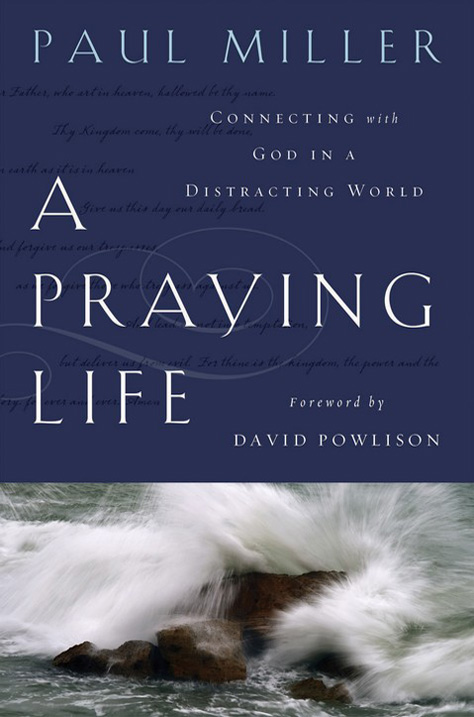
A Praying Life

Praying Life“Lord, teach us to pray.”   That’s the request of the disciple of Jesus. (Luke 11.1)  That’s a request that should not be limited to ages past or the pages of the Bible. It is the heart request of any disciple of Jesus. 

My friend, Paul Miller is Jesus’ tool to answer that request in this generation.  In his book, A Praying Life: Connecting With God in a Distracting World, Paul helps people like me, people who sometimes struggle in knowing how or what to pray; people who find their minds wandering often whenever trying to commit longer periods of time to pray; people who sometimes wonder if God get’s tired of these simple, random, and inarticulate petitions.

Paul reminds us what it means to be a child of God, and the implications that has for our prayer life. He helps us see that God will never reject those who come to him with a child-like heart, and therefore will certainly not be disappointed in us if we come to him with child-like characteristics.  Paul “redeems” the mind-wandering, and sets us free to enjoy our Father in prayer.

Check out a sample chapter and a review from NavPress.

In Constant Prayer

 Prayer Posture

Here is a challenging insight from Robert Benson, taken from his book In Constant Prayer:

Our modern church has some distinct advantages over the early church. Or at least I suspect it does.  We have better youth programs and better acoustics and finer buildings. We have better literature that is more easily available to our flocks, most of whom happen to be literate. We have some pretty fair preachers, or at least we have some who are more fun to listen to than the blessed Saint Augustine. (Have you ever actually attempted to read Augustine?)

We have better choirs, I suspect, and we can put on a Sunday morning service with more art and more dignity and more beauty than ever before. We have mailing lists and newsletters and Web sites. We have educational buildings and discipleship classes and Bible study groups where students bring their own Bibles.  We have Sunday School buses and youth lock-ins and Christian rock-and-roll bands.

What we do not have so much of sometimes, it seems to me, is the depth of spirit and of devotion and of piety – now, there is a scary word – that marked the life of the faithful in the hundreds and thousands of years before us, the centuries that produced the Church we built our buildings and programs around in the first place.

It is worth noting, I believe, that this tradition of daily prayer is one of the practices our modern church does not do that the ancient Church did.  We preach sermons, study the Scriptures, gather to worship on the Sabbath, teach our children the faith, and fellowship with one another – but we do not say our prayers.

A Call to Prayer

pray2

With today being National Day of Prayer, I thought I would post a wonderful and challenging message from one of my favorite writers from the 19th Century, J.C. Ryle, Bishop of Liverpool in England.  The message is titled: A Call To Prayer

One of the great things about Ryle is that his style is not stilted.  With few exceptions his words almost seem contemporary.  Thus his message is clear both across the ocean and across time.

 ***

Men ought to always pray.   -Luke 18:1

 I will that men pray everywhere  -1 Timothy 2:1

I have a question to offer you. It is contained in three words, DO YOU PRAY?

The question is one that none but you can answer. Whether you attend public worship or not, your minister knows. Whether you have family prayers or not your relations know. But whether you pray in private or not, is a matter between yourself and God.

I beseech you in all affections to attend to the subject I bring before you. Do not say that my question is too close. If your heart is right in the sight of God, there is nothing in it to make you afraid. Do not turn off my question by replying that you say your prayers. It is one thing to say your prayers and another to pray. Do not tell me that my question is necessary. Listen to me for a few minutes, and I will show you good reason for asking it.

I. I ask whether you pray, because prayer is absolutely needful to a person’s salvation.

I say, absolutely needful, and I say so advisedly. I am not speaking now of infants or idiots. I am not setting the state of the heathen. I know where little is given, there little will be required. I speak especially of those who call themselves Christians, in a land like our own. And of such I say, no man or woman can expect to be saved who does not pray.

I hold to salvation by grace as strongly as anyone. I would gladly offer a free and full pardon to the greatest sinner that ever lived. I would not hesitate to stand by their dying bed, and say, “Believe on the Lord Jesus Christ even now, and you shall be saved.” But that a person can have salvation without asking for it, I cannot see in the Bible. That a person will receive pardon of their sins, who will not so much as lift up their heart inwardly, and say, “Lord Jesus, give it to me,” this I cannot find. I can find that nobody will be saved by their prayers, but I cannot find that without prayer anybody will be saved.

It is not absolutely needful to salvation that a person should read the Bible. A person may have no learning, or be blind, and yet have Christ in their heart. It is not absolutely needful that a person should hear public preaching of the gospel. They may live where the gospel is not preached, or they may be bedridden, or deaf. But the same thing cannot be said about prayer. It is absolutely needful to salvation that a person should pray.

There is no royal road either to health or learning. Prime ministers and kings, poor men and peasants, all alike attend to the needs of their own bodies and their own minds. No person can eat, drink, or sleep, by proxy. No person can get the alphabet learned for them by another. All these are things which everybody must do for themselves, or they will not be done at all.

Just as it is with the mind and body, so it is with the soul. There are certain things absolutely needful to the soul’s health and well-being. Each must attend to these things for themselves. Each must repent for them self. Each must apply to Christ for them self. And for them self each must speak to God and pray. You must do it for yourself, for by nobody else it can be done. To be prayerless is to be without God, without Christ, without grace, without hope, and without heaven. It is to be in the road to hell.

Now can you wonder that I ask the question, DO YOU PRAY?

II. I ask again whether you pray, because a habit of prayer is one of the surest marks of a true Christian.

All the children of God on earth are alike in this respect. From the moment there is any life and reality about their religion, they pray. Just as the first sign of the life of an infant when born into the world is the act of breathing, so the first act of men and women when they are born again is praying.

This is one of the common marks of all the elect of God, “They cry unto him day and night.” Luke 18:1. The Holy Spirit who makes them new creatures, works in them a feeling of adoption, and makes the cry, “Abba, Father.” Romans 8:15. The Lord Jesus, when he quickens them, gives them a voice and a tongue, and says to them, “Be dumb no more.” God has no dumb children. It is as much a part of their new nature to pray, as it is of a child to cry. They see their need of mercy and grace. They feel their emptiness and weakness. They cannot do other wise than they do. They must pray.

I have looked careful over the lives of God’s saints in the Bible. I cannot find one whose history much is told us, from Genesis to Revelation, who was not a person of prayer. I find it mentioned as a characteristic of the godly, that “they call on the Father,” that “they call upon the name of the Lord Jesus Christ.” I find it recorded as a characteristic of the wicked, that “they call not upon the Lord.” 1 Peter 1:17; 1 Corinthians 1:2; Psalm 14:4.

I have read the lives of many eminent Christians who have been on earth since the Bible days. Some of them, I see, were rich, and some poor. Some were learned, and some were unlearned. Some of them were Episcopalians, and some were Christians of other names. Some were Calvinists, and some were Arminians. Some have loved to use liturgy, and some to use none. But one thing, I see, they all had in common. They have all been people of prayer.

I have studied reports of missionary societies in our own times. I see with joy that lost men and women are receiving the gospel in various parts of the globe. There are conversions in Africa, in New Zealand, in India, in China. The people converted are naturally unlike one another in every respect. But one striking thing I observe at all the missionary stations: the converted people always pray.

I do not deny that a person may pray without heart and without sincerity. I do not for a moment pretend to say that the mere fact of a persons’ praying proves everything about their soul. As in every other part of religion, so also in this, there may be deception and hypocrisy.

But this I do say, that not praying is a clear proof that a person is not yet a true Christian. They cannot really feel their sins. They cannot love God. They cannot feel themselves a debtor to Christ. They cannot long after holiness. They cannot desire heaven. They have yet to be born again. They have yet to be made a new creature. They may boast confidently of election, grace, faith, hope and knowledge, and deceive ignorant people. But you may rest assured it is all vain talk if they do not pray.

And I say furthermore, that of all the evidences of the real work of the Spirit, a habit of hearty private prayer is one of the most satisfactory that can be named. A person may preach from false motives. A person may write books and ,make fine speeches and seem diligent in good works, and yet be a Judas Iscariot. But a person seldom goes into their closet and pours out their soul before God in secret, unless they are in earnest. The Lord himself has set his stamp on prayer as the best proof of conversion. When he sent Ananias to Saul in Damascus, he gave him no other evidence of his change of heart than this, “Behold he prayeth.” Acts 9:11.

I know that much may go on in a person’s mind before they are brought to pray. They may have many convictions, desires, wishes, feelings, intentions, resolutions, hopes, and fears. But all these things are very uncertain evidences. They are to be found in ungodly people, and often come to nothing. In many a case they are not more lasting than the morning cloud, and dew that passes away. A real hearty prayer, moving from a broken and contrite spirit, is worth all these things put together.

I know that the Holy Spirit, who calls sinners from their evil ways, does in many instances lead them by very slow degrees to acquaintance with Christ. But the eye of man can only judge by what it sees. I can not call anyone justified until they believe. I dare not say that anyone believes until they pray. I cannot understand a dumb faith. The first act of faith will be to speak to God.

Faith is to the soul what life is to the body. Prayer is to faith what breath is to the body. How a person can live and not breathe is past my comprehension, and how a person can believe and not pray is past my comprehension too.

Never be surprised if you hear ministers of the gospel dwelling much on the importance of prayer. This is the point they want to bring to you. They want to know that you pray. Your views of doctrine may be correct. Your love of Protestantism may be warm and unmistakable. But still this may be nothing more than head knowledge and party spirit. They want to know whether you are actually acquainted with the throne of grace, and whether you can speak to God as well as speak about God. Continue reading

2009 Lenten Devotional

czech-cross

We have now entered into the Season of Lent.  I realize that for many who read this blog Lent may be a familiar word, but still it may be a word that really carries no meaning.  If you are not from a church with a liturgical background it probably won’t mean much. In fact, for some it may carry some negative connotations. That need not be.

My intention is not to write a discourse about the meaning of Lent. For one reason, I am not qualified. While I have some interest in the subject, I don’t come from a liturgical tradition, so I don’t know enough to presume to explain anything.

What I do know is that any season is a good time to reflect on the Life & Work of Jesus Christ.  And my friend, Fred Harrell, who pastors City Church of San Francisco, and his staff,  have developed a Devotional for the Season of Lent. 

If you are looking for a fresh resource for your time with God, I encourage you to check it out:

Lent Devotional 2009

      -or-

Subscribe RSS

Seek God for the City 2009

seek-god-for-the-city-2009

Beginning today and continuing through Palm Sunday members of our church, individually and corporately, will join thousands of others in churches throughout the world to Seek God for the City.

Seek God for the City is an anual season of prayer initiated by Waymakers.  Using a prayer guide designed by Waymakers individuals and groups will pray for the cities and communities in which they live.

How We’re Praying: As One Body

Why We’re Praying: God’s Glory & Our Joy

Who We’re Praying For: Those Beyond Ourselves

We’re Praying Toward: God’s Purpose Fulfilled

I invite you top join us, wherever you live. It’s not too late even if you jump in mid-stream.  Just check out Seek God for the City 2009 at Waymakers.  You might also want to download thier free Children’s Prayer Guide.