
God grant you …
- the light of Christmas, which is faith;
- the warmth of Christmas, which is purity;
- the righteousness of Christmas, which is justice;
- the belief in Christmas, which is truth;
- the ALL of Christmas, which is Christ.
All glory and honor to you, Living God.
You made our world by your wisdom,
and you sent your Wisdom into the world.You rule all things by your word,
and you caused your Word to dwell among us.You filled heaven and earth with your glory,
and you made the the very Radiance of your Glory to shine on earth.You gave us life and created us in your image,
and you have given us eternal life through your eternal Image.You formed us to be your children,
and now your eternal Son has come to claim us for brothers and sisters.Heavenly Father, your Son became poor,
and now we share in his riches.He came to be despised and rejected,
and now you have accepted us through him.You laid our sins on him,
and now we come to you with his righteousness.You sent him to live the life that we failed to live,
and now we have his life in us.By your will, he came as a slave,
and now we reign with him.He was conceived, lived, died and rose by your Spirit,
and now he has given that Spirit to us.Renew us therefore, by that same Spirit, we pray.
By him, unite us to Jesus so we bear much fruit and bring you glory.
By him, fill our hearts so we cry out to you with the voice of your Son.
By him, bind us together in the gospel of Jesus and speak the truth in love.
By him, transform us to the image of our Lord, with ever-increasing glory.
By his power, deliver us from discouragement and idolatry,
and fill our hearts and lives and mouths with grace,By him, make us proof of your manifold wisdom before the powers and authorities,
so that the powers of darkness should not prevail,
and we might press on through the night to the dawn;
warmed by the light of your Son. ~ Amen.
Original Source: TGC @ Australia (12/25/21)
Author Martin Cothran, opens a piece he wrote for Intellectual Takeout, Charles Schultz’s Pushback Against Secularism, with these words:
We often think of the secularization of Christmas as a very recent thing. But its origins go back to the nineteenth century with the writing of “The Night Before Christmas,” and the Thomas Nast version of Santa Claus: the jolly, plump, white-bearded rendition we know today.
It’s not so much that a war has been raging against Christmas since the 19th Century. It is more that there are at least two different takes on what Christmas is supposed to be about. There is the Christian celebration of the birth of the long-promised Messiah, through whom God would redeem and reconcile a People to himself, and through whom “everything sad will come untrue.” And there is the more secular take, which seems to take delight in the Judeo-Christian virtues promised in the Messiah: “Peace on Earth” and “good-will to all men (and women)…”, but replaces Jesus as the focal-point of this holiday with a host of other figures: Santa Claus, Frosty the Snowman, just to name two.
In the same story cited above, Cothran ends with these words:
In many ways secularism has sidelined the real meaning of Christmas, and commercialism has covered it up. But truth has a way of intruding on our world of secular pretense and profit. At a time when it sometimes seems as if all is going dark, there are still places where there is a spotlight trained on the most important story of all.
I think Cothran has a point.
Now, I have no aversion to the festivities of the culture during this season of the year. In fact, I quite enjoy them. For the most part. But – and this is a big “but” – in recent years I have become less inclined to try to reconcile the two expressions of Christmas with one another. I am much more comfortable accepting the two divergent ways as co-existing. It seems to me that Christian attempts to synergize the celebration of the Christ-child with the merriment and cultural icons of this season are often times a source of the confusion of the meaning of Christmas.
Why not just recognize that, for Christians, there are two coinciding celebrations going on throughout December? Let’s recognize that these two celebrations have many aspects that overlap. Let’s promote the common ground values of joy, peace, hope, and love. Let’s strive for and contribute to “peace on earth, and goodwill toward mankind”, rather than warring against those who are (or, at least who may seem to be,) at war with Christmas.
But, for the Christian, we cannot stop there. For we know all of our striving will not lead to peace, but rather to more strife. That is because we have a sin problem, not just an absence of peace problem. And that is problem that we cannot save ourselves from. It will take God to intervene. So we need to pray. We need to pray that God will bring peace to this earth; and that God will work good-will among mankind. And… we do well to remember – and to celebrate – that God has intervened.
In Galatians 4.4-5, the Apostle Paul tells us:
4 But when the set time had fully come, God sent his Son, born of a woman, born under the law, 5 to redeem those under the law, that we might receive adoption to sonship.
That is what Christmas is all about – for all who Believe. (John 3.16)
As much as I appreciate and enjoy the traditional Christmas hymns and carols – O Come All Ye Faithful high up on my list – here is a worthy addition to the Christmas song catalog: O Come All You Unfaithful. Though not an especially new song, (it has been around for several years,) this song beautifully captures the heart behind the reason for the Incarnation.
In Luke 5, Jesus declared:
31 “Those who are well have no need of a physician, but those who are sick. 32 I have not come to call the righteous but sinners to repentance.”
Advent/Christmas should be a season during which we remind ourselves, and remind one another, of God’s love for the broken, the outcast, and even the sinner – like me.
“The saying is trustworthy and deserving of full acceptance, that Christ Jesus came into the world to save sinners, of whom I am the foremost.” (1 Timothy 1.15)
“God shows his love for us in that while we were still sinners, Christ died for us.” (Romans 5.8)
As Brennan Manning wrote in The Ragamuffin Gospel:
One of the mysteries of the gospel tradition is this strange attraction of Jesus for the unattractive, this strange desire for the undesirable, this strange love for the unlovely.
As C.S. Lewis wrote in Mere Christianity:
The son of God became a man to enable men to become sons of God.
Are some Christmas hymns better than others? Consider what Martin Luther says to his Anglican friends in this imaginary discussion, from Lutheran Satire.
“There has got to be more to the holiday season than this.”
Have you ever thought this way? I have – and I do – every year, around this time.
While there is nothing inherently wrong with our many traditions and celebrations, it is beneficial to repeatedly remind ourselves what this season is primarily about: that Christ Jesus came into the world to redeem sinners; to set free those captive to their sin and their situations.
And just as Jesus came into the world, he has also commissioned his followers to be his agents to continue what he began. (John 20.21)
In 2006 Advent Conspiracy was birthed, with the aim to remind the world what really matters during the Advent-Christmas season; and to urge Christians to embrace four simple but key tenets:
Let’s consider how we can make a difference in some small way. Let’s all join in this most wonderful Conspiracy.

As Christmas Day falls on a Sunday this year, church leaders across the country are making decisions about whether their respective congregation will hold services or forgo them. As one who holds a firm resolve about the prudency, even the appropriateness, of arbitrarily canceling services on any Sunday, no matter how noble-sounding the reasoning, I appreciate Grayson Gilbert’s thoughts on this matter, posted for Chorus In The Chaos:
Every set number of years, the church has an opportunity to gather with the saints on Christmas Day—and yet this often becomes a point of controversy for professing Christians. Some churches cancel services, while many others keep their doors open. I will admit at the onset of this that I believe those who shut their doors are not only doing a disservice to their congregants, but are in disobedience to the Scriptures.
The call to gather with the saints in the local assembly of believers is one that holds few exceptions to the rule. What has been traditionally held is that unless one is barred from attending church due to the providence of God or works of necessity, Christians should be among God’s people on the Lord’s Day (i.e., Sunday service). That time should be a designated time for all who profess faith in Christ simply because it is a time where the Spirit is uniquely present to work in and through His people as they serve one another, through the proclamation of the Word, the public reading of Scripture, corporate prayer, and congregational signing. In other words, unless we are providentially hindered or performing works of necessity, church attendance should be a non-negotiable to us. That is the general rule.
Continue reading
Christmas Day falls on a Sunday this year. It happens every several years. Across the country churches are cancelling Sunday service; or, harkening back to the pandemic, some are pre-recording elements of a worship service to be consumed via streaming at the convenience of those who take the time to watch. (Is “watching” actually worshipping? That’s probably a good subject for another post.)
Granted, church attendance will likely be low even in churches committed to holding worship services. And family time is important. So, I get the factors that lead some to feel the need to cancel. (Well, “need” is probably too strong of a word. “Preference” is probably more apt.) Point being that the issues that cause a dilemma for some are not lost on me.
The question is, what is the best way to resolve these tension points? Even granting latitude for the consciences of individual Christians and families, what should the Church do?
I appreciated the solution proposed by Blake Larebee in his post for Chorus in the Chaos: 3 Good Reasons to Move the Gathering to Saturday the 24th. (NOTE: I had to read through it twice before I caught what he was actually saying. The key is in the end, and what he proposes ought to be done on “The Lord’s Day”.)
For many Black Friday – the day after Thanksgiving – marks opening day for an exciting month long contact sport – shopping! For many others it is just one more cause for anxiety. In the midst of the seasonal hubbub, take a moment to watch this short video from the Advent Conspiracy.
Share the joy of Christmas!

And the Word became flesh and dwelt among us, and we have seen his glory, glory as of the only Son from the Father, full of grace and truth. ~ John 1.14
Anglican Bishop J.C. Ryle elaborates on these words to deepen our appreciation for the Incarnation of Christ:
The plain meaning of these words is, that our divine Savior really took human nature upon Him, in order to save sinners. He really became a man like ourselves in all things, sin only excepted. Like ourselves, he was born of a woman, though born in a miraculous manner. Like ourselves, he grew from infancy to boyhood, and from boyhood to man’s estate, both in wisdom and in stature (Luke 2.52). Like ourselves he hungered, thirsted, ate, drank, slept, was wearied, felt pain, wept, rejoiced, marveled, and was moved to anger and to compassion. Having become flesh, and taken a body, He prayed, read the Scriptures, suffered being tempted, and submitted His human will to the will of God the Father. And finally, in the same body, He really suffered and shed his blood, really died, was really buried, really rose again and really ascended up into heaven. And yet all this time He was God as well as man!
Nowhere, perhaps, shall we find a more wise and judicious statement than in the second article of the Church of England. ‘The Son, which is the Word of the Father, begotten from everlasting of the Father, the very and eternal God, and of one substance with the Father, took man’s nature in the womb of the blessed Virgin of her substance: so that two whole and perfect natures, were joined together in one Person, that is to say, the Godhead and the manhood were joined together in one person, never to be never to be divided, whereof is one Christ, very God and very man.’
This is still one of the best explanations of the meaning of Christmas anyone can hear. Thank you, Linus! (And Thank you, Charles Schultz!)
There are no shortages of claims that Christmas, and Christianity, is based upon the ancient myths of other cultures. I appreciate the work of the folks at Lutheran Satire for so humorously dispelling those claims.
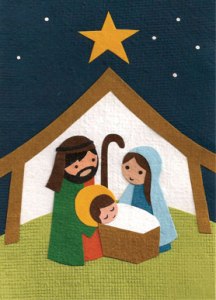
Some of the more curious lyrics to songs seem to be evident in some of the best known Christmas-time hymns. At least it seems that way to me.
Perhaps the cause is sometimes from lack of attention. For instance, as a kid I was certain that the prolonged “glo-r-ia, in excelsius deo” of Angels We Have Heard on High was somehow about Oreo cookies. I was in my early 20’s before I gave it enough thought and discovered the Latin lingo. (Truth be told, even now knowing I still hear “O-re-o” echo in my head whenever the song is sung.)
But sometime it is not lack of attention, but archaic language that causes the confusion. One such example may be some of the words to the song Silent Night, sung at the conclusion of many Christmas Eve services, as candles are being lighted all throughout the sanctuaries. The folks from Mental Floss have shed some light on the odd phrases of that popular tune:
The “round” in Silent Night might call up imagery of the soft, maternal kind, but in the phrase “round yon virgin,” it simply means “around.” “Yon” is an antiquated word for “that one” or “over there.” The meaning of the phrase in the song depends on the line before it. It should be understood in the context “all is calm, all is bright round yon virgin mother and child.” In other words “Everything is calm and bright around that virgin mother over there and her child.” In technical terms, “round yon virgin mother and child” is a prepositional phrase.
So now we know. The words do not describe a pregancy weight gain, or some other kind of personal allusion, but rather an idylic bucolic serenity that accompanied the Prince of Peace into this world.

Martin Luther expresses his appreciation of Christmas, not just that Jesus was born, but how and to whom he was born:
If Christ had arrived with trumpets and lain in a cradle of gold, His birth would have been a splendid affair. But it would not be a comfort to me. He was, rather, to lie in the lap of a poor maiden and be thought to be of little significance in the eyes of the world. Now I can come to Him. Now He reveals Himself to the miserable in order not to give any impression that He arrives with great power, splendor, wisdom, and aristocratic manners. But upon His return, on that Day when He will oppose the high and the mighty, it will be different. Now He comes to the poor, who need a Savior; but then He will come as a Judge against those who are persecuting Him now. ~ from a sermon from 1530
Remember Christ dwelt with us in humility so that we might approach him receiving the covenant of peace which he secured for us by the blood of his cross. (Colossians 1.19-20)
Paul Tripp reminds us that the greatest Christmas gift anyone could possibly receive has already been given to us – by the Living and True God. And the greatest gift, which God has given to us, is God himself.
 GRACE & PEACE