Dr. Os Guinness speaks to Acton Institute, a message titled: The Power of the Gospel No Matter How Dark the Times. This message, though long, is powerful, and is related to a post I published earlier this week titled: Culture Shaping Power of the Church.
Church
Culture Shaping Power of the Church

Os Guinness, in his excellent book, Renaissance, concerning the church in midst of the present challenges unprecedented in Western Culture, notes the culture changing and culture shaping power of the gospel, when the gospel is both declared by God’s People and is actively shaping God’s People. When many of our churches are caving in pursuit of “relevance”, which is hoped will cause people to “like” the church, so we can keep our numbers up, I think Guinness offers a both prophetic and strategic word:
What we have here in the teaching of Jesus and the Scriptures, and amplified in Augustine, is the very heart of the secret of the culture-shaping power of the gospel in the church. When the church goes to either of two extremes, and is so “in the world” that it is of the world and worldly, or so “not of the world” that it is otherworldly and might as well be out of the world altogether, it is powerless and utterly irrelevant. But when the church, through its faithfulness and its discernment of the times, lives truly “in” but “not of” the world, and is therefore the City of God engaging the City of Man, it touches off the secret of its culture-shaping power. For the intellectual and social tension of being “in” but “not of” the world provides the engagement-with-the-critical-distance that is the source of the church’s culture-shaping power.
In short, the decisive power is always God’s, through his Word and Spirit. But on her side the church contributes three distinct human factors to the equation: engagement, discernment, and refusal.
First, the church is called to engage and to stay engaged, to be faithful and obedient in that it puts aside all other preferences of its own and engages purposefully with the world as the Lord commands.
Second, the church is called to discern, to exercise its spiritual and cultural discernment of the best and worst of the world of its day, in order to see clearly where it is to be “in” and where it is to be “not of” that world.
Third, the church is called to refuse, a grand refusal to conform to or comply with anything and everything in the world that is against the way of Jesus and his kingdom.
Race and the Church RVA: Telling the Truth
On Saturday morning January 30, scores of church leaders, along with a smathering of parishioners, gathered in the basement of an old department-store-turned-church in Richmond, Virginia for a discussion on Race and the Church. The invited primary speaker was Dr. Sean Lucas, pastor of historic First Presbyterian Church of Hattiesburg, Mississippi; adjunct professor at Reformed Theological Seminary; and author of the recently released For A Continuing Church. I considered it a privilege to be among those gathered, though participation was an open invitation.
My primary takeaway from that morning meeting is that much of our current racial rifts, and the prevailing voluntary segregation of Sunday mornings, is due in large part to a history that has barely been openly acknowledged, much less genuinely and transparently repented. Dr. Lucas provided ample examples, as the video above reveals (and his book expands upon). And while in many respects progress has been made, and reconciliation is occuring, there is still work to be done for the church in America to truly be one, as Jesus prayed for us to be. (John 17) A large part of what is left to be done is for White Christians – the “White” church – to go back in time, to understand and to own our sins, and our forefathers’ sins, related to racism.
Some may balk. Perhaps understandably.
“How many times must we say we are sorry?”
“I was not even born during the period of the Civil Rights Movement, so how can I be responsible?”
While such rebuttals may be honest and true, they have not proven effective to bridge the reconciliation gap. The desire and demand of Jesus is not that we merely go through the motions, but that we be “One” just as he is one with the Father, and with the Holy Spirit. No doubt that in many cases there is forgiveness that has been withheld. But even where this is the case, there is still a need for those of us who were born into the majority side to repent – to take steps back, to come to understand what was done in the name of the Church bur for the cause of bigotry. And we do not go alone, but rather we go there with our brothers and sisters of color. We go together that we may walk together, retracing the ways we have failed – failed one another, and failed our God – moving together in repentance and faith.
Take some time to watch the video. If you are in the Richmond area, join us for a future event.
6 Ways Ministry Spouses Get Hurt By the Church

Researcher Thom Rainer identifies Six Ways Ministry Spouses Get Hurt. I have listed them below, slightly reworded:
- Complaints About Their Minister-Spouses
- Complaints About the Children
- Unreasonable Expectations About Ministry Involvement
- Gossip & Murmering
- Isolation
- Attacking the (non-Staff) Spouse to Get Desired Results
Every non-staff church leader should be aware of these. Every church member should be aware of these. They are very real. I have experienced all of these in one form or another, in one church or another. I see these happen to friends serving other churches. While I am fortunate that all of my children, now grown or in college, have not only continued in their faith journeys but have actually increased ministry involvement, such patterns of behavior are common contributors to the high numbers of ministry children leaving the church, if not also the faith. The behaviors Rainer identifies are often devastating to ministry families.
For those serving in churches where you are experiencing some of these abuses, perhaps causing you concern for your spouse and children, I will share the counsel I received from a godly older minister during a time when our experience was most acute. I was told: “If you don’t let it crush you, it won’t crush them (the children). Don’t share details (with your children) – they likely already know. But do talk with them, be honest about it, and make sure they understand that those in the church are also broken and sinful, just like those outside the church.” Our children learned this lesson; they consequently have a pretty good grasp of Total Depravity and Luther’s concept of simul iustus et peccator (Simultaneously Just and Sinner) -even if they don’t necessarily know the term. But because they understand that even as believers – as those “credited” as “righteous” – we are all still infected by our own selfishness and sin, they have a greater appreciation of why we all are in need of Jesus’ redeeming grace. Though the blood of Christ was shed “once for all”, bringing forgiveness, we all have an ongoing need for the blood of Christ to continually cleanse us from our sin. Though shed “once for all”, a one-time shot of Jesus’ blood is not all there is.
I encourage you, whether on church staff or a church member, click the link above to read Rainer’s descriptions. One important thing to note, Rainer does not limit this behavior against only the Pastor’s family; it happens, at one time or another, to almost all ministry families. Check your own church to see if (where) this is happening. Then step up, and step in where necessary.
Prayer Group Participants

Earlier this week, for a change of pace, and to set our orientation, I had our staff open our weekly meeting with a period of liturgical prayer. This kind of prayer is not really part of our tradition. It appears, from what I occasionally read, that some from our tradition are intensely opposed to such Anglican/Catholic practices. I am not exactly sure why. Ever since first participating in a liturgical prayer experience several years ago in a small gathering of pastors – all PCA – I have found this expression of corporate prayer to be quite refreshing, at least when in smaller groups. If little else, liturgical prayer, when done appropriately, minimizes a lot of the quirkiness common to other kinds of prayer gatherings.
Prayer gatherings at many churches are… – well, somewhat bizarre. I do not mean to impugn the sincerity or intent of any of them. But even when sincere that does not mean there is necessarily an absence of weird. This is probably a good thing, since many of us whom God has redeemed, and adopted as his children, are somewhat strange; a little quirky. And this seems to become evident at some of our prayer gatherings.
I served one church where the prayer gathering was held almost sacred. However, when I had the audacity to suggest that maybe we should minimize the length of time in study (which was roughly 45 minutes) and increase the time of praying (which was roughly 10 minutes – if we included the amount of time it took to allow everyone to “share” their prayer requests, before actually praying), my suggestion was met with some serious push-back. How silly I was to assume prayer should comprise the bulk of our time at a prayer meeting.
Even when the prayer is taking place in the prayer gathering, some of our peculiarities are evident in the practices. A few churches in which I have been part the practice was what I have come to call “serpentine prayer”. (And no, despite being from Tennessee, this has nothing to do with snake handling.) Serpentine prayer is somewhat of a variant of a prayer circle, where one prays, then the next, all around the circle. In serpentine prayer, when the room is not large enough to accommodate everyone in a circle, people sit in rows, and prayer goes down each row and wiggles to the next row. Nothing wrong with this. But when I encouraged more spontaneous prayer, revolving around some pre-agreed subjects, the evident initial discomfort was quickly – and spontaneously – replaced by the re-emergence of the serpentine method. But this may not be nearly as odd as some other groups. A friend served a church where the long held practice for the Wednesday Night Prayer Meeting was to have the pastor open in a brief prayer, the people spend 30-minutes or so sharing what was on their minds and hearts, then watch the pastor pray for everything during the remainder of the time. No attempt to get the people to pray was successful, or even welcome. (They eventually fired him for trying to change the church too much, prayer meeting being among the most aggregious. Before he was fired, however, someone from the congregation, in attempt to get him to leave because he was “changing” things, even poisoned his dog. It had worked before. My friend later learned that his predecessors dog had been poisoned for similar reasons. But I digresss…)
But even when quirky, the prayer meeting can be a beautiful thing. For those present. And for God. (see Psalm 133)
I was amused by Steve Burchett‘s article penned for For the Church. In the article Burchett identifies and names some of the quirky participants found in many prayer gatherings. If you have been in many church prayer meetings you will likely recognize many, of not all of them. Who knows, you might even see yourself!
- The Sleeper
- The Non-Participator
- The Whisperer
- The Rambler
- The Dominater
- The Repeater
- The Preacher
- The Gossiper
- The Distracter
- The KJVer
(Check out the descriptions and encouragements from the whole article for yourself: Prayer Group Participants)
Quirky or not, there is something to be said for those committed to gathering for prayer.
I am saddened by the decline of weekly prayer meetings in most churches. If they are not yet dead, they are almost certainly under hospice care. And more frustrating are those who are activists for prayer in schools and in public forums, and yet who themselves will not commit to regular participation of group prayer. It is no wonder that at times non-believers may look upon the church with scorn, as such hypocrisy is startling. We loudly lament the absence of prayer in public places, yet we as a people will not commit to joining together for prayer in the one place from which prayers should be perpetually lifted up to God! How absurd. Maybe we should fill our houses of prayer before we condemn the culture for not doing what we do not do.
May God, in his grace, bring about a change, and restore prayer to a place of prominence in his church. In the means time, and always, may God have mercy upon us.
Marks of Revival

I had the privilege last week to meet a man convinced we are headed for revival. He is a gentle man, who thinks often of God, wishing for a return to some semblance of the way things used to be – minus the overt sins of racism and sexism that were so widely tolerated in days gone by. But the basic reason for his certainty is simple: We are in desperate need of revival. He had other reasons, of course; supporting reasons. Among them, through his examination of of history he has concluded that God works cyclically, and that we are presently overdue for the next revival.
I share his desire to see God bring revival. I can’t argue that we are overdue and in desperate need. And it is not just America that needs to be “revived”. More than our culture, I believe the American Church needs to experience revival. And when God works, he works through his church. So if revival is to occur, reorienting the cultural drift, renewing God as the rightful object of our collective affection, it is going to be at work in and through the Church.
But still, what does revival actually mean? Of course it means “to make alive”. But what does it look like? Do all revivals look alike? What are the characteristics?
I suspect the answer the the question “Do all revivals look alike?” is likely a “No”. Cultures are different. God seems to bless different expressions of evangelism and ministry approaches from one generation to the next; one culture to the next. So to assume when revivals hit they will be uniform seems a bit of a stretch to me.
J.I. Packer,defines a revival this way:
“Revival is God accelerating, intensifying, and extending the work of grace that goes on in every Christian’s life!”
In his book God in our Midst, Packer suggests that, among the variety of God’s ways, there are at least five constants that seem to always appear in biblical revivals:
1. Awareness of God’s presence: “The first and fundamental feature in renewal is the sense that God has drawn awesomely near in his holiness, mercy and might.”
2. Responsiveness to God’s Word: “The message of Scripture which previously was making only a superficial impact, if that, now searches its hearers and readers to the depth of their being.”
3. Sensitiveness to (Our Own) Sin: “Consciences become tender and a profound humbling takes place.”
4. Liveliness in Community: “Love and generosity, unity and joy, assurance and boldness, a spirit of praise and prayer, and a passion to reach out to win others, are recurring marks of renewed communities.”
5. Fruitfulness in Testimony: “Christians proclaim by word and deed the power of the new life, souls are won, and a community conscience informed by Christian values emerges.”
I hope my new friend is right, that God – who is always at work – will soon be at work in unusual ways. These are some of the signs I will pray will be evident in our culture, and in our church.
Illustration of a Healthy Church

If our congregation were to be a church with the gospel, plus a group that enjoys being together in community, but we were not on mission to reach out to our neighbors and the Nations, for the sake of advancing Christ’s Kingdom, then we would just be another social club for people to attend.
Gospel + Community – Mission = Club
If we were to be a church with the gospel, and we were actively engaged in mission to our neighbors, but not together in community, then we would be like a bunch of silos that aren’t truly showing off the body of Christ. We could not be considered like a city on a hill.
Gospel + Mission – Community = Para-Church
If we were to become a church actively on mission, serving together in community with one another, but we had no gospel, or we were careless about the truths of the gospel, we would then merely be just another non-profit organization.
Community + Mission – Gospel = Non Profit
To be the church, to be what Jesus calls us to be, what he created us to be, is a Gospel-centered, missional, gathering of people living life together, sharing one another’s joys and pains, serving together in various ways for the good of our city, expecting nothing in return, all for the glory of Jesus, the joy of being together, and love for our neighbors.
We must be a church that is gospel centered, on mission in community so that we can be the organism, the family, the church that Christ gave the Spirit to empower, and of which he said could not be stopped. (Matthew 16.13-18)
Gospel + Community + Mission = Church
Authentic Church: Road to a Re-newed Reality

I have been mulling on something the late Francis Schaeffer said:
“There are four things which are absolutely necessary if we as Christians are going to meet the need of our age and the overwhelming pressure we are increasingly facing.”
No doubt that the Church, in our culture as well as other cultures, faces increasing and overwhelming pressure. Pressure to cave. Pressure to capitulate. Pressure to compromise. These pressures come from both subtle and overt threats from the culture and from the government, as George Orwell predicted in his classic 1984. Perhaps even more devastating is the subversive seductive pressure. The craving of the church to be “relevant”, to fit in, to be liked, so people will come in great numbers, so we can be considered successful, has seemingly replaced a commitment to faithfulness and fruitfulness. This mindset seems in line with Aldous Huxley‘s “nightmarish vision of the future” in his opus Brave New World. And while there is certainly nothing wrong with a desire to be liked, nor to see our churches full, these consuming desires are antithetical to the teachings of Jesus, and consequently, I fear, resulting in an increasingly impotent Church.
So what are Schaeffer’s four things?
Schaeffer labeled them Two Contents and Two Realities.
Is This Why We Don’t Engage Our Neighbors?

Here is a challenging perspective and good instruction from Leon Brown, church planter and pastor at Crown & Joy Presbyterian Church in South Richmond, Virginia:
“I fear that one of the reasons we don’t know how to engage non-Christians to talk about Jesus is because we’ve forgotten how to have regular conversations. If the conversation is not about the Bible, a child’s education, church, other forms of ministry, or the occasional sporting event, we don’t have a paradigm for much else. If this is you, here’s a remedy. Spend more time in public places and listen to the discussions that are occurring around you. You’ll begin to notice what’s important to people. Grow in your understanding of those things. Even consider how the word of God speaks to those situations. After some time, it’ll be easier to have ‘common grace’ conversations, and you’ll be prepared to share the word in a natural manner, as the scriptures speak to many, many things.”
Advent Conspiracy
For many Black Friday – the day after Thanksgiving – marks opening day for an exciting month long contact sport – shopping! For many others it is just one more cause for anxiety. In the midst of the seasonal hubbub, take a moment to watch this short video from the Advent Conspiracy.
Share the joy of Christmas!
Chrysalis Factor

There are times I feel somewhat like a sea captain who took charge of a ship that had experienced unprecedented prosperity under the direction of his predecessor, and then sprung a leak a few months into his tenure. Don’t get me wrong, I love the church where I serve, but some of the challenges came as a bit of a surprise. Chiefly a decline in attendance and a corresponding budgetary strain.
In some ways this was inevitable. In some ways this is circumstantial. And in other ways it is personal.
It was inevitable because nothing stays the same forever. No organization, or organism, experiences perpetual increase in prosperity. Sooner or later, changes, challenges, and a period of decline is certain.
It is circumstantial, if for no other reason, the nature of the community where our church is located is a very fluid, very transient community, Many who live here are in the military, and so they are only here for a short time. Others who live here have retired – often early – and come to enjoy the wealth of cultural, historical, and natural amenities. However, there seems to be a pattern – when one member of the marriage, husband or wife, experience injury or become ill, the couple moves away, back home, or somewhere near their children. Understandable. While Williamsburg is a beautiful place to settle, they have no roots here, so they move on.
It is personal in the sense that whenever a church changes pastors there is almost always some turnover among the members. No matter how capable the new minister is, his presence is a constant reminder that things have changed; that this is not exactly the church that they had joined anymore. And as American church culture becomes increasingly more consumeristic, the less likely folks are to stick around to get used to the changes. After all, if they have to adjust to change, why not use it as an opportunity to trade in for a new model that has some amenities that they had not been looking for a few years ago, but would provide a pleasant upgrade. Consequently new pastors are often not treated like people, who might have feelings, but rather as a commodity to be embraced or discarded at the whim of the customer. Or another aspect of the personal – some church members just don’t like the new pastor’s personality (or lack of it).
I suspect differing measures of all three of these played a part in our initial decline. Fortunately we remained stable. We have a good cohesive staff; wise and godly officers who work as a team, a band of brothers; and no panic or finger pointing from the congregation. So despite our leak our ship has remained in pretty good shape.
As we move forward it is essential to assess where we are, and to map out where we are headed.
At present we are in what Thom Rainer calls the Chrysalis Period. According to Rainer, during the Chrysalis Period a church or organization undergoes changes beneath the surface that are necessary to become what we will inevitably become.
The chrysalis is the pupa of a butterfly encased in a cocoon. It is the former caterpillar and the future butterfly. It is the stage when the worm-like, slow-moving caterpillar becomes a beautiful, free-flying butterfly.
I like the imagery. It seems apt. We are a work in process. And not all that is going on is evident to all who take a look.
Top 3 Needs of the Church Today

The late great John Stott was asked: “What are the top three needs of the church today?”
Here is Stott’s prophetic three-fold response:
The church’s most basic need is to remember what kind of community it is, and in particular its double identity. For God calls his people out of the world to belong to him and sends them back into the world to serve and to witness. The first calling is to ‘holiness’ and the second to ‘worldliness,’ using the word as the opposite of ‘other worldliness,’ and meaning ‘involved in the life of the world.’ So the church is called to ‘holy worldliness’, for this is its double identity. It needs constantly to ensure that neither identity smothers the other.
The church’s second need is to be what it claims to be, and so to allow no dichotomy or conflict between its profession and its practice. Without this the church lacks authenticity and so credibility.
In response to the challenge of pluralism, the church needs to be faithful in defending and proclaiming the uniqueness and finality of Jesus Christ. If it does so, it will certainly suffer for its faithfulness. If we compromised less, we would undoubtedly suffer more.
Bounded-Set vs Centered-Set
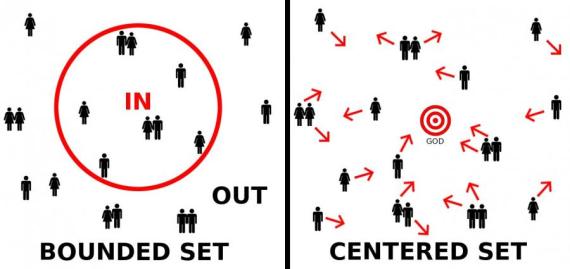
Some time back I posted a piece titled Numbering Those On the Ranch, exploring the concept of what missiologist Alan Hirsch refers to as a “centered-set” metric for evaluating a church. More recently I stumbled across a post by Bob Thune, of Coram Deo Church in Omaha, explaining his understanding of Centered-Set verses the more traditional Bounded-Set metric. I appreciated what Thune had to say, so I wanted to post it, even if primarily for my own benefit, as a resource for future use.
***
There are two ways of thinking about social groupings: centered-set and bounded-set. These terms come to us from the field of mathematics (set theory). In recent years they’ve been applied more broadly by sociologists and missiologists. The fountainhead of most of this thinking in the Christian church was Paul Hiebert, a missiologist at Fuller Seminary.
Hiebert suggested that our minds categorize people according to either “bounded set” or “centered set” thinking:
Bounded Sets
- … are formed by defining the boundaries – the essential qualities which separate something inside the set from something outside. Heibert’s classic example is “apples.” Either a fruit is an apple, or it isn’t.
- Maintaining the boundary is crucial to maintaining the category.
- Bounded sets are static sets – they don’t change, they only add or lose members.
- The important thing is to “cross the boundary” to be part of the set.
Centered Sets
- … are formed by defining a center. The set is made up of all objects moving toward that center. As an everyday example: “bald men.”
- While a centered set does not focus on the boundary, a boundary does indeed exist. The boundary is clear so long as the center is clear.
- The objects within a centered set are not categorically uniform. Some may be near the center and others far from it, even though all are moving towards the center.
Hiebert asserts that Americans tend to think almost exclusively in bounded-set categories. And this affects our understanding of Christian discipleship. We tend to “stress evangelism as the major task — getting people into the category. Moreover, we… see conversion as a single dramatic event — crossing the boundary between being a ‘non-Christian’ and being a ‘Christian’” (Hiebert, 1978).
Hiebert argues instead for a “centered-set” way of thinking about Christian conversion:
A Christian would be defined in terms of a center—in terms of who is God. The critical question is, to whom does the person offer his worship and allegiance? …Two important dynamics are recognized. First there is conversion, which in a centered set means that the person has turned around. He has left another center or god and has made Christ his center. This is a definite event—a change in the God in whom he places his faith. But, by definition, growth is an equally essential part of being a Christian. Having turned around, one must continue to move towards the center. There is no static state. Conversion is not the end, it is the beginning. We need evangelism to bring people to Christ, but we must also think about the rest of their lives. We must think in terms of bringing them to Christian maturity in terms of their knowledge of Christ and their growth in Christlikeness.
Theologically, I find some aspects of Hiebert’s argument poorly nuanced. He would do well to differentiate regeneration (the invisible, immediate work of the Holy Spirit on the soul, which is in fact a decisive event) from conversion (our experience of that event, which often feels more like a “process” than like a decisive moment). Those who have applied Hiebert’s set theory to individual salvation (Brian McLaren, for instance) have tended to drift in fuzzy doctrinal directions.
But I find Hiebert’s insights immensely helpful when applied to ecclesiology. This is where I first encountered the set-theory rubric, as applied by Alan Hirsch and Michael Frost in their 2003 book The Shaping of Things to Come. Frost and Hirsch argued for viewing the church as a centered set rather than a bounded set. Why not build a church by defining the center rather than patrolling the boundaries? Why not place the gospel of Jesus Christ at the center of the church’s life and practice, inviting everyone to reorient their lives around Him? In this way, we continually invite Christians into deeper and deeper discipleship, while also inviting non-Christians to deal with the claims of Jesus on their lives. As Hiebert himself acknowledges, this does not mean there is no boundary; there is just “less need to play boundary games and to institutionally exclude those who are not truly Christian. Rather, the focus is on the center and pointing people to that center” (Hiebert, 1978).
It is my personal conviction that: a) this is what the New Testament church did (see, for example, Galatians 1:6-9; Colossians 1:6; Romans 1:13-15); b) this is what it truly means to be a “gospel-centered” church; and c) this is the only way to have a truly missional church, where non-Christians are treated with true Christian hospitality AND are regularly being converted to faith in Jesus.
Christian’s Cultural Assessment Toolbox

Here’s an astute observation from Os Guinness:
“Christians simply haven’t developed Christian tools of analysis to examine culture properly. Or rather, the tools the church once had have grown rusty or been mislaid. What often happens is that Christians wake up to some incident or issue and suddenly realize they need to analyze what’s going on. Then, having no tools of their own, they lean across and borrow the tools nearest them.
They don’t realize that, in their haste, they are borrowing not an isolated tool but a whole philosophical toolbox laden with tools which have their own particular bias to every problem (a Trojan horse in the toolbox, if you like). The toolbox may be Freudian, Hindu or Marxist. Occasionally, the toolbox is right-wing; more often today it is liberal or left-wing (the former mainly in North America, the latter mainly in Europe). Rarely – and this is all that matters to us – is it consistently or coherently Christian.
When Christians use tools for analysis (or bandy certain terms of description) which have non-Christian assumptions embedded within them, these tools (and terms) eventually act back on them like wearing someone else’s glasses or walking in someone else’s shoes. The tools shape the user. Their recent failure to think critically about culture has made Christians uniquely susceptible to this.”
In Spirit Produced Corporateness

As I reflect upon the need of our church to constantly cultivate community among those within our congregation, as well as between those already part of the congregation and those who have newly arrived, I am pondering the poignancy of this statement by Stanley Grenz, from his book Theology for the Community of God:
“Only in our Spirit-produced corporateness do we truly reflect to all creation the grand dynamic that lies at the heart of the triune God. As we share together in the Holy Spirit, therefore, we participate in relationship with the living God and become the community of Christ our Lord.”
 GRACE & PEACE