In this video Tim Keller offers some insights about ministry in areas that still largely hold to traditional conservative values.
This is helpful to me because the place where I live and serve is still largely characterized this way.
While I embrace a missional mindset, how our church lives that out in East Tennessee and Southwest Virginia will look very different from how Keller lives it out in Manhattan and others live it out in places like San Francisco or Seattle.
“How can we be the best church for our community?’
The difference between the two questions dramatically influences the way we approach ministry, approach our community, and relate to other churches. Those driven by this question are inclined to be highly attractional, may tend to view neighbors as being placed by God so that they can be harvested for the growth and benefit of the church. And while many people would be gracious enough to realize that there are enough people to go around, and that no one church can monopolize all the people in an area, this question inherently promotes a sense of competion between churches.
Perhaps even more significant, the differences between these two questions radically reveals our view of God and what we believe to be God’s purpose for the church. The church that wants to know how they can be the best for the community understands that God is on a mission and invites us – even demnds for us – to engage in it. It is a church that recognizes God has placed His church in the community primarily to benefit the city and it’s people (see Jeremiah 29.7 & Proverbs 11.10), and consequently to draw people to himself. While some may ask this question and still posess an unhealthy competitiveness, the question itself does not inherently demand competiton. To be the best for the community means to play the roles needed in the community. There is room for more than one church to play various roles.
This past Sunday I offered a brief exposition of John 17.6-21 & John 20.21, explaining what it means to be “sent” into our community and world in the same way God the Father sent Jesus into our world. These texts demand that we understand, as John Stott says: “Our God is a missionary God.” They also demand that we continually ask ourselves:
In what way was Jesus sent?
How am I responding to/reflecting being sent?
While in no way exhaustive, I offered 5 simple observations for us to put into practice:
More Incarnational than Attractional
Focus More on Building Bridges than Building Walls
Prioritize Service > “Serve Us”
Move Beyond Fellowship to Functional Unity
Measure Our Effectiveness More by Our Impact than Our Attendance.
Unbeknownst to me when I posted earlier today, two of my long-time friends interviewed Jim Belcher, author of Deep Church, earlier this year for their podcast: Ordinary Means.
In this interview Jim introduces and discusses his book with two guys, Matt Bohling & Shaun Nolan, who unhesitatingly identify themselves with the Traditional Church.
At the suggestion of a friend, I recently read Jim Belcher’s Deep Church. I was not disappointed. This is thoughtful and thought-provoking book.
The subtitle really captures the theme of this book: A Third Way.
With all the discussions about “how” to do church, and the polemic approaches of the Traditionalists and the Emerging/Emergent, some of us find ourselves caught somewhere in the middle. I see strengths and weakness in both movements.
Belcher offers understanding of both worlds. With his understanding he offers honest reflections. Belchers experience and research are helpful for bringing clarity about the issues of the debate and the players doing the debating. I especially appreciated his dilineation of the “protests” being offered by the Emergning/Emergents against the practices of traditional church:
Captivity to Enlightenment Rationalism
A Narrow View of Salvation
Belief Before Belonging
Uncontextualized Worship
Ineffective Preaching
Weak Ecclesiology
Tribalism
Honestly, I share these collective frustrations – though I cannot endorse the Emergent solutions.
More than just offering perspective, Belcher offers his thought process as he wrestles with the strengths and weaknesses of both the Emerging/Emergent and Traditionalist arguments. He does not seem to be trying to convince anyone to embrace his positions, only sharing the insights of his personal and spiritual leadership journey. I found this helpful. It was almost as if I had someone to talk with about these issues as I contemplate my own positions, questions, and inclinations.
Most important, at no point does Belcher compromise by seeking the “middle way”. Instead, listening to both sides of the debate, he searches and wrestles with Scripture to find “A Third Way”.
A group of pastors invited the mayor of their city to discuss his dream for the city, along with the issues that were hindering that dream from becoming a reality. The mayor came with a list of pervasive issues that the pastors in this group were eager to address: at-risk kids, elderly shut-ins, dilapidated housing, and hunger.
But before addressing these issues the mayor said to the gathered pastors:
“After thinking about all of these things, it occurred to me that what our city really needs are good neighbors….The majority of the issues our community is facing would be eliminated or drastically reduced if we could just become a community of people who are great neighbors.”
To this statement one pastor responded:
“Here we are asking the mayor what areas of the city are most in need, and he basically tells us that it would be great if we could just get our people to obey the second half of the Great Commandment.”
In his book The Present Future, Reggie McNeal reveals the contrasts in the different ways leaders can think about the church and its ministry. McNeal reveals the different paradigms that pastors can have as they fulfill their ministry in the church. Being missional is first a shift in thinking about the nature of the church. Once a missional understanding is adopted, the way we do church begins to change.
A missional church stresses community transformation over growing the church.
A missional church strives to turn members into missionaries over turning members into ministers.
A missional church focuses on recovering Christian mission over doing church better.
In the above video, Tim Keller also offers some insights about the missional church. Keller explains why this label – Missional – is not just new slang for being Evangelistic.
A missional church is rooted in the purpose of God, and understands that God is on a mission to reclaim a People for himself and restore a Creation to it’s orignal beauty. This is known as missio dei – Mission of God.
A missional church recognizes that our culture in North America is no longer an expression of Christendom.
Christendom was a period in history when Christianity was the prevailing religion. During this time Christian thought, directed by the Bible, provided the lense through which people evaluated the world.
We can no longer assume that:
People are part of a congregation. In the past, most people had some affiliation with a church. Now, most people have no connection with a church, increasing numbers of people have never even been in a church.
People define Right vs. Wrong based upon some understanding of God’s Standard.
People necessarily care what the Bible says, much less that most people have any understanding of what it teaches.
Consequently:
The church can no longer serve as chaplain to a culture, and a People, as if they only need encouragement along Life’s Journey.
Each congregation must engage the culture(s) in the community where God has sovereignly placed us in the same way that a missionary must engage a foreign culture:
Learning to understand before trying to be understood.
Presuming our neighbors have no previous understanding of God and the Gospel – or at best they have a fragmented and distorted understading.
Look for Redemptive Analogies – stories from within the culture that reflect the truths of God and the Gospel.
Loving a People who may reject us, and even hate and harm us.
The church must:
Grow inwardlay strong yet Outwardly Focused.
Be MORE Incarnational than Attractional
Evaluate all ministries with a missional lense.
In summary: A Missional Church pours itself out on the community, seeking cultural transformation more than its own prosperity.
Working through the Sermon on the Mount on Sunday mornings, a few weeks ago I preached from Matthew 5.13-16, the Salt & Light passage. What I explained to our congregation is that, after instrucitng us about what our attitude ought to be as citizens of the Kingdom, Jesus goes on to reveal the Influence he expects his people to have on the communites where we live, and on the world around us.
In this video Tim Keller offers his thoughts about being Salt & Light.
To read something I disagree with on the Internet is not an unusual thing. When what I disagree with comes from a source that I respect – highly respect – it makes me somewhat uncomfortable. When the source I respect seems to oppose what I hold, well that is just down-right disappointing.
I’ve been listening to the audio of sessions from Acts 29 Network’s 2009 Bootcamp: Ambition. While not everyone will find these talks of interest, I think they are challenging and stimulating for those of us in ministry and church leadership.
Ministry for the Long Haul & Ambition (Matt Chandler)
Acts 29 is a missional church planting network of Reformed Evangelicals. Each year they hold Boot Camps to train and re-energize like minded church planters and church leaders. Many of these, and other, talks are available on the Resource section of thier web page.
I don’t know Francis Chan, but I think I like him. I know I like what I see so far.
A friend, who is also an Elder in our church, introduced me to Chan a few months ago. He had just finished reading Chan’s book, Crazy Love, and said that Chan was teaching the same things I had been introducing to Walnut Hill Church – namely a Gospel-driven, missional approach to living. He wanted to know if I was familiar with Chan, and what my thoughts were. At the time I had none. But obviously I was curious. I was curious to see what this guy was saying, if indeed we were teaching similarly. I was curious to see what my friend and colleague percieved I was teaching, since he thought we were teaching the same things.
I did some investigation on the Internet. The only negatives I found, or rather the only criticisms of Chan I found, were a couple of Asian-American bloggers who thought Chan acted too “White” or Anglo; and someone who seemed put off by Chan’s frequent application of the Gospel to the use of money. I didn’t find either of these charges to be anything to discredit Chan, so I conintued with my investigation.
Now, a few months after first hearing Chan’s name, I find myself impressed. I don’t know all he has said or written, so the day may come when I find myself disagreeing with Chan about something. But that day is not today. And even if, or when, it does come I suspect it won’t be too big a deal. It’ll only be a matter of degree. Francis Chan is a man who loves God, who loves people, and who knows how God has loved His people. He is passionate about telling people about God’s Crazy Love. He is faithful to call people to love God and each other in tangible ways, in seemingly crazy ways.
So not only has my friend stumbled upon a faithful teacher, I have become a student as well.
To get acqauinted with Francis Chan, check out the above video, and the related website, Just Stop and Think.
As our church begins to explore what it means to be a missional church, it might be helpful to hear the insights of one of the most effective practitioners and proponents of the missional approach to ministry. In the above video Tim Keller, of Redeemer Church in Manhattan, explains some of the key characteristics of a missional church.
Some might ask: What’s the difference between a Missional Church and an Evangelistic Church? Is this just a new label?
The answer to the latter question is “No. It’s not just a label.” It is a different way of thinking about the church. Rooted in the understanding that God is himself on mission (missio dei) a missional church seeks to become engaged in God’s mission in the very place(s) God has sovereignly placed the church and the church members.
Reggie McNeal, in his book, The Present Future, provides some insights about the differences between a Missional Church and an Evangelistic Church that will help answer the former question. McNeal says a missional church stresses:
> community transformation over growing the church
> turning members into missionaries over turning members into ministers
> recovering Christian mission over doing church better
The gospel is always conveyed through the medium of culture. It becomes good news to lost and broken humanity as it is incarnated in the world through God’s sent people, the church. To be faithful to its calling, the church must be contextual, that is, it must be culturally relevant within a specific setting. The church relates constantly and dynamically both to the Gospel and to its contextual reality. …In order to contextualize responsibly, the church must assess its culture critically, discerning and unmasking its philosophical foundations and values.
Today is Maundy Thursday. It is a special day on the Christian calendar. But many Christians don’t know what maundy means. I imagine for some this day could easily fall just after Manic Monday, Ruby Tuesday… You get the idea. So if the term Maundy Thursday sounds foreign to you, relax, you are far from alone.
The term Maundy is generally held to be derived through Middle English and old French, mande’; which comes from the Latin mandatum, meaning mandate or command. This is the first word of the Latin phrase:
“Mandatum novum do vobis ut diligatis invicem sicut dilexi vos.”
Or more familiar:
“A new command I give to you: Love one another. As I have loved you so you must love one another.” (John 13.34)
This is a special day in the life of Christ’s People. It is a day when we remember that Jesus has commissioned us, not only to believe the Gospel of his life which was to be – and has been – given for the redemption of all who believe, but to live out the Gospel in relation to one another. We are to love one another in the same tangible way, and to the same extent, as Jesus has loved us.
This is what Jesus commanded of his believers only hours before he willingly gave his life for ours. (John 15.12-14)

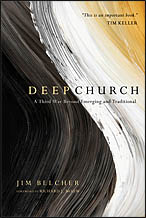 Unbeknownst to me when I posted earlier today, two of my long-time friends interviewed Jim Belcher, author of






 GRACE & PEACE
