Race and the Church RVA: Telling the Truth

On Saturday morning January 30, scores of church leaders, along with a smathering of parishioners, gathered in the basement of an old department-store-turned-church in Richmond, Virginia for a discussion on Race and the Church. The invited primary speaker was Dr. Sean Lucas, pastor of historic First Presbyterian Church of Hattiesburg, Mississippi; adjunct professor at Reformed Theological Seminary; and author of the recently released For A Continuing Church.  I considered it a privilege to be among those gathered, though participation was an open invitation.

My primary takeaway from that morning meeting is that much of our current racial rifts, and the prevailing voluntary segregation of Sunday mornings, is due in large part to a history that has barely been openly acknowledged, much less genuinely and transparently repented.  Dr. Lucas provided ample examples, as the video above reveals (and his book expands upon).  And while in many respects progress has been made, and reconciliation is occuring, there is still work to be done for the church in America to truly be one, as Jesus prayed for us to be. (John 17) A large part of what is left to be done is for White Christians – the “White” church – to go back in time, to understand and to own our sins, and our forefathers’ sins, related to racism.

Some may balk. Perhaps understandably.

“How many times must we say we are sorry?”

“I was not even born during the period of the Civil Rights Movement, so how can I be responsible?”

While such rebuttals may be honest and true, they have not proven effective to bridge the reconciliation gap.  The desire and demand of Jesus is not that we merely go through the motions, but that we be “One” just as he is one with the Father, and with the Holy Spirit.   No doubt that in many cases there is forgiveness that has been withheld.  But even where this is the case, there is still a need for those of us who were born into the majority side to repent – to take steps back, to come to understand what was done in the name of the Church bur for the cause of bigotry.  And we do not go alone, but rather we go there with our brothers and sisters of color. We go together that we may walk together, retracing the ways we have failed – failed one another, and failed our God – moving together in repentance and faith.

Take some time to watch the video. If you are in the Richmond area, join us for a future event.

Selling Out the Gospel at the Altar of Politics

Divided Heart (Pink-Green)

I don’t do politics on social media (nor in the pulpit), but I feel an exception is warranted – on social media, anyway. With the exception that I don’t really care that Donald Trump has not previously held public office, nor do I care that neither Ben Carson nor Carly Fiorina have ever held public office, pretty much everything else Peter Wehner writes in his Op Ed for the New York Times, Why I Will Never Vote for Donald Trump, reflects my sentiments. I am disturbed by Trump’s behavior, and even more so by some of his supporters who have compromised core values and beliefs to empower him.

I know. This is politics. And Trump’s supporters have every right to support him, for whatever the reasons.  For a time I was open to the possibility, despite questions about the basis of his present positions.  I accept that people change.  But with no history, or substantive rationale for changes in convictions, I can only wonder how long it will be, or what circumstances might arise, before we see some of these key convictions shift back.

More disturbing to me than Trump are some of his supporters.  Here I do not mean the rank-and-file Trump supporters, who enjoy the bravado, and with whom the simple catch phrase “Make America Great Again” resonates.  I too am entertained, or at least I have been, to a degree. And I appreciate the vision of restoring the greatness of the USA – even if I am a little unclear whether Trump’s definition of what would make America great and my definition are similar; and even if Trump’s specific plans to usher in such restoration seem a little fuzzy to me.  I am disturbed most by those who are endorsing Trump, even when Trump clearly does not represent their core values and beliefs.  In other words, I am most chagrined by Christians – especially those claiming to be Evangelicals – who are compromising their faith to endorse Trump.

Now let me be clear here.  Every citizen of the USA has a right to support whatever candidate they want. I do not believe Christians have a responsibility to restrict their vote to only Christian candidates. Therefore, I support the right of my fellow Christians, even fellow Evangelicals, to support Trump, if they believe he would be the best leader for our country. (Check out Mark Tooley’s thoughtful piece: Trump, Evangelicals & Security.) What I do not accept are Christians – especially Evangelicals – who will rewrite the Faith to justify their support.

The poster boy of my ire is Jerry Falwell, Jr.

In recent months Falwell has made some asinine statements and decisions. Among them was to invite Trump to speak at Liberty University, where Falwell is currently president, on Martin Luther King Day.  Again, I need to be clear. I support Liberty University’s decision to have Trump speak, just as I appreciated them inviting Bernie Sanders to speak. A university is a place of ideas, where a variety of viewpoints should be allowed to be expressed.  So as long as a clear distinction is made between a chapel service (during which any speakers should intelligently and faithfully exalt the One True God) and a convocation (where any variety of ideas could be expressed) I have no problem.  But given Trump’s history, or at least his reputation, of bigoted statements, it seems more wisdom could have been exercised about the date when Trump would be invited to speak.  A day that is designated to highlight efforts to bring about racial reconciliation does not seem the most sensitive or appropriate.  Of course that is just a judgment call. (For anyone interested, my friend Marc Corbett, a Liberty University alumnus, wrote an excellent piece for The Gospel Coalition.  Take a moment to listen to Marc’s lament: Why I Will Protest a School I Love.)

Most disturbing to me is Falwell’s recent total redefinition of Christianity in his justification for inviting Trump to speak on MLK Day, and in his subsequent official endorsement of Trump.  Again, I believe Falwell has the right to support, and even endorse, whoever he wants.  In his formal endorsement Falwell said only that:

“[Trump is] a successful executive and entrepreneur, a wonderful father and a man who I believe can lead our country to greatness again.”

But Falwell’s previous justification and reasoning was this:

“I have seen firsthand that his staff loves him and is loyal to him because of his servant leadership. In my opinion Donald Trump lives a life of loving and helping others as Jesus taught in the great commandment.”

Falwell has since offered an explanation, an Op Ed in the Washington Post.  And I concur with much of his reasoning, even if I would not land on the same candidate. Nevertheless, his reasoning and his freedom – both as an American and as a Christian – to endorse Trump does not negate Falwell’s compromise of the gospel,  and his misuse of the scripture.

Continue reading

I Pledge My Life to Jesus & the Gospel

Stanied Glass Pathway

I pledge my life to Jesus and the Gospel. I want Jesus not to be just part of my life or something that makes me feel good, but to be the very center – controlling everything. I want only the knowledge of the love of God. I want to know Christ.

I want no desire, idol, or sinful way of dealing with hurt to control any part of my life no matter how small. I put away from myself the love of money, power, comfort, and success. I count everything rubbish.

I bind myself to Christ as bond-servant for life. I want no master other than Christ. I purpose to own nothing. I surrender to Jesus my family, my friends, my ministry, my ideas, my possessions, and my future.

I commit myself to submission to others and a willingness to learn from all kinds of Christians. I commit myself to speak only your words, not my own. I commit myself to speak the truth in love to others.

I want to love people. I want to lay down my life for others, especially those closest to me, as God gives us grace. I want to love people by telling them about Jesus.

I understand that this will mean suffering in my life, that I will join in the sufferings of Christ. But that I always want to be dying, so that I can always be living in Christ.

~ Paul Miller

Symbol of a New Day Dawning

Rooster Colors

From time to time I am asked why I have a rooster for a profile picture, both on my blog and on Facebook.  What’s more, the rooster is also the screensaver on my phone.  I use these images for more reason than just the bucolic tranquility they depict.  The rooster has a long history as an interesting symbol.

While Celtic and Norse cultures saw the rooster as a creature of the underworld – a messenger screeching warnings of danger, and calling for the souls of those killed in battles; most have viewed the rooster in a more positive light.

In art, the rooster has long symbolized the fanning out of brilliance – i.e. showing the world the shimmering facets of ones personality.  As one  scholar has noted, the rooster is used in art to display courage, strength, pride,  honesty, vigilance, watchfulness, as well as flamboyance.  Most of these are excellent qualities. And flamboyance is not entirely bad, though too much of it may be somewhat obnoxious.

In Christianity the rooster is associated with Peter’s denial of Christ on the night of betrayal, leading up to the crucifixion.  So the rooster is associated with Christ’s death – which while tragic, was also God’s intention, the reason for which Jesus was born.  And while not lessening the tragedy, it is important to remember that Jesus himself says of the crucifixion: “I lay down my life, no one takes it from me.”  (John 10.11-18) Jesus laid down his life that those who believe would have life. Yet the effect of his substitutionary death only reached its full effect upon his resurrection – which Jesus hinted at in John 10.17.  In that sense the rooster, which symbolizes betrayal and death, cannot be separated from the purpose of Jesus’ death, and thus cannot be separated from the resurrection.  Therefore, the rooster is an appropriate symbol of the gospel itself.

What the rooster most symbolizes, at least to me, is the dawning of a new day. This is the reason I use it so freely.   The rooster crows at the first hints of new light.  This was a primary reason the rooster was used as a symbol of the Reformation – it was a reminder that the Reformation itself signaled a new day.  Of course the resurrection of Jesus is the ultimate sign of a new day.  And God himself tells us, through his prophet Jeremiah, that “his mercies are new every morning”.  (Lamentations 3.22-23)

So to me, the rooster is a constant reminder of the gospel, and that today is a new day – every day is a new day.  This being New Years Day, the rooster seems to me to be an especially appropriate symbol.

Warped Christianity

Warped Reality

Sociologist Christian Smith introduced the phrase Moralistic Therapeutic Deism in his book Soul Searching:The Religious and Spiritual Lives of American Teenagers.  Smith, and his colleagues, assert that, from their research, this would be a fitting description of the spirituality of the typical American teenager – a spirituality they gained from watching and listening to their Baby Boomer parents.

Al Mohler, in a post titled Moralistic Therapeutic Deism – the New American Religion, describes Moralistic Therapeutic Deism as consisting of beliefs like these:

  1. “A god exists who created and ordered the world and watches over human life on earth.”
  2. “God wants people to be good, nice, and fair to each other, as taught in the Bible and by most world religions.”
  3. “The central goal of life is to be happy and to feel good about oneself.”
  4. “God does not need to be particularly involved in one’s life except when God is needed to resolve a problem.”
  5. “Good people go to heaven when they die.”That, in sum, is the creed to which much adolescent faith can be reduced.

What is perverse about these statements is that none of them is entirely wrong.  But it is the subtle errors that erode genuine faith, especially when the propositions fit together to form a worldview.  Together they create a warped perspective that, while borrowing the language of Christianity, is not actually Christianity.

Here We Stand: An Evangelical Declaration on Marriage

Image processed by CodeCarvings Piczard ### FREE Community Edition ### on 2015-06-25 18:32:21Z | http://piczard.com | http://codecarvings.comÞâÚÙÝÿþÿýüþ¸ÏÀÿž¸¨ÿ”l²i¥W€0»

After the U.S. Supreme Court’s ruling on marriage yesterday, a diverse coalition of Evangelical leaders, gathered by the Ethics & Religious Liberty Commission, drafted and released the following statement.  Had I been asked – and if I am asked – I would gladly add my name.  ~ WDG

***

As evangelical Christians, we dissent from the court’s ruling that redefines marriage.

The state did not create the family, and should not try to recreate the family in its own image. We will not capitulate on marriage because biblical authority requires that we cannot. The outcome of the Supreme Court’s ruling to redefine marriage represents what seems like the result of a half-century of witnessing marriage’s decline through divorce, cohabitation, and a worldview of almost limitless sexual freedom. The Supreme Court’s actions pose incalculable risks to an already volatile social fabric by alienating those whose beliefs about marriage are motivated by deep biblical convictions and concern for the common good.

The Bible clearly teaches the enduring truth that marriage consists of one man and one woman.

From Genesis to Revelation, the authority of Scripture witnesses to the nature of biblical marriage as uniquely bound to the complementarity of man and woman. This truth is not negotiable. The Lord Jesus himself said that marriage is from the beginning (Matt. 19:4-6), so no human institution has the authority to redefine marriage any more than a human institution has the authority to redefine the gospel, which marriage mysteriously reflects (Eph. 5:32). The Supreme Court’s ruling to redefine marriage demonstrates mistaken judgment by disregarding what history and countless civilizations have passed on to us, but it also represents an aftermath that evangelicals themselves, sadly, are not guiltless in contributing to. Too often, professing evangelicals have failed to model the ideals we so dearly cherish and believe are central to gospel proclamation.

Evangelical churches must be faithful to the biblical witness on marriage regardless of the cultural shift.

Evangelical churches in America now find themselves in a new moral landscape that calls us to minister in a context growing more hostile to a biblical sexual ethic. This is not new in the history of the church. From its earliest beginnings, whether on the margins of society or in a place of influence, the church is defined by the gospel. We insist that the gospel brings good news to all people, regardless of whether the culture considers the news good or not.

The gospel must inform our approach to public witness.

As evangelicals animated by the good news that God offers reconciliation through the life, death, and resurrection of His Son, Jesus, we commit to:

  • Respect and pray for our governing authorities even as we work through the democratic process to rebuild a culture of marriage (Romans 13.1-7);
  • teach the truth about biblical marriage in a way that brings healing to a sexually broken culture;
  • affirm the biblical mandate that all persons, including LGBT persons, are created in the image of God and deserve dignity and respect;
  • love our neighbors regardless of whatever disagreements arise as a result of conflicting beliefs about marriage;
  • live respectfully and civilly alongside those who may disagree with us for the sake of the common good;
  • cultivate a common culture of religious liberty that allows the freedom to live and believe differently to prosper.

The redefinition of marriage should not entail the erosion of religious liberty.

In the coming years, evangelical institutions could be pressed to sacrifice their sacred beliefs about marriage and sexuality in order to accommodate whatever demands the culture and law require. We do not have the option to meet those demands without violating our consciences and surrendering the gospel. We will not allow the government to coerce or infringe upon the rights of institutions to live by the sacred belief that only men and women can enter into marriage.

The gospel of Jesus Christ determines the shape and tone of our ministry.

Christian theology considers its teachings about marriage both timeless and unchanging, and therefore we must stand firm in this belief. Outrage and panic are not the responses of those confident in the promises of a reigning Christ Jesus. While we believe the Supreme Court has erred in its ruling, we pledge to stand steadfastly, faithfully witnessing to the biblical teaching that marriage is the chief cornerstone of society, designed to unite men, women, and children. We promise to proclaim and live this truth at all costs, with convictions that are communicated with kindness and love.

***

To read the original post, and to find the names of the signatories, click: Here We Stand

Gospel Greater Than God’s Law

Niagara at Night

Preaching through Paul’s Letter to the Galatians, I have received quite a bit of feedback – more than I receive during most series I have done.  Much to the relief of my thin skin, I have received no criticism (to date).  Most of the comments have been appreciative, either for the reminder of things that we need to remember, or for clarity on matters previously not understood.  (Either way, this is music to any ministers ears!)  The rest are questions – good questions; well-intentioned questions – concerning the role of our obedience. One godly man, a man I respect and enjoy, offered concerns about the possibility of people “hearing” cheap grace, knowing neither I nor our church believes grace is ever cheap.

These interactions have reminded me of what Martyn Lloyd-Jones wrote regarding the possible charge of anti-nomianism:

If your presentation of the Gospel does not expose it to the charge of Anti-nomianism you are probably not putting it correctly.

(NOTE: Anti-nomianism means “against law” or “anti-law.  It is a $20 word for someone who sees no use or present value for God’s law or commands in the Christian Life.)

This semi-famous saying is excerpted from Lloyd-Jones commentary on Romans.  Lloyd-Jones’ insights are so well expressed that they are worth revisiting even now and again.  Below are his thoughts from Romans 3 (which include the above statement):

A very good way of testing any view that you may hold is this one: Is this view humbling to me, glorifying to God? If it is, it is probably right. You won’t go far wrong if whatever view you are holding is glorifying to God, humbling to man. But if your view seems to glorify you and to query God, well (there’s no need to argue or to go into details) it’s wrong. It’s a very good universal rule– that!

My last word of all is, again, a word primarily to preachers – indeed it’s a word to everybody in the sense that if ever you are putting the Gospel to another person, you’ve got a very good test whether you are preaching the Gospel in the right way. What’s that? Well, let me put it like this to you: If your presentation of the Gospel does not expose it to the charge of Antinomianism you are probably not putting it correctly.

What do I mean by that? Just this: The Gospel, you see, comes as this free gift of God – irrespective of what man does.

Now, the moment you say a thing like that, you are liable to provoke somebody to say: “Well, if that is so it doesn’t matter what I do.”

The Apostle takes up that argument more than once in this great epistle. “What then,” he says at the beginning of chapter 6, “shall we do evil – commit sin – that grace might abound?” He’s just been saying: “where sin abounded grace does much more abound.” “Very well,” says someone. “This is a marvelous doctrine, this ‘Go and get drunk, do what you like the grace of God will put you right.’” Anti-nomianism.

Now, this doctrine of the Scriptures – this justification by faith only, this free grace of God in salvation – is always exposed to that charge of Anti-nomianism. Paul was charged with it. He said, “You know, some people say that’s what I’m preaching.” Paul’s preaching was charged with Anti-nomianism…So I say, it is a very good test of preaching.

You see – what is not evangelical preaching is this: It’s the kind of preaching that says to people, “Now, if you live a good life; if you don’t commit certain sins; and if you do good to others; and if you become a church member and attend regularly and are busy and active you will be a fine Christian and you’ll go to Heaven. That’s the opposite of Evangelical preaching – and it isn’t exposed to the charge of Anti-nomianism because…it is telling men to save themselves by their good works…And it’s not the Gospel – because the Gospel always exposes itself to this misunderstanding from the standpoint of Anti-nomianism.

So, let all of us test our preaching, our conversation, our talk to others about the Gospel by that particular test…If you don’t make people say things like that sometimes, if you’re not misunderstood and slanderously reported from the standpoint of Anti-nomianism, it’s because you don’t believe the Gospel truly, and you don’t preach it truly.

Gospel vs. Legalism

Gospel vs. Legalsim

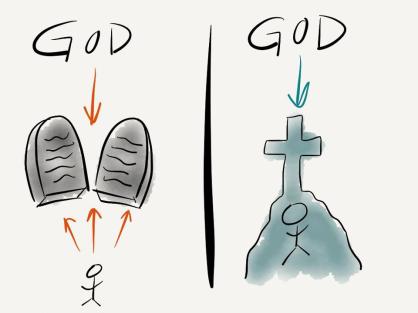
What is the difference between legalism and the gospel?

  • Legalism (or Moralism) says God looks at how well we keep the law.
  • The Gospel says we are hidden in Christ. So God sees how well Jesus kept the Law (perfectly), all his works, and his death on our behalf.  Consequently, because we are hidden in Christ, God sees the work of Jesus when he sees us. The gospel says that, because of God’s grace, all that Jesus is and did is credited (imputed) to us, through faith.  (Colossians 3.3, Ephesians 2.8, Romans 5.2, Galatians 2.20)

So what is the difference between the gospel and legalism? It is the difference between Christianity and every religion in the world.

New City Catechism

Over the weekend I spent some time reviewing the relatively new New City Catechism.  While it has been around for a couple years now, and I had heard about it even prior to it’s original publication, I had not really given it much attention, until now.

I was impressed by the combination of depth and simplicty this catechism posesses.  Broken into just 52 questions, it is a fairly comprehensive introduction to the substance of the Christian Faith, and yet it manages to avoid being verbose in any of it’s questions and answers.  I am now giving thought to ways we might make use of this tool in our church.

The video above is an Introduction to the New City Catechism from Knox Seminary.  The New City Catechism web site not only has the Q&A’s, but for each of the 52 Questions there is a tab with accompanying scripture support, a short commentary, and even a brief video explanation by a variety of renouned pastors and theologians.

Check out: New City Catechism

New City Catechism

Inebriated by the Gospel

Smoky Mountain Moonshine

Great grace laced imagery from Robert Capon:

The Reformation was a time when men went blind, staggering drunk because they had discovered, in the dusty basement of late medievilism, a whole cellarful of fifteen-hundred-year-old, two-hundred-proof grace – of bottle after bottle of pure distillate of Scripture, one sip of which would convince anyone that God saves us single-handedly. The word of the gospel – after all those centuries of trying to lift yourself into heaven by worrying about the perfection of your bootstraps – suddenly turned out to be a flat announcement that the saved were home before they started… Grace has to be drunk straight: no water, no ice, and certainly no ginger ale; neither goodness, nor badness, nor the flowers that bloom in the spring of super-spirituality could be allowed to enter into the case.

You Might Be Reformed If…

Reformation Wall @ Geneva

As one who dwells firmly within the Reformed wing of Evangelical Christianity, I found the following to be astute, accurate, and a little bit amusing:

You might be Reformed …

  • If you think prayer is more than just trying to manipulate God into giving you what you want …
  • If you think that there are things more important to God than your comfort …
  • If you think the Bible has more to say about the Church than just what is found in the second chapter of Acts …
  • If you suspect that how you “think” about God might be at least as important as how you “feel” about God …
  • If you believe that the fact that a doctrine is described in the Bible supersedes your personal feelings about that doctrine…
  • If you feel that nagging suspicion that something isn’t right when the pastor can preach an entire sermon series without ever opening a Bible…
  • If you think that all of those letters that Paul, Peter, James and John wrote to the churches have something to do with how the Church should look today…
  • If you think that there has to be more to the Christian life than just being nice…
  • If you have always suspected that the pick­-and­-choose belief buffet can’t really reflect Christianity as it is expressed in Scripture…
  • If the theology of, “God has a plan, and it’s all about you!” makes you suspicious…
  • If you like the hymns unrelated to “tradition,” but because they are meaningful and true; in contrast with the mindless drivel of many “modern worship” songs…
  • If you accept God’s election because you find the doctrine clearly stated in Romans, even if you don’t necessarily  “like it” …
  • If you get a little creeped-out when someone stands up in church and declares: “I’ve had a revelation from God” …
  • If a “worship service” comprised of 45 minutes of near ­meaningless, highly repetitive songs leaves you hungering and thirsting for something real and meaningful…
  • If you’ve secretly abandoned Dispensationalism for not making sense, and gone searching for an eschatology that actually reflects what is taught in Scripture.

***

Thanks to Timothy J. Hammon.  This post originally appeared on his blog: The Things That Matter

Uneasy ‘Calvinist’

Branded

I feel no little uneasiness when labeled a Calvinist.  It is not that the description is unfitting.  Nor is it because I have any disaffection for Calvin. Quite the contrary.  My reservation is that there is much baggage that accompanies that label – baggage assigned by those who reject the tenants of the Faith associated with this particular theological system; and baggage freely toted by some who proudly – and sometimes obnoxiously – wear the label.  So, while happy to be identified as belonging in the Calvinist camp, I tend to agree with theologian Douglas Wilson who says that whoever coined the phrase “Calvinist” is a “marketing chucklehead”.  Wilson says he prefers to simply be called “Christian”.  Me too.

I am gladdened, though, that I do not need to carry my ill-ease alone; nor do I need to craft a defense or explanation of my (clearly Calvinistic) convictions.  It has already been marvelously expressed, by no less a stalwart of the Faith than Charles Haddon Spurgeon.  In his autobiography, The Early Years, Spurgeon wrote:

I have my own private opinion that there is no such thing as preaching Christ and Him crucified, unless we preach what is nowadays called Calvinism. It is a nickname to call it Calvinism; Calvinism is the gospel, and nothing else. I do not believe we can preach the gospel . . . unless we preach the sovereignty of God in His dispensation of grace; nor unless we exalt the electing, unchangeable, eternal, immutable, conquering love of Jehovah; nor do I think we can preach the gospel unless we base it upon the special and particular redemption of His elect and chosen people which Christ wrought out upon the Cross; nor can I comprehend a gospel which lets saints fall away after they are called.’

Well said.