Author: Dennis Griffith

  • Re-Gridding the Christian Life

    Measures

    Not long ago, while a friend of mine was preaching in my place at Walnut HIll Church, I had somewhat of an epiphany.  I understood something that had been nagging at me for a long, long time, but that I had never before been able to express – even to myself.  I realized: We have it all wrong. We are using the wrong standard to measure our spiritual lives.  We need a new grid.

    Too often, I am afraid, we gauge the Christian Life through a grid of Good vs. Bad, or of Right vs. Wrong.  The more serious of us may see that both ought to be wedded together.  But I am convinced that, while both of these grids have some value, the real grid that God fundamentally calls us to use is Humble vs. Proud.

    Good vs. Bad gauges our behavior.   Right vs. Wrong evaluates our doctrine, or our Worldview.  But Humble vs. Proud reflects our heart – and that is where everything must begin. If we get that out of whack, everything else will be too.

    God opposes the proud but He gives grace to the humble.”

  • A Praying Life

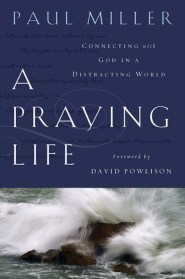
    Praying Life“Lord, teach us to pray.”   That’s the request of the disciple of Jesus. (Luke 11.1)  That’s a request that should not be limited to ages past or the pages of the Bible. It is the heart request of any disciple of Jesus. 

    My friend, Paul Miller is Jesus’ tool to answer that request in this generation.  In his book, A Praying Life: Connecting With God in a Distracting World, Paul helps people like me, people who sometimes struggle in knowing how or what to pray; people who find their minds wandering often whenever trying to commit longer periods of time to pray; people who sometimes wonder if God get’s tired of these simple, random, and inarticulate petitions.

    Paul reminds us what it means to be a child of God, and the implications that has for our prayer life. He helps us see that God will never reject those who come to him with a child-like heart, and therefore will certainly not be disappointed in us if we come to him with child-like characteristics.  Paul “redeems” the mind-wandering, and sets us free to enjoy our Father in prayer.

    Check out a sample chapter and a review from NavPress.

  • Grace Will…

    Paradox Hand

    I was blown away as I thought about the paradoxes of the Gospel as it was described by Paul Tripp in his book, Broken-Down House.  Don’t just read through quickly. Stop and consider the contrasts:

    Grace is a story and grace is a gift. It is God’s character and it is your hope. Grace is a transforming tool and a state of relationship.  Grace is a theology and an invitation. Grace is an experience and a calling. Grace will turn your life upside down while giving you a rest you have never known.  Grace will convince you of you unworthiness without ever making you feel unloved.

    Grace will make you acknowledge that you cannot earn God’s favor, and it will remove your fear of not measuring up to his standards. Grace will confront you with the fact that you are much less than you thought you were, even as it assures you that you can be far more than you had ever imagined. Grace will put you in your place without ever putting you down.

    Grace will enable you to face truths about yourself that you have hesitated to consider, while freeing you from being self-consciously introspective. Grace will confront you with profound weaknesses, and at the same time introduce you to new-found strength. Grace will tell you what you aren’t, while welcoming you to what you can now be. Grace will make you as uncomfortable as you have ever been, while offering you more comfort than you have ever known. Grace will drive you to the end of yourself, while it invites you to fresh starts and new beginnings.  Grace will dash your hopes, but never leave you hopeless. Grace will decimate your kingdom as it introduces you to a better King. Grace will expose your blindness as it gives you eyes to see. Grace will make you sadder than you have ever been, while it gives you greater cause for celebration than you have ever known.

    Grace enters your life in a moment and will occupy you for eternity. You simply cannot live a productive life in this broken-down world unless you have a practical grasp of the grace you have been given.

  • A Time for Work, A Time for Worship

    Wondering Which

    A woman walked into our church building during the service this past Sunday morning. I did not see her, but reportedly she was rather rough looking, even intimidating.  She was seeking financial assistance, and she was clear and determined in her objective. 

    The lady from our congregation who got up to greet her would not ordinarily be considered a timid soul.  She is seasoned in ministry and has met all kinds of people.  But she admitted later to feeling ill at ease with this stranger.  Perhaps her discomfort was because of the woman’s gruff exterior and demeanor.  Perhaps it was because she remembered that the writer of Hebrews tells us sometimes we entertain angels disguised as the poor.  (Hebrews 13.2)  But I suspect there may have been other factors at play.

    I believe most of us want to be helpful, though we don’t always know how. This may be particularly true when we are dealing with the underprivileged.  And  I wonder if, because of both the renewed emphasis of the importance of mercy ministry and the proliferation of political exploitation of the poor, some of us are not prone to feel a twinge of guilt on occasions when we are not prepared to address a need.

    In my opinion the incident at our church this past weekend was handled appropriately.  The woman from our church invited our visitor to join us in worship, and told her  that after the service she was sure one of our deacons would be happy to meet with her to discuss her situation.  The woman declined and walked out of the building. 

    Why do I believe it was handled appropriately, when no assistance was given?

    1. Those in Need will always be around. 

    Jesus told us: “You will always have the poor with you”.  In other words, no matter how effective we are, individually and collectively, we will not entirely alleviate poverty.  We may minimize it but we will not eliminate it.

    Some have used this fact as an excuse to do little or nothing to address poverty and minister to the poor.  And that is wrong.

    But that is not the case for our church. 

    Our deacons regularly meet with people in need, both members of our church and people from outside it. We have budgeted a fair percentage of church income to be distributed for benevolence. Our deacons give toward needs as they are finanically able.  Individual members of our church are known to give to others as they are aware of needs. Our church also partners with and supports other organizations, such as Bristol Faith in Action and Harbor of Light, who minister mercy to people who have had no contact with our church. 

    We have put structures in place to guide us in our benevolence. These structures and guidelines are not implemented to minimize what we give. They were designed to help us be more effective in our giving. They enable us to truly be more merciful because we are able to meet real needs.  We are not just trying to make ourselves feel better by giving, but actually trying to provide help to those in need.

    While we still have room to grow, charity and grace are characteristics of the congregation and leaders of Walnut Hill Church. 

    While we may be inclined to feel bad that we cannot meet all needs, if we are faithful in extending mercy we have no reason to feel ashamed or embarrassed on those occasions we truly are unable or when it would be unwise.

    2. This was a Mary moment. 

    Solomon tells us: “For everything there is a season, and a time for ever matter under heaven.” (See Ecclesiastes 3.1-8)

    Jesus adds another application to Solomon’s insight. 

    During a time when he was visiting his dear friends, Martha and Mary, Martha was acting the busy homemaker while Mary was just visiting with the company.  Martha, frustrated by the lack of help her sister was providing, complained to Jesus in an attempt to get him to get Mary to kick in instead of continuing to kick back. 

    Jesus said to Martha: “Martha, Martha… You are uptight and worried about so many things. But only one thing is worth concerning yourself like that; only one thing is really necessary.  Mary has chosen wisely. What she has chosen cannot be taken away from her.” (See Luke 10.38-42)

    What Jesus tells us, essentially, is that there is a time to work and a time to worship; a time to serve and a time to enjoy God. 

    When we are gathered for worship it is not a time to deal with ordinary demands and needs. It is not that those needs are not important. It is just that worship is a priority that ought not be neglected nor interupted, even for important things.

    So, in short, while the lady from our congregation may have second guessed herself and felt a little guilty, I don’t think she has any need to feel that way. She acted wisely.  Our church is committed to extending compassion and mercy.  But when it is time to worship… everything else gets put on the back burners.

  • Salt & Light

    God Rays Redwoods

    “The true Christian cannot be hid, he cannot escape notice.  A man truly living and functioning as a Christian will stand out.  He will be like salt; he will be like a city set on a hill, a candle set upon a candlestick.

    But we can also add this further word: The true Christian does not even desire to hide his light.  He sees how ridiculous it is to claim to be a Christian and yet deliberately to try to hide the fact. 

    A man who truly realizes what it means to be a Christian, who realizes all that the grace of God has meant to him and done for him, and understands that, ultimately, God has done this in order that he may influence others, is a man who cannot conceal it.  Not only that; he does not desire to conceal it, because he argues thus, ‘Ultimately the object and purpose of it all is that I might be functioning in this way’.” 

    -Martin Lloyd-Jones, Studies in the Sermon on the Mount.

  • But You Are Not Invited

     In the Corn

    There is a scene in the film Field of Dreams where Kevin Costner’s Ray Kinsella gently argues with Ray Liotta’s Shoeless Joe Jackson.  Shoeless Joe had just invited the writer, Terrance Mann (played by James Earl Jones), to follow him into the corn, which in the film is the symbol of heaven.  Ray (Kinsella, not Liotta) grew excited with anticipation of what would be experienced on the other side of the corn. He expected to go. But Shoeless Joe informs him: “You’re not invited.”  That’s when Ray grew irritated and began to argue his case. “What do you mean I am not invited?!  After all I’ve done! What’s in it for me?” Shoeless Joe rhetorically asks: “Is that why you did it, Ray? For you?”

    That scene intrigues me, because it reflects a conversation that many people will have one day with Jesus.  And it is not only people in general that come to mind, but many who are wonderful, committed, churched people, who will be told,  “You’re not invited,” while many less “worthy” are receiving gold-clustered engraved invites. 

    Why won’t these who gave themsleves to much for the sake of the church be invited?  Because they don’t understand the basis of the invitation; they don’t understand the heart of the Host. 

    Brennan Manning, in The Ragamuffin Gospel, writes:

    “Jesus says the kingdom of His Father is not a subdivision for the self-righteous nor for those who feel they possess the state secret of salvation. The kingdom is not an exclusive, well-trimmed suburb with snobbish rules about who can live there. No, it is for a larger, homelier, less self-conscious caste of people who understand they are sinners because they have experienced the yaw and pitch of moral struggle.”

    In Isaiah 55 the Lord extends an invitation:

    “Come, all you who are thirsty, come to the waters; and you who have no money, come, buy and eat! Come, buy wine and milk without money and without cost.

    Why spend money on what is not bread, and your labor on what does not satisfy? Listen, listen to me, and eat what is good, and your soul will delight in the richest of fare.

    Notice that this invitation is eerily akin to the one depicted in Field of Dreams. The invitation is made by the Lord of Hosts to those he wants to invite. Those he invites here are those who are not able to pay their own way; spiritually those who don’t have enough righteousness to warrant an invite.  Conversely, there are some, like Ray in the movie, who feel desering; who have stored up some moral savings, i.e. good deeds or righteousness. To them the Lord says, “What that’ll get you isn’t as good as if you come to my party purely as another  invited ‘unworthy’ guest”.

    Among the most difficult things I have to deal with as a pastor are people who are much like Ray Kinsella – maybe even better.  These are good people, kind people, people who have sacrificed much, qualities Ray has in the movie.  In addition to Ray’s qualities, many of these people are also responsible and exercise wisdom in their daily lives. In other words, they have their act together – far more than I do.  Ray did not exercise those traits in the film. In fact, he was raging against the fact that his who life up to that point had been lived out in practicality.  But he was good; he was deserving.  He just wasn’t invited.

    It seems that to be around such people would be a pleasure.   And it is.  And that’s part of what makes it so difficult.  They are wonderful people to be around, but it is very difficult for many of them to accept that those God invites to the party – those Jesus died for – are not the prim and proper but people who are a mess, people more like me. Only those who are willing to come as unworthy guests are invited.

    But Isaiah 55 does give me comfort about this matter. It shows that God says that polished people can come to the party too, if only they will put away the wallets in which they store their own goodness and righteousness.

  • Navigating the Narrow Path Between the Gospel and Politics

    Golden Path

    It is a constant tension for me.  How do I juggle my personal political views with my responsibility to remain faithful to the Gospel? How do I strive to keep the Gospel message pure and not pollute my teaching with  political biases interjected?

    It is a difficult dilemma. Many political issues have moral roots, and can be informed by theological reflection.  At the same time God is not partisan. No party, nor candidate, can claim God’s endorsement.  All are flawed to some degree – some more obvious tha others. None sufficiently reflect the character and commands of God.

    In fact, the Gospel itself creates somewhat of a tension. It simultaneously compels us to be both conservative and liberal.  It leads toward conservatism in the sense that it compels us to recognize that there is absolute truth, there is right and wrong, righteousness and evil.  God calls us to seek truth and to walk in the light of truth.  Yet the heart of the message of the Gospel has a very liberal emphasis: God gives graciously and lavishly to those who do not deserve what they receive.  We are to seek justice and to show mercy, two words often associated more with classical liberalism yet are reflections of the character of God.

    Rejecting the notion that there can be a pure Church-State, a theocracy, in this era between ancient Israel and the future Kingdom, I am left with the realization that we are to discern wisdom in order to govern effectively, and to address contemporary problems.  Wisdom is discerned from God’s Word. But specific application of wisdom to lifes various issues is not always spelled out by God’s Word.  That leaves room for good people to disagree about solutions, and sometimes even about the nature of the problems.

    I cringe whenever I hear Christians indiscriminately integrate a party platform with the true Faith, as if it is an undeniable marriage, making it impossible to distinguish or separate one from the other; or that to choose an opposing party is akin to spiritual adultery.  In my circles, which tends to lean right, even far right,  I hear stupid things said – including from some pulpits – such as: “I don’t see how anyone can be a Democrat and a Christian”.  I try to stay as far away from such inane rhetoric as I can. But I suspect sometimes I try too hard, and therefore stand too far away.

    I want to be clear: Such sentiments are not only wrong, they are EVIL.  To attach partisan politics to the Gospel is a distortion of the Gospel. It keeps people from understanding, and sometimes embracing, the only hope we have, which is God’s grace received through faith in Christ.  It prevents some from thinking outside the box of strict conservatism, and therefore may rob our society of possible solutions for very real problems, that just may be both Biblical AND “liberal”.  All of these are, in my estimation, evil consequences, no matter how well intentioned the rationale behind it.

    But lacking wisdom about how to navigate the narrow path beween politics and the Gospel, my tactic has been to forgo engaging in political discussion at all, except in close circles where I am sure not to offend.  I am becomming convinced that this is not really wisdom, it is wimpy-ness on my part.

    I have very definite political views. I have strong opinions about many of the issues that are plaguing our society and world; and which divide people.  If I refrain from partaking in the conversation I offer nothing toward the solutions. I want to re-enter the discussion.

    Here are a few things I will need to do to keep my balance on this narrow path:

    1. I will continue to refrain from bringing my partisan views into the pulpit.  This includes not only avoiding stupid comments like the one I previously mentioned, but personal or partisan allusions that could reasonably alienate or offend people of either political leanings. The pulpit is for the proclamation of the Gospel. If the Gospel is not proclaimed from the pulpit, not only is it an abuse of the purpose of the pulpit, but it is to deny the people the Gospel. If the Gospel is not proclaimed in the pulpit, it will not be proclaimed anywhere else.

    2. I need to grow in my ability to clearly communicate the  various aspects of the Gospel, and affirming the tension it creates for those who follow Jesus.  The Gospel is an offense. It is like a stone that makes man stumble, a rock that causes them to trip and fall.  If I am faithful and articulate I should become an equal-opportunity offender, causing discomfort to people on both the Left and the Right.

    3. I will commit to pray for the good of those who are in positions of authority, especially the President, whether I agree with them or not; whether I even like them or not.  God has commanded that we do this. My personal preferences cannot mitigate God’s clear command. (See Presidential Prayer Team

    4. I will be diligent to dilineate political views in such a way that I give no occasion for anyone to infer that I am making them a basis of  Christian fellowship.  Somehow I must learn how to enter the discussion without attaching Gospel authority to my political perspective.  In other words, I want to learn how to dialogue yet affirm that those who differ may well still be more godly than I am – whether they are wrong and I right or I am wrong and they are right.  Fellowship is rooted in what Christ has done, PERIOD.

    None of this is profound, I know.  But I just need to wrestle through it to guide me if and when I address any political issues.  If anyone has other suggestions, I’m all ears.

  • Contemporary Evangelical Creed


    Crumbling Steeple

    The following is a spoof on the substance of much of contemporary Evangelicalism.  It is taken from a past edition of Modern Reformation, probably Jan/Feb 1997, but I am not sure of the original publication date. 

    I know I may be stepping into a hornets nest here, but I post it because I find it funny – sad, but funny:

    I believe in God who once was Almighty, but sovereignly chose not to be sovereign;  and in Jesus, my personaLordandSavior, Who loves me and has a wonderful plan for my life, Who came into my heart when I asked him to, and is now seated at the right ventricle of my belief in him, Who walks with me and talks with me along life’s narrow way, and tells me I am his own, Who shall come again with secrecy to rapture us outta’ here, Whose kingdom shall last exactly one thousand years; And in the Holy Ghost, who did some weird stuff at Pentecost, but doesn’t do much more anymore except speak to the hearts of individual believers.

    And I believe in this local, independent, and powerless church, insofar as it is in line with my personal interpretation of the Bible and does stuff I like;  in one Believer’s baptism for the public proof of my decision for Christ; and in giving my personal testimony for soul winning.

    And I look for the identity of the Antichrist, and know that the Last Days are upon us.

    – Ay-men

  • 3 Responses to Sin

    Howl of Indifference

    “When we as Christians sin, we can react in one of three ways:

    1) We can become hardened to our sin. 

    2) We can sink into utter despair and say, ‘Its all over.’  I’ve known Christians who have spent twenty years despairing over one sin….

    [T]he only right course of action for us as Christians is to…

    3) become increasingly sensitive to our sin, but also increasingly to know the forgiveness that is ours on the basis of the blood of Christ – to have the assurance that, if Jesus died for me when I was a sinner before my salvation, how much more He must love me now!” 

    -Francis Schaeffer, The Finished Work of Christ.

  • Slow Like Oak

    Great Oak

    In a culture conditioned to instant everything, perhaps we would do well to pause and consider these words from John Newton, author of the hymn Amazing Grace:

    “A Christian is not of hasty growth, like a mushroom, but rather like the oak, the progress of which is hardly perceptible, but in time becomes a great deep-rooted tree.”

    -from The Letters of John Newton

  • Crazy Love

    I don’t know Francis Chan, but I think I like him.  I know I like what I see so far.

    A friend, who is also an Elder in our church, introduced me to Chan a few months ago. He had just finished reading Chan’s book, Crazy Love, and said that Chan was teaching the same things I had been introducing to Walnut Hill Church – namely a Gospel-driven, missional approach to living.  He wanted to know if I was familiar with Chan, and what my thoughts were.  At the time I had none.  But obviously I was curious. I was curious to see what this guy was saying, if indeed we were teaching similarly.  I was curious to see what my friend and colleague percieved I was teaching, since he thought we were teaching the same things.

    I did some investigation on the Internet.  The only negatives I found, or rather the only criticisms of Chan I found, were a couple of Asian-American bloggers who thought Chan acted too “White” or Anglo; and someone who seemed put off by Chan’s frequent application of the Gospel to the use of money.  I didn’t find either of these charges to be anything to discredit Chan, so I conintued with my investigation.

    Now, a few months after first hearing Chan’s name, I find myself impressed.  I don’t know all he has said or written, so the day may come when I find myself disagreeing with Chan about something. But that day is not today.  And even if, or when, it does come I suspect it won’t be too big a deal.  It’ll only be a matter of degree.  Francis Chan is a man who loves God, who loves people, and who knows how God has loved His people.  He is passionate about telling people about God’s Crazy Love. He is faithful to call people to love God and each other in tangible ways, in seemingly crazy ways.

    So not only has my friend stumbled upon a faithful teacher, I have become a student as well.    

    To get acqauinted with Francis Chan, check out the above video, and the related website, Just Stop and Think.

  • 3 Short Books I Wish Everyone in My Church Would Read

    I read a fair amount.  I have been accused, and probably rightly so, of unrealistically pushing books and other reading materials on people who don’t read quite as much; who don’t have the time to read as much; who don’t get “paid” to read as much (as I, in part, am).  But there are ideas and expressions I have benefited from, that I am not sure I can adequately convey, and I like to share them with others. I like to hear how others are struck by the same insights, when the authors’ words are not colored by my thoughts.

    I know that I will never get everyone in my church to read all the things I’d like them to read.  But there are three very short books that I have begun to encourage people to read:


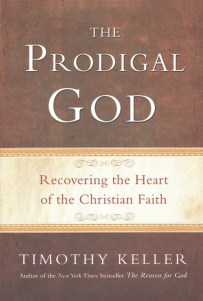
    The Prodigal God by Tim Keller

    This book is subtitled: “Recovering the Heart of the Christian Faith”.    
    Cover Prodigal God

    Keller elaborates on the well known story of the Prodigal Son, and offers a not-so-often recognized perspective:  The story is not about a wild son who receives mercy and grace from his benevolent father.  This is a story about two sons. In fact, this is a story about a Father who had two very different sons. It is THE story of God the Father and how people relate to Him in two different ways.

    Each son is a reflection of the respective ways people relate to God.   

    The younger son is the picture of all who go astray from God and his Law and, having been broken, recognize the emptiness and hopelessness of life apart from the Father.  When awakened to their desperate situation they find a grace and relationship with the Father that is ovewhelming.

    The older son is the picture of all who try to relate to God, and please God, by being good; by following all the rules.  This is a picture of religious people, of many Conservative Christians. Yet in their own goodness there is an evident lack of heartfelt fondness for the Father, a lack of joy, obvious to all except for them.

    In this book Keller helps us to discern our own tendencies in our relation to God.  Using this story Keller helps us see with keener insight that the ONLY way to have a relationship with God the Father is by recognizing that we are all in need and by being recipients of His compassion, grace, and generosity.  Keller shows us that at the end of the story there is only one son, one type of person, still alienated from the Father. It is not the one who seems to have been the most egregious.  It is the one who seems the most righteous.

    Keller has also noted: “Our churches are full of Older Brother types… Is it any wonder, then, that the Younger Brother-types don’t want to come home (come to church)?”

    OUCH!! 

    The Prodigal God is only 133 pages – and the pages are double-spaced.
     Cover Cross Centered Life

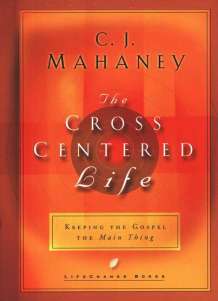
    The Cross-Centered Life by C.J. Mahaney

    In this 85 page, pocket sized, book Mahaney helps the reader to keep the Gospel at the center of our lives. He helps us to recognize various subtle substitutes that lead us from the Cross, but ultimatley are of little or no help in strengthening the soul. 

    Mahaney uses a plethora of annecdotes and illustrations to convey the simple, yet often forgotten and neglected, essential truth: The Gospel is the power to give and to transform life.  Understanding how we can appropriate the present benefits of the Cross is key to vibrant spirituality and joy.


    The Dangerous Duty of Delight by John Piper

     I am a long-time fan of Piper’s writing. Nevertheless, I confess, for a long time I refused to read this simple book. I guess I thought this pocket sized 84 page primer of his contemporary classic, Desiring God, was beneath me. After all, I’ve read the BIG book – several times!  But I was wrong.Cover Dangerous Duty
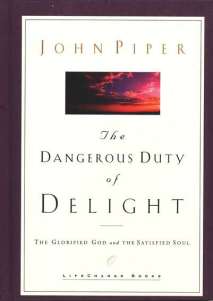
    In this little book Piper conveys the essence of the Christian life: To glorify God by enjoying him forever.  It is a great introduction to what Piper calls Christian Hedonism. 

    Christian Hedonism may sound like an oxymoron, and even inappropriate, to those who do not undertand what is behind Piper’s message.  But I am convinced that what he espouses is thoroughly Biblical.  It is the recognition that we are created to have a relationship with God; that we are commanded to take delight in God (i.e. Psalm 37.4); and that we are all prone to sell out the ultimate joy we can have in life, in God, for the cheap thrills and pleasures we find elsewhere. 

    While I still hope everyone will read Desiring God, this little book, Dangerous Duty, serves as a great introduction that will both lay a groundwork of understanding and whet the appetite for the whole feast found in Desiring God.

    You can check out a sample of Dangerous Duty or the entirety of Desiring God online. Just click the highlighted titles.

  • Characteristics of a Missional Church

    As our church begins to explore what it means to be a missional church, it might be helpful to hear the insights of one of the most effective practitioners and proponents of the missional approach to ministry.  In the above video Tim Keller, of Redeemer Church in Manhattan, explains some of the key characteristics of a missional church.

    Some might ask: What’s the difference between a Missional Church and an Evangelistic Church? Is this just a new label? 

    The answer to the latter question is “No. It’s not just a label.”  It is a different way of thinking about the church. Rooted in the understanding that God is himself on mission (missio dei) a missional church seeks to become engaged in God’s mission in the very place(s) God has sovereignly placed the church and the church members. 

    Reggie McNeal, in his book, The Present Future, provides some insights about the differences between a Missional Church and an Evangelistic Church that will help answer the former question. McNeal says a missional church stresses:  

    > community transformation over growing the church

    > turning members into missionaries over turning members into ministers

    > recovering Christian mission over doing church better

  • Death of Michael Jackson: Reconsidered

    The sudden death of music icon Michael Jackson has certainly been the news of the weekend. Peoples’ emotions have run from crying to curious to cynical.  I confess, my own attitude has probably been a little closer to snide.  My mental response to news updates declaring “Latest Details” is to think, sometimes outloud, “Is his status going to change?”

    Apparently my reaction was not entirely unique.  According to an article by Mike Cosper of Sojourn Music:

    The reaction of Christians to Jackson’s death surprised me. Some reacted with pity and sadness. Others with a tone of indifference. Some reacted harshly, pronouncing final judgment.

    Cosper goes on to offer his own perspective about Jackson’s magic & tragic life, about death, and the reaction of the masses.  The article is short and simple, but it convinced me that I was wrong.  My attitude needed some adjustment. Death of a celebrity is more complex than I had considered. 

    Check out Cosper’s article: The Good, The Bad, The Ugly.