Now is the time to sing, envision, enact, and retell a story of God coming unexpectedly in the worst of times as a baby born poor, born homeless, born to die that all human life might be transformed and dreams made real.
It’s God’s Good News — but only because we already know the story of Easter.
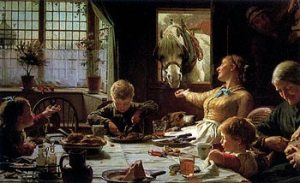
For parents with small children, order sometimes comes from laying down the law. The following are household rules patterned in style after Levitical Law, taken from A Prarie Home Companion.
Laws of Forbidden Places
Of the beasts of the field, and of the fishes of the sea, and of all foods that are acceptable in my sight you may eat, but not in the living room.
Of the hoofed animals, broiled or ground into burgers, you may eat, but not in the living room.
Of the cereal grains, of the corn and of the wheat and of the oats, and of all the cereals that are of bright color and unknown provenance you may eat, but not in the living room.
Of quiescently frozen dessert and of all frozen after-meal treats you may eat, but absolutely not in the living room.
Of the juices and other beverages, yes, even of those in sippy-cups, you may drink, but not in the living room, neither may you carry such therein.
Indeed, when you reach the place where the living room carpet begins, of any food or beverage there you may not eat, neither may you drink.
But if you are sick, and are lying down and watching something, then may you eat in the living room.
Laws When at Table
And if you are seated in your high chair, or in a chair such as a greater person might use, keep your legs and feet below you as they were.
Neither raise up your knees, nor place your feet upon the table, for that is an abomination to me. Yes, even when you have an interesting bandage to show, your feet upon the table are an abomination, and worthy of rebuke.
Drink your milk as it is given you, neither use on it any utensils, nor fork, nor knife, nor spoon, for that is not what they are for; if you will dip your blocks in the milk, and lick it off, you will be sent away from my presence.
When you have drunk, let the empty cup then remain upon the table, and do not bite it upon its edge and by your teeth hold it to your face in order to make noises in it sounding like a duck: for you will be sent away from my presence.
When you chew your food, keep your mouth closed until you have swallowed, and do not open it to show your brother or your sister what is within; I say to you, do not so, even if your brother or your sister has done the same to you.
Eat your food only; do not eat that which is not food; neither seize the table between your jaws, nor use the raiment of the table to wipe your lips. I say again to you, do not touch it, but leave it as it is.
And though your stick of carrot does indeed resemble a marker, draw not with it upon the table, even in pretend, for we do not do that, that is why.
And though the pieces of broccoli are very like small trees, do not stand them upright to make a forest, because we do not do that, that is why.
Sit just as I have told you, and do not lean to one side or the other, nor slide down until you are nearly slid away. Heed me; for if you sit like that, your hair will go into the syrup. And now behold, even as I have said, it has come to pass.
Laws Pertaining to Dessert
For we judge between the plate that is unclean and the plate that is clean, saying first, if the plate is clean, then you shall have dessert.
But of the unclean plate, the laws are these: If you have eaten most of your meat, and two bites of your peas with each bite consisting of not less than three peas each, or in total six peas, eaten where I can see, and you have also eaten enough of your potatoes to fill two forks, both forkfuls eaten where I can see, then you shall have dessert.
But if you eat a lesser number of peas, and yet you eat the potatoes, still you shall not have dessert; and if you eat the peas, yet leave the potatoes uneaten, you shall not have dessert, no, not even a small portion thereof.
And if you try to deceive by moving the potatoes or peas around with a fork, that it may appear you have eaten what you have not, you will fall into iniquity. And I will know, and you shall have no dessert.
On Screaming
Do not scream; for it is as if you scream all the time. If you are given a plate on which two foods you do not wish to touch each other are touching each other, your voice rises up even to the ceiling, while you point to the offense with the finger of your right hand; but I say to you, scream not, only remonstrate gently with the server, that the server may correct the fault.
Likewise if you receive a portion of fish from which every piece of herbal seasoning has not been scraped off, and the herbal seasoning is loathsome to you and steeped in vileness, again I say, refrain from screaming. Though the vileness overwhelm you, and cause you a faint unto death, make not that sound from within your throat, neither cover your face, nor press your fingers to your nose. For even I have made the fish as it should be; behold, I eat it myself, yet do not die.
Concerning Face and Hands
Cast your countenance upward to the light, and lift your eyes to the hills, that I may more easily wash you off. For the stains are upon you; even to the very back of your head, there is rice thereon.
And in the breast pocket of your garment, and upon the tie of your shoe, rice and other fragments are distributed in a manner beyond comprehension.
Only hold yourself still; hold still, I say. Give each finger in its turn for my examination thereof, and also each thumb. Lo, how iniquitous they appear. What I do is as it must be; and you shall not go hence until I have done.
Various Other Laws, Statutes, and Ordinances
Bite not, lest you be cast into quiet time. Neither drink of your own bath water, nor of the bath water of any kind; nor rub your feet on bread, even if it be in the package; nor rub your feet against cars, not against any building; nor eat sand.
Leave the cat alone, for what has the cat done, that you should so afflict it with tape? And hum not the humming in your nose as I read, nor stand between the light and the book. Indeed, you will drive me to madness. Nor forget what I said about the tape.
Complaints and Lamentations
O my children, you are disobedient. For when I tell you what you must do, you argue and dispute hotly even to the littlest detail; and when I do not accede, you cry out, and hit and kick. Yes, and even sometimes do you spit, and shout “stupid-head” and other blasphemies, and hit and kick the wall and the molding thereof when you are sent to the corner. And though the law teaches that no one shall be sent to the corner for more minutes than he has years of age, yet I would leave you there all day, so mighty am I in anger. But upon being sent to the corner you ask straightaway, “Can I come out?” and I reply, “No, you may not come out.” And again you ask, and again I give the same reply. But when you ask again a third time, then you may come out.
Hear me, O my children, for the bills they kill me. I pay and pay again, even to the twelfth time in a year, and yet again they mount higher than before. For our health, that we may be covered, I give six hundred and twenty talents twelve times in a year; but even this covers not the fifteen hundred deductible for each member of the family within a calendar year. And yet for ordinary visits we still are not covered, nor for many medicines, nor for the teeth within our mouths. Guess not at what rage is in my mind, for surely you cannot know.
For I will come to you at the first of the month and at the fifteenth of the month with the bills and a great whining and moan. And when the month of taxes comes, I will decry the wrong and unfairness of it, and mourn with wine and ashtrays, and rend my receipts. And you shall remember that I am that I am: before, after, and until you are twenty-one. Hear me then, and avoid me in my wrath, O children of me.
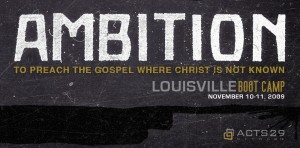
I’ve been listening to the audio of sessions from Acts 29 Network’s 2009 Bootcamp: Ambition. While not everyone will find these talks of interest, I think they are challenging and stimulating for those of us in ministry and church leadership.
Ministry for the Long Haul & Ambition (Matt Chandler)
Acts 29 is a missional church planting network of Reformed Evangelicals. Each year they hold Boot Camps to train and re-energize like minded church planters and church leaders. Many of these, and other, talks are available on the Resource section of thier web page.
The more things have changed, some things have remained the same. Such is the case for Christians in a typical church.
When Samuel Blair assumed the pulpit of Faggs Manor Presbyteran Church in 1740 he found a congregation in a spiritual condition not uncommon even in our day. Blair wrote that when he came to the church he found many good religious people who performed their religious obligation rather well. Yet they were, in his estimation, somewhat formal and unenthusiastic:
If they performed these duties pretty punctually in their seasons and, as they thought, with good meaning, out of conscience, and not just to obtain a name for religion among men, then they were ready to conclude that they were truly and sincerely religious. A very lamentable ignorance of the main essentials of true practical religion, and the doctrines nearly relating thereunto very generally prevailed. The nature and necessity of the new birth was but litle known or thought of, the necessity of a conviction of sin and misery, by the Holy Spirit’s opening and applying the law to the conscience, in order to a saving closure with Christ, was hardly known at all to most. It was thought, that if there was any need of a heart-distressing sight of the soul’s danger, and fear of divine wrath, it wa only needed for the grosser sort of sinners; and for any others to be deeply exercised this way (as might in some rare instances observable), this was generally looked upon to be a great evil and temptation that had befallen those persons. The common names for such soul-concern were, melancholy, trouble of mind, or despair. These terms were common, so far as I have been acquainted, indifferently used as synonymous; and trouble of mind was looked upon as a great evil, which all persons that made any sober profession and practice of religion ought carefully avoid. …There was scarcely any suspicion at all, in general, of any danger of depending upon self-righteousness, and not upon the righteousness of Christ alone for salvation. Papists [Roman Catholics) and Quakers would be readily acknowldeged guilty of this crime, but hardly any professed Presbyterian. The necessity of being first in Christ by a vital union, and in a justified state, before our religious services can be well pleasing and acceptable to God, was very little understood or thought of; but the common notion seemed to be, that if people were aiming to be in the way of duty as well as they could, at they imagined, there was no reason to be much afraid.
[Source: The Forming of an American Tradition: A Re-Examination of Colonial Presbyterianism, by Leonard J. Trinterud; Westminster Press, 1959; pp. 77-78]
“The Bible’s purpose is not so much to show you how to live a good life. The Bible’s purpose is to show you how God’s grace breaks into your life against your will and saves you from the sin and brokenness otherwise you would never be able to overcome…”
“Christians have made the gospel about so many things… Things other than Christ.” So opens the document, written by Leonard Sweet and Frank Viola, titled: A Jesus Manifesto.
I’ve long been a fan of Leonard Sweet, our theological differences aside. But Sweet’s love for Jesus, his love for God’s people, and his amazing story-telling ability make his books and articles a pleasure to read. Besides, I’ve not found our differences to come up that frequently in the things he writes. His focus is spirituality, not systematic theology. At the very least Sweet always makes me think – and often makes me laugh.
I don’t know as much about Frank Viola. I’ve heard of him, but I don’t recall having ever read anything he has written – at least nothing before A Jesus Manifesto.
But as I read through this manifesto I found I appreciated the heart of both men. I also appreciate their effort to put into words something that needs to be said in this generation. Paraphrasing the words of the old hymn, we need to “Turn our Eyes upon Jesus.”
To read the document click the link above. On that blog you will also find links to download the document in .pdf, listen to the authors read their manifesto, and listen to Steve Brown interview the authors at Steve Brown, Etc. Facebook users will also find a link to a group page discussing the manifesto.
“Prayer mirrors the gospel. In the gospel, the Father takes us as we are because of Jesus and gives us his gift of salvation. In prayer, the Father receives us as we are because of Jesus and gives us the gift of help. We look at the inadequacy of our praying and give up, thinking something is wrong with us. God looks at the adequacy of his Son and delights in our sloppy, meandering prayers.”
From time to time a new and faithful expression of faith is necessary. I am not speaking of a new faith, or of new doctrines, but of the historic Christian faith prophetically applied to current and world events. Such a statement of faith has recently been produced: The Manhattan Declaration.
The Manhattan Declaration is a collective affirmation of fundamental Truths shared by Evangelicals, Roman Catholics, and Eastern Orthodox Christians living in the United States. In particular, this declaration addresses:
Sanctity of Human Life
Sanctity of Marriage
Rights of Conscience and Religious Liberty
Some may question why believers who hold some vastly different perspectives would join together and unite their voices to address these social issues. On the other hand, why would they not? These issues that both result from and contribute to our social decay are intolerable and need to be addressed. Francis Schaeffer referred to such joint operations as “co-beligerence”.
This afternoon I signed my name to this declaration. While I don’t presume anyone really cares what I sign, or even what I think, it was a way for me to lend my voice to an effort that needs to be heard. I invite you to check it out – and sign-on, if you share the concerns and agree to these solutions.
It may defy common wisdom, but sound doctrine is important to the renewal of the contemporary church. While many view doctrine as divisive and unecesary trivia, recent studies by Thom Rainer, Ed Stetzer, and others, reveal that sound doctrine is a hallmark of churches that are the most effective in evangelism. Further, both writers, in addition to Collin Hansen’s experience, suggest that open discussion about sound doctine is what younger, unchurced spiritual seekers are clamoring for. So while it may defy common wisdom, we also need to remember that some things are more common than wise.
The following is a short article by 19th Century Anglican Bishop, J.C. Ryle, who makes the case for the necessity of sound teaching in our lives and ministries. See what you think.
***
The times require distinct and decided views of Christian doctrine. I cannot withhold my conviction that the professing Church is as much damaged by laxity and indistinctness about matters of doctrine within, as it is by skeptics and unbelievers without. Myriads of professing Christians nowadays seem utterly unable to distinguish things that differ. Like people afflicted with color–blindness, they are incapable of discerning what is true and what is false, what is sound and what is unsound. If a preacher of religion is only clever and eloquent and earnest, they appear to think he is all right, however strange and heterogeneous his sermons may be. They are destitute of spiritual sense, apparently, and cannot detect error. The only positive thing about them is that they dislike distinctiveness and think all extreme and decided and positive views are very naughty and very wrong!
These people live in a kind of mist or fog. They see things unclearly, and do not know what they believe. They have not made up their minds about any great point in the Gospel, and seem content to be honorary members of all schools of thought. For their lives they could not tell you what they think is truth about justification, or regeneration, or sanctification, or the Lord’s Supper, or baptism, or faith or conversion, or inspiration, or the future state. They are eaten up with a morbid dread of controversy and an ignorant dislike of party spirit; and yet they really cannot define what they mean by these phrases. And so they live on undecided; and too often undecided; they drift down to the grave, without comfort in their religion, and, I am afraid, often without hope. (more…)
The first and worst cause of error that prevails in our day is spiritual pride. This is the main door by which the devil comes into the hearts of those who are zealous for the advancement of Christ. It is the chief inlet of smoke from the bottomless pit to darken the mind and mislead the judgment, and the main handle by which Satan takes hold of Christians to hinder a work of God. Until this disease is cured, medicines are applied in vain to heal all other diseases.
Pride is much more difficult to discern than any other corruption because, by nature, pride is a person having too high a thought of himself. Is it any surprise, then, that a person who has too high a thought of himself is unaware of it? He thinks the opinion he has of himself has just grounds and therefore is not too high. As a result, there is no other matter in which the heart is more deceitful and unsearchable. The very nature of it is to work self-confidence and drive away any suspicion of evil respecting itself.
Pride takes many forms and shapes and encompasses the heart like the layers of an onion- when you pull off one layer, there is another underneath. Therefore, we need to have the greatest watch imaginable over our hearts with respect to this matter and to cry most earnestly to the great searcher of hearts for His help. He who trusts his own heart is a fool. (more…)
A few days ago I penned a post suggesting that we consider the Christian Life through a different paradigm than what I believe is ordinary. I suggested the the fundamental gauge ought to be Humble vs. Proud, rather than Good vs. Bad and/or Right vs. Wrong. I have received several positive responses, and I have been asked a couple times for some clarification.
While I suspect few, if any, would suggest that Humble vs. Proud is not a valid grid, I understand how some might find it a bit audacious to say it should be the fundamental, or primary grid. What makes this the predominant paradigm?
Humble vs. Proud is the grid within which these other standards fit.
Let me explain:
First, Christianity is a substantive faith. Doctrine is the way we express and transfer the substance of Truth. So Right vs. Wrong is an important concept; an indispensible concept. But God tells us that there is a knowledge that merely “puffs up”, a knowledge that may be true but which is not helpful. It is not the substance of truth that it the problem. The problem is the condition of the heart that is receiving and processing this truth.
What is interesting is that understanding Truth also promotes humility. Paraphrasing C.J. Mahaney: “Humility is seeing ourselves in right relation to God.” In other words, the more we understand about God and about ourselves the more humble we wil feel. But paradoxically, before Truth produces humility the heart must already be humble before God.
Second, James tells us that we are known by our actions; that Faith without works is dead. This underscores the importance of Good vs. Bad. But our actions can be deceiving. Not only can we deceive others by our actions, but we often deceive ourselves. Many people think of themselves as being loved by God because of their actions. But this often stems from a false sense of righteousness. God tells us that our best efforts, if they are not generated from faith and a love for God, are as appealing as a filthy rag. And Jesus spoke to a group of people telling them that despite their “good deeds” he had no relationship with them. (See Matthew 7.21-23)
Again, while both the Good vs. Bad and Right vs. Wrong paradigms are important, and have their place, I still suggest that Humble vs. Proud is the most fundamental. Against this paradigm there is no warning. And it is only within this paradigm that the others get their meaning.
“To become more like Jesus is to feel increasingly unable to do life, increasingly wary of your heart. Paradoxically, you get holier while you are feeling less holy. The very thing you were trying to escape – your inability – opens the door to prayer and then grace.”
Do you know the Christ of the Gospels? Or have you fallen into the trap to which Christians (especially, perhaps, Reformed Christians) who love doctrine and systematic theology are sometimes susceptible (unlike John Calvin, it should be said): fascination with dogmatic formula at the expense of love for the Savior’s person?










 GRACE & PEACE
