Why So Afraid?

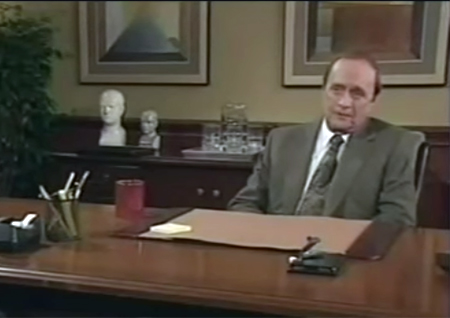
Bob Newhart, in his classic comedy sketch, “Stop It!“, plays a psychologist who offers unusual therapy to his patients.  The patient in this particular sketch is a woman who expresses fear of being buried alive in a box. She laments that her fear is affecting, even debilitating, her in her day to day life – her ability to go through tunnels, to be in elevators, or even to be in other kinds of enclosed or “boxy” spaces. Newhart’s hilariously, insensitive, practical counsel: “Stop It!! You don’t want to go through life being scared of being buried alive in a box, do you? I mean, that sounds … frightening.”

Dan Allender, in The Cry of the Soul, describes fear:

Fear is like a manipulative con man, seeming like it only has your best interests at heart, but lies to us, and distorts the truth, and in the end warps our thinking, robs us of our understanding of reality.

Allender goes on to describe some of the negative effects un-checked fear can cause us in our day to day lives:

“Fear erodes our relationships with others and with God, causes us feel abandoned and alone.”

“Fear makes us focus on the worst possible outcome. It is not necessarily wrong, but it never gives us the whole picture.”

So…

The Word Snatchers

I am not alone in lamenting the foolishness and the ugliness of “cancel culture”. Expressions of “cancel culture” take many forms, from outright shunning, to virtue signaling, to quiet but pretentious attitudes of superiority and self-righteousness simply because one sees himself or herself on a particular side of a cultural issue.

Among the more foolish and frustrating consequences of the cancel culture phenomena is the misuse and abuse of certain words – words which, of themselves, are perfectly good and useful, but which for any number of reasons are hijacked from their actual meanings and used as weapons of cultural warfare.

My old friend, Randy Nabors, offers some wise words reflecting upon this unfortunate and misguided trend in a post he titled The Word Snatchers:

Watch out for the word snatchers, these thieves of beautiful and important words. They sloganize to demonize, so as to thought despise. By taking words out of context, (and context is everything) they label to divide. The tactic is simplistic so the simple minded and the gullible will hear “signal” words and assume they have met the enemy. This is propaganda so the target’s very words become weaponized against them. Remember, even the word God is a bad word in the Devil’s mouth, he refers to God often enough in his lies, but his use doesn’t make God bad or his name less than glorious.

Take a word like justice, add the word social to it (which is a bit redundant since all justice is “social” in that it is only revealed in relationship to others-between God and man, and between persons) and then associate it with causes one might despise, and you have taken one of the attributes of God and made it something to belittle and fear.

These word thieves have taken away diversity, equity, and inclusion as if they were bad words when they are in fact artifacts of love, kindness, and reconciliation. It is their context which matters, who is being included for what purpose? I speak as a Christian, I don’t want sin in the camp, I don’t want to open the door to evil, so I discriminate based on the Truth (God’s word) but not on the basis of skin color. I can be discriminatory without practicing discrimination.

These deceivers have tried to steal away our use of the word empathy. Now they seek to steal the word missional. Just associate it with liberals and it gets caught in our mouths. We become suspicious of those who use such words, we stop using the words ourselves lest we become suspect. The insidious and pharisaical word police have used social media to such powerful effect that we have failed to keep our cool under fire, we wilt under the onslaught of false associations and ad hominem arguments.

Let this storm of slanted dribble pass you by; false association is the same as slander, it is a lie. Just define what you mean, and mean what you say, and take time to think, time to listen, time to understand, time to explain. Show some grace by asking, “what do you mean by that?” instead of being guided by political presuppositions. We live in an age of demogaugic denouncing for propagandic and political posturing to belittle and thus divide, by twits who tweet. We have abandoned wisdom for the clever, and abandoned analysis for instant reaction in the name of idealogical self-protection.

It is time to have the mind of Christ, and to think, and not lose our minds.

Those Blasted Presbyterians

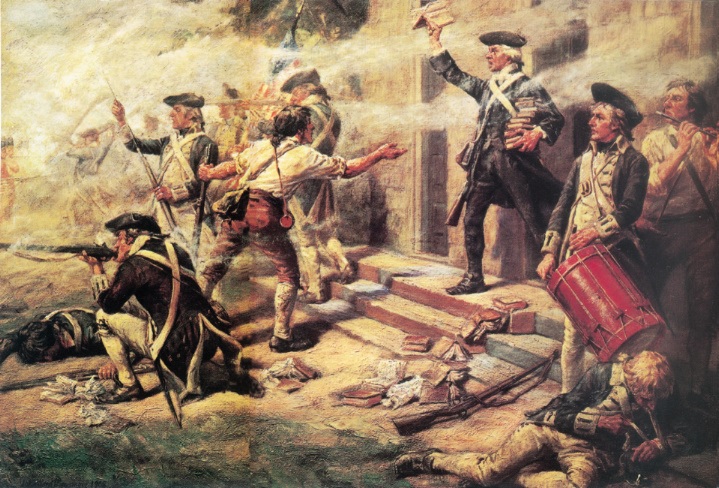
Around the same time, Horace Walpole spoke from the English House of Commons to report on these “extraordinary proceedings” in the colonies of the new world.  “There is no good crying about the matter,” he said.  “Cousin America has run off with the Presbyterian parson, and that is the end of it.”

The parson of which he spoke, was  John Witherspoon—a Presbyterian minister, as well as a descendant of John Knox.  At the time, Witherspoon was president of the College of New Jersey (now Princeton).  He was also the only clergyman to sign the Declaration of Independence.

From the English perspective, the American revolution was often perceived as a “Presbyterian Rebellion.”  And its supporters were often disdained as “those blasted Presbyterians.”

The Presbyterian Revolution
Most American Christians are unaware of the fact that the American Revolution, as well as the new American state, was greatly shaped by Presbyterians and the Calvinism that was at its root.  Some modern-day  Presbyterians have moved light years away from the convictions of these early colonists.

An estimated three million people lived in the colonies at the time of the Revolutionary War.  Of that number, “900,00 were of Scotch or Scotch-Irish origin, 600,000 were Puritan English, while over 400,000 were of Dutch, German Reformed and Huguenot descent. That is to say, two thirds of our Revolutionary forefathers were trained in the school of Calvin.”  (Carlson, p. 19)

As one historian puts it, “When Cornwallis was driven back to ultimate retreat and surrender at Yorktown, all of the colonels of the Colonial Army but one were Presbyterian elders. It is estimated that more than one half of all the soldiers and officers of the American Army during the Revolution were Presbyterian.” (Carlson, p. 16)

To the man, Presbyterian clergy joined the Colonialist cause. It was said that many of them led the Revolution from the pulpit.  In doing so, they paid a heavy price for their support for independence.  Many lost family members or their own lives.  Some had their churches burned to the ground.

The Presbyterian Drive
We forget that many of the early American colonists had left England precisely because Presbyterian Christianity was rejected.  After its brief reign as the established church through the English Civil War and the work of the Westminster Assembly, Britain returned to Anglicanism.  Thousands of non-conforming Presbyterian ministers were then ejected from their churches.  Some, such as the Covenanters, were martyred in a period that came to be known as “the killing times.” Rigid laws of conformity drove many to seek a better life somewhere else.  After 1660, many Presbyterians began to make their way to the colonies in North America.  It was these individuals who brought a new strength to the colonies as they inched their way forward towards independence.

They had little loyalty, and often outright hostility, to the crown of England.  They were armed with the theology of John Calvin, mediated through John Knox, and solidified during the English Civil war. It was a theology which devalued the divine right of human kings, and elevated the worth and dignity of the individual under God.  This theology shaped the early American understanding of civil liberty.

It shaped our founding fathers. The idea of human equality which influenced John Locke, who in turn,  influenced our founding fathers, was learned from the Puritans. Locke’s father had been on Cromwell’s side during the English Civil war.

It also shaped the general population under the influence of the Great Awakening. The Great Awakening was a massive 18th century religious revival that shook the colonies. It was promoted by preachers such as Gilbert Tennent and George Whitfield who travelled up and down the coast calling for a return to a robust Christian and Biblical faith.  Emphasizing the new birth and a Calvinist theology, the Great Awakening had an immense influence on colonial sentiments in the generation just preceding the American Revolution.

Consider then, some of what was at work in the American consciousness preceding the revolution. There was the memory of their horrid experience in England. There was the worry that Anglicans would establish this same kind of church in the colonies. There was a persistent fear of the imposition of bishops who were viewed as “holy monarchs,”  (monarchy in any form was considered bad)!  There was a belief in the absolute sovereignty of God. God alone is Lord of all and the author of liberty. There was a corresponding belief in the absolute equality of individuals (king and peasant, clergy and laity) under God’s law. There was the belief that no human should be entrusted with absolute power, given our radically fallen human nature.  There was a belief that there should be a separation of powers in any new government that is established.  And because of their experience in England, there was the belief that religious freedom and freedom of conscience should be respected.

In other words, for these Presbyterians, liberty is affirmed, but it is not an absolute liberty. It is always to be lived out under the sovereign creator God. It was this theology, a theology rooted, not just in Calvin, but in the Bible, which ultimately gave the colonialist the will to resist.

The Presbyterian Legacy
So this year, as we celebrate our independence once again, and as we think of early American courage, and the genius of our founding fathers, let us not forget those blasted Presbyterians who sought to understand liberty in light of the Bible.  A liberty which conceived of a nation and its entire government under God.

***

NOTE: This piece was originally written by Don Sweeting and posted on his old blog, The Chief End of Man, on July 4, 2014.

Sources:  Our Presbyterian Heritage, Paul Carlson (Elgin:  David C. Cook, 1973)Presbyterians: Their History and Beliefs, Walter L. Lingle and John W. Kuykendall, (Atlanta:  John Knox Press, 1988), The Emergence of Liberty in the Modern World, Douglas F. Kelly, (Phillipsburg, New Jersey:  P&R Publishing, 1992)
A Prayer for the Fourth of July

It is for freedom that Christ has set us free. Stand firm, then, and do not let yourselves be burdened again by a yoke of slavery.” ~ Galatians 5.1

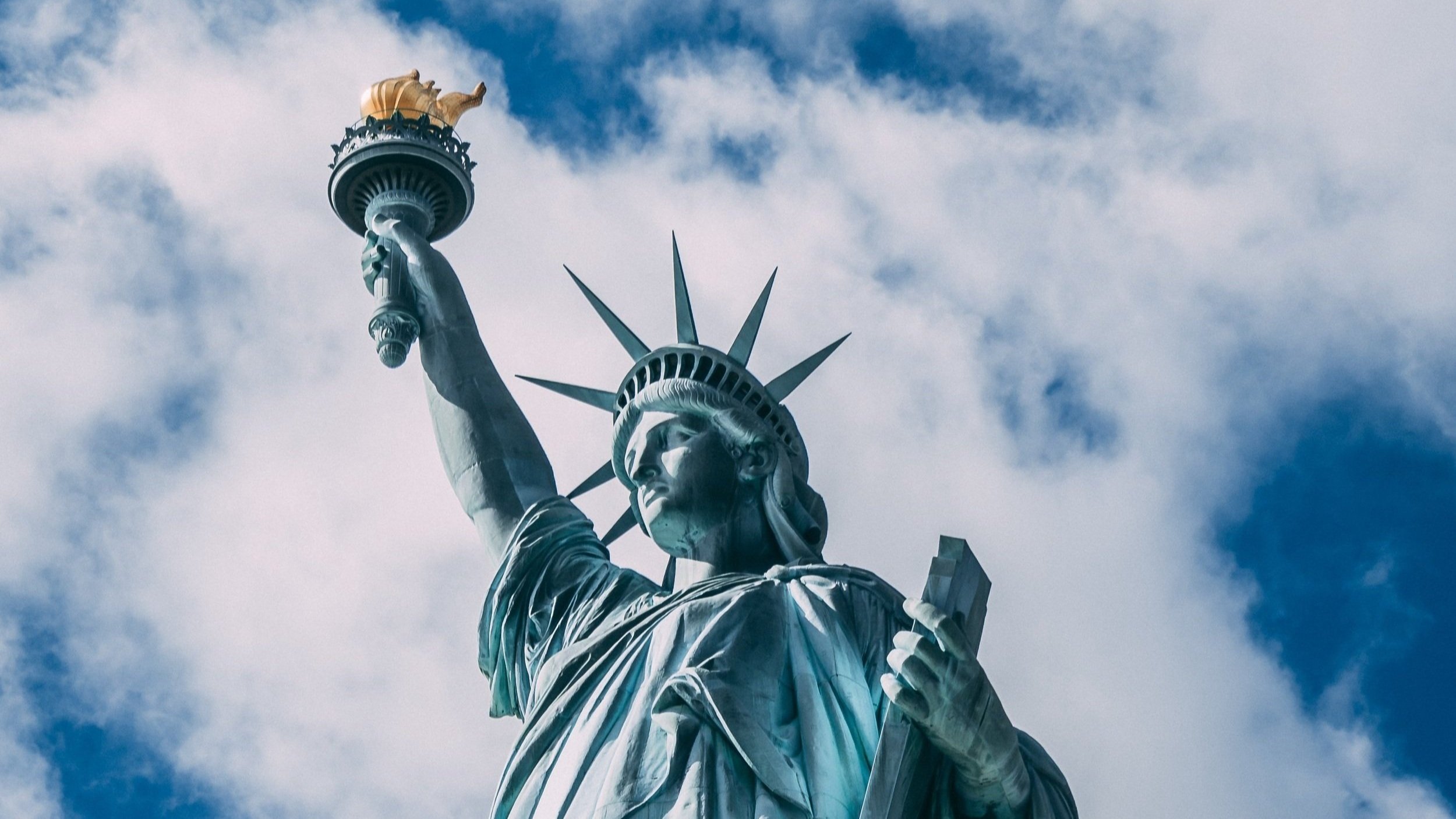
Lord Jesus, it’s the Fourth of July – a holiday set aside to remember and revel in the freedom we enjoy as citizens of America. As broken as she is, we’re still thankful for our country and for the privileges we enjoy.

But the gratitude we feel for our USA citizenship pales in comparison with the joy generated by our citizenship in heaven. (Philippians 3.20) We praise you today for making us members of the “chosen people, a royal priesthood, a holy nation, God’s special possession“. (1 Peter 2.9) This is our true and lasting identity – our consummate passport and eternal liberty.

Indeed, Jesus, only those you set free are really free. (John 8.36) You took our guilt and gave us your righteousness. We’re no longer condemned for our sin or in fear of death. Hallelujah! Sin’s dominion has been broken in our lives; never again will it be our master. (Romans 6.14) We obey you because we love you – not because of pride, pressure, or pragmatics. Holiness is beautiful, and no longer a burden.

We get to run freely and boldly to the throne of grace – into your holy presence, where we only experience your welcome and joy. We’re free to own our sin and brokenness, and to repent with joy, for you bore our shame and we don’t have to pose or pretend anymore. Three Hallelujahs, for that!

You’ve set us free from seeking fool’s gold and a fool’s reward, by making us characters in, and carriers of, your story. Our tiny fiefdoms of self have been crushed under the grace of your all-things-new kingdom. We’re now free to love others as you love us – forgiving and forbearing, encouraging and hoping. Take us WAY deeper into this particular freedom, Jesus.

By the power of the gospel, we will seek to stand firm in these and the many more freedoms you’ve won for us, until the Day you return to usher in the new heaven and new earth. So very Amen we pray, in your liberating and loving name.

***

NOTE: This prayer was originally composed by Scotty Smith for The Gospel Coalition (7/4/16)