Here We Stand: An Evangelical Declaration on Marriage

Image processed by CodeCarvings Piczard ### FREE Community Edition ### on 2015-06-25 18:32:21Z | http://piczard.com | http://codecarvings.comÞâÚÙÝÿþÿýüþ¸ÏÀÿž¸¨ÿ”l²i¥W€0»

After the U.S. Supreme Court’s ruling on marriage yesterday, a diverse coalition of Evangelical leaders, gathered by the Ethics & Religious Liberty Commission, drafted and released the following statement.  Had I been asked – and if I am asked – I would gladly add my name.  ~ WDG

***

As evangelical Christians, we dissent from the court’s ruling that redefines marriage.

The state did not create the family, and should not try to recreate the family in its own image. We will not capitulate on marriage because biblical authority requires that we cannot. The outcome of the Supreme Court’s ruling to redefine marriage represents what seems like the result of a half-century of witnessing marriage’s decline through divorce, cohabitation, and a worldview of almost limitless sexual freedom. The Supreme Court’s actions pose incalculable risks to an already volatile social fabric by alienating those whose beliefs about marriage are motivated by deep biblical convictions and concern for the common good.

The Bible clearly teaches the enduring truth that marriage consists of one man and one woman.

From Genesis to Revelation, the authority of Scripture witnesses to the nature of biblical marriage as uniquely bound to the complementarity of man and woman. This truth is not negotiable. The Lord Jesus himself said that marriage is from the beginning (Matt. 19:4-6), so no human institution has the authority to redefine marriage any more than a human institution has the authority to redefine the gospel, which marriage mysteriously reflects (Eph. 5:32). The Supreme Court’s ruling to redefine marriage demonstrates mistaken judgment by disregarding what history and countless civilizations have passed on to us, but it also represents an aftermath that evangelicals themselves, sadly, are not guiltless in contributing to. Too often, professing evangelicals have failed to model the ideals we so dearly cherish and believe are central to gospel proclamation.

Evangelical churches must be faithful to the biblical witness on marriage regardless of the cultural shift.

Evangelical churches in America now find themselves in a new moral landscape that calls us to minister in a context growing more hostile to a biblical sexual ethic. This is not new in the history of the church. From its earliest beginnings, whether on the margins of society or in a place of influence, the church is defined by the gospel. We insist that the gospel brings good news to all people, regardless of whether the culture considers the news good or not.

The gospel must inform our approach to public witness.

As evangelicals animated by the good news that God offers reconciliation through the life, death, and resurrection of His Son, Jesus, we commit to:

  • Respect and pray for our governing authorities even as we work through the democratic process to rebuild a culture of marriage (Romans 13.1-7);
  • teach the truth about biblical marriage in a way that brings healing to a sexually broken culture;
  • affirm the biblical mandate that all persons, including LGBT persons, are created in the image of God and deserve dignity and respect;
  • love our neighbors regardless of whatever disagreements arise as a result of conflicting beliefs about marriage;
  • live respectfully and civilly alongside those who may disagree with us for the sake of the common good;
  • cultivate a common culture of religious liberty that allows the freedom to live and believe differently to prosper.

The redefinition of marriage should not entail the erosion of religious liberty.

In the coming years, evangelical institutions could be pressed to sacrifice their sacred beliefs about marriage and sexuality in order to accommodate whatever demands the culture and law require. We do not have the option to meet those demands without violating our consciences and surrendering the gospel. We will not allow the government to coerce or infringe upon the rights of institutions to live by the sacred belief that only men and women can enter into marriage.

The gospel of Jesus Christ determines the shape and tone of our ministry.

Christian theology considers its teachings about marriage both timeless and unchanging, and therefore we must stand firm in this belief. Outrage and panic are not the responses of those confident in the promises of a reigning Christ Jesus. While we believe the Supreme Court has erred in its ruling, we pledge to stand steadfastly, faithfully witnessing to the biblical teaching that marriage is the chief cornerstone of society, designed to unite men, women, and children. We promise to proclaim and live this truth at all costs, with convictions that are communicated with kindness and love.

***

To read the original post, and to find the names of the signatories, click: Here We Stand

Some Thoughts After the Supreme Court Ruling on Marriage

Star Gazing

With a landmark decision, and a monumental example of judicial overreach, the U.S. Supreme Court this morning announced their decision regarding same-sex-Marriage. By the awesome power vested in just five people, marriage has been redefined in our land.  This decision will continue to shake our cultural landscape for years to come, with the aftershocks of both unintended consequences (by some) and intentional-but-hidden agendas (of others).

While some who know me, or who read this blog, may assume my chagrin is in the validation of same-sex-marriage, it is actually far greater regarding the other implications related to this decision.  I am opposed to same-sex-marriage, on the grounds that it is clearly not in line with the design and decree of the Lord of Heaven and Earth.  So I am disappointed, though not surprised, by this decision.  But if this is the law of the land where I live, I can live with it being the law – as long as I am not compelled to comply. It is no greater difficulty than the first century apostles, and other Christians, faced in Rome, Corinth, Ephesus, and other ancient pagan territories.  What concerns me more is that I now live in a land where we officially believe that “Rights” are not endowed by our Creator, but rather bestowed by the government.  This is a very treacherous problem – especially in this case where it was not even by a democratic process; and where there is no court of appeal.

Think about it for a moment.  In Nazi Germany the government decided that those who were Jewish had no rights, and that the government had the right to exterminate them simply because they were Jews.  In the Antebellum South, those of African decent had no rights – with relative few exceptions – and were thus allowed to be held enslaved.  Some may argue that this example, especially the latter one, illustrates why the court decision this morning is a corrective, granting freedom to a group of people to marry who were previously denied that “right”.  But look at the root. Both illustrations are similar to the court ruling, all assuming that “rights” are bestowed by the government.  Yet if this is correct, that rights do come from the government, then why would one argue that the institution of slavery was so reprehensible?  Was it not the law of the land? Government dictating who had rights an who did not?  If one argues that the government has the inherent authority to determine rights, then what makes it appropriate to decry the decisions they make about who has rights and who has not?  If a government has the authority to determine who has rights and who does not, then what makes it morally wrong for a government to decide to eradicate some group it determines undesirable?

No, I have no sympathy for the institution of slavery, nor do I support any practice of genocide.  My point is not that the government should not be the protector of rights, but rather that it is not government that is the originator of any rights.  All good governments must protect the rights of all its citizens!  But what a “right” is is not ultimately determined by the government.  As Jefferson (with help from Franklin) wisely assessed and asserted, “rights are endowed by the Creator”, not by the throne of government.

In April, Justice Anthony Kennedy seemed to grasp the weightiness:

“This definition [of marriage] has been with us for millennia, and it’s very difficult for the court to say, ‘Well, we know better’”.

In the end Kennedy must not have found it all that difficult.  By siding with the majority, Kennedy essentially declares: “Well, we do know better.”

In response to the decision, in his published dissent, Chief Justice John Roberts writes:

If you are among the many Americans – of whatever sexual orientation – who favor expanding same-sex marriage, by all means celebrate today’s decision. Celebrate the achievement of a desired goal. Celebrate the opportunity for a new expression of commitment to a partner. Celebrate the availability of new benefits. But do not celebrate the Constitution. It had nothing to do with it.

While there is a sense that I appreciate these words, it still leaves me  – and others like me – with a practical dilemma: How should those of us who disagree with this decision – whether on its own merits, or because of the ripple effects that it will engender in days ahead, or both – how should we respond?  Especially as a Christian, how ought I respond?  Roberts’ words are merely philosophical and political.  They offer nothing practical to the question: So What Now?

My sincere hope is that I will, now and eventually, act faithfully to God, and lovingly to my neighbors (whether I am in agreement with them or not). In short, I hope in time to gain both perspective and wisdom – and wise perspective.  One thing I keep reminding myself is that God is still in control.  And while I mull over the realities of the day, I am also finding some food for thought in the counsel of some others:

Continue reading

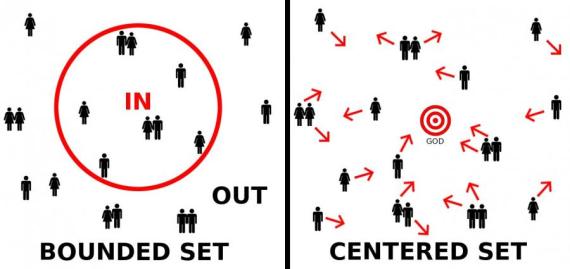
Bounded-Set vs Centered-Set

Bounded-vs-Centered-Set

Some time back I posted a piece titled Numbering Those On the Ranch, exploring the concept of what missiologist Alan Hirsch refers to as a “centered-set” metric for evaluating a church.  More recently I stumbled across a post by Bob Thune, of Coram Deo Church in Omaha, explaining his understanding of Centered-Set verses the more traditional Bounded-Set metric. I appreciated what Thune had to say, so I wanted to post it, even if primarily for my own benefit, as a resource for future use.

***

There are two ways of thinking about social groupings: centered-set and bounded-set. These terms come to us from the field of mathematics (set theory). In recent years they’ve been applied more broadly by sociologists and missiologists. The fountainhead of most of this thinking in the Christian church was Paul Hiebert, a missiologist at Fuller Seminary.

Hiebert suggested that our minds categorize people according to either “bounded set” or “centered set” thinking:

Bounded Sets

  •  are formed by defining the boundaries – the essential qualities which separate something inside the set from something outside. Heibert’s classic example is “apples.” Either a fruit is an apple, or it isn’t.
  • Maintaining the boundary is crucial to maintaining the category.
  • Bounded sets are static sets – they don’t change, they only add or lose members.
  • The important thing is to “cross the boundary” to be part of the set.

Centered Sets

  •  are formed by defining a center. The set is made up of all objects moving toward that center. As an everyday example: “bald men.”
  • While a centered set does not focus on the boundary, a boundary does indeed exist. The boundary is clear so long as the center is clear.
  • The objects within a centered set are not categorically uniform. Some may be near the center and others far from it, even though all are moving towards the center.

Hiebert asserts that Americans tend to think almost exclusively in bounded-set categories. And this affects our understanding of Christian discipleship. We tend to “stress evangelism as the major task — getting people into the category. Moreover, we… see conversion as a single dramatic event — crossing the boundary between being a ‘non-Christian’ and being a ‘Christian’” (Hiebert, 1978).

Hiebert argues instead for a “centered-set” way of thinking about Christian conversion:

A Christian would be defined in terms of a center—in terms of who is God. The critical question is, to whom does the person offer his worship and allegiance? …Two important dynamics are recognized. First there is conversion, which in a centered set means that the person has turned around. He has left another center or god and has made Christ his center. This is a definite event—a change in the God in whom he places his faith. But, by definition, growth is an equally essential part of being a Christian. Having turned around, one must continue to move towards the center. There is no static state. Conversion is not the end, it is the beginning. We need evangelism to bring people to Christ, but we must also think about the rest of their lives. We must think in terms of bringing them to Christian maturity in terms of their knowledge of Christ and their growth in Christlikeness.

Theologically, I find some aspects of Hiebert’s argument poorly nuanced. He would do well to differentiate regeneration (the invisible, immediate work of the Holy Spirit on the soul, which is in fact a decisive event) from conversion (our experience of that event, which often feels more like a “process” than like a decisive moment). Those who have applied Hiebert’s set theory to individual salvation (Brian McLaren, for instance) have tended to drift in fuzzy doctrinal directions.

But I find Hiebert’s insights immensely helpful when applied to ecclesiology. This is where I first encountered the set-theory rubric, as applied by Alan Hirsch and Michael Frost in their 2003 book The Shaping of Things to Come. Frost and Hirsch argued for viewing the church as a centered set rather than a bounded set. Why not build a church by defining the center rather than patrolling the boundaries? Why not place the gospel of Jesus Christ at the center of the church’s life and practice, inviting everyone to reorient their lives around Him? In this way, we continually invite Christians into deeper and deeper discipleship, while also inviting non-Christians to deal with the claims of Jesus on their lives. As Hiebert himself acknowledges, this does not mean there is no boundary; there is just “less need to play boundary games and to institutionally exclude those who are not truly Christian. Rather, the focus is on the center and pointing people to that center” (Hiebert, 1978).

It is my personal conviction that: a) this is what the New Testament church did (see, for example, Galatians 1:6-9; Colossians 1:6; Romans 1:13-15); b) this is what it truly means to be a “gospel-centered” church; and c) this is the only way to have a truly missional church, where non-Christians are treated with true Christian hospitality AND are regularly being converted to faith in Jesus.