6 Ways Ministry Spouses Get Hurt By the Church

Endangered Pawn

Researcher Thom Rainer identifies Six Ways Ministry Spouses Get Hurt.  I have listed them below, slightly reworded:

  • Complaints About Their Minister-Spouses
  • Complaints About the Children
  • Unreasonable Expectations About Ministry Involvement
  • Gossip & Murmering
  • Isolation
  • Attacking the (non-Staff) Spouse to Get Desired Results

Every non-staff church leader should be aware of these. Every church member should be aware of these.  They are very real.  I have experienced all of these in one form or another, in one church or another.  I see these happen to friends serving other churches.  While I am fortunate that all of my children, now grown or in college, have not only continued in their faith journeys but have actually increased ministry involvement, such patterns of behavior are common contributors to the high numbers of ministry children leaving the church, if not also the faith.  The behaviors Rainer identifies are often devastating to ministry families.

For those serving in churches where you are experiencing some of these abuses, perhaps causing you concern for your spouse and children, I will share the counsel I received from a godly older minister during a time when our experience was most acute.  I was told: “If you don’t let it crush you, it won’t crush them (the children).  Don’t share details (with your children) – they likely already know.  But do talk with them, be honest about it, and make sure they understand that those in the church are also broken and sinful, just like those outside the church.”  Our children learned this lesson; they consequently have a pretty good grasp of Total Depravity and Luther’s concept of simul iustus et peccator (Simultaneously Just and Sinner) -even if they don’t necessarily know the term. But because they understand that even as believers – as those “credited” as “righteous” – we are all still infected by our own selfishness and sin, they have a greater appreciation of why we all are in need of Jesus’ redeeming grace.   Though the blood of Christ was shed “once for all”, bringing forgiveness, we all have an ongoing need for the blood of Christ to continually cleanse us from our sin.  Though shed “once for all”, a one-time shot of Jesus’ blood is not all there is.

I encourage you, whether on church staff or a church member, click the link above to read Rainer’s descriptions.  One important thing to note, Rainer does not limit this behavior against only the Pastor’s family; it happens, at one time or another, to almost all ministry families.  Check your own church to see if (where) this is happening. Then step up, and step in where necessary.

Chrysalis Factor

Chrysalis

There are times I feel somewhat like a sea captain who took charge of a ship that had experienced unprecedented prosperity under the direction of his predecessor, and then sprung a leak a few months into his tenure.  Don’t get me wrong, I love the church where I serve, but some of the challenges came as a bit of a surprise.  Chiefly a decline in attendance and a corresponding budgetary strain.

In some ways this was inevitable. In some ways this is circumstantial. And in other ways it is personal.

It was inevitable because nothing stays the same forever. No organization, or organism, experiences perpetual increase in prosperity.  Sooner or later, changes, challenges, and a period of decline is certain.

It is circumstantial, if for no other reason, the nature of the community where our church is located is a very fluid, very transient community, Many who live here are in the military, and so they are only here for a short time. Others who live here have retired – often early – and come to enjoy the wealth of cultural, historical, and natural amenities. However, there seems to be a pattern – when one member of the marriage, husband or wife, experience injury or become ill, the couple moves away, back home, or somewhere near their children.  Understandable. While Williamsburg is a beautiful place to settle, they have no roots here, so they move on.

It is personal in the sense that whenever a church changes pastors there is almost always some turnover among the members.  No matter how capable the new minister is, his presence is a constant reminder that things have changed; that this is not exactly the church that they had joined anymore.  And as American church culture becomes increasingly more consumeristic, the less likely folks are to stick around to get used to the changes.  After all, if they have to adjust to change, why not use it as an opportunity to trade in for a new model that has some amenities that they had not been looking for a few years ago, but would provide a pleasant upgrade.  Consequently new pastors are often not treated like people, who might have feelings, but rather as a commodity to be embraced or discarded at the whim of the customer.  Or another aspect of the personal – some church members just don’t like the new pastor’s personality (or lack of it).

I suspect differing measures of all three of these played a part in our initial decline.  Fortunately we remained stable. We have a good cohesive staff; wise and godly officers who work as a team, a band of brothers; and no panic or finger pointing from the congregation.  So despite our leak our ship has remained in pretty good shape.

As we move forward it is essential to assess where we are, and to map out where we are headed.

At present we are in what Thom Rainer calls the Chrysalis Period.  According to Rainer, during the Chrysalis Period a church or organization undergoes changes beneath the surface that are necessary to become what we will inevitably become.

The chrysalis is the pupa of a butterfly encased in a cocoon. It is the former caterpillar and the future butterfly. It is the stage when the worm-like, slow-moving caterpillar becomes a beautiful, free-flying butterfly.

I like the imagery.  It seems apt.  We are a work in process.  And not all that is going on is evident to all who take a look.

Three Times a Month

Abstract Trinity (Dumitru Verdianu)

Thom Rainer recently noted that there has been a marked change in the measure of comitment the average Christian had to his or her church. At least there has been a change in one measurable detail:

An active church member 15 years ago attended church three times a week. Now it’s three times a month

I do not know if this is an accurate assessment from some of Rainer’s research, or if this is more of an anecdotal hyberbole reflecting an evident trend. Regardless, I suspect that it is not far off base.

I also suspect there are some reasons. Among them would seem:

  • Baby Boomers Reaching Retirment Age
  • Rise of Churchless Christianity

10 Warning Signs of an Inwardly Obsessed Church

Researcher Thom Rainer warns of signs of a church that is so inwardly focused that it has ceased to be the church of Jesus Christ and has become, at best, a museum to (assumed) past glories, in which the membership makes up the board of directors.   Rainer writes:

Any healthy church must have some level of inward focus. Those in the church should be discipled. Hurting members need genuine concern and ministry. Healthy fellowship among the members is a good sign for a congregation.

But churches can lose their outward focus and become preoccupied with the perceived needs and desires of the members. The dollars spent and the time expended can quickly become focused on the demands of those inside the congregation. When that takes place the church has become inwardly obsessed. It is no longer a Great Commission congregation.

In my research of churches and consultation with churches, I have kept a checklist of potential signs that a church might be moving toward inward obsession. No church is perfect; indeed most churches will demonstrate one or two of these signs for a season. But the real danger takes place when a church begins to manifest three or more of these warning signs for an extended period of months and even years.

1. Worship wars. One or more factions in the church want the music just the way they like it. Any deviation is met with anger and demands for change. The order of service must remain constant. Certain instrumentation is required while others are prohibited.

2. Prolonged minutia meetings. The church spends an inordinate amount of time in different meetings. Most of the meetings deal with the most inconsequential items, while the Great Commission and Great Commandment are rarely the topics of discussion.

3. Facility focus. The church facilities develop iconic status. One of the highest priorities in the church is the protection and preservation of rooms, furniture, and other visible parts of the church’s buildings and grounds.

4. Program driven. Every church has programs even if they don’t admit it. When we start doing a ministry a certain way, it takes on programmatic status. The problem is not with programs. The problem develops when the program becomes an end instead of a means to greater ministry.

5. Inwardly focused budget. A disproportionate share of the budget is used to meet the needs and comforts of the members instead of reaching beyond the walls of the church.

6. Inordinate demands for pastoral care. All church members deserve care and concern, especially in times of need and crisis. Problems develop, however, when church members have unreasonable expectations for even minor matters. Some members expect the pastoral staff to visit them regularly merely because they have membership status.

Continue reading

The Un-Churched Next Door

It has been an encouraging trend.  After several months during which we observed a score of painful defections from our church, the past few months have seen a rebound.  We have been blessed to see a number of new folks join our fellowship. Among them are a handful of mature transplants, Christians new to our area, who bring with them a measure of much appreciated stability. But maybe even more exciting is the number of those who had been previously un-churched.  These folks add something refreshing.  They are a reminder of an important aspect of what we are about – or at least what we should be about as the church of Jesus Christ in our community.  I want us to be a church that sees growth primarily through conversion, and by assimilating the formerly un-churched and de-churched,  not growth by enticing the transient hoppers to come from whatever pews they are presently adorning.

I use the term “un-churched” intentionally.  I know it has been common in the past to refer to reaching the “lost” – something I agree is important.  I also realize that this shift to reach the “un-churched” has caused a bit of concern to some who fear that this is somehow a compromise of our evangelistic mandate. But this is no compromise.

Our forefathers in the Faith long asserted that “ordinarily there is no salvation apart from the church”.  The word “ordinarily” is important, because it admits that there are circumstances where men and women are legitimately regenerated and converted and yet, for whatever the reasons, are not a part of any visible expression of the Body of Christ.  But the word ordinarily also conveys that this situation ought to be highly unusual.  Implied in this expression is that whenever someone is not a part of a visible church, genuine Believer or not, there is reason to assume that they are not Christians. This is not judgment. It is simply a rational assumption based on evidence and what scripture declares to be the expected norm.

What I appreciate about this position is the simplicity.  Rather than attempting to discern which of the un-churched are Christians and which are among the “lost” – a task that is essentially near impossible, since I cannot see into each heart as God does –  instead assume all are in need of grace.  My role, and our role as the church, is simply to express the gospel to them through both Word & Deed, and encourage them to unite with some faithful congregation – hopefully many of them to ours.  In the region where we live (Appalachia), where most people make some profession of being a Christian, even if many have no idea of what that actually means, it certainly clarifies our mandate for outreach and evangelism.

But with the number of un-churched friends we are now making, I am reminded of an important detail: Not all the un-churched are the same, and thus they should not all be treated exactly the same.  In other words there are distinctions between the un-churched, categories or levels of their un-churchedness.

Thom Rainer, in his book The Unchurched Next Door, reveals the findings of research by the Rainer Group that is both important and helpful.  Rainer observes that there are five categories, or five degrees, of un-churched:

Continue reading

Cutting-Edge Way to Reach the Un-churched

Now the probing question for you and me:

“When was the last time you invited an un-churched person to church?”

We in the church are searcning and agonizing over ways to reach the lost… yet research indicates a simple invitation may be the most cutting-edge approach we can employ.

– Thom Rainer, The Unchurched Next Door

Putting a Bus Stop at Our Church

A generation ago it was not uncommon for a churches to have bus ministries. Volunteers would drive a bus to pick people up from around the community and shuttle them to and from the church.  Jim Collins, in his best-selling book Good to Great, seems to suggest churches still need to get people on and off the “bus”.  But Collins, if we apply what he writes to ministry, has a more allegorical idea about the Church Bus:

The executives who ignited the transformations from good to great did not first figure out where to drive the bus and then get people to take it there. No, they first got the right people on the bus (and the wrong people off the bus) and then figured out where to drive it. They said, in essence, “Look, I don’t really know where we should take this bus. But I know this much: If we get the right people on the bus, the right people in the right seats, and the wrong people off the bus, then we’ll figure out how to take it someplace great.

Collins’ insight offers great wisdom to those leading churches and minstries.  Thom Rainer picks up and develops this idea, in his book Breakout Churches, calling it the Who/What Simultrack. I am certainly giving it serious consideration as the church I have the privilege to pastor, Walnut Hill Presbyterian Church, gives thought to our mission and vision. 

First, I think Collins’ observation is consistent with Solomon’s counsel of Proverbs 15.22:

Plans fail for lack of counsel, but with many advisers they succeed.

Anyone can offer a two-bit opinion. But to gain wise counsel we need the insights of the right people.

Second, it reminds me that people are at the very heart of God, not necessarily success.  To be  successful a church must focus on people. People are our mission, not programs.

Third, it inclines me toward humility. If Collins is right (and I believe he is) then I cannot do this alone.  I need the people God will bring into the picture, or will put on the bus, in order for us to be what God intends us to be and do what he has purposed for us to do. We have already seen examples of that, as God has brought certain people, and their gifts, to add to those who were already aboard. 

Fourth, it promotes patience. There are people who we need to get on our bus, but they won’t get on until we get to their stop.  It is foolishness, and counter-productive, to assume that the people  already with us will do all we need done; that they will do what God has not desgined them to do.  We must patiently depend upon God to introduce us to the people he wants to use.  As Rainer points out: Better to leave a postion unfulled for a long time than to rush to fill it with the wrong person.

Unchurched Next Door

According to Thom Rainer, your unchurched neighbors are not all alike. At least that is what the research from Rainer Group indicates.

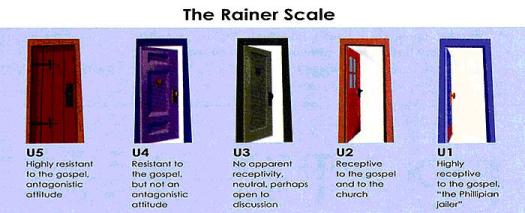
In his book, The Unchurched Next Door, Rainer puts the unchurched in our lives into five distinct categories:

U1 – Highly receptive to the Gospel. In fact this group includes some who may well be Christians who, for one reason or another, are not presently part of any expression of the Visible Body of Christ. These folks are the very essence of the word Seekers.

U2 – Receptive to the Gospel and to the Church. They may even see the church as a value, and admit that they “ought to go to church”.  However, they probably have not been to church,  nor taken any initiative in finding a church, and finding a church is not on thier immediate agenda whatsoever.

U3 – Neutral about church and spiritual things. They show neither signs of interest nor opposition. They may be open to some conversations about spiritual things but they do not feel their lives are lacking without Jesus being in their lives or their lack of involvement in the life of a local church.

U4 – Resistant to the Gospel, but show no antagonistic attitudes about those who profess faith and/or who go to church.

U5 – Highly antagonistic about church and the Gospel.

At first thought one might assume this is a matter of common sense, if not common knowledge. What difference does it make to consider these categories?

Those were some of my initial musings.

But then I began to think about how I, and how others I know, relate to unchurched friends and neighbors. Am I conscious of where they are on their spiritual pilgrimmage, of do I functionally lump them all into the category of “THEM” as opposed to “US”? Do I wish they would come to church, or do I understand where they are coming from? Am I willing to converse with them at their interest level, or do I use a half-hearted one-size-fits-all approach when spiritual matters come up? Like most Christians I know, I have often been guilty of the all the wrong things.

While being careful not to judge people, I have found that applying Rainers insights has made interacting and relating with unchurched neighbors and friends has become more enjoyable. Probably for them too. I listen more attentively to what they are saying. I converse more freely. I say fewer dumb things that lead to alienation. In short, I think Rainers categories are not only on-target but practically helpful.

Interestingly, The Rainer Group study has shown that 75-80% of our unchurched neighbors and friends would be open to an invitation to go to church if invited by a Christian friend.  This does not mean that all of them would be equally excited about the invitation. And this does not mean that if you ask four people to come to church this week that you will see three of them there on Sunday.  It means that if genuinely and sensitvely invited most would at some time or another be willing to go with you to your church.

So now here is the probing question for you & me: When was the last time you invited an un-churched person to church?

We in the churches are agonizing over ways to reach the un-churched, yet research indicates a simple invitation may be the most “cutting edge” approach we can employ.