Those Blasted Presbyterians

Around the same time, Horace Walpole spoke from the English House of Commons to report on these “extraordinary proceedings” in the colonies of the new world.  “There is no good crying about the matter,” he said.  “Cousin America has run off with the Presbyterian parson, and that is the end of it.”

The parson of which he spoke, was  John Witherspoon—a Presbyterian minister, as well as a descendant of John Knox.  At the time, Witherspoon was president of the College of New Jersey (now Princeton).  He was also the only clergyman to sign the Declaration of Independence.

From the English perspective, the American revolution was often perceived as a “Presbyterian Rebellion.”  And its supporters were often disdained as “those blasted Presbyterians.”

The Presbyterian Revolution
Most American Christians are unaware of the fact that the American Revolution, as well as the new American state, was greatly shaped by Presbyterians and the Calvinism that was at its root.  Some modern-day  Presbyterians have moved light years away from the convictions of these early colonists.

An estimated three million people lived in the colonies at the time of the Revolutionary War.  Of that number, “900,00 were of Scotch or Scotch-Irish origin, 600,000 were Puritan English, while over 400,000 were of Dutch, German Reformed and Huguenot descent. That is to say, two thirds of our Revolutionary forefathers were trained in the school of Calvin.”  (Carlson, p. 19)

As one historian puts it, “When Cornwallis was driven back to ultimate retreat and surrender at Yorktown, all of the colonels of the Colonial Army but one were Presbyterian elders. It is estimated that more than one half of all the soldiers and officers of the American Army during the Revolution were Presbyterian.” (Carlson, p. 16)

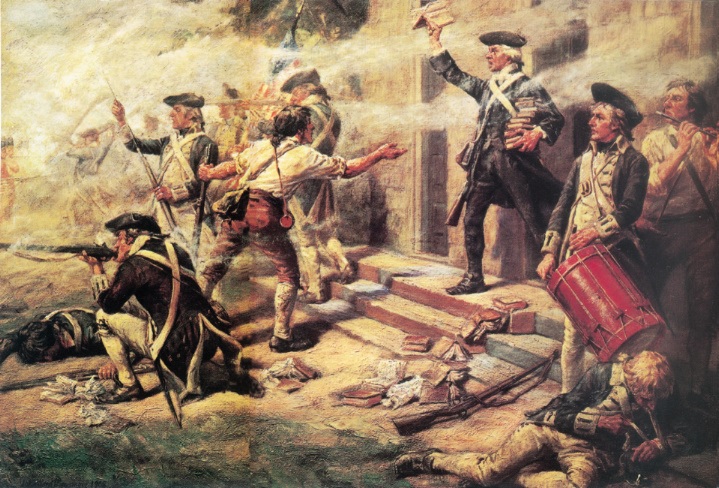
To the man, Presbyterian clergy joined the Colonialist cause. It was said that many of them led the Revolution from the pulpit.  In doing so, they paid a heavy price for their support for independence.  Many lost family members or their own lives.  Some had their churches burned to the ground.

The Presbyterian Drive
We forget that many of the early American colonists had left England precisely because Presbyterian Christianity was rejected.  After its brief reign as the established church through the English Civil War and the work of the Westminster Assembly, Britain returned to Anglicanism.  Thousands of non-conforming Presbyterian ministers were then ejected from their churches.  Some, such as the Covenanters, were martyred in a period that came to be known as “the killing times.” Rigid laws of conformity drove many to seek a better life somewhere else.  After 1660, many Presbyterians began to make their way to the colonies in North America.  It was these individuals who brought a new strength to the colonies as they inched their way forward towards independence.

They had little loyalty, and often outright hostility, to the crown of England.  They were armed with the theology of John Calvin, mediated through John Knox, and solidified during the English Civil war. It was a theology which devalued the divine right of human kings, and elevated the worth and dignity of the individual under God.  This theology shaped the early American understanding of civil liberty.

It shaped our founding fathers. The idea of human equality which influenced John Locke, who in turn,  influenced our founding fathers, was learned from the Puritans. Locke’s father had been on Cromwell’s side during the English Civil war.

It also shaped the general population under the influence of the Great Awakening. The Great Awakening was a massive 18th century religious revival that shook the colonies. It was promoted by preachers such as Gilbert Tennent and George Whitfield who travelled up and down the coast calling for a return to a robust Christian and Biblical faith.  Emphasizing the new birth and a Calvinist theology, the Great Awakening had an immense influence on colonial sentiments in the generation just preceding the American Revolution.

Consider then, some of what was at work in the American consciousness preceding the revolution. There was the memory of their horrid experience in England. There was the worry that Anglicans would establish this same kind of church in the colonies. There was a persistent fear of the imposition of bishops who were viewed as “holy monarchs,”  (monarchy in any form was considered bad)!  There was a belief in the absolute sovereignty of God. God alone is Lord of all and the author of liberty. There was a corresponding belief in the absolute equality of individuals (king and peasant, clergy and laity) under God’s law. There was the belief that no human should be entrusted with absolute power, given our radically fallen human nature.  There was a belief that there should be a separation of powers in any new government that is established.  And because of their experience in England, there was the belief that religious freedom and freedom of conscience should be respected.

In other words, for these Presbyterians, liberty is affirmed, but it is not an absolute liberty. It is always to be lived out under the sovereign creator God. It was this theology, a theology rooted, not just in Calvin, but in the Bible, which ultimately gave the colonialist the will to resist.

The Presbyterian Legacy
So this year, as we celebrate our independence once again, and as we think of early American courage, and the genius of our founding fathers, let us not forget those blasted Presbyterians who sought to understand liberty in light of the Bible.  A liberty which conceived of a nation and its entire government under God.

***

NOTE: This piece was originally written by Don Sweeting and posted on his old blog, The Chief End of Man, on July 4, 2014.

Sources:  Our Presbyterian Heritage, Paul Carlson (Elgin:  David C. Cook, 1973)Presbyterians: Their History and Beliefs, Walter L. Lingle and John W. Kuykendall, (Atlanta:  John Knox Press, 1988), The Emergence of Liberty in the Modern World, Douglas F. Kelly, (Phillipsburg, New Jersey:  P&R Publishing, 1992)

The Problem of Pretentious Piety

When Samuel Blair assumed the pulpit of Faggs Manor Church in 1740, he found a congregation in a spiritual condition not uncommon in our day. Blair wrote that when he came to the church he found “many good religious people who performed their religious obligation rather well”. Yet they were, in his estimation, somewhat formal and unenthusiastic:

If they performed these duties pretty punctually in their seasons and, as they thought, with good meaning, out of conscience, and not just to obtain a name for religion among men, then they were ready to conclude that they were truly and sincerely religious. A very lamentable ignorance of the main essentials of true practical religion, and the doctrines nearly relating thereunto very generally prevailed. The nature and necessity of the new birth was but litle known or thought of, the necessity of a conviction of sin and misery, by the Holy Spirit’s opening and applying the law to the conscience, in order to a saving closure with Christ, was hardly known at all to most. It was thought, that if there was any need of a heart-distressing sight of the soul’s danger, and fear of divine wrath, it was only needed for the grosser sort of sinners; and for any others to be deeply exercised this way (as might in some rare instances observable), this was generally looked upon to be a great evil and temptation that had befallen those persons. The common names for such soul-concern were, melancholy, trouble of mind, or despair. These terms were common, so far as I have been acquainted, indifferently used as synonymous; and trouble of mind was looked upon as a great evil, which all persons that made any sober profession and practice of religion ought carefully avoid. …There was scarcely any suspicion at all, in general, of any danger of depending upon self-righteousness, and not upon the righteousness of Christ alone for salvation. Papists [Roman Catholics] and Quakers would be readily acknowledeged guilty of this crime, but hardly any professed Presbyterian. The necessity of being first in Christ by a vital union, and in a justified state, before our religious services can be well pleasing and acceptable to God, was very little understood or thought of; but the common notion seemed to be, that if people were aiming to be in the way of duty as well as they could, at they imagined, there was no reason to be much afraid.

[Source: The Forming of an American Tradition: A Re-Examination of Colonial Presbyterianism, by Leonard J. Trinterud; Westminster Press, 1959; pp. 77-78]

Unfortunately, it seems that this same presumption still exists in too many congregations, and among too many professing Christians. Brennan Manning, in his thoughtful book, Ruthless Trust, identifies the problem with the superficial spirituality of pretentious piety:

In a world where the only plea is “Not Guilty”, what possibility is there of an honest encounter with Jesus, who “died for our sins”? We can only pretend that we are sinners, and thus only pretend that we are forgiven.

A Prayer for Christmas

All glory and honor to you, Living God.

You made our world by your wisdom,
and you sent your Wisdom into the world.

You rule all things by your word,
and you caused your Word to dwell among us.

You filled heaven and earth with your glory,
and you made the the very Radiance of your Glory to shine on earth.

You gave us life and created us in your image,
and you have given us eternal life through your eternal Image.

You formed us to be your children,
and now your eternal Son has come to claim us for brothers and sisters.

Heavenly Father, your Son became poor,
and now we share in his riches.

He came to be despised and rejected,
and now you have accepted us through him.

You laid our sins on him,
and now we come to you with his righteousness.

You sent him to live the life that we failed to live,
and now we have his life in us.

By your will, he came as a slave,
and now we reign with him.

He was conceived, lived, died and rose by your Spirit,
and now he has given that Spirit to us.

Renew us therefore, by that same Spirit, we pray.

By him, unite us to Jesus so we bear much fruit and bring you glory.

By him, fill our hearts so we cry out to you with the voice of your Son.

By him, bind us together in the gospel of Jesus and speak the truth in love.

By him, transform us to the image of our Lord, with ever-increasing glory.

By his power, deliver us from discouragement and idolatry,
and fill our hearts and lives and mouths with grace,

By him, make us proof of your manifold wisdom before the powers and authorities,
so that the powers of darkness should not prevail,
and we might press on through the night to the dawn;
warmed by the light of your Son. ~ Amen.

Original Source: TGC @ Australia (12/25/21)

Too Much Religion

Eugene Peterson, in the Introduction to the book of Hebrews in his book The Message, writes:

“It seems odd to have to say so, but too much religion is a bad thing. We can’t get too much of God, can’t get too much faith and obedience, can’t get too much love and worship. But religion – the well intentioned efforts we make to ‘get it all together’ for God – can very well get in the way of what God is doing for us. The main & central action is everywhere, and always what God has done, is doing and will do for us. Jesus is the revelation of that action”.

A Jesus Manifesto

“Christians have made the gospel about so many things… Things other than Christ.”  So opens the document, written by Leonard Sweet and Frank Viola, titled: A Jesus Manifesto.

I’ve long been a fan of Leonard Sweet, our theological differences aside. But Sweet’s love for Jesus, his love for God’s people, and his amazing story-telling ability make his books and articles a pleasure to read. Besides, I’ve not found our differences to come up that frequently in the things he writes. His focus is spirituality, not systematic theology.  At the very least Sweet always makes me think – and often makes me laugh.

I don’t know as much about Frank Viola. I’ve heard of him, but I don’t recall having ever read anything he has written – at least nothing before A Jesus Manifesto.

But as I read through this manifesto I found I appreciated the heart of both men. I also appreciate their effort to put into words something that needs to be said in this generation.  Paraphrasing the words of the old hymn, we need to “Turn our Eyes upon Jesus.”

To read the document click the link above.  On that blog you will also find links to download the document in .pdf, listen to the authors read their manifesto, and listen to Steve Brown interview the authors at Steve Brown, Etc.  Facebook users will also find a link to a group page discussing the manifesto.