Explosive Power of the Gospel

“The Gospel is God’s explosive power that changes everything.

The gospel makes us Christians….  God forgives your sin, declares you righteous in Christ, gives you eternal life, adopts you as His child, and ushers you into an intimate relationship with Himself, through the Holy Spirit.

Secondly, the gospel grows us.  The gospel is not merely the way we enter, it is the way we make all progress…it is the ‘way of righteousness from first to last.’…  Since the gospel not only makes us Christians, but also grows us as Christians, the most desperate need of both unbelievers and believers… is to hear and appropriate the Gospel to their lives.

Thirdly, the gospel empowers us to serve…with a whole new motivational structure…setting us free to love and serve unconditionally in response to God’s grace in Christ”.

-Dick Kaufmann

The Least We Can Do

If Jesus could rise from the dead, we can at least rise from our bed, get off our couches and pews, and respond to the Lord’s resurrection life within us, joining Jesus in what he’s up to in the world. We call on others to join us—not in removing ourselves from planet Earth, but to plant our feet more firmly on the Earth while our spirits soar in the heavens of God’s pleasure and purpose. We are not of this world, but we live in this world for the Lord’s rights and interests. We, collectively, as the ekklesia of God, are Christ in and to this world.

 -Leonard Sweet & Frank Viola, from A Jesus Manifesto

Prayer Mirrors the Gospel

“Prayer mirrors the gospel. In the gospel, the Father takes us as we are because of Jesus and gives us his gift of salvation. In prayer, the Father receives us as we are because of Jesus and gives us the gift of help. We look at the inadequacy of our praying and give up, thinking something is wrong with us. God looks at the adequacy of his Son and delights in our sloppy, meandering prayers.”

– Paul Miller, A Praying Life

Grace Will…

Paradox Hand

I was blown away as I thought about the paradoxes of the Gospel as it was described by Paul Tripp in his book, Broken-Down House.  Don’t just read through quickly. Stop and consider the contrasts:

Grace is a story and grace is a gift. It is God’s character and it is your hope. Grace is a transforming tool and a state of relationship.  Grace is a theology and an invitation. Grace is an experience and a calling. Grace will turn your life upside down while giving you a rest you have never known.  Grace will convince you of you unworthiness without ever making you feel unloved.

Grace will make you acknowledge that you cannot earn God’s favor, and it will remove your fear of not measuring up to his standards. Grace will confront you with the fact that you are much less than you thought you were, even as it assures you that you can be far more than you had ever imagined. Grace will put you in your place without ever putting you down.

Grace will enable you to face truths about yourself that you have hesitated to consider, while freeing you from being self-consciously introspective. Grace will confront you with profound weaknesses, and at the same time introduce you to new-found strength. Grace will tell you what you aren’t, while welcoming you to what you can now be. Grace will make you as uncomfortable as you have ever been, while offering you more comfort than you have ever known. Grace will drive you to the end of yourself, while it invites you to fresh starts and new beginnings.  Grace will dash your hopes, but never leave you hopeless. Grace will decimate your kingdom as it introduces you to a better King. Grace will expose your blindness as it gives you eyes to see. Grace will make you sadder than you have ever been, while it gives you greater cause for celebration than you have ever known.

Grace enters your life in a moment and will occupy you for eternity. You simply cannot live a productive life in this broken-down world unless you have a practical grasp of the grace you have been given.

Salt & Light

God Rays Redwoods

“The true Christian cannot be hid, he cannot escape notice.  A man truly living and functioning as a Christian will stand out.  He will be like salt; he will be like a city set on a hill, a candle set upon a candlestick.

But we can also add this further word: The true Christian does not even desire to hide his light.  He sees how ridiculous it is to claim to be a Christian and yet deliberately to try to hide the fact. 

A man who truly realizes what it means to be a Christian, who realizes all that the grace of God has meant to him and done for him, and understands that, ultimately, God has done this in order that he may influence others, is a man who cannot conceal it.  Not only that; he does not desire to conceal it, because he argues thus, ‘Ultimately the object and purpose of it all is that I might be functioning in this way’.” 

-Martin Lloyd-Jones, Studies in the Sermon on the Mount.

Infection of Complacency

Indifferent

Here is a thought from J.C. Ryle that transcends the gulf between 19th Century Britain to speak to 21st Century American Evangelicals:

The times require distinct and decided views of Christian doctrine. I cannot withhold my conviction that the professing Church is as much damaged by laxity and indistinctness about matters of doctrine within, as it is by skeptics and unbelievers without. Myriads of professing Christians nowadays seem utterly unable to distinguish things that differ. Like people afflicted with color–blindness, they are incapable of discerning what is true and what is false, what is sound and what is unsound. If a preacher of religion is only clever and eloquent and earnest, they appear to think he is all right, however strange and heterogeneous his sermons may be. They are destitute of spiritual sense, apparently, and cannot detect error. The only positive thing about them is that they dislike distinctiveness and think all extreme and decided and positive views are very naughty and very wrong!

These people live in a kind of mist or fog. They see things unclearly, and do not know what they believe. They have not made up their minds about any great point in the Gospel, and seem content to be honorary members of all schools of thought. For their lives they could not tell you what they think is truth about justification, or regeneration, or sanctification, or the Lord’s Supper, or baptism, or faith or conversion, or inspiration, or the future state. They are eaten up with a morbid dread of controversy and an ignorant dislike of party spirit; and yet they really cannot define what they mean by these phrases. And so they live on undecided; and too often undecided; they drift down to the grave, without comfort in their religion, and, I am afraid, often without hope.

The explanation of this boneless, nerveless, jelly–fish condition of soul is not difficult to find. To begin with, the heart of man is naturally in the dark about religion – has no intuitive sense of truth – and really needs instruction and illumination. Besides this, the natural heart in most men hates exertion in religion, and cordially dislikes patient, painstaking inquiry. Above all, the natural heart generally likes the praise of others, shrinks from collision, and loves to be thought charitable and liberal. The whole result is that a kind of broad religious “agnosticism” just suits an immense number of people, and specially suits young persons. They are content to shovel aside all disputed points as rubbish, and if you charge them with indecision, they will tell you: “I do not pretend to understand controversy; I decline to examine controverted points. I dare say it is all the same in the long run” – Who does not know that such people swarm and abound everywhere?

Now I do beseech all to beware of this undecided state of mind in religion. It is a pestilence which walks in darkness, and a destruction that wastes at noonday. It is a lazy, idle frame of soul which, doubtless, saves man the trouble of thought and investigation but it is a frame of soul for which there is no warrant in the Bible. For your own soul’s sake, dare to make up your mind what you believe, and dare to have positive, distinct views of truth and error. Never, never be afraid to hold decided doctrinal opinions; and let no fear of man and no morbid dread of being thought party–spirited, narrow, or controversial, make you rest contented with a bloodless, boneless, tasteless, colorless, lukewarm, undogmatic Christianity.

Mark what I say. If you want to do good in these times, you must throw aside indecision, and take up a distinct, sharply–cut, doctrinal religion. If you believe little, those to whom you try to do good will believe nothing. The victories of Christianity, wherever they have been won, have been won by distinct doctrinal theology; by telling men roundly of Christ’s vicarious death and sacrifice; by showing them Christ’s substitution on the cross, and His precious blood; by teaching them justification by faith, and bidding them believe on a crucified Savior; by preaching ruin by sin, redemption by Christ, regeneration by the Spirit; by lifting up the brazen serpent; by telling them to look and live – to believe, repent, and be converted. This – this is the only teaching which for centuries God had honored with success, and is honoring at the present day both at home and abroad.

It is doctrine – doctrine, clear, ringing doctrine which, like the ram’s horn at Jericho casts down the opposition of the devil and sin. Let us cling to decided doctrinal views, whatever some may please to say in these times, and we shall do well for ourselves, well for others, and well for Christ’s cause in the world.

Natural Born Skeptics

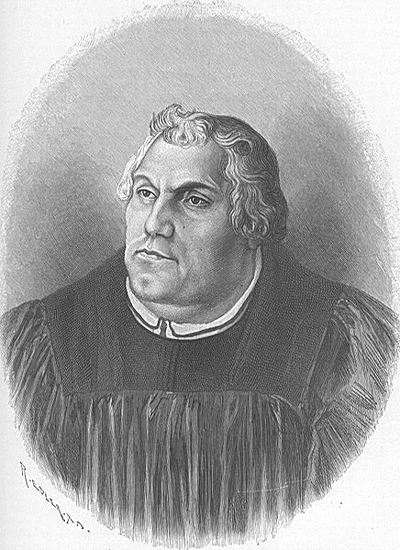
luther

To doubt the good will of God is an inborn suspicion of God with all of us.

Besides, the devil…goes about seeking to devour us by roaring: ‘God is angry at you and is going to destroy you forever.’

In all these difficulties we have only one support, the Gospel of Christ. To hold on to it, that is the trick. 

Christ cannot be perceived with the senses…

The heart does not feel His helpful presence…

Especially in times of trials a Christian feels the power of sin, the infirmity of his flesh, the goading darts of the devil…the scowl and judgment of God.  All these things cry out against us, death thunders at us, the devil roars at us.

In the midst of the clamor the Spirit of Christ cries in our hearts, ‘Abba, Father.’ 

And this little cry of the Spirit transcends the hullabaloo of the Law, sin, death, and the devil, and finds a hearing with God.  The Spirit cries because of our weakness…(and) is sent forth into our hearts…to assure us of the grace of God.”  

– Martin Luther, Commentary on Galatians

The A-to-Z of the Christian Life

“The gospel shows us that our spiritual problem lies not only in failing to obey God, but also in relying on our obedience to make us fully acceptable to God, ourselves and others.

Every kind of character flaw comes from this natural impulse to be our own savior through our performance and achievement. On the one hand, proud and disdainful personalities come from basing your identity on your performance and thinking you are succeeding. But on the other hand, discouraged and self-loathing personalities also come from basing your identity on your performance and thinking you are failing.

Belief in the gospel is not just the way to enter the kingdom of God; it is the way to address every obstacle and grow in every aspect. The gospel is not just the “ABCs” but the “A-to-Z” of the Christian life.

The gospel is the way that anything is renewed and transformed by Christ — whether a heart, a relationship, a church, or a community. All our problems come from a lack of orientation to the gospel. Put positively, the gospel transforms our hearts, our thinking and our approach to absolutely everything.”

– Timothy Keller

Share this:

Prayer is…


Prayer…is a confessing of impotence and need, an acknowledging of helplessness and dependence, and an invoking of the mighty power of God to do for us what we cannot do for ourselves… God means us… to recognize and confess our impotence, and to tell Him that we rely on Him alone, and to plead with Him to glorify His name.

It is His way regularly to withhold His blessings until His people start to pray.

J.I. Packer, Evangelism & the Sovereignty of God

Faith & Hope

The question occurs to us, What difference is there between faith and hope? We find it difficult to see any difference. Faith and hope are so closely linked that they cannot be separated. Still there is a difference between them.

First, hope and faith differ in regard to their sources. Faith originates in the understanding, while hope rises in the will.

Secondly, they differ in regard to their functions. Faith says what is to be done. Faith teaches, describes, directs. Hope exhorts the mind to be strong and courageous.

Thirdly, they differ in regard to their objectives. Faith concentrates on the truth. Hope looks to the goodness of God.

Fourthly, they differ in sequence. Faith is the beginning of life before tribulation (Hebrews 11). Hope comes later and is born of tribulation (Romans 5).

Fifthly, they differ in regard to their effects. Faith is a judge. It judges errors. Hope is a soldier. It fights against tribulations, the Cross, despondency, despair, and waits for better things to come in the midst of evil.

Without hope faith cannot endure. On the other hand, hope without faith is blind rashness and arrogance because it lacks knowledge. Before anything else a Christian must have the insight of faith, so that the intellect may know its directions in the day of trouble and the heart may hope for better things. By faith we begin, by hope we continue.

– from Martin Luther’s commentary on Galatians

My Sin is Ever Before Me

untitled-montietalbert-final.jpg

‘My sin is ever before me’ -Psalm 51.3  

A humble soul sees that he can stay no more from sin, than the heart can from panting, and the pulse from beating. He sees his heart and life to be fuller of sin, than the firmament is of stars; and this keeps him low. He sees that sin is so bred in the bone, that till his bones, as Joseph’s, be carried out of the Egypt of this world, it will not out. Though sin and grace were never born together, and though they shall not die together, yet while the believer lives, these two must live together; and this keeps him humble. 

-Thomas Brooks, English Puritan