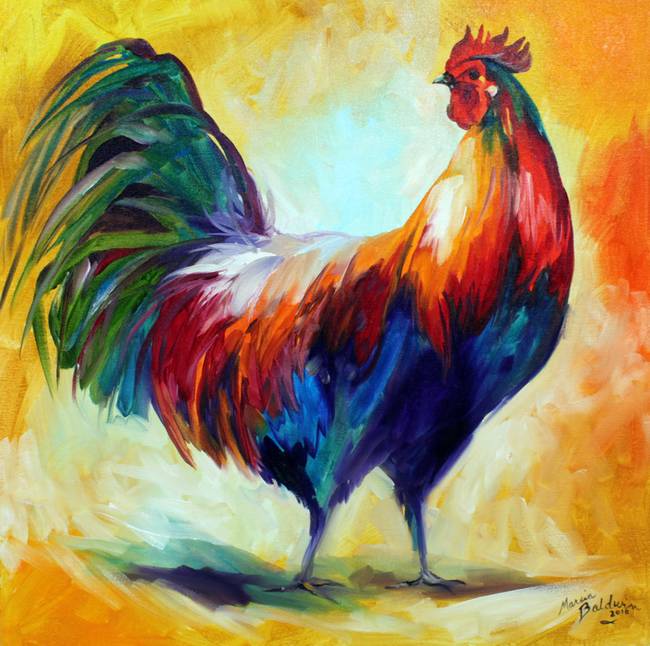
From time to time I am asked why I have a rooster for a profile picture, both on my blog and on Facebook. What’s more, the rooster is also the screensaver on my phone. I use these images for more reason than just the bucolic tranquility they depict. The rooster has a long history as an interesting symbol.
While Celtic and Norse cultures saw the rooster as a creature of the underworld – a messenger screeching warnings of danger, and calling for the souls of those killed in battles; most have viewed the rooster in a more positive light.
In art, the rooster has long symbolized the fanning out of brilliance – i.e. showing the world the shimmering facets of ones personality. As one scholar has noted, the rooster is used in art to display courage, strength, pride, honesty, vigilance, watchfulness, as well as flamboyance. Most of these are excellent qualities. And flamboyance is not entirely bad, though too much of it may be somewhat obnoxious.
In Christianity the rooster is associated with Peter’s denial of Christ on the night of betrayal, leading up to the crucifixion. So the rooster is associated with Christ’s death – which while tragic, was also God’s intention, the reason for which Jesus was born. And while not lessening the tragedy, it is important to remember that Jesus himself says of the crucifixion: “I lay down my life, no one takes it from me.” (John 10.11-18) Jesus laid down his life that those who believe would have life. Yet the effect of his substitutionary death only reached its full effect upon his resurrection – which Jesus hinted at in John 10.17. In that sense the rooster, which symbolizes betrayal and death, cannot be separated from the purpose of Jesus’ death, and thus cannot be separated from the resurrection. Therefore, the rooster is an appropriate symbol of the gospel itself.
What the rooster most symbolizes, at least to me, is the dawning of a new day. This is the reason I use it so freely. The rooster crows at the first hints of new light. This was a primary reason the rooster was used as a symbol of the Reformation – it was a reminder that the Reformation itself signaled a new day. Of course the resurrection of Jesus is the ultimate sign of a new day. And God himself tells us, through his prophet Jeremiah, that “his mercies are new every morning”. (Lamentations 3.22-23)
So to me, the rooster is a constant reminder of the gospel, and that today is a new day – every day is a new day. This being New Years Day, the rooster seems to me to be an especially appropriate symbol.

 GRACE & PEACE