Reflecting Jesus in Christ’s Church


If, as most Christians profess, Jesus is indeed the only Head of the Church, it seems reasonable that Christ’s Church should reflect His personality in it’s ministries and structure. 

One way that Jesus is reflected in the ministry of faithful churches has been the recovery of a balanced Word & Deed holistic ministry. By balanced I am in no way suggesting a compromise. Instead I am referring to churches that are uncompromising BOTH in their pursuit of sound Biblical and theological instruction AND in thier practice of meeting the real – spiritual and tangible – needs of their neighbors. 

This only makes sense, since Jesus is himself the Word Incarnated and the one who “came to serve, not to be served”. (See Mark 10.45)  Jesus’ service was expressed through miraculous practical, provision and help. And Jesus is the one who said to his disciples: “Just as the Father has sent me, I am sending you.” (See John 20.21)  Traditionally churches have structured their leadership into the offices of Elder and Deacon, in accord with Biblical directive, to reflect Word & Deed. (Elders = Word; Deacons = Deed)

But I am increasingly becoming convinced that there is another, an additional, way that the personality of Jesus should be expressed in the Church.  This additional way, often referrred to as Tri-Perspectivalism or Multi-Perspectivalism, should be expressed in the Leadership Structure and in the ministry of the church. In fact, I am convinced that it needs to be the guage by which we evaluate the faithfulness of our congregations.

The Bible teaches that Jesus exercised three distinct offices:

  • Prophet
  • Priest
  • King

Each of these offices carry a significance.  In exercising these three offices Jesus also reveals aspects of his personality.

The Westminster Shorter Catechism summarizes for us how Jesus exercised each of these offices:

Q. 24. As a Prophet, Christ reveals the Will of God to us for our salvation by His Word and Spirit.

Q. 25. As a Priest, Christ offered himself up once as a sacrifice for us to satisfy divine justice and to reconcile us to God; and He continually intercedes for us.

Q. 26. As a King, Christ brings us under His power, rules and defends us, and restrains and conquers all his and our enemies.

Another way of looking at these distinct roles is:

Prophet is concerned with understanding and communicating God’s Truth, and applying it to every aspect of life.

Priest is concerned with the Spiritual Renewal and Transformation of all Christ’s People. The Priest is concerned not only for the conversion and intial reconcilation of the Believer to God, but also that all our lives be increasingly lived out in the joy and freedom that the Gospel secures and applies to us.

King is concerned with the advancement of Christ’s Kingdom, with both the Future fulfillment and Present Realities in mind.  In that sense, the King is concerned about both the mission and the structures of his Church.

What I have discovered is that each of these offices offers a unique perspective for leadership and ministry.  Each is equally important. Each must be equally considered. If all three are not equally considered the ministry of the church is unbalanced. In fact, if all three aspects, or perspectives, are not equally considered the ministry is not only unbalanced it is unfaithful.  It is not faithful to reflect the whole person of Christ, who is not only the Head but also the Model. Continue reading


7 Ways to Be a Great Host

There is an ancient rule among the Benedictines

“Let every guest who arrives be received like Christ. For He is going to say, ‘I came as a guest and you received me’.”

This would be a good concept for all churches to remember and instill.

Unlike most churches in our country, the church I have the privilege to pastor frequently and regularly has new visitors.  But like most churches, we have much to learn before we could claim that the Rule of Benedict is an accurate description of our congregational practice.

I am confident some would feel it is true of us already. I have never been part of a church that better demonstrates a love for one another than Walnut Hill Church does. And that love is frequently extended to our guests.  That’s why many of them are now part of the family.

But I also suspect that there are others, for whatever reasons, who have come and gone without necessarily having experienced the same thing. While it is obvious that we will never get to the point where we will keep everyone, I am concerned about those who do not stick because they did not feel loved, or perhaps even welcomed.

Studies indicate that the typical church needs to keep 16% of first-time guests in order to have a growth rate that roughly keeps pace with the annual national birth rate.  Churches that are growing and healthy generally see a 25-30% rate of assimilation/integration of those who visit.  (By the way, on average, 85% of guests who return the following week generally join with that church.) 

Gary McIntosh, in his book, Beyond the First Visit, offers seven suggestions about how church members can move beyond being friendly to becomming great hosts:

  1. Invite your guests with a personal invitation.
  2. Arrive early and make sure everything is prepared for your guests’ arrival.
  3. Greet the guests warmly at the entrance and escort them to their seats.
  4. Assist guests with understanding what is taking place.
  5. Anticipate as many questions as possible in advance, so guests do not have to ask.
  6. Do something extra to make your guests’ visit special.
  7. Walk guests to the door and invite them back.

Let me suggest that these suggestions be adopted by individual church members. Don’t try to program this as much as cultivate it.  There is no need to wait for the pastor, or some formal committee, to be hospitable.

9 Church Diseases

According to Peter Wagner:

Healthy churches build an immune system to resist disease. It is much more advisable to prevent an illness than to contract one and then have to cure it.

The following are the most common diseases that infect churches.  By recognizing some of the symptoms my hope is that we will turn to the Great Physician, the Gentle Healer, and seek necessary medical attention.

I am using Wagner’s terms here, and have added my own commentary:

Ethnikitis

Ethnikitis is fear or disregard for others of different ethnicities and/or races.  This disease is caused by contextual factors, usually revolving around a static church (in-grown and non-growing) in an ethnically transitioning neighborhood.

Ghost-Town Disease

Another contextual illness, this illness is found in communities where old residents are moving out, and no one is moving in.

People-Blindness

This malady is directly related to a lack of understanding of the significant differences between diverse people groups within the community.  It occurs when churches fail to consider how those differences may impede evangelism efforts.

Hyper-Cooperativism

Wagner says: “When everyone is responsible for evangelism, no one is responsible for evangelism.  Local-church evangelism is much more effective than city-wide cooperative efforts.”

This malady occurs when local congregations loose their distinct identity because the church is too committed to being part of something else.  There is nothing wrong with partnering and cooperative ministries. But if the only ministry a church does is under the umbrella of others, and the church does not bring any distinct character to the joint-effort, it may be a sign that the church is not healthy.

The healthy alternative is not to forgo all partnerships and joint efforts, through isolationism or competition. Instead each church should develop its own distinct personality which it can then contribute to the community and cooperative efforts.

Koinonitis

Koinonia is the Greek word for fellowship.  Koinonitis occurs when interpersonal relationships within the church become so deep and mutually absorbing that we ignore the needs of the community and world around us. When Koinonitis is present church programs tend to become centripetal rather than centrifugal; entirely attractional rather than missional and incarnational.

Sociological Strangulation

Wagner says: “This is a slowdown in the rate of church growth caused when the flow of people into a church begins to exceed the capacity of the facilities to accommodate it.”

In other words, this occurs when the building and sanctuary are too small to accomodate more people.  The general rule here, in suburban communities is 80% capacity = FULL.  In more rural communities, where people are used to having more elbow room, the rule may be as low as 50% = FULL. 

Another aspect that George Barna deals with, more than Wagner,  is when growth occurs at a rate too fast to effectively assimilate new people into an existing church community.  Barna suggests that healthy churches grow at a rate of no more than 10% – 15% anually.  Thus, if Barna is correct, a church with a 6% or 7% growth rate may be healthier than a church that is growing at 20% rate over an extended period of time.

Arrested Spiritual Development

Wagner: “When people in the church are not growing in the things of God or in their relationships with one another, the total health of the church deteriorates, and the church cannot grow.”  To this I will add, if the church did grow, it really has nothing to offer those who come, nor to the community where God placed them.

St. John’s Syndrome

When Christians become Christians in name only; feel that their faith is only routine; when church involvement is largely going through the motions, and belonging to church is nothing more than a family tradition or social nicety, St. John’s Syndrome is likely at work.

Why is this called St John’s Syndrome?  I have no idea. At least I do not recall off the top of my head. But I agree that the symptoms described are unhealthy, no matter what you want to call it.

Hypo-pneumia

Hypo-pneumia is a condition caused by a subnormal level of the presence and power of the Holy Spirit in the life and ministry of the church.  This is a church that depends upon talent of the members and the resources on hand.  It is a church that may pray, but is not depending upon prayer.

It is this type of church Francis Schaeffer had in mind when he asked his wife what she thought would happen if the Holy Spirit departed from the local church.  Their joint conclusion was that in the vast majority of churches nothing would change, and few people would notice.

Missing the Missional Mark

To read something I disagree with on the Internet is not an unusual thing.  When what I disagree with comes from a source that I respect – highly respect – it makes me somewhat uncomfortable.   When the source I respect seems to oppose what I hold, well that is just down-right disappointing.

But that is the experience I have had these past few days while reading 9 Marks January/February 2010 e-Journal.

Continue reading

How to KEEP Your Church FROM Vitality & Fruitfulness

There are conferences, seminars, articles, books, curricula telling us how to grow a church. It’s high time the other side of the issue be considered. While I don’t guarantee these easy-to-apply steps will always keep your church from health and vitality, they will, with proper application, certainly increase the chances of stagnation.

1. Change Pastors Every Few Years.

This will assure that no pastor gets too much “power.” It will also discourage members from committing to any long-term goals or growth efforts. And those brought into the church by the pastor’s personal ministry will feel insecure because “their” pastor may not stay more than a couple of years.

2. Don’t Allow New People to Serve.

This applies particularly to those who have never been a church member before, or who were recently converted. These people tend to identify strongly with the group from which they came and offer many unwanted suggestions for reaching others from those groups. By insisting that they serve a proper and lengthy “probationary period” before participating in church decision-making, they can be stalled until they lose their enthusiasm and relationships with the un-churched.  Once this happens, THEN they can be used for church work.

3. Split Up Small Groups & Ministry Teams Regularly.

This will greatly frustrate the people who are most active in the church. They won’t have a chance to build and strngthen meaningful relationships; and they will not develop any deep sense of belonging, ownership, or empowerment.

4. Try to Reach Only People in ‘Stable’ Situations.

Since people are often more responsive to the Gospel following geographic, social, vocational, or life-situational changes, concentrate on people in stable circumstances to minimize contacts with the kind of people that often lead to responsiveness and change.

5. Don’t Send Your Pastor to Conferences or Encourage Him to Read Books on Evangelism & Mission.

If he insists on attending such a workshop, make sure no other church leaders go with him. Enthusiasm for outreach and mission can be easily squelched as long as the pastor is the only one who gets enthused.

6. Emphasize “Quality not Quantity.”

This one almost always works!

Make it sound like those who want to see new people join the church are playing the ‘numbers game’.  The myth that numerical growth automatically and spontaneously comes as a result of spiritual growth – without actual outreach and evangelism – is believed by many, so take advantage of it. 

Also, point to unmet needs of your own people as the only real concern of the church, and the primary concerns for the pastor.

7. Don’t Be Friendly to Visitors.

If this seems too extreme, be friendly to them at first – THEN ignore them! Don’t visit them.  Don’t invite them to church activities.  Don’t talk to them during the week. Above all: DON’T become friends with them!

8. Don’t Invite People to Visit or Join Your Church.

 We can justify this by saying: “We don’t want to force church membership on anybody.”   To neighbors and guests it says: “You don’t belong here.”  But that’s all we need. 

One variable to this is to allow the pastor to be the only one to do the inviting and relationship building.

 9. Try to Reach Everyone In Your Community the Same Way.

Ignore racial, social, economic, linguistic, and cultural differences. Assume all people are like you – or they should be. 

A  church out to “reach everybody”, without considering even subtle cultural differences, using the same old strategies used in the past, often reaches nobody. Churches are effective when they recognize these distinctions, and develop relevent strategies to serve the different segments of their community.

If you don’t want to grow, don’t aim at a target.

 10. Make Growth Entirely Dependent on the Holy Spirit.

 This not only encourages prayerlessness and evangelistic laziness on our part, but it gives us a convenient excuse if growth doesn’t occur.  We can always blame God.

 11. Don’t Staff & Don’t Budget for Outreach & Mission.

Our resources are precious and limited. Staff and budget for Christian Education, Youth Ministries, etc. first.  Staff and budget for outreach & mission ONLY after these priorities are perfectly met.

 12. Insist on Using Evangelistic Methods That Were Used During the ‘Good Old Days’.

 Don’t consider methods that God may be using today.  Stick with crusades, simplistic tracts, and answering questions no one is asking.

By all means avoid meeting actual needs.  A church that adresses the needs of the poor – like Jesus & Paul said we should – might be accused of Liberalism and promoting a Social Gospel.

13. Don’t Set Goals.

Say that goals produce frustration. Discourage measurement of any kind. Label statistical analysis as ‘worldly’. If that fails, label it ‘demonic and destructive’.   Though that may be unfair, and UNTRUE, it will certainly discourage goal-setting and statistical analysis as a diagnostic tool.

 14. Say that God Doesn’t Want the Church to Grow.

 Though this statement may be false, you can dig up enough proof-texts to make it seem believable.

 15. Don’t Advertise Your Church.

 Any advertising should be avoided. Especially don’t let newcomers to your community know where your church is, when services are held, and what ministries might be most beneficial to them.

If you must advertise, put the ad on the church page where only those already churched are likley to see it. And put a picture of the pastor or the building on it, not something that would be of interest to anyone outside your church. And never put a picture of people enjoying themselves together in Christ. Never promote something that might connect with the un-Churched.

 16. Don’t Pray for Kingdom Advancement.

 Pray for people in hospitals and on sick lists. Pray for generic “spiritual blessings”.  Pray for missions, but not specific prayers for individual missionaries; Not prayers informed about the challenges missionaries face in their particular locations and work. Pray only for un-named people who you will never meet.  Pray only for people to be healed.  NEVER pray for un-churched neighbors and friends. NEVER pray for God to change you and/or your church to become more godly.

***

This post is satirical and sarcastic.  I have edited and adapted it from a chapter titled: 17 Way to Keep Your Church from Gowing.  from a book by Mike Grogan, then-pastor of the Bethel Friends Church in Poland, OH.  I don’t know if he is still the pastor there. Nor do I recall the title of the book.

The Baker’s Dirty Dozen Stagnant Church Types


At a time when potential epidemics may be on the horizon the wise person is on the lookout for the signs of disease. The hope is that early detection will enable more effective and less severe treatment.

Such a time surrounds the American church. It is widely reported that 85% of all churches are in a state of stagnation, if not serious decline. 

Jeff Gauss, of Rurality Bytes, summarizes the Baker’s-Dirty-Dozen stagnant church types.  At least one of these 13 types, taken from Ed Stetzer’s Comeback Churches, probably characterizes almost any struggling & stagnant church:

  1. Institutionalized Church – More committed to the forms and programs of ministry than to the work of God; activity has choked out productivity and “good enough” has become the enemy of great.
  2. Voluntary Association Church – This church models itself after democratic government rather than New Testament principles. It is a church for the people, rather than for God. “Whenever one group seeks to make a positive change in the church in one direction, the opposing factions begin to whine, complain, and gossip… This type of church will not change until they change their value system.”
  3. “Us Four and No More” Church – This church doesn’t want to get any larger for fear that it will lose its family feel.
  4. “We Can’t Compete” Church – This church has simply given up, deciding that it can’t compete with other churches so they’re not even going to try.
  5. “Decently and in Order” Church – High regard for process, but lack passion. “They run everything by the book; unfortunately, it’s not the Bible.” All matters great and small must meet the approval of various committees.
  6. “Square Peg in a Round Hole” Church – People are enlisted for service, not based on passion and gifts, but because of need. The mindset is “We’ve got to fill this position. Whose turn is it?”
  7. “Time-Warp” Church – This church has managed to preserve the positions, practices, and appearances of days long gone. They expect others to accept and adapt to what they’ve grown comfortable doing over the years, and give no thought to change. “If it’s good enough for me, it should be good enough for them,” is the prevailing attitude.
  8. “My Way or the Highway” Church – This is usually a vocal minority who, no matter the issue, won’t be satisfied unless it’s done their way.
  9. “Chaplaincy” Church – The church views its pastor as a hired hand and expects him to meet all of their needs. They want a chaplain, not a leader.
  10. “Play-it-Safe” Church – Has little faith that God will provide. Instead of enabling ministry and evangelism, it hinders them by safeguarding what it has. “As much money as possible is placed in a certificate of deposit” for safekeeping.
  11. Unintentional Church – Good intentions, but little action. Rarely follow through on what they hope to do.
  12. “Tidy” Church – Members take pride in the church building and make sure that everything is well-kept and meticulously organized. New growth – especially children – is seen as a threat because they are messy. 
  13. The “Company” Church – The church is more focused on the denomination than the community. They fill up the calendar with denominations meetings and things at the expense of ministering to their community. 

I suspect traces of most of these traits can be seen in almost any church, ailing or healthy.  But a good prelimnay self diagnosis may hold the ecclesiastical undertaker at bay.

Ambition

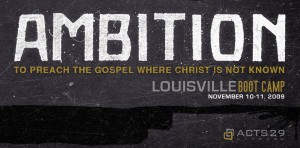
I’ve been listening to the audio of sessions from Acts 29 Network’s 2009 Bootcamp: Ambition. While not everyone will find these talks of interest, I think they are challenging and stimulating for those of us in ministry and church leadership.

Ministry for the Long Haul & Ambition (Matt Chandler)

Decoding Your City & Ambition (Kevin Cawley)

Discipleship & Ambition (Bob Thune)

Preaching as Expository Exorcism (Russell Moore)

Leadership & Ambition (Darrin Patrick)

The Church & Ambition (Steve Timmis)

Church Planting & Ambition (Ed Stetzer)

The Gospel & Ambition (Dave Harvey)

My thanks to the folks at Sojourn Community Church, who have made all the above sessions available to be listened to online and/or downloaded. Click: Ambition Conference.

Acts 29 is a missional church planting network of Reformed Evangelicals.  Each year they hold Boot Camps to train and re-energize like minded church planters and church leaders.  Many of these, and other, talks are available on the Resource section of thier web page.

Characteristics of a Missional Church

As our church begins to explore what it means to be a missional church, it might be helpful to hear the insights of one of the most effective practitioners and proponents of the missional approach to ministry.  In the above video Tim Keller, of Redeemer Church in Manhattan, explains some of the key characteristics of a missional church.

Some might ask: What’s the difference between a Missional Church and an Evangelistic Church? Is this just a new label? 

The answer to the latter question is “No. It’s not just a label.”  It is a different way of thinking about the church. Rooted in the understanding that God is himself on mission (missio dei) a missional church seeks to become engaged in God’s mission in the very place(s) God has sovereignly placed the church and the church members. 

Reggie McNeal, in his book, The Present Future, provides some insights about the differences between a Missional Church and an Evangelistic Church that will help answer the former question. McNeal says a missional church stresses:  

> community transformation over growing the church

> turning members into missionaries over turning members into ministers

> recovering Christian mission over doing church better

In Constant Prayer

 Prayer Posture

Here is a challenging insight from Robert Benson, taken from his book In Constant Prayer:

Our modern church has some distinct advantages over the early church. Or at least I suspect it does.  We have better youth programs and better acoustics and finer buildings. We have better literature that is more easily available to our flocks, most of whom happen to be literate. We have some pretty fair preachers, or at least we have some who are more fun to listen to than the blessed Saint Augustine. (Have you ever actually attempted to read Augustine?)

We have better choirs, I suspect, and we can put on a Sunday morning service with more art and more dignity and more beauty than ever before. We have mailing lists and newsletters and Web sites. We have educational buildings and discipleship classes and Bible study groups where students bring their own Bibles.  We have Sunday School buses and youth lock-ins and Christian rock-and-roll bands.

What we do not have so much of sometimes, it seems to me, is the depth of spirit and of devotion and of piety – now, there is a scary word – that marked the life of the faithful in the hundreds and thousands of years before us, the centuries that produced the Church we built our buildings and programs around in the first place.

It is worth noting, I believe, that this tradition of daily prayer is one of the practices our modern church does not do that the ancient Church did.  We preach sermons, study the Scriptures, gather to worship on the Sabbath, teach our children the faith, and fellowship with one another – but we do not say our prayers.

Core Values of Walnut Hill Church

Walnut Hill Logo

I recently finished a series unveiling the Core Values of Walnut Hill Presbyterian Church.   The Elders of our church worked on these for several months, as we tried to discern the characteristics that define and drive our church.

Leadership expert Aubrey Malphurs calls Core Values “the qualities that make up and establish an organizations character, and that character determines how the organization conducts its ministry or business…” 

In short you might say that the Core Values reflect the DNA of a church or organization.  While other things my change, such as worship style, ministries, etc, the Core Values should remain pretty much intact.  In the fae of a changing surrounding culture, or the addition of new members, the Core Values themselves do not change. Only the ways that the values are expressed should change.

So what are those Core Values that make Walnut Hill unique?

God’s Global Glory 

Authentic Spirituality

Gospel Transformation

Kingdom Advancement

Relational Vitality

Contagious Joy

Overcoming Evil Leadership

leader

Reggie McNeal, in his book Practicing Greatness, makes this audacious statement:

“Bad leaders are a form of evil.”

When I first read that statement I thought “Woe! That’s a bit strong.”  But as I read further I came to understand his thinking… and agreed. 

Consider his whole point:

Bad leaders are a form of evil. They curse people by diminishing their life. They rob people  of hope. They reduce people’s dreams and expectations for their lives. They discourage and disparage people.  They leave people worse off than when they found them. Bad leadership is not always the result of bad character or intentional malevolence. It can result from simple incompetence.

While McNeal’s assertion is strong, I think it has strong merits.  Consider the results he associates with bad leadership: lost hope, diminished dreams that lead to settling, demoralization and discouragement.  All of these things are bad, even evil really.  And while poor leadership is not the only cause of such attitudes, bad leadership is a frequent incubator of them. 

As a pastor, which is the primary target McNeal is aiming at, this perspective hits home. It also hits deep.  My very job, my calling, is to remind people of the hope they have in Christ and to help them to function in line with that hope according to their God-given purpose.  When, by God’s grace, I am effective, I get to see God change peoples lives for the better.  When that happens it is exciting and exhilerating.  But when I fail… well it can get pretty ugly.  And I do fail. Sometimes because of matters beyond my influence. But at other times I fail because I am not up to the challenge – which is a gentle way of admitting my incompetence.

I have become keenly aware of the influence of bad leadership, not only by my own failures, but as I have watched my son’s athletic career.  I have seen good coaches make a positive impact that extends far beyond the playing fields.  And I have seen my son demoralized, I have seen his dreams and aspiarations diminished, and I have seen the sense of purposelessness that accompanies hopelessness, not because of an innate lack of talent but as a result of bad coaching – or bad leadership from a coach.  McNeal’s perception is all the more pertinent as I  watched this take place, because the coach who was primarily responsible for this is not a bad guy. Quite the contrary. He is likeable. He seems to have his priorities in exemplary order.  He was never unpleasant. He was simply not competent in the job he held. And that incompetence negatively influenced scores of young men, including my son.  So, as McNeal says, while the man is good, the effects of his bad leadership are evil.  

It is sobering to realize I can have that same negative effect on people when I fail them as a pastor, or as a father, or in any other leadership role I may assume.

A few applications come to mind as I think through this.

1. This truth applies to every person in a position of leadership, professional or volunteer, formal or informal, organizational or recreational.  The purpose of leadership is always to guide and ultimately enhance.

I say “ultimately” because sometimes leadership requires breaking down or taking steps backward before moving forward.  It depends upon the inherited situation. At such times what may temporarily appear to be failure, is in reality a necessity. Not everyone will always see this, but then again, that’s why not everyone was called to be the leader.

This is humbling, and a bit frightening.  But the words of the Lord to Joshua come to mind: “Be strong and corageous…” (Joshua 1.6) And paraphrasing the rest of that passage: “Be strong and very courageous, being careful to do everything God has called you to do, and to do it in the manner he wants you to do it.”

This command applies to all of us who assume leadership roles. In the church, as Elders, youth leaders, etc; In the community as coaches, civic leaders, elected officials, etc; or in the business world as supervisors, foremen, or executives.  All of these roles can be catalysts for the advancement of God’s Kingdom, done for his glory, and can benefit  those God has called us to lead. (1 Corinthians 10.31)

2. We must live in line with the Gospel, or with the Gospel always in mind. 

Now, of course, this is always a truth. But I think it is pertinent to say again here for a simple reason. We will all fail at some point in our leadership. Only God is omni-competent.  Some of our failures will be situational, and are not reflective of our leadership abilities. But at other times the Peter Principle comes into play – we are in over our heads, not up to the challenge, not competent for the job.  At those times we embody the “good guy, bad leader = evil” eqation.

Knowing this ahead of times makes leadership rather daunting. Many would rather foresake the risk of leadership altogether – if they could. But this need not be our attitude if we understand the gospel.  God does not, and will not, reject us on the basis of our failure and incompetence, even when that spells evil.  Quite the contrary, God called us who are evil, failures, and incapable in the first place.  He redeemed such people through the blood of Christ. And He is in the process of shaping us and growing us.  So we can own up to our “evil” in leadership, and be grateful for God’s provision in Christ. 

In fact, we should even be grateful for the reminder of our inability.  Because the one whom God is angered with and rejects is not the one who humbly recognizes failure and incompetence, and consequently turns to Jesus. Instead the Lord rejects the one who is confident in his/her own leadership abilities and, at best, simply pays lip service to God.

3. I need to pursue greatness in leadership. It is not so that I become the object of admiration. And it is not only so I can avoid being a contributor to evil.  It is so that I can bless others through serving them as a leader. Or put a better way, so that God can bless people through me and my simple competent leadership.

Common Perils of the Professionally Holy

inclement-weather

There are some peculiar perils prevalent among the professional holy – those in full time ministry or service for God. High on this list: We know a lot of stuff and we do a lot of good things.  And it is easy to misconstrue either, or both, of these with being righteous. But neither of these things makes us righteous.

In Christ alone we are declared righteous, by God’s grace through faith in the substitutionary life and death of Jesus. (The theological word is “imputed”.)  Actual righteousness is faith in Christ expressing itself in good actions; or to put it another way, only when our actions are driven by genuine faith are we actually righteous.

Knowing a lot of stuff, even sound, biblical theological stuff is not itself righteousness.  It is not even faith. It may provide the substance for faith, but  right knowledge alone does not necessarily lead to faith.  There are a lot of things that I know, that I agree are true, yet that at any given time I still fail to trust and act upon.  Many things I assent to are not manifest in my character.  Such knowledge is my profession-al faith (that which I profess) but not a functional faith. And that disparity is important.

This is a particular problem in my denominational circles. We have a rich, deep, profound, and thoroughly biblical theological heritage.  It takes discipline and commitment to get a firm grasp on the system of doctrine.  And I suspect it may be for that reason that some have, historically as well as today, felt a sense of righteousness for enduring the rigors of study and learning. 

But apart from actual faith there is no righteousness. In fact, even if faith is present there is no righteousness unless that faith is coupled with good works.  (Please note: I am not suggesting that there is no salvation without “works”.  We are saved – “justified” – by grace through faith in Christ alone.  Nothing else added – nada.  Nor am I suggesting that apart from works there is no “imputed righteousness” – the righteousness of Christ credited to us at the moment of conversion/justification.  What I am saying is that there is no “actual righteousness”, no righteousness of our own, apart from faith being expressed through our conduct.)

Just what makes a good deed “good” I cannot say.  At least I cannot say concisely enough to ponder in this post.  I hope it will suffice to say that good deeds are those things that benefit others and honor God. 

I suspect that many deeds are done to the benefit of others, whether there is any mind toward honoring God or not.  In many cases we would never be able to tell, at least so far as those deeds are done by others. Sometimes, if we are honest, our own good deeds are done without conscious thought of honoring God.  I do not want to make the case here that these deeds are therefore not “good”.  But I do want to again suggest that they fail to qualify as righteous.

Again, righteousness may best be defined as Faith expressed through good deeds.  Genuine faith has a conscious awareness of God, his glory, his grace to us, and his expectations of us. And in this we are all deficient, sometimes more so than at others. 

Jerry Bridges, in his excellent book Respectable Sins, explains that our thoughtlessness about God, those moments or periods when we are not thinking about or conscious of God, demonstrates the very essence of “ungodliness”.  It is the sin of not being conscious of God.  And all are guilty of this sin, to varying degrees.

But if this is so, and I’m convinced it is, it is then possible to do good deeds and sin at the same time, and by the same act.  (Again, it could be reasoned that this negates the idea that the act is good. But for practical reasons I am not making that argument.)  People benefit from our actions, God may even be praised for our work, but we workers fail to recognize God – except maybe in hindsight.  Good as this may be, we must never kid ourselves into mistaking these deeds as righteous. 

Only when our genuine faith is expressed in action that honors God and benefits others, only when all those criteria are met, are we actually righteous. 

As I write I am well aware that most who read this post are probably not in full-time ministry. Nevertheless you most likely will recognize this same tension, this same problem, in your own life.  That’s because, while this problem is prevalent among ministers, it is not limted to us.   It is universal among all who “profess” faith in Christ.  And in that sense, with a little play on words, we can still say this problem is common to the “professional holy”.

So what is the solution?

I don’t have anything profound to say. I know nothing that will eliminate the problem from your life, this side of heaven.  But a couple things do come to mind that may help us deal with it, and perhaps lessen the extent of it over time.

1. Reflect on the meaning of Righteousness. Train yourself to evaluate your life in light of the twin requisites of righteousness: Faith + Good Deeds. Don’t allow yourself to settle for one or the other.  Remember these twins cannot be separated.

2. Deal with it.  Recognize the problem, and the associated sin.  Realize this is not the way it ought to be, but it is the way it is.  Confess the sin.

3. Apply the Gospel to yourself.  Remember, Christ did nto die for the righteous but for the ungodly.  His death has paid the penalty of your sins of ungodliness and lack of righteousness. When you repent of these sins and believe what he has done on your behalf you grow in grace; his righteousness is credited to you.  (What an amazing exchange!)

4. Live in light of that Gospel.  Act toward God in accord with the love he has given to you. Act toward others with the grace & love you know God has demonstrated to you.  And do you know what that is if you do these things?  Righteousness.

Maundy Thursday Matters

help-me

Today is Maundy Thursday.  It is a special day on the Christian calendar. But many Christians don’t know what maundy means. I imagine for some this day could easily fall just after Manic Monday, Ruby Tuesday… You get the idea. So if the term Maundy Thursday sounds foreign to you, relax, you are far from alone. 

The term Maundy is generally held to be derived through Middle English and old French, mande’; which comes from the Latin mandatum, meaning mandate or command.  This is the first word of the Latin phrase:

Mandatum novum do vobis ut diligatis invicem sicut dilexi vos.”

Or more familiar:

“A new command I give to you: Love one another.  As I have loved you so you must love one another.” (John 13.34)

This is a special day in the life of Christ’s People. It is a day when we remember that Jesus has commissioned us, not only to believe the Gospel of his life which was to be – and has been – given for the redemption of all who believe, but to live out the Gospel in relation to one another.  We are to love one another in the same tangible way, and to the same extent, as Jesus has loved us. 

This is what Jesus commanded of his believers only hours before he willingly gave his life for ours. (John 15.12-14)

Blessed Are the Peacemakers

boxing-baby

Jeff Purswell writes:

Who dreamed that their church participation was so significant? Giving the world a glimpse of the consummated kingdom of God!

Does such a grand vision govern our attitude toward our local churches?  If it does, our participation will no doubt reflect it.  We will love, serve, sacrifice, forgive, forbear, employ our gifts, mortify our pride – all that we might together “display in this present evil age the life and fellowship of the Age to come.” 

Churches that display such a life, however imperfectly, are God’s most potent intstruments in his cosmic program to reclaim and restore his creation.

At first glance this may not seem to be all that interesting of a paragraph.  But it is far more than a poetic ode to the Church and what the Church ought to be.

I think it safe to say that most of us desire peace in our churches.  We want to get along with everyone. We want everyone to think well of us.  That is, afterall, what the church is supposed to be like.  Unfortunately, it is not the reality experienced all the time in any church.

When we find ourselves in the middle of tensions or conflict, or even if we are simply on the perifery observing it between friends and fellow church members, it can cause an agonizing feeling.  We know this is not the way things ought to be. We think, “God cannot be glorified in this.”

While God is not glorified by church conflict, notice two of the words in the above paragraph: forgive and forbear.  These are important words to think about.  While both are noble words, they would not exist apart from some sort of tension or conflict.

What Jeff seems to be suggesting is that while peace & unity are marks of Christ’s Church, the real life struggles of living, breathing, sin-infected people that make up the membership of the church almost guarantees that from time to time we will rub one another the wrong way.  Yet if we are a people, marked by the gospel, committed to reconciliation through the practices of forbearing and forgiving one another, even the presence of conflict within a congregation provides opportunity to glorify God.

Pastors & REAL People

My friend Nathan Lewis has written a profoundly heartfelt, insightful post titled: Why So Many Pastors Don’t Get Close to Church Members.

Nathan is an excellent writer, and has a broad spectrum of interests, so that he has written a good post is no surprise.  But the theme he dares to address treads into sensitive territory: the relationships between church members and pastors.  And this post will be beneficial to those in both categories.

It is important for pastors because he expresses the pains and vulnerabilities that all pastors – and their families – have to live with.  There is a sort of catharsis in knowing that someone understands.  While not wishing the pain on anyone else, it is nice to know you are not alone -and that it is not just you!

But I think it would also be beneficial for the average church member to read Nathan’s post, and consider his reflections.  Why? Because I don’t think most church members have any idea about this dynamic; this tension that pastors, and their families, have to live with.  I think it would be helpful if you understood.  It might answer some questions you have about the way your pastor, or former pastors, have related to you.  It might give you some insight about the psyche of your pastor and his wife.  At the very least it will help you to know how to pray for your pastor.

Like Nathan, I have always chosen to befriend instead of keeping a distance. And like Nathan I have experienced the pain of rejection that accompanies the departure of a friend.  Still, I cannot imagine functioning any other way.

Whether you are a pastor or a REAL person, take a moment to read Nathan’s post.