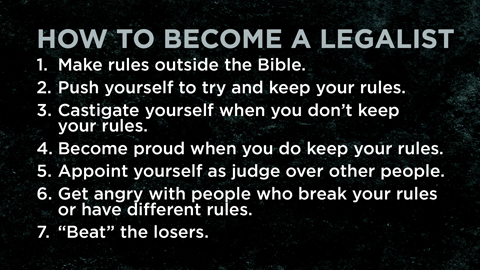
Gospel vs. Legalism

Gospel vs. Legalsim

What is the difference between legalism and the gospel?

  • Legalism (or Moralism) says God looks at how well we keep the law.
  • The Gospel says we are hidden in Christ. So God sees how well Jesus kept the Law (perfectly), all his works, and his death on our behalf.  Consequently, because we are hidden in Christ, God sees the work of Jesus when he sees us. The gospel says that, because of God’s grace, all that Jesus is and did is credited (imputed) to us, through faith.  (Colossians 3.3, Ephesians 2.8, Romans 5.2, Galatians 2.20)

So what is the difference between the gospel and legalism? It is the difference between Christianity and every religion in the world.

Confession of a Recovering Legalist

stone-face

The guy seemed somewhat indignant. “There are no legalists in this room”, he insisted in response to an indirect, and unintentional, indictment made by another member of the presbytery.

Little did he know.

“Absolutely there are legalists in the room”, I thought outloud.

I cannot say with certainty that this man, who felt compelled to defend himself and all those like him, is indeed a legalist.  I suspect he is. There seems quite a bit of evidence that suggests he is.  But I don’t know what is in his heart – or the heart of any other man in that room.

What I do know is my own heart.  And even if no one else there in that room matched the description, at heart I am a legalist.

That would surprise many. In our presbytery, which is historically characterized as being very narrow and uptight, I am, I suspect, by comparison seen as being ‘looser’ and to the Left of center. (NOTE: It’s probably the only place I ever go where I am consisered Left of anything.)  I am the guy who frequently points out the emptiness of Fundamentalism and all the associated rules as compared to the greatness of the grace offered us in Christ.

But as Craig Cabaniss articulately points out:

Legalism, however, is not a matter of having more rigourous rules.  It’s far more lethal than that. It strikes at the very core of our relationship with God.

C.J. Mahaney explains:

Legalism is seeking to achieve forgiveness from God and acceptance by God through obedience to God. In other words, a legalist is anyone who behaves as if they can earn God’s approval and forgiveness through personal performance.

Now I am not usually so foolish as to think I can or will gain God’s forgiveness or acceptance by my behavior.  I realize my only hope is in Christ. And I know that Jesus – and He alone – has already accomplished everything that is necessary to reconcile me to God.  (This is known as forensic justification.)

But I often get the feeling that God likes me better than those uptight legalists because I am not as uptight. And I like that feeling.  Furthermore,  I like to think I am more committed to  the advancement of Christ’s kingdom than they are.  I am not sidetracked by mind-numbing minutia, as some others seem to be.  In short, I like ‘knowing’ that I am ‘better’ than others because I am faithful -more or less – to a set of behavioral standards that others are not so visibly faithful to observe.

And that is what makes me a functional legalist.

A legalist is not defined by narrowness or the imposition of rules upon others.  It is the erroneous sense that I can earn God’s favor by  my behavior – by what I do and what I don’t do.  And for me it is favor and not forgiveness that I desire through my legalism.

Cabaniss points out:

Legalism is a heart condition that can easily affect… and color any activity.  Legalism can taint our Bible reading, praying, witnessing, eating, sleeping, lovemaking, working, recreating, joking, shopping – we can be legalistic about anything!

The solution is not lowering our standards.  It is necessarily raising our understanding of and response to the glorious grace of God.

Portrait of a Recovering Pharisee

by Nancy Scott     

When Sally first heard the gospel at age eleven, she understood immediately that God’s grace is what saves us. She already knew her heart was full of evil and that she had nothing to bring to God. It made perfect sense that God would have to do the saving, if any saving was to be done. The solution of Jesus’ death on the cross was perfect, and she understood that He had died in her place.

The Bible church where Sally began her pilgrimage strongly taught the concept of grace. She learned that grace meant “undeserved favor.” Grace was getting something you didn’t deserve, whereas mercy was NOT getting what you did deserve. The gospel addressed both of these areas of life in the provision of Jesus’ death on the cross. So she fully understood that she came to Christ because God was reaching deep into her soul to regenerate her and to bring her to an awareness of her need and of His provision for her salvation. She entered the path to the kingdom on her knees, got up, and took off running.

By the time Sally was seventeen, life was not as clear-cut as it had been at the tender age of eleven. She had understood what it meant to be saved by grace; now she began wondering what it meant to live there. She began to struggle with the difficult choices of life and a tension in her desires to do the right thing. When she went to her Bible teachers for advice, they told her that God had given her all the resources she needed to live a victorious Christian life, and she only needed to avail herself of the Spirit of God who now lived inside her. If she tapped into His power, He would grant her the ability–and the desire she lacked–to do the right thing. The Bible teachers asked Sally if she did her daily devotions, and they recommended some helpful Bible studies. These things, they said, would help unleash the Spirit’s power to work in her life.

Sally took off running again. She dove into her daily devotions with renewed vigor, and even though she wasn’t a morning person, she began to get up an hour earlier. Sally was so grateful that God had given her this extra measure of grace to be so dedicated to him at such a young age. Things seemed to improve for a while.

Then something slowly changed. The excitement began to wear off, and Sally suspected that her non-Christian friends were having more fun than she. She indulged with them every now and then, only to feel tremendously guilty and to make a renewed commitment to God with each failure. The longer this pattern went on, the more confused Sally became. Why wasn’t God unleashing His Spirit inside her for victory anymore, even when she carried out all her spiritual practices and dedication? Why was the evil around her becoming more attractive instead of less attractive? Was it normal for her to find herself rededicating her life to God so routinely? Was this what it meant to live by grace?

Continue reading

Deconstructing the Twin Enemies of the Gospel

Perhaps the two of the most effective enemies of the gospel within the Church in North America are the twins: Moralism and Legalism. While there are other enemies at work, such as Relativism and Licentiousness, these are far more obvious in their opposition to the gospel.  Moralism and Legalism, however, are so potent, especially among conservatives, because they stealthily fly under the radar.  In fact, they are such subversives that they are often embraced as if they are part of the gospel, or at least partners with it.

Here is something Tim Keller offers to combat these sneaky, deadly foes:

Some claim that to constantly be striking a ‘note of grace, grace, grace’ in our sermons is not helpful in our culture today.

The objection goes like this: “Surely Phariseeism and moralism is not a problem in our culture today. Rather, our problem is license and antinomianism. People lack a sense of right or wrong. It is ‘carrying coal to Newcastle’ to talk about grace all the time to postmodern people.”

But I don’t believe that’s the case. Unless you point to the ‘good news’ of grace, people won’t even be able to bear the ‘bad news’ of God’s judgment. Also, unless you critique moralism, many irreligious people won’t know the difference between moralism and what you’re offering.

The way to get antinomians to move away from lawlessness is to distinguish the gospel from legalism. Why? Because modern and post-modern people have been rejecting Christianity for years thinking that it was indistinguishable from moralism. Non-Christians will always automatically hear gospel presentations as appeals to become moral and religious, unless in your preaching you use the good news of grace to deconstruct legalism. Only if you show them there’s a difference–that what they really rejected wasn’t real Christianity at all–will they even begin to consider Christianity.

Ah!! You Just Said a BAD Word!

Tony Campolo is famous – or infamous – for a statement made at a Christian college chapel service:

“The United Nations reports that over ten thousand people starve to death each day, and most of you don’t give a SH%T.  However, what is even more tragic is that most of you are more concerned about the fact that I just said “sh%t” than you are about the fact that ten thousand people are going to starve today.”

Let me ask you:

  • What was your first thought when you read that quote?  Did you visualize thousands of starving people? Or were you stunned by the use of the “bad” word?
  • Imagine if you had been in the congregation at your church and he made that statement. What would have struck you then?
  • Can think of any better way to point out that sometimes we do not have the heart and priority of Christ? 
  • Can you think of a better way to reveal our tendency toward self-righteousness and legalism?

I’ve never had the nerve to say anything like this from the pulpit. Maybe if I was a traveling speaker who didn’t have to face the same crowd again a week later I might have considered it…

Measuring Up?

Do you ever feel that you have to measure up? 

Do you wonder sometimes how  you are grading out in God’s eyes?  I suspect the answer for most people is “Yes”.    Our theology may tell us otherwise, but I think most people struggle with this from time to time – especially when we feel emotionally tired and as if we are coasting in neutral gear spiritually.   

I’m not sure many people are even aware they feel this way. We know our theology well enough, and so we remind ourselves of the truth of the Gospel: That we are declared righteous in Christ.  This is a wonderful truth.  But sometimes we don’t really live in the light of this truth.  This is the difference between our confessional theology and our functional theology.   

In other words there is sometimes (often?) a gap between what we know to be the facts and the way we allow those facts to impact our heart and emotions.  Put mathmatically, the difference between our confessional theology and our functional theology equals frustration.  (F – C = Frus)

A few months ago I posted an excellent article by Paula Rinehart, that had originally been written for The Navigators’ Discipleship Journal.  Because I know the tendency we have toward wandering onto what Jerry Bridges calls a Performance Treadmill, I wanted to post it again.   

If you ever find yourself tired of trying to measure up, or if know others around you who seem to fall into that trap, you will appreciate: 

Good Enough!

Teenagers: Tendency Toward Legalism

Do you remember a Brady Bunch episode where Greg and his parents got into a debate about “Exact Words”?  Greg, who had been grounded from driving, when confronted about borrowing a friends wheels, insisted that his parents only instruction to him was that he was not drive the family car.    The rest of the episode is an illustration of the difficulty of livng by exact words.

What I never realized was that this episode also illustrated a more universal principle. 

According to Paul Tripp:

“Teenagers have a natural tendency toward legalism.”

What parent has not heard something like:

  • “You didn’t say I couldn’t…” or
  • “You didn’t tell me to.. today”  

I’ll have to be honest, sometimes my kids are technically correct. BUT still, …we all understand, by common sense, what should have been expected.

Such statements are merely expressions of this tendency toward legalism. 

There is no use trying to make certain we are right.  There is no sense in trying to be more clear in our instructions.  We need to recognize this for what it is: Legalism. And we need to get across to our teenagers that, in the end, legalism does no one any favors.

Our teenagers need to understand, not only the lesson Greg Brady learned in that episode, but more importantly they – and we – need to be reminded what Paul says in Galatians 3.10:

“All who rely on observing the law are under a curse, for it is written: “Cursed is everyone who does not continue to do everything written in the Book of the Law”

***

This is the Second in a series of six posts elaborating on the insights Paul Tripp offers in his book Age of Opportunity.  To read the others click: Teen Tendencies & Temptations.

The Gospel Saves From Morality

It sounds like a contradiction, doesn’t it?  The Gospel saves you from morality.  Can this be true?

It is true. And it is an important truth.  And understanding what John Piper is saying in this video can free people from the crushing weight of trying to be good. For others it will free them from self-righteousness, which is a cancer that eats away at the spiritual sensitivity system.

I Want to Walk Free, But I Still Hear the Chains Rattling

As a pastor I frequently encourage people to embrace the Gospel. It is not just to unbelievers that I present that challenge, but to believers as well – even to some who have been Christians for decades. 

We all need to grow in grace, and live by grace day by day. But as easy as it sounds, I sometimes have to stop and realize that it may be far easier to say than it is to live out. Many people – many good people – struggle with how to let go of our propensity toward legalism and embrace the freedom found in Christ.

For that reason I find the following article by Richard Pratt, of Reformed Theological Seminary & Third Millenium Ministries, to be particularly pertinent. And it is as entertaining as it is insightful – at least, I think so.

The story behind it, as I understand, is that Pratt had been encouraged by fellow RTS prof, Steve Brown (Old While Guy), to write a book about the experience of freedom found in the Christian life.  “I Want to Walk Free, But Still hear the Chains Rattling” is Pratt’s response to Brown’s prodding.

Continue reading

What is the Gospel?

Gospel means “good news.” The good news is: you (and I) are more sinful and flawed than you (or I) ever dared believe, yet you (and I) can be more accepted and loved than you (or I) ever dared hope at the same time, because Jesus Christ lived and died in our place. As the apostle Paul said, “God made him who had no sin to be sin for us, so that in him we might become the righteousness of God.” (2 Corinthians 5.21)

That paradoxical statement is a simple formulation of the gospel.

More thoroughly we could say that the whole Bible is the gospel. It is a book about the God who rescues people from their moral and spiritual rebellion against him. The teaching of the Bible can be summarized under four headings: God, Man, Jesus Christ, and Our Response. 

Firstly, the gospel teaches that God is our creator. Thus he has the right to rule and command us as he does in his law. God is also holy, that is, he is absolutely pure morally, and he hates and punishes rebellion on the part of his creatures. He is more holy than anyone would ever imagine. 

Secondly, the gospel teaches us about human beings. We are creatures made by God and for God. We were originally created to live in relationship with God and we were morally pure. But because our first parents rebelled against God (just as we also all have done), human beings are now cut off from relationship with God and are subject to his condemnation. We are more sinful than we ever dared believe.  

Thirdly, the gospel teaches us what Jesus Christ has done for sinners like you and me. Jesus became a man and lived a life of perfect obedience to God’s law, and then died as a sacrifice in our place under the judgment of God. He was raised from the dead and now reigns in heaven. The condemnation that he suffered takes away the necessity that we suffer judgment for our own sins- “God made him who had no sin to be sin for us.” The righteous life he lived is credited to us, not because we are actually righteous, but because of God’s mercy and grace- “in him we might become the righteousness of God.” 

Fourthly, the gospel teaches us how to respond to the good news. We turn away from our rebellion and put our trust in Jesus Christ. Despairing of our own worthiness to stand before God, we believe the promise that those who trust in Jesus Christ will be forgiven and declared righteous. Those who put their faith in Jesus Christ are accepted as loved sons and daughters of God, and God sends his Spirit to live in them. 

Counterfeit Gospels

 Martin Luther said that “a sinner trying to believe the gospel was like a drunk man trying to ride a horse; he will always be falling off on one side or the other”. The two errors that the sides of the horse represent are

  • legalism or moralism, and
  • pragmatism or relativism or antinomianism.  

Moralism is the view that a person is made acceptable to God through his own attainments. Moralists are usually very religious, and often very conservative in their religion. Legalism tends to stress truth without grace. Moralists are usually very rules oriented, and depending on their success in keeping the rules they will be either arrogantly self-righteous or depressed and morose. If they go to Jesus for forgiveness, it is just to ask him to fill in the gaps they have left in their own religious performance. For the moralist, the cross is not the only basis for acceptance by God, but is an adjunct to our performance. 

Pragmatists are often irreligious, or prefer more liberal religion. They tend to stress grace over truth, assuming everyone is accepted by God and that we each have to decide what we think is true for us. Often relativists will talk about God’s love, but since they do not see them selves as deeply sinful people, God’s love for them costs him nothing. For them the cross is not the necessary condition of our acceptance by God. 

The gospel holds out to us a whole new system of approach to God. It rejects our attempts to justify ourselves before God, to be our own saviors and lords. It rejects both our pragmatic presumption and our religious attempts to earn our way into God’s favor. It destroys the perception that Christianity is just an invitation to become more religious. The gospel will not let us think Jesus is just a coach to help us get stronger where we are weak. To be a Christian is to turn from self-justification of all sorts and to rely exclusively on Jesus’ record for a relationship with God. 

Christians and non-Christians both stumble over the two counterfeits of the gospel. Many Churches are deeply moralistic or deeply relativistic. Christians who understand the gospel very clearly still look like the drunk man on the horse, as the desire to justify ourselves and trust in our own performance continually reappears. 

The gospel tells the pragmatist that he is more flawed and sinful than he ever dared believe. The gospel tells the moralist that he is more loved and accepted than he ever dared hope.