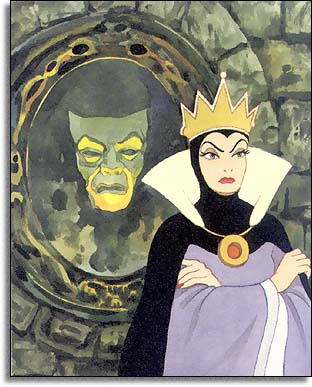
Mirror, Mirror on the Wall

In the Preface to Joe Thorn‘s book, Note to Self, Sam Storms penned a paragraph that strikes at the heart of the difference between those with a vital Chrisian faith, and those who show little if any hint of actually being a follower of Jesus Christ.  Here is what Storms says about the functional place of Scripture in the life of a Believer:

Merely affirming the Bible is inspired accomplishes very little.  Asserting it’s authority isn’t much better.  The inspiration and authority of the Scriptures are of value to us only so far as we change our beliefs to conform to its principles and alter our behavior to coincide with its imperatives.  The Bible is meant to govern our lives, to fashion our choices, to challenge our cherished traditions, and ultimately make us more like Jesus.

The question for each of us, then, is whether the Bible actually functions in this way.

  • Do we submit to its dictates?
  • Do we put our confidence in its promises?
  • Do we stop living in a certain way in response to its counsel?
  • Do we embrace particular truths on its authority?
  • Do we set aside traditional practices that conflict with its instruction?

In other words, for the Bible to be of value to us it must actually function to shape how we think, feel, and act, as well as what we believe, value, and teach.

I think Storms nails it here; hits it square on its head.

A number of dialogues I have recently had broached the subject of the differences of maturity levels between professing Christians. What Storms addresses is one of the most vital dynamics that explain the differences.  In fact, since we who believe have all been given the same Spirit, perhaps the differences in the way we approach and apprehend the Scripture may be THE most important explanation for such differences.

Some see the Scriptures as they are to be seen, as a revelation of what is good and a mirror to show us what needs addressing in our lives, which in turn drives us to the Cross, where the power of transformation rests.  Here they find the promises of God to be true: He is making us beautiful, to become a Bride for the King.

Others also see the Scriptures as a mirror. But, for these folks, this mirror is more like the one used by that witch in the story Snow White, who declared: “Mirror, mirror on the wall, who is the fairest one of all?”  All she wanted was to hear how good she was; how much better she was than others. Sadly some people look to the mirror of Scripture only willing to see whatever appears to validate them.  Failing to see, by the mirror, the ugly-fying effects of sin in their hearts and lives, they see no real need to return to the Cross.  Thus they seem to never be changed.  They never become truly beautiful.

3 Lane Escape from Moralism

I am thankful to Joe Thorn for concisely clarifying an issue that I believe confounds many well intentioned Christians.  The problem addressed is the confusion of moralism with the gospel.  In many case moralism is an attempt to take seriously both God and the Christian faith.  Nevertheless, moralism is off track.

In a post titled Killing Moralism, Thorn observes:

Many Christians have grown up in the church on moralistic preaching; that is, preaching that calls for obedience without connecting the commands of God to the cross of Christ.

Thorn goes on to suggest:

This disconnect is dangerous, potentially leading hearers into either self-loathing or self-righteousness. Moralistic preaching is often the ground in which the devil sows the seeds of legalism.

The more I study the more I am amazed by how cohesive the Scriptures are – both Old Testament and New Testament.  Christ is central to both, as together they unfold God’s awesome plan and work of redemption. 

But Thorn is right, too much of what we hear from our pulpits fails to make the connection.  And sadly that has all too often been true of the pulpits I have stood in through the years.  Oh, the Word was proclaimed. The teaching was faithful. Often rich truth was expressed: doctrinal, devotional, and dutiful.  But too often the cross – which is the crux of the whole Bible – was not clearly tied in.

In recent years I have labored to remedy that. But it is still a work in progress.

In his post Thorn suggests three observations we should look for to draw more deeply from the Scriptures for our preaching, teaching, and personal formation:

  • See the God of the Command
  • See the Grace Behind the Command
  • See the Gospel Above the Command.

To practice this observation Thorn wisely instructs us to remind ourselves of three truths:

  1. Jesus atoned for our failure in this command. (Colossians 1.3; Colossians 2.13, 14; Ephesians 2.16; Romans 5.9)
  2. Jesus fulfilled this command for us. (1 Corinthians 1.30-31; Romans 5.19; Philippians 3.9)
  3. Jesus empowers us to live out this command. (Philippians 2.12-13; Ephesians 6.10-20; 1 Peter 4.11)

The more we embrace these principles the better we will become in “preaching the gospel to ourselves”.  And living in light of the gospel is the key to escaping well intentioned but ultimately vapid moralism.

Gospel-Centered Lives

From time to time I am asked by some in our church what I mean when I repeatedly declare that we are – and we must be – a Gospel-Centered Church. I think it may be the hyphen that confuses people.

To be “something”-centered is simply to focus on the relation an individual or a church has to a central value.  While there could be any number of things at the center of a persons or organizations values, in our case the point of emphasis is the Gospel (or the Cross).

As for what it means to be Gospel-centered, as an individual or as a church, I don’t think I could answer better than Joe Thorn did in a post titled: Gospel-Centered.  One of the things Joe points out is:

[T]he gospel-centered life is a life where a Christian experiences a growing personal reliance on the gospel that protects him from depending on his own religious performance and being seduced and overwhelmed by idols.