Dangers of Spiritual Resolutions

I’ve been there. Likely, so have you.  The year begins with good intentions, and maybe even a strong start, only to fizzle days later.  The Statistic Brain Research Institute reports that 75% of New Years Resolutions are broken within the first week of the New Year.  No doubt most of the others go down soon thereafter.

Among the more frequent vows is a renewed commitment to read the Bible:

  • Read the whole Bible in one year
  • Read the Bible daily, or just more often

This seems a noble resolve. And as a church pastor, it is certainly one I applaud.  In fact, I often share some Bible Reading plans for anyone who endeavors to take up this challenge.  (Like this one: Bible Reading Plan for Slackers & Shirkers)

But in the brief (3 minute) video above, Steve Childers, of Global Church Advancement, offers a caution about making such resolutions – even resolutions such as to pray more or to read the Bible.

It may seem odd that I am posting such caution about making spiritual resolutions, especially since I commended the Resolutions of Jonathan Edwards in a post just yesterday.  But without denying the potential benefit of reflecting upon Edwards’ Resolutions, nor even the positive effects of increased Bible reading and prayer during the coming year, I think Childers makes a good point.

Consider this:

The state of our heart is of utmost importance as we practice spiritual disciplines. It’s possible to read our Bibles, pray, attend Lord’s Day worship, and even take the Lord’s Supper for all types of reasons. But unless we do it for God’s glory, and our joy in him, it does us no ultimate good.

Or as Charles Spurgeon reasoned:

“It is not enough to do the correct thing; it must be done in a right spirit, and with a 
pure motive. A good action is not wholly good unless it be done for the glory of God, 
and because of the greatness and goodness of his holy name.”

In no way would I ever dissuade anyone from increasing their spiritual vitality through partaking in such means of grace as prayer and Bible study. Nor does Childers.  But Childers does wisely warn against resolutions that may result in merely going through religious motions – even if those motions come more frequently.  Instead Childers points us to the source of all grace, and encourages us to avail ourselves of all that is offered.

Take a moment to watch the video, and to consider what Childers says.  For those who prefer to read, a transcript of the message can be read on Childers’ blog: Pathway Learning
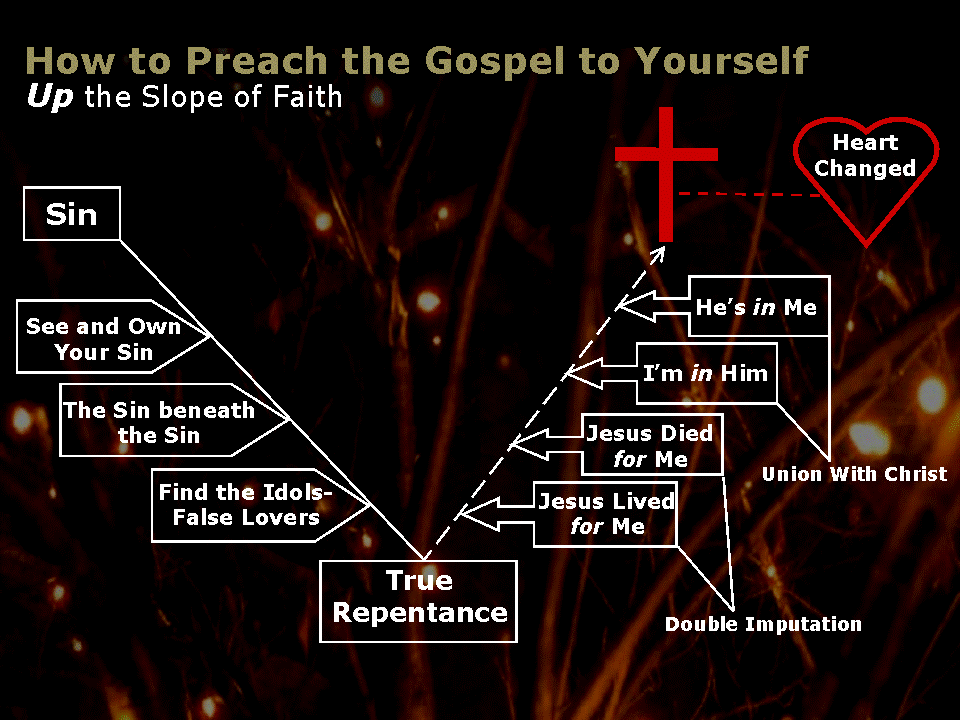
How to Preach the Gospel to Yourself

Preaching Gospel to Self

Paul, in Colossians 2.6, instructs us: “So then, just as you received Christ Jesus as Lord, continue to live your lives in him…”  Simple words, but powerfully practical when unpacked.

How did we “receive” Jesus?  By faith and repentance – or by repentance and faith.  We are not quite sure which comes first, but perhaps that does not matter.  It may be that the order is different with different people. What matters is that genuine conversion involves both of these elements: Repentance of our sin and of all our desire and attempts to save ourselves through our good behavior; Faith in the gospel – the good news – of what Jesus has done on our behalf, and what is offered to us in him.

If these are the two elements by which we received Jesus then, according to the Apostle’s instruction, these are the two elements that should be characteristic of our day-to-day life in Jesus.  The old Puritan Thomas Watson once wisely noted: “Faith and repentance are the two wings by which we fly toward heaven.”  In other words, faith and repentance are not only the instruments by which the journey of salvation is initiated, these are the practices by which we travel.  These are the ingredients of spiritual growth leading to maturity.

The chart above reflects both faith and repentance, and provides a tool to help us be able to “preach the gospel to ourselves”.

It reminds us that when recognize sin in our lives, our response should not be to simply resolve to “stop it”. We need to discern its source.  In other words, the sin we see, the sin which shows itself in our behavior (and in our attitudes), has deeper roots and causes.  So, like an explorer commissioned to trace the a great river to discover its tributaries and its origin, we are called upon to discover what “root sins” are tributaries of our behavior, and ultimately what idols are the original source.  Once discovered – or even while in the process of discovery – “putting sin to death” requires that we confess it and repent of it.  All of it – the sinful behaviors, the attitudes that lead to it, and the idols that source it.  Growth in grace is greater than mere moral reform.  Growth in grace is a work of the Spirit upon the heart which eventually and inevitably leads to a change in behavior.

Yet growth in grace does not come by confession and repentance alone.  Such may lead to behavior change, if we feel guilty enough and desire to change. But that is not growth in grace.  Growth in grace requires that we believe what grace gives; that we ponder what is true, and good, and beautiful: chiefly among such things is the gospel, the good news of what God promises – and does – when we trust  in Jesus.  (Philippians 4.8)   Reminded of the truths of the gospel, our hearts change; they turn toward God, causing us to hunger to grow more like him, and enabling us to rely more on his promise that what he began he will complete.  (Philippians 1.6)

This is the spiritual discipline of preaching the gospel to ourselves.

Sailboat Spirituality

Do you sometimes have difficulty understanding or remembering who does what in our Spiritual maturation? We get that it is God who must make us alive to believe (regeneration), and that he gives us the gift of faith to believe, which leads to salvation (justification).  But then what?  Surely there is something we must do.  What about spiritual disciplines? But then, how does grace work? What does the Holy Spirit do?

I love the imagery Jared Wilson offers in his excellent book Gospel-Wakefulness:

As long as we are thinking of achieving the fruit of the Spirit by our own efforts to be more fruitful and joyful, we may be working in their direction, but we’re getting there by the sweat of our brow.  We’ve embraced rowboat spirituality.   But think of the obedient work of the Christian life like a sailboat.  There are lots of things to do on a sailboat. Sailors don’t just sit there – at least, not for too long.  There are lots of working parts on a sailboat and lots of things to pay attention to. But none of those things make the boat go.  The boat doesn’t go unless the wind catches the sail.

What we are picturing here is the work of the Spiritual Disciplines in conformity with the law of God found in Scriptures, not as the means of propulsion, but as the means of setting the conditions for Spiritual fertility. In obedience, we till the soil of our hearts so that they are more receptive for the planting and growth of the Word in our lives.  We obey both in response to the Spirit’s awakening us and in order to raise the sail for the Spirit’s movement.

“If we live by the Spirit, let us also walk by the Spirit.” ~ Galatians 5.25

Gospel-Driven Sanctification

The first thing to remember is that we must never separate the benefits (regeneration, justification, sanctification) from the Benefactor (Jesus Christ). The Christians who are most focused on their own spirituality may give the impression of being the most spiritual but from the New Testament’s point of view, those who have almost forgotten about their own spirituality because their focus is so exclusively on their union with Jesus Christ and what He has accomplished are those who are growing and exhibiting fruitfulness. Historically speaking, whenever the piety of a particular group is focused on OUR spirituality, that piety will eventually exhaust itself on its own resources. Only where our piety forgets about us and focuses on Jesus Christ will our piety be nourished by the ongoing resources the Spirit brings to us from the source of all true piety, our Lord Jesus Christ.

~ Sinclair Ferguson

Grace of Repentance


Today is Ash Wednesday. That does not mean much to many in my theological circles.  But for many other Christians it is a day that launches the Season leading to Easter – the Season of Lent.  This day is designated Ash Wednesday because of an ancient practice of marking believers with ashes as a symbol of repentance. 

Hopefully it is more than symblolic, but is also a reminder that, as Martin Luther said, “When Christ said ‘Repent’ he called for the entire lives of Believers to be lived out in repentance.” 

Repentance is a lost art.  Repentance is also a neglected practice.  I suspect that many assume repentance is someting to be avoided; that repentance is what we must do if we have sinned; but if we can avoid sin we have no need of repentance. 

Seems logical. Except it mischaracterizes the nature of sin.  Sin is not what we do, sin is the condition we have, whether we are aware of it or not.  I find helpful the old saying: “We are not sinners because we sin. We sin because we are sinners.”  Thus, as Luther suggested, the necessity of life lived out in repentance. 

Perhaps a better way of putting it might be that our lives should include repentance.  I say that because repentance never stands alone. Repentance should always accompany Faith; and Faith should always accompany Repentance.  They are two sides of the same coin of Gospel Christianity.

I like the way the old Puritan Thomas Watson says it:

“Faith and Repentance are the two wings by which we fly toward heaven.” 

I love the imagery. It shows us that our salvation involves not only our conversions (which, by the way, requires both Faith & Repentance), but is a sanctifying journey which requires us to grow in our awarenss of both our ungodliness and the greatness of the Gospel.  To have one wing longer than the other; or worse, to have only one wing, would be disastrous.  Try it for yourself.  Try flying one of those balsa wood planes, with one wing longer than the other and see how it flies.  But this is life without both Faith & Repentance.

Three books I have found helpful in shaping my understanding and appreciation of the need of ongoing repentance:

Repentance & 21st Century Man by C. John Miller

The Doctrine of Repentance by Thomas Watson

Repentance: The First Word of the Gospel by Richard Owen Roberts

The Gospel in 6 Minutes

What is the Gospel? 

While in many ways this should be a simple question to answer, experience has taught me that many people are confused about what the Gsopel is.  Most agree that the Gospel is something good.  But they are confused about what particularly defines the Gospel. 

Some see the Gospel as merely that message necessary to receive salvation, but have no idea it has a huge impact on how we live our lives even after becomming Christians. Some associate it with a style of music often found in a rural church.  Some view at is as a synonym for “Truth”.  Others simply think of the whole Bible, or at least the New Testament, as being the Gospel. 

While the latter statement is true in a sense, there is a particular message that runs throughout the Bible that is most properly seen as the Gospel; and by which the entirely of Scripture can be said to be Gospel. This message is at times more detectable than  at other times.  It may be said to be like a stream that runs both above and under ground. Even when it is not obvious, if you look closely its presence can be seen.

Getting the Gospel right is essential to a healthy and vibrant spiritual life.  Many problems experienced by Christians in their spiritual and emotional lives, and in evangelsim and mission, can be traced to a misunderstanding or masapplication of the Gospel.  That’s why I want to take every opportunity to clearly declare and define the Gospel.

John Piper succinctly explains this vital message in this brief video.  (It is well worth the few minutes.)

Signs of Living to Please God

In Galatians 1:10, the Apostle Paul asks a semi-rhetorical question: “Am I now trying to win the approval of men, or of God?”   

 At this time of the year most of us see the opportunity for a new start. Whether you are one who makes New Year’s Resolutions or not, there seems to be a sense of a“Do Over” that comes almost as soon as that ball drops in Times Square, and the Bowl season begins to make way for the roundball & puck.   

The Apostle’s question raises another, more fundamental question: Who is it that we are to live to please?  

I want that to be a question that will be given consideration for this new year (… and every year).  

It would not be appropriate to suppose Paul suggests affirmation from the people around us is a bad thing. On many occasions Paul expressed his thankfulness for having been well received, for the friendships he enjoyed with many among whom he had lived and labored.  Yet his question should remind us: “The primary purpose of man is to glorify and enjoy God”. (Westminster Shorter Catechism, Q. 1)

While earning esteem at work, in your neighborhood, or among family members may often be a good thing, Paul reminds us that it is when this is our driving motivation that we may be out of accord with the very purpose for which we are created, and for which we are redeemed.   

So how do we know when we are falling into this? (Yes, when, not if.)   

The great English Puritan, Richard Baxter, provides us with some thoughts, and exhorts us: “See therefore that you live for God’s approval as that which you chiefly seek, and as that will suffice you.”

You may discover yourself by these signs: 

  1. You will be careful to understand the Scripture, to know what pleases and displeases God
  2. You will be more careful in the doing of every task, to fit it to the pleasure of God rather than men.
  3. You will look to your hearts, and not only to your actions; to your goals, and thoughts, and the inward manner and degree.
  4. You will look to secret duties as well as public, and to that which men do not see as well as those which they see.
  5. You will revere your conscience, paying close attention to it, and not slighting it; when it tells you of God’s displeasure, it will disquiet you; when it tells you of His approval, it will comfort you.
  6. Your pleasing men will be charitable for their good, and pious (holy) in order to please God, not proud and ambitious for your honor among men, nor impious against the pleasing of God.

Baxter Goes on to say:

Whether men are pleased or displeased, how they judge you or what they call you, will seem a small matter to you, as their own interests, in comparison to God’s judgment. You don’t live for them. You can bear their displeasure, and comments, if God is pleased.