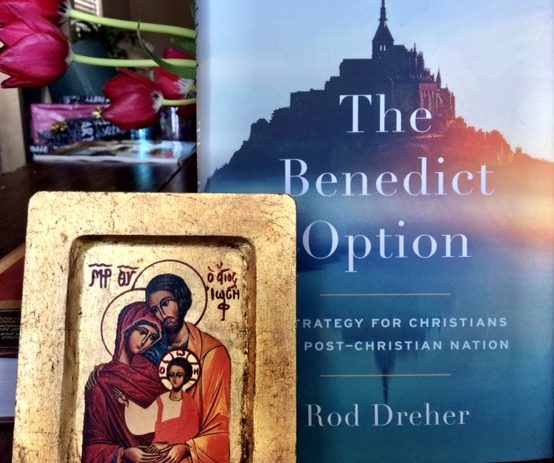
The Benedict Option is Not Really an Option

Benedict Option collage

Since I already have some pretty definite opinions about the book, I thought maybe I ought to read it.  My preliminary thoughts about Rod Dreher‘s The Benedict Option is that it offers a good analysis of the present states of both culture and Church, but Dreher’s solution seems more imposed than necessary or biblical. In other words, Dreher seems to have a fascination with the Rule of Benedict, and uses the current social climate as an excuse to encourage others to embrace it.

It’s not that I think there is no benefit from Benedictine practices. On the contrary, I was intrigued a few years ago when reading Dennis Okholm’s Monk Habits for Everyday People with a group of pastors with whom I would meet monthly or so.  What I appreciated from Okholm’s work, and expect to appreciate from Dreher, are the categories of thought the Benedictine’s have developed.  I appreciate many of their disciplines, and I can see that many of their practices could help cultivate a disciplined and rich spiritual vitality.  However, the notion of withdrawal from the world at the root of Benedictine discipline, is not only an impractical option for most people, I am convinced that it violates Jesus’ command to his disciples found in John 20.21:

“Peace be with you. As the Father has sent me, even so I am sending you.”

And it is out of line with God’s expressed instruction to his people who were living in Babylonian exile, as recorded in Jeremiah 29.7:

“But seek the welfare of the city where I have sent you into exile, and pray to the Lord on its behalf, for in its welfare you will find your welfare.”

In other words, despite some – even many – ideas worthy of serious consideration, and that might be appropriate to be adopted with some adjustments, it seems to me that The Benedict Option is not really an option for those who want to be faithful followers of Jesus Christ.  And Dreher himself seems to understand this since, despite the provocative title, he spends much energy explaining that what he is encouraging is the employment of some of Benedict’s principles without necessarily actually withdrawing into monastic communities.

See also:

Different Worlds

While I’ve long known it, recently I’ve finding the following quote to be painfully all too true:

Following Jesus today requires you to practice the same single-minded non-conformity. And it will produce the same effect in your life that it did with Jesus.  If you truly follow Jesus, in addition to enjoying a most excellent adventure, you will likely end up seeming too Christian for many of your pagan friends and too pagan for many of your Christian friends.  When you truly follow Jesus, you’ll spend considerable time in the world like he did, and as a result, many of your religious friends will think you’re too irreligious. On the other hand, many of your irreligious friends will find it odd that you are so focused on the spiritual.  Thus, you end up seeming both too Christian AND too pagan.

~ Dick Staub, Too Christian, Too Pagan

Making a World of Difference

“What will it take to change the world – to really change it for the better?”

Ron Sider asks that question in the Introduction to his book, Living Like Jesus.  And his question resonates with me. It has for a long time – long before I heard Sider aksing it. 

I grow bored and frustrated with a faith that simply exists to perpetuate itself.  It has never seemed to me to be the faith I see in the Bible.  The early disciples of Jesus turned the world upside down! Jesus came to reclaim the world that is rightfully his.  Somehow, isolating oursleves while singing “When the Roll is Called Up Yonder” does not seem to match God’s purpose for his church.

The church of Jesus Christ is intended to be an expression of what the Kingdom of God is and will be.  We are called to be influencers in a world that is corrupt to its very core.  (See Matthew 5:13-16 & Jeremiah 29:7)

And we are to be influencers while recognizing that we have been infected by the very corruption of sin that is continuing to devastate the world around us. We are not immune. But we are in remission because of the blood of Christ. (See Romans 3:25 & Hebrews 9:22

Such an understanding shapes our attitdes as we do what we are called to do. Knowing that we are not superior, but are totally dependent upon the grace of God in the blood of Christ, we are humble and compassionate toward the world we are called to serve.  And knowing that our only hope is God’s grace, we glorify God through thankfulness to him and dependence upon him. 

Sadly, I see too may churches, and too many Christians, who have chosen to isolate themselves from the world they see as polluted.  They have no intention of trying to influence it, only to escape it. 

This seems foolish to me for a number of reasons.

First, it is directly disobedient to God’s intention for his people (See Genesis 12:2-3).  The motive for this disobedience may be the understanding that we are not immune to the corruption of sin. It is therefore an act of self preservation; it is an attempt to avoid becomming infected.  But it is still disobedience to God.  And it is a lack of functional faith that he will preserve his people.

Secondly, self preservation is misguided because, as Romans 3:23 shows us, we have all already beeen infected! We can hide if we want, but it will do us no good.  The infection is already inside the camp!

Finally, worst of all are those who isolate themselves and live as if they think they are immune to the effect of sin. These are self-righteous separatists. If they are impervious to sin, why isolate themselves? Such people make no positive influence on the world that I can see.  And frankly, because of their wrong view of themsleves and their direct disobedience to God, I am not sure I really consider them truly Christian! (However, I don’t get a vote.)

So I wrestle with the question: How can we make a difference? How can we change the world? How can we influence it toward what God intends it to be?

Sider offers an answer to his own question:

“I think the answer is simple: It would take just a tiny fraction of today’s Christians truly believeing what Jesus taught and living the way Jesus lived.”

I think Sider is right.

Siders book elaborates on practical ways we need to examine our lives, and ways our lives are to reflect the life & teaching of Jesus.  It revolves around what Sider labels Characteristics of a Genuine Christian: 

1. Genuine Christians embrace both God’s holiness and God’s love.

2. Genuine Christians live like Jesus.

3. Genuine Christians keep their marriage covenants and put children before career.

4. Genuine Christians nurture daily spiritual renewal and live in the power of the Spirit.

5. Genuine Christians strive to make the church a little picture of what heaven will be like.

6. Genuine Christians love the whole person the way Jesus did.

7. Genuine Christians mourn church divisions and embrace all who confess Jesus as God and Savior.

8. Genuine Christians confess that Jesus is Lord of politics and economics.

9. Genuine Christians share God’s special concern for the poor.

10. Genuine Christians treasure the creation and worship the Creator.

1l. Genuine Christians embrace servanthood.

This list alone is worth the price of the book. 

I think much good would come if we sincerely reflected on these premises.  How much more if we began to humbly acknowledge that often we have been negligent in many of these areas, and began to act on them in accordance with the teaching and life of Christ?

I suspect we would see our influence grow; that our influence would be viewed as a positive thing.  I suspect we may even see Proverbs 11:10 come to life:

When the righteous prosper the city rejoices;  When the wicked perish, there are shouts of joy!