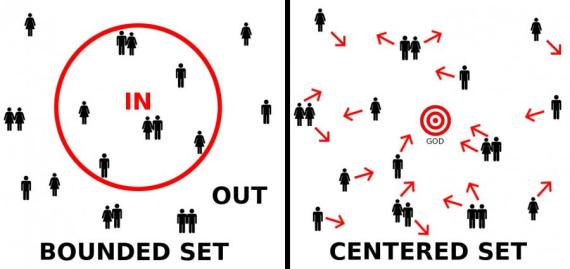
Bounded-Set vs Centered-Set

Bounded-vs-Centered-Set

Some time back I posted a piece titled Numbering Those On the Ranch, exploring the concept of what missiologist Alan Hirsch refers to as a “centered-set” metric for evaluating a church.  More recently I stumbled across a post by Bob Thune, of Coram Deo Church in Omaha, explaining his understanding of Centered-Set verses the more traditional Bounded-Set metric. I appreciated what Thune had to say, so I wanted to post it, even if primarily for my own benefit, as a resource for future use.

***

There are two ways of thinking about social groupings: centered-set and bounded-set. These terms come to us from the field of mathematics (set theory). In recent years they’ve been applied more broadly by sociologists and missiologists. The fountainhead of most of this thinking in the Christian church was Paul Hiebert, a missiologist at Fuller Seminary.

Hiebert suggested that our minds categorize people according to either “bounded set” or “centered set” thinking:

Bounded Sets

  •  are formed by defining the boundaries – the essential qualities which separate something inside the set from something outside. Heibert’s classic example is “apples.” Either a fruit is an apple, or it isn’t.
  • Maintaining the boundary is crucial to maintaining the category.
  • Bounded sets are static sets – they don’t change, they only add or lose members.
  • The important thing is to “cross the boundary” to be part of the set.

Centered Sets

  •  are formed by defining a center. The set is made up of all objects moving toward that center. As an everyday example: “bald men.”
  • While a centered set does not focus on the boundary, a boundary does indeed exist. The boundary is clear so long as the center is clear.
  • The objects within a centered set are not categorically uniform. Some may be near the center and others far from it, even though all are moving towards the center.

Hiebert asserts that Americans tend to think almost exclusively in bounded-set categories. And this affects our understanding of Christian discipleship. We tend to “stress evangelism as the major task — getting people into the category. Moreover, we… see conversion as a single dramatic event — crossing the boundary between being a ‘non-Christian’ and being a ‘Christian’” (Hiebert, 1978).

Hiebert argues instead for a “centered-set” way of thinking about Christian conversion:

A Christian would be defined in terms of a center—in terms of who is God. The critical question is, to whom does the person offer his worship and allegiance? …Two important dynamics are recognized. First there is conversion, which in a centered set means that the person has turned around. He has left another center or god and has made Christ his center. This is a definite event—a change in the God in whom he places his faith. But, by definition, growth is an equally essential part of being a Christian. Having turned around, one must continue to move towards the center. There is no static state. Conversion is not the end, it is the beginning. We need evangelism to bring people to Christ, but we must also think about the rest of their lives. We must think in terms of bringing them to Christian maturity in terms of their knowledge of Christ and their growth in Christlikeness.

Theologically, I find some aspects of Hiebert’s argument poorly nuanced. He would do well to differentiate regeneration (the invisible, immediate work of the Holy Spirit on the soul, which is in fact a decisive event) from conversion (our experience of that event, which often feels more like a “process” than like a decisive moment). Those who have applied Hiebert’s set theory to individual salvation (Brian McLaren, for instance) have tended to drift in fuzzy doctrinal directions.

But I find Hiebert’s insights immensely helpful when applied to ecclesiology. This is where I first encountered the set-theory rubric, as applied by Alan Hirsch and Michael Frost in their 2003 book The Shaping of Things to Come. Frost and Hirsch argued for viewing the church as a centered set rather than a bounded set. Why not build a church by defining the center rather than patrolling the boundaries? Why not place the gospel of Jesus Christ at the center of the church’s life and practice, inviting everyone to reorient their lives around Him? In this way, we continually invite Christians into deeper and deeper discipleship, while also inviting non-Christians to deal with the claims of Jesus on their lives. As Hiebert himself acknowledges, this does not mean there is no boundary; there is just “less need to play boundary games and to institutionally exclude those who are not truly Christian. Rather, the focus is on the center and pointing people to that center” (Hiebert, 1978).

It is my personal conviction that: a) this is what the New Testament church did (see, for example, Galatians 1:6-9; Colossians 1:6; Romans 1:13-15); b) this is what it truly means to be a “gospel-centered” church; and c) this is the only way to have a truly missional church, where non-Christians are treated with true Christian hospitality AND are regularly being converted to faith in Jesus.


Is Bigger Really Better?

Big Fish Small Pond, Small Fish Big Pond

No matter how much I have grown to despise the discussion, it seems I cannot avoid it entirely.  Almost any conversation about church, it seems, inevitably gravitates in some form toward the Bigger is Better or Great Things Come in Small Packages debate.

It is not always an actual debate. In fact it is probably more often than not simply an expression of personal preference. But I have come to loathe the whole subject, having come to believe that the comparisons are largely irrelevant. There are some great large churches, and there are some great small churches; There are some horrendous large churches, and there are some pathetic small churches. And there are good and bad churches of all sizes in between.  The issue is not which size is best, but rather: Is your particular church – and my particular church – healthy, God-honoring, and fruitful?

That said, and with no desire to encourage debate, I found an observation by Neil Cole to be interesting:

There are millions of people in smaller congregations across the country who live with a feeling that they are failures because their church isn’t as big as the megaplex congregation down the street. This is sad and should not be the case.

A global survey conducted by Christian Schwartz found that smaller churches consistently scored higher than large churches in seven out of eight qualitative characteristics of a healthy church. A more recent study of churches in America, conducted by Ed Stetzer and Life Way Research, revealed that churches of two hundred or less are four times more likely to plant a daughter church than churches of one thousand or more. The research seems to even indicate that the pattern continues—the smaller the size of the church the more fertile they are in planting churches.

It pains me that so many churches and leaders suffer from an inferiority complex when in fact they could very well be more healthy and fruitful than the big-box church down the street.

I am not suggesting that the mega church is something we need to end, I am simply saying that we need other kinds of churches to truly transform our world. I also do not want people in huge churches to think that just because they have more people and more money that they are more blessed by God. The stats tell us that ten smaller churches of 100 people will accomplish much more than one church of 1000.

Read the rest of  Cole’s article: Is Bigger Really Better?

And again, while not wanting to prompt debate, I do welcome any comments about Cole’s observations.

More Than Numbers

Miracle Gro

Here is a needed reminder:

I’m not so sure God cares how big your church is. Seriously. If your numbers aren’t “growing,” so what? I’m also not sure that the sign of a vibrant healthy church is ever-increasing growth, significant growth. It seems to me that the sign of a vibrant, healthy fully alive church is one where God’s people are growing in love, knowledge, and insight, not numbers. I’d rather be in a church like this than a church that is “growing” with greater numbers of people with shallow faiths who do not love well.

Where did Paul ever rebuke a church because their numbers were not growing by some set of hoped for percentage points?

Great point. I would add: Or Jesus, in his Letters to the 7 Churches in Revelation 2-3

I get the church growth rationale.  And I agree with some of the foundations of it, at least as it was originally developed as a mission strategy. But the American obsession with Bigger is Better has distorted much – maybe most – of the good that the original proponents of church growth may have intended.  Many of us have misapplied the whole concept of growth and mistaken it as the measuring stick for God’s blessing.  Size of a congregation is about as good of an indicator of being blessed by God, as is wealth an indicator of worth; or better still, as height an indicator of greatness.  (In other words, not a valid standard at all.) Consequently, faithfulness and substance is often subverted by gimmicks and pragmatism.  Whatever works to get them in… right?

Years ago, while I was servivng a fast growing congregation (that a year later showed the evidence of serious fractures), a good and gifted friend was “languishing” in a church that could not quite break the 100 barrier – even on Easter.  He was discouraged –  to put it mildly.  To encourage him, I offered a parallel thought.  Knowing of a huge community college in his city, I asked about the number of students who attended the school. He said he estimated 50,000 – 60,000 students.  So I observed that the school must be some impressive, prestigious place.  After all Harvard has only 6000 or so students.  The guy who is president of that community college must be thought of as having had 10 times the success as the guy who can’t lead a school any larger than Harvard!

He got the my point of my sarcasm.  It is a ridiculous analogy to compare a community college with a school with the history, the resources, and he selectivity of a Harvard.  Size is no indication of anything.  And neither is size any measure of a church.


To read the whole short post I quoted at the top, click: A Healthy Vibrant Church May Never Be Big


Numbering the Sheep on the Ranch

Counting Sheep

Blogger Tim Challies is at the Together for the Gospel Conference, surrounded by other church leaders.  No surprise then that he is hearing this common question all around him: “How many people go to your church?”  And apparently Challies, whose primary vocation is writer not pastor, has some concerns about this question:

I’d like to make the same two-part proposal I made a few years back: Let’s stop asking, “How many people go to your church?” And when someone asks us that question, let’s not feel obliged to give a direct answer.

Challies understands the heart challenge for the pastor in those moments when that question is posed:

For the pastor this can be a moment of pride or humility, freedom or shame…

While not presently prone to the tugs toward embellishment, I am not sure whether it is because of personal growth or just that my external circumstances have changed.  I serve a good-sized congregation, with an excellent staff, in a desirable locale.  But I know those feelings well.  On occasions in the past I’ve felt the temptation to exaggerate, such as to cite Easter attendance as if that were the norm. (I know others who have also considered that one.)  The obvious reason for the temptation is embarrassment about the reality, as if the number in attendance is somehow a precise indicator of the abilities or worth of a pastor or congregation, or of God’s pleasure in either.

Challies writes:

We all pay lip service to the reality that we cannot necessarily measure the health of a church by its size. We all know that some of the biggest churches in the world are also some of the unhealthiest churches in the world. The history of Christianity has long-since shown that it is not all that difficult to fill a building with unbelievers by just tickling their ears with what they want to hear. We also know that the Lord is sovereign and that he determines how big each church should be and we know that in some areas even a very small church is an absolute triumph of light over darkness. And yet “How big is your church?” is one of the first questions we ask.

Why is this?

I don’t know all the reasons but I’d suggest at least two. First, I think our question betrays us and shows that in the back of our minds we equate size and health. Somewhere we make the connection between big and healthy, between big and blessing. We exacerbate the problem when we ask and answer this too-easy question. Second, we just haven’t taken the time and made the effort to form better questions. Instead, we gravitate to the easy one.

So what might be some better questions to ask?  I appreciate Challies’ suggestions:

  • How have you seen the Lord working in the lives of the people in your church?
  • What evidences of the Lord’s grace has your church experienced in the last few months?
  • What are you excited about in your church right now?
  • Who are you excited about in your church right now?
  • What has the Lord been teaching you?
  • Who have you been discipling recently?
  • Tell me about some of the future leaders at your church.

These are much better to get a sense of the story in any congregation.

And inevitably when asked: “How many people go to your church?” Challies suggests answering something like this:

  • As many as the Lord has determined we can care for at this time.
  • Enough that we are actively working toward planting a church.
  • I don’t know, but let me tell you about a few of them…

Interest in numbers is not wrong.  Numbers tell us things.  But just what numbers tell us is not always readily clear.  Numbers are not wrong, it is the fascination with numbers that is problematic.  Numbers just do not tell a story.  Much more valuable is the number of stories of how God is at work in any congregation.

To read Challies’ post, click: How Many People?