God’s Glory Among the Nations: What’s it Worth to Us?

by Rick Wood

As evangelical Christians, we often speak of living to glorify God. I usually sign my columns here with, “For His Glory.” But what does that really mean in our everyday lives? How does this desire to glorify God affect the way we live, the commitments and sacrifices we make, and the price we will pay to build God’s kingdom so He will be worshiped and glorified by all peoples?

As we seek to establish God’s kingdom within every unreached people and destroy Satan’s dominion over their lives, we must ask ourselves the question, “Are we willing to pay the price needed to see these peoples come to Christ?” Is there a price we are unwilling to pay? Will we say to God, ‘I am sorry, but Your glory among the nations and Your worship by all peoples is not worth my time, my money, my ________?'” You fill in the blank. Are we willing to give up the possessions we hold dear, to suffer, or even risk the loss of our lives for the sake of His glory and His kingdom? These tough questions strike at the heart of our concept of God, the nature of our relationship with Him and our priorities in life. They are difficult for all of us to honestly face and answer.

In a world wrapped up in the passionate pursuit of materialism, comforts, pleasures, safety and the abundant life, where do the examples of a Jim Elliot or a Graham Staines fit in? Both were martyred as they attempted to bring the Gospel to an unreached people. Do we see their lives as well spent, or do we pity them for being so foolish as to leave the comforts of their homes and risk their lives to bring the love of Christ to people who were unworthy of their attention?

Who chooses most wisely: the one who plays it safe and seeks all of the things this world has to offer or the one who “gives what he cannot keep to gain what he cannot lose,” as Jim Elliott wrote, so that God’s kingdom would be established and His glory made known to all peoples? The answer that each of us gives to these very important questions will reveal a great deal about where our heart is, what we value most and the quality of our walk with Christ.

Continue reading

Haitian Hope

The eyes of America are turned toward Haiti, and hearts are going out to that poorest country in the Western Hemishpere, too.  Like many, it is with great interest I am watching the news and hearing of all the tangible aid that is going to the people who were tragically impacted by that 7.0 eathquake. 

I am glad to see people moved in this way – both people of faith and faithless people.  I am glad because every resident of Haiti is a creature made after the image of God – as am I, as are we all.  As those made in the image of God the people of Haiti have an inherent value.  Thus all attempts to alleviate their suffering is a proper response to their present plight. Their inherent value as bearers of the image of God demands it.

But one question remains in my mind: What is the objective of this relief?   Are we simply trying to help these people to put thier lives back together the way they were before the earhtquake? 

That hardly seems much better than their current circumstances. 

If you know anything about Haiti you know it is a vivid illustration of contrasts: The natural beuaty of creation inhabited by the ugliness of  humanity.  Not only is it the poorest country in the Western Hemisphere, but it is also perhaps the most corrupt, unstable, and ungodly.  By no reasonable measure was life good even before the earthquake that has rocked their world. 

Here is a little background on Haiti:

Explored by Columbus on Dec. 6, 1492, Haiti’s native Arawaks fell victim to Spanish rule. In 1697, Haiti became the French colony of Saint-Dominique, which became a leading sugarcane producer dependent on slaves. In 1791, an insurrection erupted among the slave population of 480,000, resulting in a declaration of independence by Pierre-Dominique Toussaint l’Ouverture in 1801. Napoléon Bonaparte suppressed the independence movement, but it eventually triumphed in 1804 under Jean-Jacques Dessalines, who gave the new nation the Arawak name Haiti . It was the world’s first independent black republic.  (Source: Countries of the World)

What is less known and less reported is that during the 1791 revolution the slaves in revolt dedicated the island to Satan.  In their eyes, Satan was seen to be the opposition of the (pretense of) Christianity their oppressors instituted.  Subsequently and consequently, despite a long history of being a Roman Catholic Church-State, (which ended in 1987,) Voodooism is the real religion of the island.  Even 75% of the professing Catholics in Haiti practice voodoo. 

With voodoo as the prevailing religon, is it any wonder that instability, injustice, and treachery are marks of this civilization? 

As aid pours into Haiti, my hope is that it would be accompanied by even more prayer.  Haiti needs a change at its very core.  The people who live there, made after the image of God, need a major work of God.  My hope is that this earthquake has prepared the people to recieve it. 

Let me encourage you, each time you see Haiti on the news, in these coming days and week, in addition to any tangible assitance God may lead you to offer, take a moment to offer prayer for the transformation of that island.  To aid you in aiding the people of Haiti through informed prayer check out Operation World: Haiti

May God make beauty from the ashes of Haiti. (Isaiah 61.3)

Global Missions is Not For SuperChristians

Missions is not just for Super Christians.  The Great Commission will be accomplished by ordinary people, who posess a heartfelt faith in Jesus Christ, and who are faithful to follow Jesus’ instruction to go into all the world to make discples. 

Simple, right?

Well, the concept is simple. Even the decision to oby or not obey is a simple choice. There are only two options, yes and no. There is no in between.  But the implementation is not so simple.  Each individual has a question to answer regarding his/her role.  Even before that role is determined one must be informed about what roles there are that need to be played.  Then there are the questions about what God is doing in the world. What skills do I have, or do I need to develop?  How do I figure out where in the world I should go?

Every Christian is called to answer these questions.  No one can slip by, simply dismissing Jesus’ mandate by saying, “I’m not called to missions.”  Even if that were true – and I suspect it would be more accurate to say “I am not called to go overseas” – we are still left to answer the question: Then what are you called to do?  And, Where are you called to do it? No one whom God has called has been called without a purpose for his/her life.  And frankly, whatever the specific purpose, at least an aspect of everyone’s calling is connected to taking the Gospel to the Nations. 

I am aware of no better tool to help people discover what God is doing in the world and what role they can play in God’s Mission (missio dei) than the PERSPECTIVES course.  This course does take work, but the benefits far overshadow the expended effort.  To say PERSPECTIVES makes a life-changing impact is not mere hyperoble.  It’s true. 

The above video offers testimonies from some who have participated in this couse.  The video encourages you to find a class near you, which I would also urge.  But what is not revealed in the video is that if an intensive 15 week course is not feasible for you, for whatever reasons, there are alternatives. One is an Intensive PERSPECTIVES class, where participants are indundated with God’s Global Glory for either one or three weeks of instruction. I am not sure how the corresponding readings are handled.  Another option is to take this course online. When taken online you don’t have the benefit of  interaction with other participants, but you can spread your reading out over the course of a year.  For this option check out: PERSPECTIVES Online.

And finally, if you are a college or seminary student, PERSPECTIVES can be taken for either undergad or grad school credits.

Perspectives

One of my driving convictions is that every Christian is to be actively involved in the advancement of the Kingdom of God throughout the world.  It is not a task assigned to only a select few. 

The question for any of us is: “What role will I play?”

Obviously not all are called to a career of cross culture ministry.  But to be active in the advancement of the Kingdom, it may mean you are called  to be a Goer, a Sender, or a Mobilizer.  All are necessary. 

But which one?

I know of no better resource to explore what is doing around the world and discover what God is calling you to do than PERSPECTIVES on the World Christian Movement.  Check out this introductory video clip:

PERSPECTIVES is offered at a number of venues across the USA each year, or you can participate online.

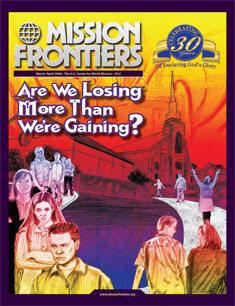
Are We Declaring a Defective Gospel?

by Rick Wood, Managing Editor

Mission Froniers Magazine

U.S. Center for World Mission 


Is the Gospel message that hundreds of thousands of missionaries are proclaiming around the world defective?  Have hundreds of millions of people bought into a message that is, at its heart, unbiblical?   If true, this would be like Bill Gates sending out the latest Microsoft operating system which after installed for a year deletes all the files on the computer. To say the least, it would be a disaster, a catastrophe, and an apocalyptic nightmare all in one. But some are claiming that we are in fact proclaiming a defective, unbiblical Gospel.


Could this be one reason that so many are leaving their faith behind and the once vibrant Evangelical awakenings in Britain and America are but distant memories? The implications for world evangelization are immense. If the Gospel we proclaim will self destruct once installed on the hard drives of people’s hearts, then much of our work among un-reached peoples could be in danger of collapse as it has in much of Europe. Vishal Mangalwadi warns of this danger in his home country of India in his article, Pursuit of Knowldege & Truth: Key to a New Reformation.


Hundreds of millions of people have likely read the Four Spiritual Laws, the booklet written by Bill Bright and published by Campus Crusade for Christ. The first law in this little booklet says, “God loves you and has a wonderful plan for your life.” This sounds great and it is just the kind of message that people want to hear. Many are eager to accept such a message and justifiably so. Who would not want this to be true in their lives. They say, “Wow, I would love to have a loving God on my side to make my life wonderful, to make my life complete.”


This message is proclaimed in books, songs and sermons across the world.


But what if this message is not true – at least not true in the way that most people want it and expect it to be true? Don’t get me wrong, I have the greatest respect for Bill Bright and the ministry of Campus Crusade, but this focus of our Gospel presentation can be misunderstood by, and misleading to, a whole generation of people who want to add God to their lives to make their lives complete. In all fairness, the Four Spiritual Laws does go on to identify sin as the problem and to provide the proper solution.


But what kind of expectations are we providing to people when we say, “Come to Christ and God will reveal to you a wonderful plan for an abundant life?” Are we setting people up with false expectations of what God will do for them? Are we promising more than what God has promised to deliver? Are we trying to market the Gospel to a generation of self centered people who really don’t understand their desperately lost state before a holy God and are therefore not really saved? Have millions of ‘believers” simply hired God to make their lives complete?


Ray Comfort in his book, The Way of the Master says,


“[t]he enemy has very subtly diverted our attention away from our core message. Instead of proclaiming the Good News that sinners can be made righteous in Christ and escape the wrath to come, we have settled for a “gospel” that implies that God’s primary purpose in saving us is to unfold a “wonderful plan” for our lives to solve our problems, make us happy in Christ, and rescue us from the hassles of this life.” (p.19)


Is that the central purpose of the Gospel we preach, to give us an abundant, full and rewarding life? Many have sadly bought into this and are disillusioned when everything does not go according to plan.


One dedicated missionary family I know had their daughter brutally murdered. The very first house they ever owned after years of faithful overseas service burned to the ground just days after they moved in along with a lifetime of possessions. They did not even have a chance to unpack their boxes. Then the wife dies of cancer after a long battle.


The husband of another missionary couple I know developed Multiple Sclerosis and spent years bedridden and unable to speak until his death left his wife with four kids to raise by herself. Are these the exceptions to the wonderful, abundant Christian life that we have been promised? There seems to be a disconnect here between what the “wonderful plan” Gospel message promises and the reality of our life experiences in Christ.


This disconnect between the promise and the reality has all sorts of ramifications for our spiritual lives. As Ray Comfort explains,


“Those who come to faith through the door of seeking happiness in Christ will think that their happiness is evidence of God’s love. They may even think that God has forsaken them when trials come and their happiness leaves. But those who look to the Cross as a token of God’s love will never doubt His steadfast devotion to them. (p. 44)


Certainly many of those who have walked away from their faith have done so because the reality of their lives does not match up with the promised wonderful plan that their loving Heavenly Father has for them.


When the Church presents Jesus as the one who came to “solve our problems” and “make us happy” then we attract only those who have problems or are unhappy and those are the kinds of people who will then fill our churches. If they do not repent of their sins then they are false converts and they are not new creatures in Christ. As unsaved people who claim to be Christians, they have simply brought their sins and problems into the church. This overworks the pastors, hobbles the outreach of the Church and its mission, and defames the name of Christ when supposed Christians continue in their sins. The irony is that these will also be the people who will be most likely to leave when Jesus does not solve all their problems or make them happy. They become disillusioned and bitter because they were not presented with the true Gospel in the first place (Comfort, p.36).


The Gospel is a promise of the righteousness of Christ for all who will repent of their sins and trust Christ as their Savior. To have a right relationship with God, people must come to the understanding that they are lost and doomed to suffer the wrath of God unless they repent of their sins and trust Christ for their salvation. This must be at the heart of our Gospel message. The Gospel is not a promise of a happy, problem-free life-just the opposite.


When someone comes to genuine faith in Christ and seeks to live a life of obedience, he becomes an active soldier in the ongoing battle between God and Satan. His faith in Christ essentially puts a target on his back and makes him an object of Satan’s wrath. That person becomes an active threat to Satan and his hold on power. Satan will then take every opportunity to take any genuine believer out of action.


But if people who come to Christ are not told of this spiritual reality then there will be tremendous confusion and disillusionment when the truth of this unknown spiritual reality breaks in upon their lives.


It is like a person who buys a vacation package to the French Riviera expecting a wonderful time of fun and relaxation only to discover upon his arrival that there is open warfare taking place with bombs going off , bullets flying and the wounded littering the sandy beaches. Such a person would naturally think: “What is going on here? This is not what I signed up for.”


Until we realize that we are in a war for our lives, we will be sitting ducks for Satan’s attacks and schemes. We will continue to lose those people who were never adequately prepared for battle. We must proclaim a true Gospel of grace and forgiveness of sin and stop trying to market the Gospel as the solution to all of our problems. It is already the greatest gift anyone can receive.


For a .pdf copy of this article click: a-defective-gospel?


Global Missions Glossary

Adherent: A follower of a particular religion, church or philosophy. This is the broadest possible category of such followers and includes professing and affiliated adults and also their children (practicing and non-practicing) who may reside in a given area or country.  

Adoption (of an unreached people): Making a commitment to an unreached people until there is an indigenous, reproducing church established among them. Aspects may include prayer, research, and networking toward church planting. Sometimes called “people group adoption” or adopt-a-people 

Advocate: People group advocates are individuals who have committed themselves to one specific people group (ethnic group), to learn about them, their environment, culture, demographics, status, etc. They pray about how churches can be established among them. They may network and partner with others to encourage their involvement.  

Affinity Bloc: Families of peoples related in aspects such as religion, culture, history, politics, and geography. In nearly every bloc there are widely dissimilar and unrelated linguistic minorities, but often there is one particular culture that is dominant. 

Church planting: Missionary role of evangelism, discipleship and training of leaders for the establishment of a body of believers, or a church. Does not refer to a physical building.  

Closed Country: Countries that limit or prevent Christian ministry by expatriates as missionaries. Alternatively they are called creative-access countries, restricted access countries, closing countries, restrictive countries, sensitive countries.  

Cluster: Grouping of peoples within each affinity bloc which are closely related peoples and, for strategic purposes, may be clustered together. These relationships are often based on a common identity of language and name, but sometimes on the basis of culture, religion, economy, or dominance of one group over another.  

Collaboration: To combine forces and resources to meet a common goal.  

Contextualization: Adapting a biblical concept, mission method, etc., without changing the substance, to make it understood within the context of an ethnic culture. 

Ethnocentrism: Seeing the world through self-colored glasses, so that your culture always looks best and becomes the pattern everyone else should fit into. By no means is ethnocentrism restricted to the majority culture in a country, but it is a nearly universal tendency among humans. 

Ethnolinguistic People: An ethnic or racial group speaking its own language. A people group distinguished by its self-identity with traditions of common descent, history, customs and language. Also known as a people.  

Evangelism: An effective presentation of the Gospel by someone from the same culture, and within a culture where the missiological breakthrough of a viable church has already taken place.  

Expatriate: One who has taken up residence in a foreign country.  

Field: The location where ministry, church planting, and evangelism takes place.  

Field-based: Strategy determined by those on the field, rather than from those at the “home,” sending, or resource base.  

Frontier: Pertaining to unreached areas or peoples.  

Frontier Missions: Cross-cultural evangelism to People Groups where no missiological breakthroughs have occurred (or among a People Group where no viable church exists).  

Harvest Field: All who are not true Christians; not part of the Body of Christ.  

Harvest Force: Those of the Body of Christ who are involved in a direct or indirect way in helping to bring in the harvest of souls.  

Indigenous peoples or persons: Those individuals or groups who originate from a particular area; a national, a native.  

Joshua Project Unreached Peoples List: A listing of “country-distinct” peoples each over 10,000 in population that were chosen by their ethnolinguistic distinction and their status of being less than 2% Evangelical and less that 5% Christian adherents.  (see Joshua Project)

Martyr: A Christian believer who dies in a situation of witness as a result of human hostility.  

Mission: The loving work of God to bring humankind to himself as the Church (missio dei). Secondarily, the overall ministry of the Church for world evangelization. 

Missiology: The study of missions and mission strategies; the theology of missions; how and why we do missions. 

Mission agency: A Christian organization helping to further God’s work in the world. “Mission board” and “sending agency” are virtually the same thing. 

Missionary: One who is sent with a message. The Christian missionary is one commissioned by a local church to evangelize, plant churches and disciple people away from his home area, among people of a different race, culture or language (i.e. cross culture).  

Missions Resource Organization: These agencies support the work of field missions and missionaries by offering information, resources, materials, and mobilization of the Church.  

National: Any person who is from the country to which a missionary is going.  

Network: An extended group of people with similar interests or concerns who interact and remain in informal contact for mutual assistance or support.  

Non-Resident Missionary: Professional career missionary who is working towards the evangelization of a particular people or cluster, but resides outside the group, usually in a city with good international communications facilities and no surveillance. 

Para-church: Refers to a Christian organization independent of any church denominational structures. 

Partnership: An association of two or more autonomous bodies who have formed a trusting relationship and agreed upon expectations by sharing complementary strengths and resources, to reach their mutual goal.  

People Group: A significantly large sociological grouping of individuals who perceive themselves to have a common affinity with one another. From the viewpoint of evangelization, this is the largest possible group within which the gospel can be spread without encountering barriers of understanding or acceptance.  

Prayer journey: A trip to pray on location for the lost. Team members may spend extended time prayerwalking, asking God to bring the Gospel to that unreached people group. It does not entail evangelism or mercy ministries.  

Prayerwalking: Praying “on-site with insight.” Taking prayers outside the church walls as we walk through an area. Praying in the very places we expect to see God bring forth His answers. Usually low profile and unobtrusive in appearance. 

Praying Through the Window: Prayer initiatives developed for the purpose of worldwide focused prayer for the countries and peoples in the 10/40 Window.  (see Pray Thru the Window) 

Reached/unreached: A term that is widely used today to describe people groups and areas that have or have not responded to the preaching of the gospel. Strictly, it should be a measure of the exposure of a people group to the gospel and not a measure of the response.  

Regular Missions: Pertaining to cross cultureal evangelism by a different-culture worker, in association with same-cultural workers if possible, where a missiological breakthrough has already taken place.  

Strategy Coordinator: One who develops and implements a strategy to reach a people group, working with a team or network. Support: The finances and prayer needed and given for mission trips & work. 

Syncretism: Fusion of differing systems of belief. Mixing Christianity with heresy.

Synergy: The interaction of two or more agents or forces so that their combined effect is greater than the sum of their individual effects. Cooperative interaction among groups that creates an enhanced combined effect.  

Tentmaker: A cross-cultural witness who works at a paying, usually secular, job overseas. Often they are able to gain entry into “closed” countries which restrict traditional mission efforts.  

10/40 Window: The area of the world between latitudes 10 degrees and 40 degrees north of the equator in the Eastern hemisphere, covering North Africa, Middle East and Asia. The window has in view most of the world’s areas of greatest physical and spiritual need, most of the world’s least-reached peoples and most of the governments that oppose Christianity. (see 10/40 Window.org and Window International Network) 

Unreached /Least Reached People Group:  A people or people group among whom there is no viable indigenous community of believing Christians (i.e.  no church) with adequate numbers and resources to evangelize their own people without outside (cross-cultural) assistance.  The general defining critieria is a People Group that is less than 2% Evangelical Christian and less than 5% Christian Adherents.  (see Joshua Project) 

World Evangelization: The whole Church taking the whole gospel to the whole world. The goal of giving every person the opportunity to hear the gospel in a way they understand, to become disciples of Christ, and to join with others in fellowship without leaving their own culture or people.  

A Mind for Missions: Global Evangelism

With our church having just come through the front end of our first missions conference in at least a generation there are a number of people who are sensitive to what God is doing in the world, and hungry to explore what part he has in mind for us – the average Christian.  Wanting to take advantage of the high interest while it is still at its keenest, I thought I’d suggest a few books – some that are are almost must reads – for anyone wanting to learn about the advancement of the Gospel as a global enterprise.   

And while I have in mind those people from our church, I know that there are many others out there searching the web for recommendations of good mission books.  The following list is for those wanting to dig deeper, not necessarily for those who are experienced in mobilization and sending. 

This is in no way exhaustive, so feel free to add to the list.