Which Way?

Your life hangs on how you relate these two statements: 

  1. “If anyone sins, we have an advocate with the Father, Jesus Christ, the Righteous” (1 John 2:1).
  2. “Sin no more, that nothing worse may happen to you” (John 5:14). 

Do you experience the first one weakening the second? 

Or do you experience the first one joyfully empowering the second? 

Your life hangs on your answer. 

– by John Piper , via Missio Dei Suburbia 

Easy Chairs & Hard Words – Part 4

by Douglas Wilson

We join a conservation in progress; it is between a young theological questioner who grew up in a typical Evangelical church, and an older pastor from a historical theological tradition.  

 ***** 

Pastor Spenser shifted easily in his seat while I carefully thought over my next question. “Some of my friends at my church have figured out that I have been coming to see you,” I said.  

Pastor Spenser nodded, and waited.  

“Naturally,” I said, “they are somewhat concerned.”  

“Naturally. About what?”  

“Well, they say that Christians who believe in the exhaustive sovereignty of God are setting themselves up.”  

“For…?”  

“For the temptation which says that because God controls everything, then the way I live doesn’t really matter.”  

“I see. In other words, if I am elect, then my sins won’t damn me, and if I am not, then all the good works in the world won’t save me. Is that it?”  

“Yes. That is exactly it. If the whole thing was settled before the world began, then why bother? My friends know that there are true Christians who believe this, but they think that, because of this theology, these Christians will tend to become careless about how they live.”  

“Why should we take responsibility for our actions after we have embraced a theology which cuts the nerve of personal responsibility?”  

“Right. If God controls everything, then what room is there for personal holiness?”  

Pastor Spenser thought for a moment. “The problem is not with your friends’ concern for personal holiness. That is admirable. All Christians should set their faces against carnal living on the part of professing Christians. But it does no good to oppose carnal living with carnal reasoning.”  

“What do you mean?”  

“When someone is whooping it up down at the bars, or sleeping with their girlfriend, why do we say it is sin?”  

“Is this a trick question?”  

Pastor Spenser grinned. “You might say that. Why do we call such things sin?”  

“Because the Bible does.”  

“Exactly. So this carnal living we have been talking about is a lifestyle that is not in submission to the clear teaching of the Word of God.”  

“Well, sure. But I still don’t see where you are going with this.”  

“Now if carnal living is a lifestyle that does not submit to God’s Word, then how should we define carnal reasoning?” 

“The same way, I suppose?”  

“Right. It is not enough to submit what we do externally to God; we must also submit the way we think. Your friends are trying to defend God’s standards for living by abandoning His standards for thinking. It cannot be successful.”  

“Is there a passage where this point is clear?”  

“Yes, in Philippians. Chapter 2, verses 12 and 13.”  

I turned to Philippians and read. “Therefore, my beloved, as you have always obeyed, not as in my presence only, but now much more in my absence, work out your own salvation with fear and trembling; for it is God who works in you both to will and to do for His good pleasure.” I looked up.  

“What does the passage say God is doing?” Pastor Spenser asked.  

I looked down again. “It says that He is working in the Philippians, both in willing and doing, and that the result is His good pleasure.”  

“And what would carnal reasoning do with that?”  

“Well, the response would be that if God is doing the willing, and if God is doing the doing, and the result is whatever He wants, then there is no reason for me to put myself out. It is going to happen anyway.”  

“Right. The reasoning says that if God is going to do the work, then why should I have to?”  

I nodded, and Pastor Spenser went on.  

“But what application of this truth does Paul command the Philippians to obey?”  

I looked at the passage again. “He tells them to work out their own salvation, with fear and trembling.” I glanced down further. “And in the next verse he goes on to specific ethical instruction – to avoid murmuring and disputing.”  

I sat and thought for a moment. “But my friends would say that the application they are making is obvious – common sense.”  

“Well, it certainly is common. But is it biblical?”  

“Why do so many Christians fall for this line of reasoning then? It seems like a trap that is extremely easy to fall into.”  

“Well, yes, it easy to fall into. But it is also easy to drink too much, not watch your tongue, lust after women, and so forth. And these are things which the church recognizes as sin, and warns the people against. But carnal reasoning is also easy, and almost no one warns the people.”  

“Why not?”  

“Sheep are hungry because shepherds don’t feed them. Shepherds don’t feed them because shepherds don’t have food.” Pastor Spenser leaned forward in his seat. “The shepherds don’t have food because they don’t study their Bibles.”  

“You think it is obvious in the Word?”  

“Certainly. When the apostle Paul magnified the prerogatives of the sovereign God, he fully anticipated the response of carnal reasoning.” Pastor Spenser leaned back, closed his eyes, and quoted, “You will say to me then, ‘Why does He still find fault? For who has resisted His will?’” A modern pastor, in the unlikely event that someone asked him this, would say that it was a good question, and that he wrestles with it often himself. Paul tells the questioner to shut up and sit down. ‘But indeed, O man, who are you to reply against God?’”  

“Paul doesn’t answer the question then?”  

Pastor Spenser opened his eyes. “Oh, he does. It just isn’t the answer carnal reason wants.”  

“So what is the answer?”  

“The answer is God – the same answer that is given at the end of the book of Job. Carnal reason doesn’t see a real answer there either. But believe me, it is a real answer. The answer is the ground of reality; the answer is God.”  

“What happens at the end of the book of Job?”  

“The questions raised in the book are conducive to carnal reason; indeed, even non-Christians are attracted to the first part of the book of Job. As they would put it, ‘It addresses the human condition.’ But then, at the end of the book, God comes in, with glory and thunder. And do you know what? He doesn’t answer any of the impertinent questions; rather, He poses some sobering questions of His own. ‘Who is this who darkens counsel by words without knowledge? Now prepare yourself like a man; I will question you, and you shall answer Me.’”  

I nodded. “And He asks where Job was when the universe was created.”  

“The question is not irrelevant. It is the heart of the matter. Discussions of God’s sovereignty and human responsibility very rarely display any understanding at all of Who the Creator is.”  

“But my friends would say that you are making God responsible for evil, and that they are concerned to protect God’s honor and glory.”  

Pastor Spenser looked at me intently. “It is true that the affirmation of God’s total control over all things causes some to blaspheme. But your friends need not be concerned for God’s glory; man’s slanders and blasphemies do not touch Him. Such slanderers are pelting the sun with wadded-up balls of tissue paper.”  

“They are stumbling over something though.”  

“They stumble, being disobedient to the word, to which they also were appointed.”  

“Now, see? Why do you have to put these things so strongly? Doesn’t that cause people to react to what you are teaching? They were appointed to stumble?”  

“That wasn’t my choice of words. I was quoting 1 Peter 2:8.”  

“Oh. Oops.”  

“Your friends are concerned that God be seen as good. But seen as good by whom? Those who believe the Word of God will know that God is light and in Him is no darkness at all. Of course He is good – by definition. And those who do not believe the Word of God will persist in thinking that there is a tribunal or court somewhere in which God will one day be arraigned. On the day of judgment, their folly will be apparent to all – even to them.”  

“So how do we bring this back to the original point?”  

“The original point was the concern that the doctrine of God’s sovereignty would be made into a cushion for sin. My answer to this is that we must, in all things, recognize God as God. We must do so in how we live holy lives, but we must also do so in why we live holy lives. We are to live in a holy way because God has commanded it.”  

“But you would also say that what God has commanded the believer He has also given the believer.”  

“Well, certainly.”  

“I honestly see why carnal reason has a problem with this.”  

“And I honestly see why carnal men want to lust after beautiful women. But what does the Bible say?”  

“What do you mean?”  

“What is the greatest commandment?”  

“That we love God.”  

“And what is the first fruit of the Spirit?”  

“Love.” I said. “I see.”  

“What do you see?” Pastor Spenser asked.  

“This takes us back to Philippians. We are commanded to work out what God works in.”  

“Right.” he said. “Nothing less.”

***

This is Part 4 in a series of 6 posts titled Easy Chairs & Hard Words.

Holiness: The Second Mark of the Church

 by  James M. Boice

 Holiness is the characteristic of God most mentioned in the pages of the Word of God and is therefore, quite rightly, that which should characterize God’s church. We are to be a “holy” people (1 Pet. 2:9). We are to “follow” after holiness. Indeed, without it “no man shall see the Lord” (Hebrews 12:14). Jesus speaks of this characteristic of the church in our passage (John 17) by praying – it is his second petition combined with the third – that God would keep it from the evil one. 

ansel-adams.jpg

But what is holiness? Some people have identified holiness with a culturally determined behavioral pattern and so have identified as holy those who do not gamble or smoke or drink or play cards or go to movies or do any of a large number of such things. But this approach betrays a basic misconception. It may be the case that real holiness in a particular Christian may result in abstinence from one or more of these things, but the essence of holiness is not found there. Consequently, to insist on such things for the church is not to promote holiness, but rather to promote legalism and hypocrisy. In some extreme forms it may even promote a false Christianity according to which men and women are justified before God on the basis of some supposedly ethical behavior. 

The Apostle Paul had found this to be true of the Israel of his day, as Jesus had also found it before him. So he distinguished clearly between this kind of holiness (the term he used is “righteousness”) and true holiness which comes from God and is always God-oriented. He said of Israel, “For they, being ignorant of God’s righteousness, and going about to establish their own righteousness, have not submitted themselves unto the righteousness of God” (Romans 10:3). 

This biblical idea of holiness is made somewhat clearer when we consider those words that are synonyms for it in the English language, namely “saint” or “sanctify.” Christ uses the second one in verse 17. What is a saint? A saint is not a person who has achieved a certain level of goodness but rather one who has been set apart to himself by God. 

But now we need to ask this question: If holiness has to do with separation (or, better yet, consecration) and if believers are already holy by virtue of their being set apart to himself by God, why does Christ pray for our sanctification? Why pray for that which we already have? The answer is obviously that although we have been set apart to himself by God we often clearly fail to live up to that calling. 

We are worldly in the sense that the world’s values often remain our values and the world’s priorities our priorities. 

First of all, there is the matter of the world’s wisdom. The old wisdom of the church, in every age and in every denomination, was the wisdom of the Scriptures. Christian people stood before the Word of God and confessed their own ignorance in spiritual things. They even confessed their inability to understand what is written in the Scriptures except for the grace of God through the ministry of the Holy Spirit who opens the Scriptures to us. Christian people confessed their resistance to spiritual things and the fact that, if left to ourselves, we always go our own way. But what has happened in our time is that this old wisdom, the strength of the church, has been set aside for other sources of wisdom with the result that the authoritative and reforming voice of God through the Scriptures is ignored. 

Second, it is not only in the area of the world’s wisdom that we are faced with secularism; we are also faced with it in the area of the world’s theology. The world’s theology is easy to define. It is the view that man is basically good, that no one is really lost, and that belief in the Lord Jesus Christ is not necessary for salvation. 

Finally, secularism in the church is seen in the world’s methods. God’s methods are prayer and the power of the gospel, through which the Holy Spirit moves to turn God’s people from their wicked ways and heal their land. That has always been the strength of the church of Jesus Christ. But today that power is despised. It is laughed at, because the methods that those laughing want to use are politics and money. 

Well, the secularism of the church is bad. I will be considering the cure for it in our study of the church’s next distinguishing characteristic: truth. But, of course, we must notice the cure even now.  Jesus makes it clear in his prayer by saying at the beginning of this section, “I have given them thy word” (v. 14), and then again at the end, “Sanctify them through thy truth; thy word is truth” (v. 17). It is by means of the Bible, then, by the Word of God, that we are to become increasingly separated unto God and grow in practical holiness. 

Without a regular, disciplined and practical study of the Bible the church will always be secular. It will fall into that state described by Paul for Timothy, when he warned that in the last day “perilous times shall come. For men shall be lovers of their own selves, covetous, boasters, proud, blasphemers, disobedient to parents, unthankful, unholy, without natural affection, truce-breakers, false accusers, incontinent, fierce, despisers of those that are good, traitors, heady, high-minded, lovers of pleasure more than lovers of God, having a form of godliness, but denying the power of it” (2 Tim. 3:1-5). That is the secular church: “having a form of godliness, but denying the power of it.” But on the other hand, by means of the Bible, God’s people will become the opposite. For if the secular church employs the world’s wisdom, the world’s theology, the world’s agenda, and the world’s methods, the true church will invert it. It will employ the wisdom of God, the theology of the Scriptures, the agenda of God’s written revelation, and the methods that have been given to us for our exercise in the church until the Lord Jesus Christ comes again. 

This is the second in a series of six posts by Dr James M. Boice concerning the characteristics of a healthy church.

What is the Gospel?

Gospel means “good news.” The good news is: you (and I) are more sinful and flawed than you (or I) ever dared believe, yet you (and I) can be more accepted and loved than you (or I) ever dared hope at the same time, because Jesus Christ lived and died in our place. As the apostle Paul said, “God made him who had no sin to be sin for us, so that in him we might become the righteousness of God.” (2 Corinthians 5.21)

That paradoxical statement is a simple formulation of the gospel.

More thoroughly we could say that the whole Bible is the gospel. It is a book about the God who rescues people from their moral and spiritual rebellion against him. The teaching of the Bible can be summarized under four headings: God, Man, Jesus Christ, and Our Response. 

Firstly, the gospel teaches that God is our creator. Thus he has the right to rule and command us as he does in his law. God is also holy, that is, he is absolutely pure morally, and he hates and punishes rebellion on the part of his creatures. He is more holy than anyone would ever imagine. 

Secondly, the gospel teaches us about human beings. We are creatures made by God and for God. We were originally created to live in relationship with God and we were morally pure. But because our first parents rebelled against God (just as we also all have done), human beings are now cut off from relationship with God and are subject to his condemnation. We are more sinful than we ever dared believe.  

Thirdly, the gospel teaches us what Jesus Christ has done for sinners like you and me. Jesus became a man and lived a life of perfect obedience to God’s law, and then died as a sacrifice in our place under the judgment of God. He was raised from the dead and now reigns in heaven. The condemnation that he suffered takes away the necessity that we suffer judgment for our own sins- “God made him who had no sin to be sin for us.” The righteous life he lived is credited to us, not because we are actually righteous, but because of God’s mercy and grace- “in him we might become the righteousness of God.” 

Fourthly, the gospel teaches us how to respond to the good news. We turn away from our rebellion and put our trust in Jesus Christ. Despairing of our own worthiness to stand before God, we believe the promise that those who trust in Jesus Christ will be forgiven and declared righteous. Those who put their faith in Jesus Christ are accepted as loved sons and daughters of God, and God sends his Spirit to live in them. 

Counterfeit Gospels

 Martin Luther said that “a sinner trying to believe the gospel was like a drunk man trying to ride a horse; he will always be falling off on one side or the other”. The two errors that the sides of the horse represent are

  • legalism or moralism, and
  • pragmatism or relativism or antinomianism.  

Moralism is the view that a person is made acceptable to God through his own attainments. Moralists are usually very religious, and often very conservative in their religion. Legalism tends to stress truth without grace. Moralists are usually very rules oriented, and depending on their success in keeping the rules they will be either arrogantly self-righteous or depressed and morose. If they go to Jesus for forgiveness, it is just to ask him to fill in the gaps they have left in their own religious performance. For the moralist, the cross is not the only basis for acceptance by God, but is an adjunct to our performance. 

Pragmatists are often irreligious, or prefer more liberal religion. They tend to stress grace over truth, assuming everyone is accepted by God and that we each have to decide what we think is true for us. Often relativists will talk about God’s love, but since they do not see them selves as deeply sinful people, God’s love for them costs him nothing. For them the cross is not the necessary condition of our acceptance by God. 

The gospel holds out to us a whole new system of approach to God. It rejects our attempts to justify ourselves before God, to be our own saviors and lords. It rejects both our pragmatic presumption and our religious attempts to earn our way into God’s favor. It destroys the perception that Christianity is just an invitation to become more religious. The gospel will not let us think Jesus is just a coach to help us get stronger where we are weak. To be a Christian is to turn from self-justification of all sorts and to rely exclusively on Jesus’ record for a relationship with God. 

Christians and non-Christians both stumble over the two counterfeits of the gospel. Many Churches are deeply moralistic or deeply relativistic. Christians who understand the gospel very clearly still look like the drunk man on the horse, as the desire to justify ourselves and trust in our own performance continually reappears. 

The gospel tells the pragmatist that he is more flawed and sinful than he ever dared believe. The gospel tells the moralist that he is more loved and accepted than he ever dared hope.  

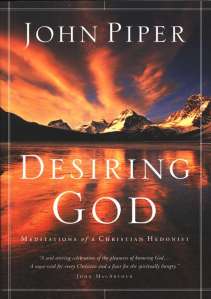
Desiring God

If you are not already familiar with his work, I want to introduce you to John Piper. In particular I commend his book Desiring GodDesiring God

This book is a modern day classic. And in my mind it an almost indespensible aid to  gaining a Biblical perspective of the Glory of God.  Well, indespensible might be a bit of an overstatement.  But, it is a book I have read and re-read many, many times, always coming away with new insights and delight.

When I first read Desiring God it resonated with me like few other books ever have. I don’t want to say it shaped my thinking at that time. Rather I think it confirmed it.  I always knew there had to be away of enjoying life and honoring God.  Piper opens the door to show us how!

Piper thoroughly saturates his writing with exposition of Scripture, and brings together two aspects of life that are sadly not often enough paired together: Our Joy and God’s Glory.  By reuniting these perspectives Piper expresses far better than I could even dream of doing what what it means to live according to our primary purpose as Christians.  And because he expressed it so well, he has subsequently shaped much of how I express this important aspect of the Gospel. 

The link I provided above is to the e-book – the entire book online.  But there are also a number of other outstanding resources available at Desiring God Ministries.

I suggest reading through and thinking about at least the Introduction: How I Became a Christian Hedonist. (I know that whole concept may be shocking at first, but it will make perfect sense once you read the Intro.)  Then look over the chapter titles.

If you are hungry to grow in both your relationship with God and how a Christian lives, you won’t be disappointed.