Can We Get Along Together?

One of my ecclesiastical/theological heroes, John Piper, came under a slew of criticism earlier this year for inviting “Purpose Diven” Rick Warren to be one of the speakers for the Desiring God 2010 Conference

I like the way Collin Hansen introduces the controversy, in his article, Piper, Warren, and the Perils of Movement Building:

You only thought junior high was over. But lately the evangelical blog world has been abuzz because John Piper invited Rick Warren to speak for his Desiring God National Conference… You see, a lot of folks who like John don’t like Rick. So now some of John’s friends aren’t sure they want to hang out with him anymore. They may not come to his party in Minneapolis. And they aren’t sure that you should either.

I’ll admit I was a little surprised when I heard about it. But I really gave it no thought, until these past few days.  There was nothing specific that compelled me to reconsider the issue. I stumbled upon a few articles that made reference to the matter. And as I began to think about it I wondered to myself: “What is the real problem here?”

Frankly, I see only possible benefits. I am no Warren proponent. But honestly, I find much admirable about the guy and his ministry. I may have concerns about some aspects of his ministry style, and I do have some theological differences with him. But then again, I have theological differences with many people I admire – Piper included.  Nevertheless I gain insights from many people in areas where I do agree. And I am challenged to think more deeply by thoughtful expressions with which I disagree. 

Some time ago I posted The Jesus Pledge, authored by my friend, Paul Miller. Those embracing that pledge declare a willingness to “learn from all types of Christians”.  That is something that I don’t think we Evangelicals do enough.  And it is something that Piper appears to be attempting to explore. At least that is the sense that I get from him in a video he did explaining and defending his reasons for inviting Warren to his party. (Click: Why Rick Warren?)

Two final thoughts:

First, do we implicitly endorse what someone from another Christian tradtion, or with a different ministry methodology, believes and practices simply by entering into conversation and fellowship?  I don’t think so.  Without such conversations, though, how would we become acquainted with anyone outside our own circles?  We can maintain our own convictions, even distinctions, without isolating ourselves from others.

Second, I wonder if there is a possibility of synthesizing Piper’s Christian Hedonism and Warren’s Purpose-Driven Life/Church.  I don’t know what that would look like, and I am not sure I would embrce it, but I know I would not ignore it.  In fact, I am intrigued by the possibility.
3 Short Books I Wish Everyone in My Church Would Read

I read a fair amount.  I have been accused, and probably rightly so, of unrealistically pushing books and other reading materials on people who don’t read quite as much; who don’t have the time to read as much; who don’t get “paid” to read as much (as I, in part, am).  But there are ideas and expressions I have benefited from, that I am not sure I can adequately convey, and I like to share them with others. I like to hear how others are struck by the same insights, when the authors’ words are not colored by my thoughts.

I know that I will never get everyone in my church to read all the things I’d like them to read.  But there are three very short books that I have begun to encourage people to read:


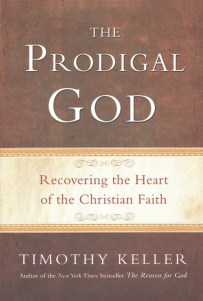
The Prodigal God by Tim Keller

This book is subtitled: “Recovering the Heart of the Christian Faith”.    

Cover Prodigal God

Keller elaborates on the well known story of the Prodigal Son, and offers a not-so-often recognized perspective:  The story is not about a wild son who receives mercy and grace from his benevolent father.  This is a story about two sons. In fact, this is a story about a Father who had two very different sons. It is THE story of God the Father and how people relate to Him in two different ways.

Each son is a reflection of the respective ways people relate to God.   

The younger son is the picture of all who go astray from God and his Law and, having been broken, recognize the emptiness and hopelessness of life apart from the Father.  When awakened to their desperate situation they find a grace and relationship with the Father that is ovewhelming.

The older son is the picture of all who try to relate to God, and please God, by being good; by following all the rules.  This is a picture of religious people, of many Conservative Christians. Yet in their own goodness there is an evident lack of heartfelt fondness for the Father, a lack of joy, obvious to all except for them.

In this book Keller helps us to discern our own tendencies in our relation to God.  Using this story Keller helps us see with keener insight that the ONLY way to have a relationship with God the Father is by recognizing that we are all in need and by being recipients of His compassion, grace, and generosity.  Keller shows us that at the end of the story there is only one son, one type of person, still alienated from the Father. It is not the one who seems to have been the most egregious.  It is the one who seems the most righteous.

Keller has also noted: “Our churches are full of Older Brother types… Is it any wonder, then, that the Younger Brother-types don’t want to come home (come to church)?”

OUCH!! 

The Prodigal God is only 133 pages – and the pages are double-spaced.

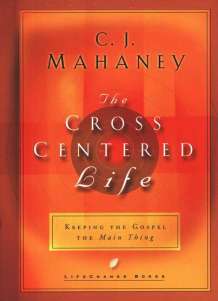
 Cover Cross Centered Life

The Cross-Centered Life by C.J. Mahaney

In this 85 page, pocket sized, book Mahaney helps the reader to keep the Gospel at the center of our lives. He helps us to recognize various subtle substitutes that lead us from the Cross, but ultimatley are of little or no help in strengthening the soul. 

Mahaney uses a plethora of annecdotes and illustrations to convey the simple, yet often forgotten and neglected, essential truth: The Gospel is the power to give and to transform life.  Understanding how we can appropriate the present benefits of the Cross is key to vibrant spirituality and joy.


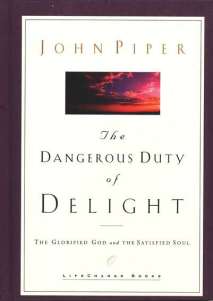
The Dangerous Duty of Delight by John Piper

 I am a long-time fan of Piper’s writing. Nevertheless, I confess, for a long time I refused to read this simple book. I guess I thought this pocket sized 84 page primer of his contemporary classic, Desiring God, was beneath me. After all, I’ve read the BIG book – several times!  But I was wrong.Cover Dangerous Duty

In this little book Piper conveys the essence of the Christian life: To glorify God by enjoying him forever.  It is a great introduction to what Piper calls Christian Hedonism. 

Christian Hedonism may sound like an oxymoron, and even inappropriate, to those who do not undertand what is behind Piper’s message.  But I am convinced that what he espouses is thoroughly Biblical.  It is the recognition that we are created to have a relationship with God; that we are commanded to take delight in God (i.e. Psalm 37.4); and that we are all prone to sell out the ultimate joy we can have in life, in God, for the cheap thrills and pleasures we find elsewhere. 

While I still hope everyone will read Desiring God, this little book, Dangerous Duty, serves as a great introduction that will both lay a groundwork of understanding and whet the appetite for the whole feast found in Desiring God.

You can check out a sample of Dangerous Duty or the entirety of Desiring God online. Just click the highlighted titles.

Desiring God

If you are not already familiar with his work, I want to introduce you to John Piper. In particular I commend his book Desiring GodDesiring God

This book is a modern day classic. And in my mind it an almost indespensible aid to  gaining a Biblical perspective of the Glory of God.  Well, indespensible might be a bit of an overstatement.  But, it is a book I have read and re-read many, many times, always coming away with new insights and delight.

When I first read Desiring God it resonated with me like few other books ever have. I don’t want to say it shaped my thinking at that time. Rather I think it confirmed it.  I always knew there had to be away of enjoying life and honoring God.  Piper opens the door to show us how!

Piper thoroughly saturates his writing with exposition of Scripture, and brings together two aspects of life that are sadly not often enough paired together: Our Joy and God’s Glory.  By reuniting these perspectives Piper expresses far better than I could even dream of doing what what it means to live according to our primary purpose as Christians.  And because he expressed it so well, he has subsequently shaped much of how I express this important aspect of the Gospel. 

The link I provided above is to the e-book – the entire book online.  But there are also a number of other outstanding resources available at Desiring God Ministries.

I suggest reading through and thinking about at least the Introduction: How I Became a Christian Hedonist. (I know that whole concept may be shocking at first, but it will make perfect sense once you read the Intro.)  Then look over the chapter titles.

If you are hungry to grow in both your relationship with God and how a Christian lives, you won’t be disappointed.