Those Blasted Presbyterians

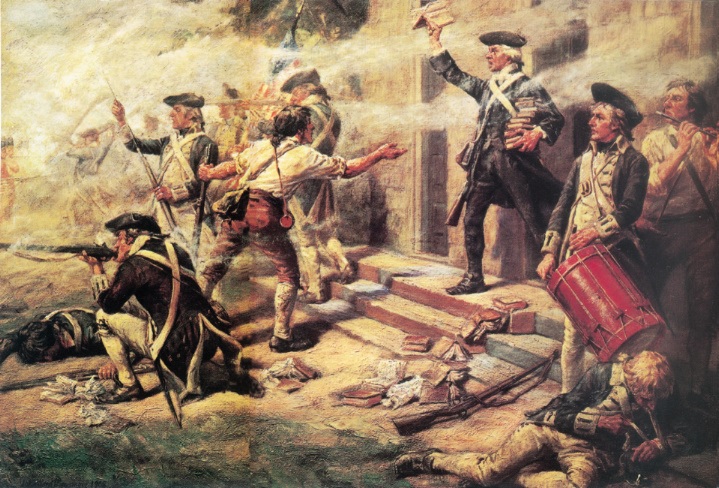
Around the same time, Horace Walpole spoke from the English House of Commons to report on these “extraordinary proceedings” in the colonies of the new world.  “There is no good crying about the matter,” he said.  “Cousin America has run off with the Presbyterian parson, and that is the end of it.”

The parson of which he spoke, was  John Witherspoon—a Presbyterian minister, as well as a descendant of John Knox.  At the time, Witherspoon was president of the College of New Jersey (now Princeton).  He was also the only clergyman to sign the Declaration of Independence.

From the English perspective, the American revolution was often perceived as a “Presbyterian Rebellion.”  And its supporters were often disdained as “those blasted Presbyterians.”

The Presbyterian Revolution
Most American Christians are unaware of the fact that the American Revolution, as well as the new American state, was greatly shaped by Presbyterians and the Calvinism that was at its root.  Some modern-day  Presbyterians have moved light years away from the convictions of these early colonists.

An estimated three million people lived in the colonies at the time of the Revolutionary War.  Of that number, “900,00 were of Scotch or Scotch-Irish origin, 600,000 were Puritan English, while over 400,000 were of Dutch, German Reformed and Huguenot descent. That is to say, two thirds of our Revolutionary forefathers were trained in the school of Calvin.”  (Carlson, p. 19)

As one historian puts it, “When Cornwallis was driven back to ultimate retreat and surrender at Yorktown, all of the colonels of the Colonial Army but one were Presbyterian elders. It is estimated that more than one half of all the soldiers and officers of the American Army during the Revolution were Presbyterian.” (Carlson, p. 16)

To the man, Presbyterian clergy joined the Colonialist cause. It was said that many of them led the Revolution from the pulpit.  In doing so, they paid a heavy price for their support for independence.  Many lost family members or their own lives.  Some had their churches burned to the ground.

The Presbyterian Drive
We forget that many of the early American colonists had left England precisely because Presbyterian Christianity was rejected.  After its brief reign as the established church through the English Civil War and the work of the Westminster Assembly, Britain returned to Anglicanism.  Thousands of non-conforming Presbyterian ministers were then ejected from their churches.  Some, such as the Covenanters, were martyred in a period that came to be known as “the killing times.” Rigid laws of conformity drove many to seek a better life somewhere else.  After 1660, many Presbyterians began to make their way to the colonies in North America.  It was these individuals who brought a new strength to the colonies as they inched their way forward towards independence.

They had little loyalty, and often outright hostility, to the crown of England.  They were armed with the theology of John Calvin, mediated through John Knox, and solidified during the English Civil war. It was a theology which devalued the divine right of human kings, and elevated the worth and dignity of the individual under God.  This theology shaped the early American understanding of civil liberty.

It shaped our founding fathers. The idea of human equality which influenced John Locke, who in turn,  influenced our founding fathers, was learned from the Puritans. Locke’s father had been on Cromwell’s side during the English Civil war.

It also shaped the general population under the influence of the Great Awakening. The Great Awakening was a massive 18th century religious revival that shook the colonies. It was promoted by preachers such as Gilbert Tennent and George Whitfield who travelled up and down the coast calling for a return to a robust Christian and Biblical faith.  Emphasizing the new birth and a Calvinist theology, the Great Awakening had an immense influence on colonial sentiments in the generation just preceding the American Revolution.

Consider then, some of what was at work in the American consciousness preceding the revolution. There was the memory of their horrid experience in England. There was the worry that Anglicans would establish this same kind of church in the colonies. There was a persistent fear of the imposition of bishops who were viewed as “holy monarchs,”  (monarchy in any form was considered bad)!  There was a belief in the absolute sovereignty of God. God alone is Lord of all and the author of liberty. There was a corresponding belief in the absolute equality of individuals (king and peasant, clergy and laity) under God’s law. There was the belief that no human should be entrusted with absolute power, given our radically fallen human nature.  There was a belief that there should be a separation of powers in any new government that is established.  And because of their experience in England, there was the belief that religious freedom and freedom of conscience should be respected.

In other words, for these Presbyterians, liberty is affirmed, but it is not an absolute liberty. It is always to be lived out under the sovereign creator God. It was this theology, a theology rooted, not just in Calvin, but in the Bible, which ultimately gave the colonialist the will to resist.

The Presbyterian Legacy
So this year, as we celebrate our independence once again, and as we think of early American courage, and the genius of our founding fathers, let us not forget those blasted Presbyterians who sought to understand liberty in light of the Bible.  A liberty which conceived of a nation and its entire government under God.

***

NOTE: This piece was originally written by Don Sweeting and posted on his old blog, The Chief End of Man, on July 4, 2014.

Sources:  Our Presbyterian Heritage, Paul Carlson (Elgin:  David C. Cook, 1973)Presbyterians: Their History and Beliefs, Walter L. Lingle and John W. Kuykendall, (Atlanta:  John Knox Press, 1988), The Emergence of Liberty in the Modern World, Douglas F. Kelly, (Phillipsburg, New Jersey:  P&R Publishing, 1992)

A Prayer for the Fourth of July

It is for freedom that Christ has set us free. Stand firm, then, and do not let yourselves be burdened again by a yoke of slavery.” ~ Galatians 5.1

Lord Jesus, it’s the Fourth of July – a holiday set aside to remember and revel in the freedom we enjoy as citizens of America. As broken as she is, we’re still thankful for our country and for the privileges we enjoy.

But the gratitude we feel for our USA citizenship pales in comparison with the joy generated by our citizenship in heaven. (Philippians 3.20) We praise you today for making us members of the “chosen people, a royal priesthood, a holy nation, God’s special possession“. (1 Peter 2.9) This is our true and lasting identity – our consummate passport and eternal liberty.

Indeed, Jesus, only those you set free are really free. (John 8.36) You took our guilt and gave us your righteousness. We’re no longer condemned for our sin or in fear of death. Hallelujah! Sin’s dominion has been broken in our lives; never again will it be our master. (Romans 6.14) We obey you because we love you – not because of pride, pressure, or pragmatics. Holiness is beautiful, and no longer a burden.

We get to run freely and boldly to the throne of grace – into your holy presence, where we only experience your welcome and joy. We’re free to own our sin and brokenness, and to repent with joy, for you bore our shame and we don’t have to pose or pretend anymore. Three Hallelujahs, for that!

You’ve set us free from seeking fool’s gold and a fool’s reward, by making us characters in, and carriers of, your story. Our tiny fiefdoms of self have been crushed under the grace of your all-things-new kingdom. We’re now free to love others as you love us – forgiving and forbearing, encouraging and hoping. Take us WAY deeper into this particular freedom, Jesus.

By the power of the gospel, we will seek to stand firm in these and the many more freedoms you’ve won for us, until the Day you return to usher in the new heaven and new earth. So very Amen we pray, in your liberating and loving name.

***

NOTE: This prayer was originally composed by Scotty Smith for The Gospel Coalition (7/4/16)

The Resolutions of Jonathan Edwards Categorized

The resolutions of Jonathan Edwards is a treasure trove of thoughtful godliness. The earliest of these Resolutions were penned when Edwards was still a teenager – age 19. The list was completed as Edwards was finishing his formal education and beginning his ministerial life. For the rest of Edwards’ remarkable life, part of his regular prayer and devotional practice was to go back and re-read these resolutions at least once a week. In all, there are 70 resolutions. Every one of them takes eternity into consideration and presents a very profound view of a life committed to living purposely for the glory of God as top priority.

Some time ago, I took it upon myself to re-write and post Edwards’ Resolutions in more contemporary English – hopefully with minimal dilution of Edwards’ insight and intent. That post has subsequently been viewed more times than any other on this blog. Some from other countries have even taken my meagre effort and translated that post into other languages.

Recently, I ran across Edwards’ Resolutions categorized, rather than in their original sequence. The categorization and subheading are intended to increase the readability. So, I express my thanks to Matt Perman for undertaking this creative and beneficial approach to Edwards’ classic work.

~ WDG

***

Preface

Being sensible that I am unable to do anything without God’s help, I do humbly entreat him by his grace to enable me to keep these Resolutions, so far as they are agreeable to his will, for Christ’s sake.

Remember to read over these Resolutions once a week.

Continue reading

Thoughts of God

I appreciate Justin Taylor for causing me to consider two seeming conflicting perspectives from two 20th Century giants of the Christian faith: A.W. Tozer and C.S. Lewis:

A. W. Tozer, from The Knowledge of the Holy:

What comes into our minds when we think about God is the most important thing about us.

The history of mankind will probably show that no people has ever risen above its religion, and man’s spiritual history will positively demonstrate that no religion has ever been greater than its idea of God. Worship is pure or base as the worshiper entertains high or low thoughts of God.

For this reason the gravest question before the Church is always God Himself, and the most portentous fact about any man is not what he at a given time may say or do, but what he in his deep heart conceives God to be like.

We tend by a secret law of the soul to move toward our mental image of God. This is true not only of the individual Christian, but of the company of Christians that composes the Church. Always the most revealing thing about the Church is her idea of God.

C.S. Lewis, from The Weight of Glory:

I read in a periodical the other day that the fundamental thing is how we think of God.

By God Himself, it is not! How God thinks of us is not only more important, but infinitely more important. Indeed, how we think of Him is of no importance except in so far as it is related to how He thinks of us.

It is written that we shall “stand before” Him, shall appear, shall be inspected. The promise of glory is the promise, almost incredible and only possible by the work of Christ, that some of us, that any of us who really chooses, shall actually survive that examination, shall find approval, shall please God. To please God . . . to be a real ingredient in the divine happiness . . . to be loved by God, not merely pitied, but delighted in as an artist delights in his work or a father in a son—it seems impossible, a weight or burden of glory which our thoughts can hardly sustain. But so it is.

Are these thoughts contradictory of one another? If not, how do we reconcile them? And assuming these statements can be reconciled, and shown not to be contradicting, what wisdom can the Christian gain that might shape the way we live?

Some things for me to think about.

Insights Into Ecclesiastes

As I read through and study Solomon’s Book of Ecclesiastes, for personal enlightenment rather than for preparation to teach, I appreciate the insights offered by Douglas Wilson, through his book Joy At the End of the Tether: The Inscrutable Wisdom of Ecclesiastes.

First, I appreciate the “scaffolding” Wilson identifies – the two great refrains that run throughout the book. Wilson notes:

Throughout the book, two great refrains can be heard. When we come to understand the meaning of these refrains, we will then know that the meaning of life cannot be found by fumbling in the dark. Instead of viewing the book as a series of disjointed and sometimes contradictory statements, we must first listen for those themes which integrate all the teaching of the entire book.

In other words, for us to understand the message of Ecclesiastes, we must recognize both of these refrains, understand what each means, and recognize how these two refrains relate to one another. What are these two themes?

  • “Under the Sun”
  • “The Great Gift of God”.

As one who benefits from outlines when I read and study, I also appreciate the simple outline Wilson sketches. Wilson writes:

Ecclesiastes has four basic sections, or divisions. In the first, Ecclesiastes 1.2 – 2.26, we see that Solomon’s experience shows that satisfaction cannot come from anything within the power or competence of man. In chapters 3.1-5.20, he shows that God is sovereign over everything. He then goes on to answer objections to this (perennially offensive) doctrine. Third, Ecclesiastes 6.1-8.15 carefully applies this doctrine that the sovereign God alone gives the power to enjoy this parade of vanity. Without an understanding of the Almighty, and without seeing his attributes, nature, and character, the world is nothing but an ongoing vexation of spirit. And finally, Ecclesiastes 8.16-12.14 removes various obstacles and discouragements, and addresses numerous practical concerns.

So, this outline of Ecclesiastes, as I paraphrase it:

  • Ecclesiastes 1.2 – 2.26: Reasons for Dissatisfactions and Frustrations in Life
  • Ecclesiastes 3.1 – 5.20: The Reality of the Sovereignty of God
  • Ecclesiastes 6.1 – 8.15: Why God’s Sovereignty is the Key to Our Satisfaction & Joy
  • Ecclesiastes 8.16 – 12.14: Practical Practices for Living a Life of Satisfaction & Joy

Just a few notes of things helping me to appreciate the wisdom of Solomon.

10 Minutes After Church

What do you usually do immediately after your Sunday morning church service ends? If you’re like most of church-going humanity, you probably have a routine. Upon the final “Amen”, you arise from your regular spot and your body follows a subconscious script. You may go to the nursery to pick up a child, maybe you have your weekly chat about the high school sports team with the person seated in the row behind you, or perhaps you hightail it toward the coffee to snag a to-go cup on your way out the door.

There’s nothing wrong with being a creature of habit, but many of us have the same routine at the end of a church service as we do at the conclusion of a sporting event or any other public gathering. We gather our belongings, utter some niceties, and shuffle toward the exits. That’s a problem. More specifically, it’s a bad habit.

Since the church body is a family of brothers and sisters in Christ, the end of the formal part of a service is not the end of church but rather the beginning of a new segment of the family gathering. When the structured gathering ends, an indispensable aspect of Christian vitality and growth—fellowship—continues.

Don’t get the wrong idea. You don’t have to be an extrovert who seeks people out like a goldendoodle puppy to faithfully participate in the fellowship of the church. You just have to be intentional.

If you’re one of the many believers with a bad habit of neglecting the broader fellowship of the church after the service, here’s one simple suggestion: set apart ten minutes after the gathering concludes and devote that time to getting to know others in the church family. This is a ten-minute commitment to invest in your eternal faith family and show hospitality to those not yet in the family.

To help set these ten minutes apart, it may help to consider what not to do, in order to be free and available for fellowship with the body of Christ.

1. Don’t Talk to Your Besties

There’s nothing wrong with having close friends in the church (in fact, there’s much right about that), but the weekly gathering is the one time each week when all the people you don’t naturally bump into are gathered in one place. Don’t miss that opportunity to experience the fullness of the body of Christ by getting to know those who are unlike you or from different life stages and interests. Not only will you benefit from a more diverse fellowship, but over time the supernatural unity of the Spirit will be gloriously on display as members of a church family have genuine care and concern for those outside their immediate circles. Let your closest friends know that right after the service (and, ideally, before the service as well), your aim is to engage the larger fellowship of the church family. Maybe this will encourage them to do the same!

2. Don’t Talk to Blood

Similarly, in those first ten minutes after the service, skip the chit-chat with your family. This is not to denigrate your family. If you get to regularly attend church with your extended family, that is a gift from God to be cherished. But very often, one’s family becomes the relationally safe enclave that undermines more intentional branching out into the broader church family. If your habit is currently to huddle up with your family to chat after church, it’s time to replace that habit with a better one. You’ll talk to your family later, so in those first moments after the official time is done, reorient your family outward toward the broader fellowship of the church family.

3. Don’t Talk Shop

While circumstances will arise that need the attention of a staff member or ministry leader, the goal in the minutes prior to and following the service is to be freed up for fellowship. It’s common for those involved in the formal functions on a Sunday (music ministry, kids ministry, elders, deacons, staff, etc.) to ‘talk shop’ with others who are also involved in leading and serving. But again, this is the one time each week that the building is filled with the faith family! The shop talk can wait or be accomplished with an email. You might even need to politely tell a fellow ministry leader, “Let’s discuss this later. I want to go meet those people before they leave.” In doing so, you’re not only prioritizing what matters, you’re setting the tone for a culture in which all the ministry leaders are flock-oriented.

Habits are what we do without noticing. Most people are not actively trying to have shallow relationships with the church family. But without realizing it, many people are missing the gift of rich church fellowship due to unexamined Sunday habits. I encourage you to devote ten minutes after the service for conversing with others in the faith family—and soon you’ll likely find that ten minutes is not nearly enough. 

***

This post was written by Andy Huette, Senior Pastor of Christ Community Church in Gridley, Illinois, and orignally published by Mattthias Media. Here is the link to the original post: The Ten Minutes After Church Ends.

Check out: How to Walk into Church

Finding My Place in the Story

The Bible comes to us in various forms of literature: history, poetry, and letters, just to name a few. But essentially, the Bible tells one epic story from beginning to end, using all the various genres.

Eugene Peterson, writing the introduction to Matthew in The Message, said:

“Every day we wake up in the middle of something that is already going on, that has been going on for a long time, genealogy and geology, history and culture, the cosmos – God. We are neither accidental nor incidental to the story. From it we get orientation, briefing, background, reassurance. Lacking such a context, we are in danger of seeing Jesus as a mere diversion from the concerns announced in the newspapers. Nothing could be further from the truth.”

The challenge is to find myself and my place in God’s great story of Redemption and Restoration.

Outline of Biblical History

I have learned that I am one who learns best from outlines. Perhaps not in all subjects, but I think certainly when it comes to learning history. I can often recall many of the stories, but I am sometimes slow to remember how things played out and how things connect. Outlines helps to remind me of the the bigger picture, the broader narrative, which is vital to understanding.

The outline below is one I have found helpful for remembering the narrative of Biblical history. It comes from the book, According to Plan: The Unfolding Revelation of God in the Bible, by Australian Anglican scholar Graeme Goldsworthy.

(See chart in .pdf)

No Other Gospel

After learning I would be beginning a new sermon series this week, a study of the book of Galatians, a friend and colleague who is an Army Chaplain asked me if I had read the relatively new book, No Other Gospel.  Though I had seen it, I admitted I was not really familiar with it.  He suggested it would be a good parallel book to coincide with the series of messages we will be offering at Grace Covenant between now and Easter.

I picked it up, skimmed it this afternoon, and expect to commend it to our congregation – at least to No Otherthose who want to do a little digging of their own over the next few months.  (I’ll read it more thoroughly as well.)

In the video above Justin Taylor interviews the author of the book, Josh Moody, who serves the historic College Church of Wheaton.  Moody explains the basis and the gist of the book.

About Bible “Admissions”

HAPPY Strawman

When first reading an article featured in Relevant Magazine by John Pavlovitz, 5 Things I Wish Christians Would Admit About the Bible, I found myself feeling a mixture of mild reactions: chagrined by the banality, and indifferent because of the banality.  While the magazine does occasionally publish some thoughtful pieces, the majority seem to be either old fashioned theological liberalism dressed up in contemporary Millennial angst, or shallow pragmatism desperately wanting to be considered poignant and profound.  This particular article managed to qualify for both categories, as Pavlovitz offered his handful of wishes that people would understand:

  1. The Bible Isn’t a Magic Book
  2. The Bible Isn’t as Clear as We’d Like It to Be
  3. The Bible Was Inspired by God, Not Dictated by God
  4. We All Pick and Choose the Bible We Believe, Preach and Defend
  5. God is Bigger Than the Bible

Really going out on a limb there, with such staggering assertions. (Note sarcasm.)

It was not until I read a post by Blake Deal, What We Will Not “Admit” About the Bible, that I even gave it a second thought.  What had seemed unworthy to receive much consideration had now been given a thoughtful, appropriate corrective.   After reading Deal’s rebuttal, I started thinking to myself: “I wish I’d written that”.

Whether one takes the time to read Pavlovitz’s piece or not, I think Deal’s observations are worth the few minutes it  takes to read them, both for their succinct affirmations of the historic faith, and as an example of a good way to address other straw man allegations levied against historic Christian orthodoxy in the name of becoming relevant to this present generation.

Finding Your Place in God’s Story

Knowing scripture is vital. But it is not the essence of Christianity.  That may sound surprising, but it really should not be.  Knowing the Bible is foundational, even essential, to vibrant faith and life. But it is also possible to have great knowledge yet have little understanding. The essence of the Faith is not information but formation.  It is understanding who God is, what he has done and is doing, and what he expects from you and me.  It is, borrowing a good popular phrase, finding your place in God’s story and living it out in light of the gospel.

I started reading D.A. Carson’s The God Who Is There.   This is a tremendous resource.  Carson does a wonderful job in walking the reader through the narrative of the Bible, or what he calls “the Big Story of Scripture”.  He touches on the major themes, comprehensively yet easily readable. And in doing this, Carson helps us understand the grand narrative of scripture, thus assisting and enabling us to more easily find our place in it.

As it so happened, in February 2009 Carson presented a 14-part seminar  at Bethlehem Baptist Church in Minneapolis. The book was developed from those messages.  And thanks to The Gospel Coalition, the MP3s and videos of the conference that closely correspond with the book are available for all 14 chapters:

  1. The God Who Made Everything | MP3 | Video
  2. The God Who Does Not Wipe Out Rebels | MP3 | Video
  3. The God Who Writes His Own Agreements | MP3 | Video
  4. The God Who Legislates | MP3 | Video
  5. The God Who Reigns | MP3 | Video
  6. The God Who Is Unfathomably Wise | MP3 | Video
  7. The God Who Becomes a Human Being | MP3 | Video
  8. The God Who Grants New Birth | MP3 | Video
  9. The God Who Loves | MP3 | Video
  10. The God Who Dies—and Lives Again | MP3 | Video
  11. The God Who Declares the Guilty Just | MP3 | Video
  12. The God Who Gathers and Transforms His People | MP3 | Video
  13. The God Who Is Very Angry | MP3 | Video
  14. The God Who Triumphs | MP3 | Video

A Word From a VBS Valedictorian

Trekking incognito along the Emmaus Road, shortly after his resurrection, unrecognized even by the few of his own disciples who walked with him, Jesus challenged the groans of perplexity and faithlessness:

He said to them, “How foolish you are, and how slow of heart to believe all that the prophets have spoken!  Did not the Christ have to suffer these things and then enter his glory?” And beginning with Moses and all the Prophets, he explained to them what was said in all the Scriptures concerning himself. (Luke 24.25-27)

All of the Scriptures speak about Jesus? Really? Yep.  And in the video above, this young guy recounts the overarching reflections of the Messiah revealed in every book of the Bible.

Impressive.

Mirror, Mirror on the Wall

In the Preface to Joe Thorn‘s book, Note to Self, Sam Storms penned a paragraph that strikes at the heart of the difference between those with a vital Chrisian faith, and those who show little if any hint of actually being a follower of Jesus Christ.  Here is what Storms says about the functional place of Scripture in the life of a Believer:

Merely affirming the Bible is inspired accomplishes very little.  Asserting it’s authority isn’t much better.  The inspiration and authority of the Scriptures are of value to us only so far as we change our beliefs to conform to its principles and alter our behavior to coincide with its imperatives.  The Bible is meant to govern our lives, to fashion our choices, to challenge our cherished traditions, and ultimately make us more like Jesus.

The question for each of us, then, is whether the Bible actually functions in this way.

  • Do we submit to its dictates?
  • Do we put our confidence in its promises?
  • Do we stop living in a certain way in response to its counsel?
  • Do we embrace particular truths on its authority?
  • Do we set aside traditional practices that conflict with its instruction?

In other words, for the Bible to be of value to us it must actually function to shape how we think, feel, and act, as well as what we believe, value, and teach.

I think Storms nails it here; hits it square on its head.

A number of dialogues I have recently had broached the subject of the differences of maturity levels between professing Christians. What Storms addresses is one of the most vital dynamics that explain the differences.  In fact, since we who believe have all been given the same Spirit, perhaps the differences in the way we approach and apprehend the Scripture may be THE most important explanation for such differences.

Some see the Scriptures as they are to be seen, as a revelation of what is good and a mirror to show us what needs addressing in our lives, which in turn drives us to the Cross, where the power of transformation rests.  Here they find the promises of God to be true: He is making us beautiful, to become a Bride for the King.

Others also see the Scriptures as a mirror. But, for these folks, this mirror is more like the one used by that witch in the story Snow White, who declared: “Mirror, mirror on the wall, who is the fairest one of all?”  All she wanted was to hear how good she was; how much better she was than others. Sadly some people look to the mirror of Scripture only willing to see whatever appears to validate them.  Failing to see, by the mirror, the ugly-fying effects of sin in their hearts and lives, they see no real need to return to the Cross.  Thus they seem to never be changed.  They never become truly beautiful.