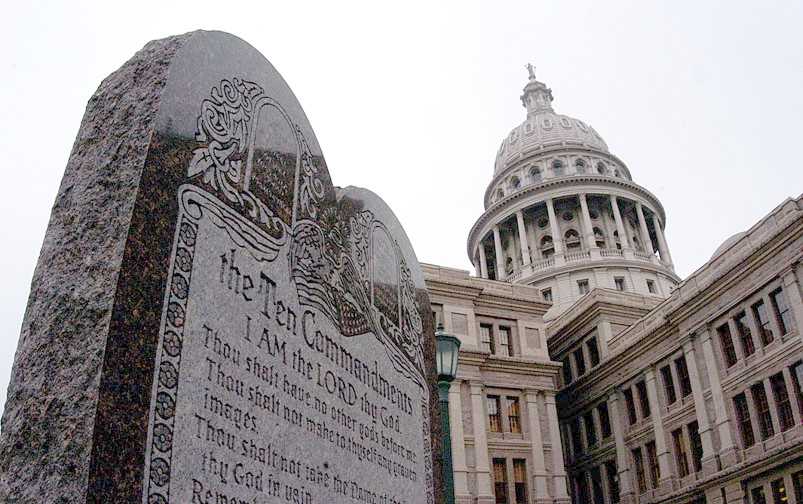
The 10 Commandments in American Culture

While reading through The Art of Pastoring: Ministry Without All the Answers, by David Hansen, (a book recently recommended to me that I find myself wishing I had read years ago,) I came across this convicting assessment of American culture – an indictment that sadly is also widely applicable to a wide swath of American Evangelicalism:

“The majority of Americans will tell any pollster that they believe in the Ten Commandments. But only a small percentage of those people could even recite the Ten Commandment; and even a smaller percentage have any genuine interest in following them.”

Ouch!

Sad State of Evangelicalism

Broken Cross

An excellent, “must read”, article by Mark Galli for Christianity Today:  The Troubled State of Christian Preaching.  This is a great example of a “I Wish I’d Said That”.  All of Galli’s insight resonate …

Here is the gist of Galli’s tought, set within the context of the Presidential Inauguration and Louie Giglio being put on the un-invite list:

Even when we try to make Jesus first, we end up inadvertently making ourselves first.   …Unfortunately, in a desire to reach the world for Christ, some inadvertently …make much about our ultimate significance. Jesus becomes merely the means by which we feel better about our place in the universe. Need purpose and meaning? Follow Jesus, that will do the trick. In this subtle shift, we become the first and the last, the Alpha and the Omega.

Lord Save Us

I spent this morning watching the documentary, Lord Save Us From Your Followers.  I was prompted by a note from a friend and, despite it not being on my agenda for the day, I was intrigued.

Once again, I am not sure where I have been. This film came out over a year ago.  Some of it looked familiar, so I may have caught part of it on GMC or some other television cable network.  But for whatever reason, what I saw before did not capture my interest enough. Perhaps I had an initial wrong impression.  Perhaps I was just busy and could not watch the whole thing before. But even if that were the case, I am not sure why this went out of mind so quickly that I did not seek it out when I had the time to check it out.

The driving questions about this exploration of the Culture Wars in the United States is: Why is the Gospel of Love Dividing Our Nation? That is a great question.

Here are a few brief thoughts that come to my mind having just finished watching:

  • Ouch!  This cuts close to home.  This film clearly reveals how we as Christians (and I personally) are at fault for much of the perception the UnBelieving Culture has about Christianity and Christians.
  • I was encouraged by the responses of those who are opposed to Christianity and Christians when a Believer was willing to engage them in an honest discussion. I was moved by the power of humility, compassion, repentance and confession by the Believer. Apparently Jesus knew something when he commanded his followers to first take the plank out of our own eyes before confronting others about the specs in theirs.  (Matthew 7.5) Paul, too, when he instructed the Galatians to “gently restore” those who were astray of the way of God, but that they should be careful that they did not stumble in their own sin in in the process. (Galatians 6.1)
  • I am hopeful of a positive impact. But our strategic priorities must be in order. First is the reformation of the Church, including widespread repentance of God’s people for our failure to seek genuine righteousness.  Only later can we expect to have any positive cultural impact.  (2 Chronicles 7.14)

Now for the qualifications:

I know some who read this blog will be inclined to immediately dismiss the message behind this film because some of the theological premises expressed by those interviewed are questionable (to say it kindly), because it is not a theological discussion, and/or because some of the Christians represented do not reflect your tradition. (For the most part, this is true of mine too. Only John Perkins comes to mind who I know to share a similar theological heritage.)  But to dismiss this film for any of those reasons is a sad mistake.  At the very least recognize that this film depicts how a wide spectrum of our culture views us.

This documentary runs 1:42, so to watch it takes some time.  I suppose it would not lessen the appreciation to break it up into segments.  But I do encourage honest Believers, those interested in engaging in holistic mission to take the time, however you break it up.

To watch, click: Lord, Save Us From Your Followers

95 Theses for the American Church

Just as Martin Luther offered some suggestions for the Church of his time in Germany, Jared Wilson has some ideas for us to consider.  On his blog: The Gospel-Driven Church, Jared has posted 95 Theses for the American Church.

Faith in America: Not What it Used to Be?

plantation-church

I appreciate the perspective of this editorial from the March 12, 2009 Kingsport Times-News. The editor integrates both history and contemporary polling data.  It eschews any alarmist inclinations and refutes any distorted notions that America was a distinctively Christian country upon it’s founding. 

I think this perspective is helpful.  I am especially hopeful that it will help in preventing Christians from mistaking either patriotism or isolationism as being synonomous with being a Christian in America. 

Whatever the current data indicates – and I suspect it changes day-to-day – our focus is not changed.  Fundamentally we are called to personally grow in grace and live out the gospel in the communities where God has placed us; to plant churches in areas underserved by faithful congregations; and to partner to see churches planted among Unreached People Groups around the world.

***

KINGSPORT – This week, the results of a new poll were eagerly distributed by national news media as evidence that faith is on the skids in America and that more and more U.S. citizens have no religion at all.

According to the latest American Religious Identification Survey, 15 percent of respondents say they have no religion, compared to 8.2 percent in 1990. The survey also recorded a decline in those identifying themselves as a member of an institutional Christian church. In 1990, 86 percent made that claim; it’s now down to 76 percent.

This isn’t necessarily evidence of anything terribly new or irreversible in the religious life of the nation. Nor do these percentages represent anything even approaching the low point in the history of American church participation. To do that, you have to go back a long, long time.

On the eve of the Revolutionary War, records show fewer than 20 percent of American adults adhered to a church in any significant way — a far cry from today when church membership stands at 146 million or roughly half of the population.

In colonial America, New England was the most churched. Between 1630 and 1660, adult church membership in most New England towns approached 70 or 80 percent. Membership was never universal, however, as these percentages demonstrate. Moreover, the cities of Boston and Salem quickly lost membership. By 1650, for example, fewer than 50 percent of Boston’s adults were church members.

By the 1680s, many New England towns reported church membership rates of no more than 10 to 25 percent. In 1690, on the eve of the Salem witch trials, that town’s churches could claim only 15 percent of its adults as members, including only half of the town’s well-to-do selectmen; yet today, Salem is a byword for religious fanaticism.

Church membership rates in the South were even worse.

In Virginia’s Charles Parish, for example, 85 percent of newborn Caucasian children went unbaptized between 1650 and 1680 — even though the parish supported a clergyman and sustained regular worship throughout the period. South Carolina had the highest church membership of any Southern state during the colonial period, at 16 percent. North Carolina had the lowest, at a mere 4 percent.

In 1780, the great church leader Samuel Mather guessed that scarcely a sixth of Boston’s adults attended church. Historians estimate that in New York City and Philadelphia, church membership probably did not approach 10 percent at that time.

Records also show that most church members during the colonial period were women. Indeed, from the 1680s — and continuing for several decades afterward, well into the 18th century — women constituted about 60 percent of church members in most congregations.

True, revivals temporarily brought more men into congregations, especially in the 1740s, but the women’s numerical majority surfaced again when the revivals faded.

Taken as a whole, at the time of the American Revolution, between 70 and 90 percent of all European colonists in America remained unattached to any church.

Such history demonstrates our ancestors were not the Christian giants they are often made out to be. On the other hand, this week’s Religious Identification Survey merely records that more Americans are opting out of organized religion, but that doesn’t necessarily mean they’ve abandoned faith.