A Jesus Manifesto

“Christians have made the gospel about so many things… Things other than Christ.”  So opens the document, written by Leonard Sweet and Frank Viola, titled: A Jesus Manifesto.

I’ve long been a fan of Leonard Sweet, our theological differences aside. But Sweet’s love for Jesus, his love for God’s people, and his amazing story-telling ability make his books and articles a pleasure to read. Besides, I’ve not found our differences to come up that frequently in the things he writes. His focus is spirituality, not systematic theology.  At the very least Sweet always makes me think – and often makes me laugh.

I don’t know as much about Frank Viola. I’ve heard of him, but I don’t recall having ever read anything he has written – at least nothing before A Jesus Manifesto.

But as I read through this manifesto I found I appreciated the heart of both men. I also appreciate their effort to put into words something that needs to be said in this generation.  Paraphrasing the words of the old hymn, we need to “Turn our Eyes upon Jesus.”

To read the document click the link above.  On that blog you will also find links to download the document in .pdf, listen to the authors read their manifesto, and listen to Steve Brown interview the authors at Steve Brown, Etc.  Facebook users will also find a link to a group page discussing the manifesto.

Prayer Mirrors the Gospel

“Prayer mirrors the gospel. In the gospel, the Father takes us as we are because of Jesus and gives us his gift of salvation. In prayer, the Father receives us as we are because of Jesus and gives us the gift of help. We look at the inadequacy of our praying and give up, thinking something is wrong with us. God looks at the adequacy of his Son and delights in our sloppy, meandering prayers.”

– Paul Miller, A Praying Life

Manhattan Declaration

From time to time a new and faithful expression of faith is necessary. I am not speaking of a new faith, or of new doctrines, but of the historic Christian faith prophetically applied to current and world events.  Such a statement of faith has recently been produced: The Manhattan Declaration.

The Manhattan Declaration is a collective affirmation of fundamental Truths shared by Evangelicals, Roman Catholics, and Eastern Orthodox Christians living in the United States. In particular, this declaration addresses:

  • Sanctity of Human Life
  • Sanctity of Marriage
  • Rights of Conscience and Religious Liberty

Some may question why believers who hold some vastly different perspectives would join together and unite their voices to address these social issues.  On the other hand, why would they not?  These issues that both result from and contribute to our social decay are intolerable and need to be addressed.  Francis Schaeffer referred to such joint operations as “co-beligerence”.

This afternoon I signed my name to this declaration. While I don’t presume anyone really cares what I sign, or even what I think, it was a way for me to lend my voice to an effort that needs to be heard.  I invite you to check it out – and sign-on, if you share the concerns and agree to these solutions.

Manhattan Declaration(.doc)

Danger of Christian Complacency

It may defy common wisdom, but sound doctrine is important to the renewal of the contemporary church.  While many view doctrine as divisive and unecesary trivia, recent studies by Thom Rainer, Ed Stetzer, and others, reveal that sound doctrine is a hallmark of churches that are the most effective in evangelism.  Further, both writers, in addition to Collin Hansen’s experience, suggest that open discussion about sound doctine is what younger, unchurced spiritual seekers are clamoring for.  So while it may defy common wisdom, we also need to remember that some things are more common than wise.

The following is a short article by 19th Century Anglican Bishop, J.C. Ryle, who makes the case for the necessity of sound teaching in our lives and ministries.  See what you think.

*** 

The times require distinct and decided views of Christian doctrine. I cannot withhold my conviction that the professing Church is as much damaged by laxity and indistinctness about matters of doctrine within, as it is by skeptics and unbelievers without. Myriads of professing Christians nowadays seem utterly unable to distinguish things that differ. Like people afflicted with color–blindness, they are incapable of discerning what is true and what is false, what is sound and what is unsound. If a preacher of religion is only clever and eloquent and earnest, they appear to think he is all right, however strange and heterogeneous his sermons may be. They are destitute of spiritual sense, apparently, and cannot detect error. The only positive thing about them is that they dislike distinctiveness and think all extreme and decided and positive views are very naughty and very wrong!

These people live in a kind of mist or fog. They see things unclearly, and do not know what they believe. They have not made up their minds about any great point in the Gospel, and seem content to be honorary members of all schools of thought. For their lives they could not tell you what they think is truth about justification, or regeneration, or sanctification, or the Lord’s Supper, or baptism, or faith or conversion, or inspiration, or the future state. They are eaten up with a morbid dread of controversy and an ignorant dislike of party spirit; and yet they really cannot define what they mean by these phrases. And so they live on undecided; and too often undecided; they drift down to the grave, without comfort in their religion, and, I am afraid, often without hope. Continue reading

Spiritual Pride

The first and worst cause of error that prevails in our day is spiritual pride. This is the main door by which the devil comes into the hearts of those who are zealous for the advancement of Christ. It is the chief inlet of smoke from the bottomless pit to darken the mind and mislead the judgment, and the main handle by which Satan takes hold of Christians to hinder a work of God. Until this disease is cured, medicines are applied in vain to heal all other diseases.

Pride is much more difficult to discern than any other corruption because, by nature, pride is a person having too high a thought of himself. Is it any surprise, then, that a person who has too high a thought of himself is unaware of it? He thinks the opinion he has of himself has just grounds and therefore is not too high. As a result, there is no other matter in which the heart is more deceitful and unsearchable. The very nature of it is to work self-confidence and drive away any suspicion of evil respecting itself.

Pride takes many forms and shapes and encompasses the heart like the layers of an onion- when you pull off one layer, there is another underneath. Therefore, we need to have the greatest watch imaginable over our hearts with respect to this matter and to cry most earnestly to the great searcher of hearts for His help. He who trusts his own heart is a fool. Continue reading

Re-Gridding Revisited

Measure of a Heart

A few days ago I penned a post suggesting that we consider the Christian Life through a different paradigm than what I believe is ordinary.  I suggested the the fundamental gauge ought to be Humble vs. Proud, rather than Good vs. Bad and/or Right vs. Wrong.  I have received several positive responses, and I have been asked a couple times for some clarification. 

While I suspect few, if any, would suggest that Humble vs. Proud is not a valid grid, I understand how some might find it a bit audacious to say it should be the fundamental, or primary grid.  What makes this the predominant paradigm?

Humble vs. Proud is the grid within which these other standards fit.  

Let me explain:

First, Christianity is a substantive faith.  Doctrine is the way we express and transfer the substance of Truth.  So Right vs. Wrong is an important concept; an indispensible concept.  But God tells us that there is a knowledge that merely “puffs up”, a knowledge that may be true but which is not helpful.   It is not the substance of truth that it the problem. The problem is the condition of the heart that is receiving and processing this truth. 

What is interesting is that understanding  Truth also promotes humility.  Paraphrasing C.J. Mahaney: “Humility is seeing ourselves in right relation to God.”  In other words, the more we understand about God and about ourselves the more humble we wil feel. But paradoxically, before Truth produces humility the heart must already be humble before God.

Second, James tells us that we are known by our actions; that Faith without works is dead.  This underscores the importance of Good vs. Bad.  But our actions can be deceiving. Not only can we deceive others by our actions, but we often deceive ourselves.  Many people think of themselves as being loved by God because of their actions.  But this often stems from a false sense of righteousness. God tells us that our best efforts, if they are not generated from faith and a love for God, are as appealing as a filthy rag. And Jesus spoke to a group of people telling them that despite their “good deeds” he had no relationship with them. (See Matthew 7.21-23)

Again, while both the Good vs. Bad and Right vs. Wrong paradigms are important, and have their place, I still suggest that Humble vs. Proud is the most fundamental. Against this paradigm there is no warning. And it is only within this paradigm that the others get their meaning.

More Like Jesus

Aqua

“To become more like Jesus is to feel increasingly unable to do life, increasingly wary of your heart. Paradoxically, you get holier while you are feeling less holy. The very thing you were trying to escape – your inability – opens the door to prayer and then grace.”

 – Paul Miller, A Praying Life

Do You Know…?

Cracked Glass

Do you know the Christ of the Gospels? Or have you fallen into the trap to which Christians (especially, perhaps, Reformed Christians) who love doctrine and systematic theology are sometimes susceptible (unlike John Calvin, it should be said): fascination with dogmatic formula at the expense of love for the Savior’s person?

Sinclair Ferguson, from Yesterday, Today, and Forever

Re-Gridding the Christian Life

Measures

Not long ago, while a friend of mine was preaching in my place at Walnut HIll Church, I had somewhat of an epiphany.  I understood something that had been nagging at me for a long, long time, but that I had never before been able to express – even to myself.  I realized: We have it all wrong. We are using the wrong standard to measure our spiritual lives.  We need a new grid.

Too often, I am afraid, we gauge the Christian Life through a grid of Good vs. Bad, or of Right vs. Wrong.  The more serious of us may see that both ought to be wedded together.  But I am convinced that, while both of these grids have some value, the real grid that God fundamentally calls us to use is Humble vs. Proud.

Good vs. Bad gauges our behavior.   Right vs. Wrong evaluates our doctrine, or our Worldview.  But Humble vs. Proud reflects our heart – and that is where everything must begin. If we get that out of whack, everything else will be too.

God opposes the proud but He gives grace to the humble.”

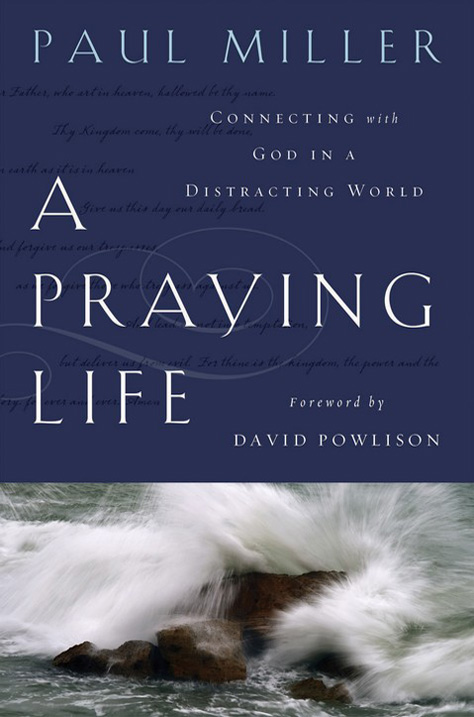
A Praying Life

Praying Life“Lord, teach us to pray.”   That’s the request of the disciple of Jesus. (Luke 11.1)  That’s a request that should not be limited to ages past or the pages of the Bible. It is the heart request of any disciple of Jesus. 

My friend, Paul Miller is Jesus’ tool to answer that request in this generation.  In his book, A Praying Life: Connecting With God in a Distracting World, Paul helps people like me, people who sometimes struggle in knowing how or what to pray; people who find their minds wandering often whenever trying to commit longer periods of time to pray; people who sometimes wonder if God get’s tired of these simple, random, and inarticulate petitions.

Paul reminds us what it means to be a child of God, and the implications that has for our prayer life. He helps us see that God will never reject those who come to him with a child-like heart, and therefore will certainly not be disappointed in us if we come to him with child-like characteristics.  Paul “redeems” the mind-wandering, and sets us free to enjoy our Father in prayer.

Check out a sample chapter and a review from NavPress.

Grace Will…

Paradox Hand

I was blown away as I thought about the paradoxes of the Gospel as it was described by Paul Tripp in his book, Broken-Down House.  Don’t just read through quickly. Stop and consider the contrasts:

Grace is a story and grace is a gift. It is God’s character and it is your hope. Grace is a transforming tool and a state of relationship.  Grace is a theology and an invitation. Grace is an experience and a calling. Grace will turn your life upside down while giving you a rest you have never known.  Grace will convince you of you unworthiness without ever making you feel unloved.

Grace will make you acknowledge that you cannot earn God’s favor, and it will remove your fear of not measuring up to his standards. Grace will confront you with the fact that you are much less than you thought you were, even as it assures you that you can be far more than you had ever imagined. Grace will put you in your place without ever putting you down.

Grace will enable you to face truths about yourself that you have hesitated to consider, while freeing you from being self-consciously introspective. Grace will confront you with profound weaknesses, and at the same time introduce you to new-found strength. Grace will tell you what you aren’t, while welcoming you to what you can now be. Grace will make you as uncomfortable as you have ever been, while offering you more comfort than you have ever known. Grace will drive you to the end of yourself, while it invites you to fresh starts and new beginnings.  Grace will dash your hopes, but never leave you hopeless. Grace will decimate your kingdom as it introduces you to a better King. Grace will expose your blindness as it gives you eyes to see. Grace will make you sadder than you have ever been, while it gives you greater cause for celebration than you have ever known.

Grace enters your life in a moment and will occupy you for eternity. You simply cannot live a productive life in this broken-down world unless you have a practical grasp of the grace you have been given.

A Time for Work, A Time for Worship

Wondering Which

A woman walked into our church building during the service this past Sunday morning. I did not see her, but reportedly she was rather rough looking, even intimidating.  She was seeking financial assistance, and she was clear and determined in her objective. 

The lady from our congregation who got up to greet her would not ordinarily be considered a timid soul.  She is seasoned in ministry and has met all kinds of people.  But she admitted later to feeling ill at ease with this stranger.  Perhaps her discomfort was because of the woman’s gruff exterior and demeanor.  Perhaps it was because she remembered that the writer of Hebrews tells us sometimes we entertain angels disguised as the poor.  (Hebrews 13.2)  But I suspect there may have been other factors at play.

I believe most of us want to be helpful, though we don’t always know how. This may be particularly true when we are dealing with the underprivileged.  And  I wonder if, because of both the renewed emphasis of the importance of mercy ministry and the proliferation of political exploitation of the poor, some of us are not prone to feel a twinge of guilt on occasions when we are not prepared to address a need.

In my opinion the incident at our church this past weekend was handled appropriately.  The woman from our church invited our visitor to join us in worship, and told her  that after the service she was sure one of our deacons would be happy to meet with her to discuss her situation.  The woman declined and walked out of the building. 

Why do I believe it was handled appropriately, when no assistance was given?

1. Those in Need will always be around. 

Jesus told us: “You will always have the poor with you”.  In other words, no matter how effective we are, individually and collectively, we will not entirely alleviate poverty.  We may minimize it but we will not eliminate it.

Some have used this fact as an excuse to do little or nothing to address poverty and minister to the poor.  And that is wrong.

But that is not the case for our church. 

Our deacons regularly meet with people in need, both members of our church and people from outside it. We have budgeted a fair percentage of church income to be distributed for benevolence. Our deacons give toward needs as they are finanically able.  Individual members of our church are known to give to others as they are aware of needs. Our church also partners with and supports other organizations, such as Bristol Faith in Action and Harbor of Light, who minister mercy to people who have had no contact with our church. 

We have put structures in place to guide us in our benevolence. These structures and guidelines are not implemented to minimize what we give. They were designed to help us be more effective in our giving. They enable us to truly be more merciful because we are able to meet real needs.  We are not just trying to make ourselves feel better by giving, but actually trying to provide help to those in need.

While we still have room to grow, charity and grace are characteristics of the congregation and leaders of Walnut Hill Church. 

While we may be inclined to feel bad that we cannot meet all needs, if we are faithful in extending mercy we have no reason to feel ashamed or embarrassed on those occasions we truly are unable or when it would be unwise.

2. This was a Mary moment. 

Solomon tells us: “For everything there is a season, and a time for ever matter under heaven.” (See Ecclesiastes 3.1-8)

Jesus adds another application to Solomon’s insight. 

During a time when he was visiting his dear friends, Martha and Mary, Martha was acting the busy homemaker while Mary was just visiting with the company.  Martha, frustrated by the lack of help her sister was providing, complained to Jesus in an attempt to get him to get Mary to kick in instead of continuing to kick back. 

Jesus said to Martha: “Martha, Martha… You are uptight and worried about so many things. But only one thing is worth concerning yourself like that; only one thing is really necessary.  Mary has chosen wisely. What she has chosen cannot be taken away from her.” (See Luke 10.38-42)

What Jesus tells us, essentially, is that there is a time to work and a time to worship; a time to serve and a time to enjoy God. 

When we are gathered for worship it is not a time to deal with ordinary demands and needs. It is not that those needs are not important. It is just that worship is a priority that ought not be neglected nor interupted, even for important things.

So, in short, while the lady from our congregation may have second guessed herself and felt a little guilty, I don’t think she has any need to feel that way. She acted wisely.  Our church is committed to extending compassion and mercy.  But when it is time to worship… everything else gets put on the back burners.

Salt & Light

God Rays Redwoods

“The true Christian cannot be hid, he cannot escape notice.  A man truly living and functioning as a Christian will stand out.  He will be like salt; he will be like a city set on a hill, a candle set upon a candlestick.

But we can also add this further word: The true Christian does not even desire to hide his light.  He sees how ridiculous it is to claim to be a Christian and yet deliberately to try to hide the fact. 

A man who truly realizes what it means to be a Christian, who realizes all that the grace of God has meant to him and done for him, and understands that, ultimately, God has done this in order that he may influence others, is a man who cannot conceal it.  Not only that; he does not desire to conceal it, because he argues thus, ‘Ultimately the object and purpose of it all is that I might be functioning in this way’.” 

-Martin Lloyd-Jones, Studies in the Sermon on the Mount.

But You Are Not Invited

 In the Corn

There is a scene in the film Field of Dreams where Kevin Costner’s Ray Kinsella gently argues with Ray Liotta’s Shoeless Joe Jackson.  Shoeless Joe had just invited the writer, Terrance Mann (played by James Earl Jones), to follow him into the corn, which in the film is the symbol of heaven.  Ray (Kinsella, not Liotta) grew excited with anticipation of what would be experienced on the other side of the corn. He expected to go. But Shoeless Joe informs him: “You’re not invited.”  That’s when Ray grew irritated and began to argue his case. “What do you mean I am not invited?!  After all I’ve done! What’s in it for me?” Shoeless Joe rhetorically asks: “Is that why you did it, Ray? For you?”

That scene intrigues me, because it reflects a conversation that many people will have one day with Jesus.  And it is not only people in general that come to mind, but many who are wonderful, committed, churched people, who will be told,  “You’re not invited,” while many less “worthy” are receiving gold-clustered engraved invites. 

Why won’t these who gave themsleves to much for the sake of the church be invited?  Because they don’t understand the basis of the invitation; they don’t understand the heart of the Host. 

Brennan Manning, in The Ragamuffin Gospel, writes:

“Jesus says the kingdom of His Father is not a subdivision for the self-righteous nor for those who feel they possess the state secret of salvation. The kingdom is not an exclusive, well-trimmed suburb with snobbish rules about who can live there. No, it is for a larger, homelier, less self-conscious caste of people who understand they are sinners because they have experienced the yaw and pitch of moral struggle.”

In Isaiah 55 the Lord extends an invitation:

“Come, all you who are thirsty, come to the waters; and you who have no money, come, buy and eat! Come, buy wine and milk without money and without cost.

Why spend money on what is not bread, and your labor on what does not satisfy? Listen, listen to me, and eat what is good, and your soul will delight in the richest of fare.

Notice that this invitation is eerily akin to the one depicted in Field of Dreams. The invitation is made by the Lord of Hosts to those he wants to invite. Those he invites here are those who are not able to pay their own way; spiritually those who don’t have enough righteousness to warrant an invite.  Conversely, there are some, like Ray in the movie, who feel desering; who have stored up some moral savings, i.e. good deeds or righteousness. To them the Lord says, “What that’ll get you isn’t as good as if you come to my party purely as another  invited ‘unworthy’ guest”.

Among the most difficult things I have to deal with as a pastor are people who are much like Ray Kinsella – maybe even better.  These are good people, kind people, people who have sacrificed much, qualities Ray has in the movie.  In addition to Ray’s qualities, many of these people are also responsible and exercise wisdom in their daily lives. In other words, they have their act together – far more than I do.  Ray did not exercise those traits in the film. In fact, he was raging against the fact that his who life up to that point had been lived out in practicality.  But he was good; he was deserving.  He just wasn’t invited.

It seems that to be around such people would be a pleasure.   And it is.  And that’s part of what makes it so difficult.  They are wonderful people to be around, but it is very difficult for many of them to accept that those God invites to the party – those Jesus died for – are not the prim and proper but people who are a mess, people more like me. Only those who are willing to come as unworthy guests are invited.

But Isaiah 55 does give me comfort about this matter. It shows that God says that polished people can come to the party too, if only they will put away the wallets in which they store their own goodness and righteousness.