Why So Afraid?

Bob Newhart, in his classic comedy sketch, “Stop It!“, plays a psychologist who offers unusual therapy to his patients.  The patient in this particular sketch is a woman who expresses fear of being buried alive in a box. She laments that her fear is affecting, even debilitating, her in her day to day life – her ability to go through tunnels, to be in elevators, or even to be in other kinds of enclosed or “boxy” spaces. Newhart’s hilariously, insensitive, practical counsel: “Stop It!! You don’t want to go through life being scared of being buried alive in a box, do you? I mean, that sounds … frightening.”

Dan Allender, in The Cry of the Soul, describes fear:

Fear is like a manipulative con man, seeming like it only has your best interests at heart, but lies to us, and distorts the truth, and in the end warps our thinking, robs us of our understanding of reality.

Allender goes on to describe some of the negative effects un-checked fear can cause us in our day to day lives:

“Fear erodes our relationships with others and with God, causes us feel abandoned and alone.”

“Fear makes us focus on the worst possible outcome. It is not necessarily wrong, but it never gives us the whole picture.”

So…

Those Blasted Presbyterians

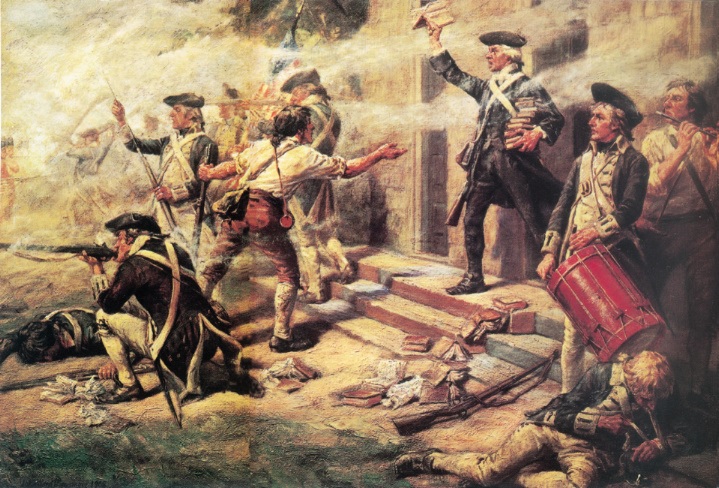
Around the same time, Horace Walpole spoke from the English House of Commons to report on these “extraordinary proceedings” in the colonies of the new world.  “There is no good crying about the matter,” he said.  “Cousin America has run off with the Presbyterian parson, and that is the end of it.”

The parson of which he spoke, was  John Witherspoon—a Presbyterian minister, as well as a descendant of John Knox.  At the time, Witherspoon was president of the College of New Jersey (now Princeton).  He was also the only clergyman to sign the Declaration of Independence.

From the English perspective, the American revolution was often perceived as a “Presbyterian Rebellion.”  And its supporters were often disdained as “those blasted Presbyterians.”

The Presbyterian Revolution
Most American Christians are unaware of the fact that the American Revolution, as well as the new American state, was greatly shaped by Presbyterians and the Calvinism that was at its root.  Some modern-day  Presbyterians have moved light years away from the convictions of these early colonists.

An estimated three million people lived in the colonies at the time of the Revolutionary War.  Of that number, “900,00 were of Scotch or Scotch-Irish origin, 600,000 were Puritan English, while over 400,000 were of Dutch, German Reformed and Huguenot descent. That is to say, two thirds of our Revolutionary forefathers were trained in the school of Calvin.”  (Carlson, p. 19)

As one historian puts it, “When Cornwallis was driven back to ultimate retreat and surrender at Yorktown, all of the colonels of the Colonial Army but one were Presbyterian elders. It is estimated that more than one half of all the soldiers and officers of the American Army during the Revolution were Presbyterian.” (Carlson, p. 16)

To the man, Presbyterian clergy joined the Colonialist cause. It was said that many of them led the Revolution from the pulpit.  In doing so, they paid a heavy price for their support for independence.  Many lost family members or their own lives.  Some had their churches burned to the ground.

The Presbyterian Drive
We forget that many of the early American colonists had left England precisely because Presbyterian Christianity was rejected.  After its brief reign as the established church through the English Civil War and the work of the Westminster Assembly, Britain returned to Anglicanism.  Thousands of non-conforming Presbyterian ministers were then ejected from their churches.  Some, such as the Covenanters, were martyred in a period that came to be known as “the killing times.” Rigid laws of conformity drove many to seek a better life somewhere else.  After 1660, many Presbyterians began to make their way to the colonies in North America.  It was these individuals who brought a new strength to the colonies as they inched their way forward towards independence.

They had little loyalty, and often outright hostility, to the crown of England.  They were armed with the theology of John Calvin, mediated through John Knox, and solidified during the English Civil war. It was a theology which devalued the divine right of human kings, and elevated the worth and dignity of the individual under God.  This theology shaped the early American understanding of civil liberty.

It shaped our founding fathers. The idea of human equality which influenced John Locke, who in turn,  influenced our founding fathers, was learned from the Puritans. Locke’s father had been on Cromwell’s side during the English Civil war.

It also shaped the general population under the influence of the Great Awakening. The Great Awakening was a massive 18th century religious revival that shook the colonies. It was promoted by preachers such as Gilbert Tennent and George Whitfield who travelled up and down the coast calling for a return to a robust Christian and Biblical faith.  Emphasizing the new birth and a Calvinist theology, the Great Awakening had an immense influence on colonial sentiments in the generation just preceding the American Revolution.

Consider then, some of what was at work in the American consciousness preceding the revolution. There was the memory of their horrid experience in England. There was the worry that Anglicans would establish this same kind of church in the colonies. There was a persistent fear of the imposition of bishops who were viewed as “holy monarchs,”  (monarchy in any form was considered bad)!  There was a belief in the absolute sovereignty of God. God alone is Lord of all and the author of liberty. There was a corresponding belief in the absolute equality of individuals (king and peasant, clergy and laity) under God’s law. There was the belief that no human should be entrusted with absolute power, given our radically fallen human nature.  There was a belief that there should be a separation of powers in any new government that is established.  And because of their experience in England, there was the belief that religious freedom and freedom of conscience should be respected.

In other words, for these Presbyterians, liberty is affirmed, but it is not an absolute liberty. It is always to be lived out under the sovereign creator God. It was this theology, a theology rooted, not just in Calvin, but in the Bible, which ultimately gave the colonialist the will to resist.

The Presbyterian Legacy
So this year, as we celebrate our independence once again, and as we think of early American courage, and the genius of our founding fathers, let us not forget those blasted Presbyterians who sought to understand liberty in light of the Bible.  A liberty which conceived of a nation and its entire government under God.

***

NOTE: This piece was originally written by Don Sweeting and posted on his old blog, The Chief End of Man, on July 4, 2014.

Sources:  Our Presbyterian Heritage, Paul Carlson (Elgin:  David C. Cook, 1973)Presbyterians: Their History and Beliefs, Walter L. Lingle and John W. Kuykendall, (Atlanta:  John Knox Press, 1988), The Emergence of Liberty in the Modern World, Douglas F. Kelly, (Phillipsburg, New Jersey:  P&R Publishing, 1992)

The Resolutions of Jonathan Edwards Categorized

The resolutions of Jonathan Edwards is a treasure trove of thoughtful godliness. The earliest of these Resolutions were penned when Edwards was still a teenager – age 19. The list was completed as Edwards was finishing his formal education and beginning his ministerial life. For the rest of Edwards’ remarkable life, part of his regular prayer and devotional practice was to go back and re-read these resolutions at least once a week. In all, there are 70 resolutions. Every one of them takes eternity into consideration and presents a very profound view of a life committed to living purposely for the glory of God as top priority.

Some time ago, I took it upon myself to re-write and post Edwards’ Resolutions in more contemporary English – hopefully with minimal dilution of Edwards’ insight and intent. That post has subsequently been viewed more times than any other on this blog. Some from other countries have even taken my meagre effort and translated that post into other languages.

Recently, I ran across Edwards’ Resolutions categorized, rather than in their original sequence. The categorization and subheading are intended to increase the readability. So, I express my thanks to Matt Perman for undertaking this creative and beneficial approach to Edwards’ classic work.

~ WDG

***

Preface

Being sensible that I am unable to do anything without God’s help, I do humbly entreat him by his grace to enable me to keep these Resolutions, so far as they are agreeable to his will, for Christ’s sake.

Remember to read over these Resolutions once a week.

Continue reading

A Guide for Personal Prayers of Confession

Perhaps the most common expression of a prayer of confession is the following:

Most merciful God, we confess that we have sinned against you in thought, word, and deed, by what we have done, and by what we have left undone. We have not loved you with our whole heart; we have not loved our neighbors as ourselves. We are truly sorry and we humbly repent. For the sake of your Son Jesus Christ have mercy on us and forgive us; that we may delight in your will, and walk in your ways, to the glory of your  Name. Amen.

The key elements in this prayer include:

  • Knowing who God is: “Most merciful God.” 
  • Acknowledging internal and external sins: “We confess that we have sinned against you in thought, word, and deed.”
  • Acknowledging sins of commission (doing what you shouldn’t): “By what we have done.”
  • Acknowledging sins of omission (not doing what you should have): “And by what we have left undone.”
  • Acknowledging sins against God: “We have not loved you with our whole heart.”
  • Acknowledging sins against our neighbor: “We have not loved our neighbors as ourselves.”
  • Expressing true remorse: “We are truly sorry and we humbly repent.”
  • Appealing to Christ’s work: “For the sake of your Son Jesus Christ, have mercy on us and forgive us.”
  • Resolving to change: “That we may delight in your will, and walk in your ways, to the glory of your Name. Amen.”

For those who might want to delve more deeply into the practice of Prayers of Confession, you might find the following books and articles to be of interest and benefit:

Thoughts of God

I appreciate Justin Taylor for causing me to consider two seeming conflicting perspectives from two 20th Century giants of the Christian faith: A.W. Tozer and C.S. Lewis:

A. W. Tozer, from The Knowledge of the Holy:

What comes into our minds when we think about God is the most important thing about us.

The history of mankind will probably show that no people has ever risen above its religion, and man’s spiritual history will positively demonstrate that no religion has ever been greater than its idea of God. Worship is pure or base as the worshiper entertains high or low thoughts of God.

For this reason the gravest question before the Church is always God Himself, and the most portentous fact about any man is not what he at a given time may say or do, but what he in his deep heart conceives God to be like.

We tend by a secret law of the soul to move toward our mental image of God. This is true not only of the individual Christian, but of the company of Christians that composes the Church. Always the most revealing thing about the Church is her idea of God.

C.S. Lewis, from The Weight of Glory:

I read in a periodical the other day that the fundamental thing is how we think of God.

By God Himself, it is not! How God thinks of us is not only more important, but infinitely more important. Indeed, how we think of Him is of no importance except in so far as it is related to how He thinks of us.

It is written that we shall “stand before” Him, shall appear, shall be inspected. The promise of glory is the promise, almost incredible and only possible by the work of Christ, that some of us, that any of us who really chooses, shall actually survive that examination, shall find approval, shall please God. To please God . . . to be a real ingredient in the divine happiness . . . to be loved by God, not merely pitied, but delighted in as an artist delights in his work or a father in a son—it seems impossible, a weight or burden of glory which our thoughts can hardly sustain. But so it is.

Are these thoughts contradictory of one another? If not, how do we reconcile them? And assuming these statements can be reconciled, and shown not to be contradicting, what wisdom can the Christian gain that might shape the way we live?

Some things for me to think about.

Resources for Racial Reconciliation

Since February is designated as Black History Month in the USA, I wanted to take the opportunity to post something that might be helpful in the ongoing discussions about Racial Divides and Racial Reconciliation.

Racial tension and racial division are major issues in our culture – and, sadly, still issues in the American Church. This is not a new problem. Racism was also a problem in the Early Church. But since it is still an issue, Paul’s words to the church in Ephesus are relevant for us today:

“Remember that you were at that time separated from Christ, alienated from the commonwealth of Israel and strangers to the covenants of promise, having no hope and without God in the world. But now in Christ Jesus you who once were far off have been brought near by the blood of Christ. For he himself is our peace, who has made us both one and has broken down in his flesh the dividing wall of hostility.” (Ephesians 2:12-14)

Whether one sees racial division as a “gospel issue” or not, racism and racial division are inarguably Kingdom issues. And these are issues that the Gospel – and only the Gospel – can resolve. Only the Gospel has the power to make us one in Christ, regardless of race or culture. 

Therefore, as tensions linger, and even at times intensify, the Church has the ability – and therefore the responsibility – to show that only Jesus has the power to break down the dividing walls of hostility and bring Shalom – true and lasting peace. In a culture that often, and increasingly, views faith in Jesus to be irrelevant and unhelpful, we have an opportunity to be “Salt & Light” by actively pursuing peace and friendship between all races and cultures in our communities. (Matthew 5.9Matthew 5.13-16)

Racial reconciliation is not the goal of a gospel-centered church and life, but it is clear from Scripture that it is a beautiful fruit of it.“ ~ Jarvis Williams

A Biblical worldview responds to every circumstance with love, empathy, and understanding even of those different from us, instead of letting popular culture and news soundbites define our attitudes and beliefs. When we listen to more voices, sometimes especially some that sound different from our own, God often reveals to us some of the blind spots in our own hearts.

What does this mean for God’s People, living in our present time and culture? As those who are part of God’s “Royal Priesthood” (1 Peter 2.9) we must be committed to mercy and justice. (see Micah 6.8) As those who have been the recipients of God’s mercy and grace, we are to those who now demonstrate and extend the grace and mercy we have received. (1 Peter 2.10; 1 Timothy 1.16) And grace changes everything! The gospel frees us, compels us, and empowers us to seek justice and reconciliation in the midst of brokenness. This is gospel work – work that, as Christians, we must be committed to doing together, even as we learn, lament, repent, and – by faith – move forward. But “to do justice” and “to do mercy” requires both humility and understanding.

With the hope of moving forward toward better understanding, I have compiled a list of Racial Reconciliation resources. This is in no way an exhaustive list, but these resources are among those I have found helpful. Some are from my own denomination, the Presbyterian Church in America, others from the broader Evangelical church. Some of these resources may resonate more than others; and some even express viewpoints that I cannot entirely endorse. Nevertheless, there is benefit from listening to a broad range of voices and seeing from a variety of perspectives.

Listen & Watch

Articles

Books

Voices

NOTE: Over time I will add to these lists. So I hope you will bookmark this page, and make use of it both now and in the future.

Letters of John Newton

In the Book of Proverbs, Solomon advises: “Let the wise hear and increase in learning, and the one who understands obtain guidance…” (Proverbs 1.5)

Among those to whom I turn to seek wisdom is John Newton, the noted slaver-turned-pastor, famed for being the author of the hymn Amazing Grace. Below is a list of letters Newton wrote to various inquirers, covering a wide range of subjects and issue, but all with the aim of helping the reader grow more in conformity to Jesus.

NOTE: The folks at Monergism have made a larger book of Newton’s Letters avaialble in EPUB, .pdf. and .MOBI formats: The Letters of John Newton (ebook)