9 Church Diseases

According to Peter Wagner:

Healthy churches build an immune system to resist disease. It is much more advisable to prevent an illness than to contract one and then have to cure it.

The following are the most common diseases that infect churches.  By recognizing some of the symptoms my hope is that we will turn to the Great Physician, the Gentle Healer, and seek necessary medical attention.

I am using Wagner’s terms here, and have added my own commentary:

Ethnikitis

Ethnikitis is fear or disregard for others of different ethnicities and/or races.  This disease is caused by contextual factors, usually revolving around a static church (in-grown and non-growing) in an ethnically transitioning neighborhood.

Ghost-Town Disease

Another contextual illness, this illness is found in communities where old residents are moving out, and no one is moving in.

People-Blindness

This malady is directly related to a lack of understanding of the significant differences between diverse people groups within the community.  It occurs when churches fail to consider how those differences may impede evangelism efforts.

Hyper-Cooperativism

Wagner says: “When everyone is responsible for evangelism, no one is responsible for evangelism.  Local-church evangelism is much more effective than city-wide cooperative efforts.”

This malady occurs when local congregations loose their distinct identity because the church is too committed to being part of something else.  There is nothing wrong with partnering and cooperative ministries. But if the only ministry a church does is under the umbrella of others, and the church does not bring any distinct character to the joint-effort, it may be a sign that the church is not healthy.

The healthy alternative is not to forgo all partnerships and joint efforts, through isolationism or competition. Instead each church should develop its own distinct personality which it can then contribute to the community and cooperative efforts.

Koinonitis

Koinonia is the Greek word for fellowship.  Koinonitis occurs when interpersonal relationships within the church become so deep and mutually absorbing that we ignore the needs of the community and world around us. When Koinonitis is present church programs tend to become centripetal rather than centrifugal; entirely attractional rather than missional and incarnational.

Sociological Strangulation

Wagner says: “This is a slowdown in the rate of church growth caused when the flow of people into a church begins to exceed the capacity of the facilities to accommodate it.”

In other words, this occurs when the building and sanctuary are too small to accomodate more people.  The general rule here, in suburban communities is 80% capacity = FULL.  In more rural communities, where people are used to having more elbow room, the rule may be as low as 50% = FULL. 

Another aspect that George Barna deals with, more than Wagner,  is when growth occurs at a rate too fast to effectively assimilate new people into an existing church community.  Barna suggests that healthy churches grow at a rate of no more than 10% – 15% anually.  Thus, if Barna is correct, a church with a 6% or 7% growth rate may be healthier than a church that is growing at 20% rate over an extended period of time.

Arrested Spiritual Development

Wagner: “When people in the church are not growing in the things of God or in their relationships with one another, the total health of the church deteriorates, and the church cannot grow.”  To this I will add, if the church did grow, it really has nothing to offer those who come, nor to the community where God placed them.

St. John’s Syndrome

When Christians become Christians in name only; feel that their faith is only routine; when church involvement is largely going through the motions, and belonging to church is nothing more than a family tradition or social nicety, St. John’s Syndrome is likely at work.

Why is this called St John’s Syndrome?  I have no idea. At least I do not recall off the top of my head. But I agree that the symptoms described are unhealthy, no matter what you want to call it.

Hypo-pneumia

Hypo-pneumia is a condition caused by a subnormal level of the presence and power of the Holy Spirit in the life and ministry of the church.  This is a church that depends upon talent of the members and the resources on hand.  It is a church that may pray, but is not depending upon prayer.

It is this type of church Francis Schaeffer had in mind when he asked his wife what she thought would happen if the Holy Spirit departed from the local church.  Their joint conclusion was that in the vast majority of churches nothing would change, and few people would notice.


Missing the Missional Mark

To read something I disagree with on the Internet is not an unusual thing.  When what I disagree with comes from a source that I respect – highly respect – it makes me somewhat uncomfortable.   When the source I respect seems to oppose what I hold, well that is just down-right disappointing.

But that is the experience I have had these past few days while reading 9 Marks January/February 2010 e-Journal.

Continue reading

Happy Birthday, ‘Ho’!

OK. I know. A lot of people don’t like Tony Campolo. A lot of my friends don’t like Tony Campolo. I know he’s  “too liberal”.  I know John MacArthur flatly states that Campolo “misses the central teaching of the Bible“.  I know he was once tried in ecclesaistical court for heresy. 

But still, you must admit, he can tell a great story!  And sometimes he makes a great point.

Watch the video above. Then tell me:

  1. Is there anything overtly theologically wrong in what he says?
  2. How does his example move you?
  3. Is this something you see would meet with Jesus’ approval?  How about the approval of the Aposte Paul, who, in Galatians 5.6, wrote: “…the only thing counts is Faith expressing itself through love.”?
  4. Would you want to be part of a chuch that does things like this?
  5. Ask yourself: How would the community around you respond to a church that does things like this?

 “When the righteous prosper, the city rejoices.”

Gospel in Word and/or Deed


For the past couple of days I’ve been involved in a discussion on Justin Taylor’s blog, Between Two Worlds.  The discussion was prompted when Justin posted a Tweeted quote from J.D. Greear:

“Preach the Gospel; if necessary, use words” is like saying: “Tell me your phone number, if necessary use digits.”

Greear’s clever and pithy defense of the importance of preaching and substantive evangelism is set up as opposite of the quote famously attributed to Francis of Assisi:

“Preach the Gospel, and if necessary use words.”

The original quote, whether by Francis or not, is intended to express the importance of Gospel-driven actions.  However, it is also a quote that has often been associated with those who promote a Social Gospel – an attempt to meet tangible needs, often with little or no concern for regeneration, conversion, or spiritual transformation.

The conversation includes people who both agree and disagree with Greear.  As one who wants to see both Word & Deed – who believes both Word & Deed are necessary to properly reflect the ministry of Christ and the Kingdom of God – I have really appreciated comments from all sides.

I will not restate my comments in this discussion in this post.  If you are interested, you can check them out for yourself.  But I will say, for those who choose to check it out, my comments are slanted toward one side of this discussion in a way that does not completely reflect my more holistic view.  But, when I first commented, one side far out-numbered the other.

To check out or join the discussion, click: A Wordless Gospel.

Theology for Life

As a pastor from a confessional denomination one of the more difficult tasks I regularly – even constantly – encounter is helping people past a distatse for doctrine. 

I understand why so many are so often hesitant to embrace any system of doctrine.  “Doctrine divides” is a commen lament. And, regretably, it is often an accurate one.  I see many who are at odds with others over secondary principles.  Another issue is that sometimes those who are the strongest proponents of sound theology carry rather “ugly” attitudes.  Looking at life, and the church, with a singular perspective (as opposed to tri-perspectival) some assume that mere apprehension and submission to a system of doctrine is the only thing that matters.  As one of my old pastors often said: “Their theology is dead right – but mostly dead.” 

Of course there are other reasons to be considered. 

The historical influence of the Second Great Awakening continues to infect large portions of the American church.  One of the most significant effects is that many Christians, and a number of church traditions, are flarly anti-intellectual.  Their faith is almost entirely “feelings” built aroud a few simple theological propositions.

And maybe the biggest hurdle is that developing a comprehensive understanding of a system of theology is, simply, hard work.  Like learning anything, it is challenging and takes time and study. 

Whatever the reasons for hesitancy, I maintain it is still important.  In this brief video Tim Keller affirms the benefits of sound doctrine. In fact he asserts, I believe correctly, that everyone already lives out their theology…

If this so, it would seem important to think it all through.

How to KEEP Your Church FROM Vitality & Fruitfulness

There are conferences, seminars, articles, books, curricula telling us how to grow a church. It’s high time the other side of the issue be considered. While I don’t guarantee these easy-to-apply steps will always keep your church from health and vitality, they will, with proper application, certainly increase the chances of stagnation.

1. Change Pastors Every Few Years.

This will assure that no pastor gets too much “power.” It will also discourage members from committing to any long-term goals or growth efforts. And those brought into the church by the pastor’s personal ministry will feel insecure because “their” pastor may not stay more than a couple of years.

2. Don’t Allow New People to Serve.

This applies particularly to those who have never been a church member before, or who were recently converted. These people tend to identify strongly with the group from which they came and offer many unwanted suggestions for reaching others from those groups. By insisting that they serve a proper and lengthy “probationary period” before participating in church decision-making, they can be stalled until they lose their enthusiasm and relationships with the un-churched.  Once this happens, THEN they can be used for church work.

3. Split Up Small Groups & Ministry Teams Regularly.

This will greatly frustrate the people who are most active in the church. They won’t have a chance to build and strngthen meaningful relationships; and they will not develop any deep sense of belonging, ownership, or empowerment.

4. Try to Reach Only People in ‘Stable’ Situations.

Since people are often more responsive to the Gospel following geographic, social, vocational, or life-situational changes, concentrate on people in stable circumstances to minimize contacts with the kind of people that often lead to responsiveness and change.

5. Don’t Send Your Pastor to Conferences or Encourage Him to Read Books on Evangelism & Mission.

If he insists on attending such a workshop, make sure no other church leaders go with him. Enthusiasm for outreach and mission can be easily squelched as long as the pastor is the only one who gets enthused.

6. Emphasize “Quality not Quantity.”

This one almost always works!

Make it sound like those who want to see new people join the church are playing the ‘numbers game’.  The myth that numerical growth automatically and spontaneously comes as a result of spiritual growth – without actual outreach and evangelism – is believed by many, so take advantage of it. 

Also, point to unmet needs of your own people as the only real concern of the church, and the primary concerns for the pastor.

7. Don’t Be Friendly to Visitors.

If this seems too extreme, be friendly to them at first – THEN ignore them! Don’t visit them.  Don’t invite them to church activities.  Don’t talk to them during the week. Above all: DON’T become friends with them!

8. Don’t Invite People to Visit or Join Your Church.

 We can justify this by saying: “We don’t want to force church membership on anybody.”   To neighbors and guests it says: “You don’t belong here.”  But that’s all we need. 

One variable to this is to allow the pastor to be the only one to do the inviting and relationship building.

 9. Try to Reach Everyone In Your Community the Same Way.

Ignore racial, social, economic, linguistic, and cultural differences. Assume all people are like you – or they should be. 

A  church out to “reach everybody”, without considering even subtle cultural differences, using the same old strategies used in the past, often reaches nobody. Churches are effective when they recognize these distinctions, and develop relevent strategies to serve the different segments of their community.

If you don’t want to grow, don’t aim at a target.

 10. Make Growth Entirely Dependent on the Holy Spirit.

 This not only encourages prayerlessness and evangelistic laziness on our part, but it gives us a convenient excuse if growth doesn’t occur.  We can always blame God.

 11. Don’t Staff & Don’t Budget for Outreach & Mission.

Our resources are precious and limited. Staff and budget for Christian Education, Youth Ministries, etc. first.  Staff and budget for outreach & mission ONLY after these priorities are perfectly met.

 12. Insist on Using Evangelistic Methods That Were Used During the ‘Good Old Days’.

 Don’t consider methods that God may be using today.  Stick with crusades, simplistic tracts, and answering questions no one is asking.

By all means avoid meeting actual needs.  A church that adresses the needs of the poor – like Jesus & Paul said we should – might be accused of Liberalism and promoting a Social Gospel.

13. Don’t Set Goals.

Say that goals produce frustration. Discourage measurement of any kind. Label statistical analysis as ‘worldly’. If that fails, label it ‘demonic and destructive’.   Though that may be unfair, and UNTRUE, it will certainly discourage goal-setting and statistical analysis as a diagnostic tool.

 14. Say that God Doesn’t Want the Church to Grow.

 Though this statement may be false, you can dig up enough proof-texts to make it seem believable.

 15. Don’t Advertise Your Church.

 Any advertising should be avoided. Especially don’t let newcomers to your community know where your church is, when services are held, and what ministries might be most beneficial to them.

If you must advertise, put the ad on the church page where only those already churched are likley to see it. And put a picture of the pastor or the building on it, not something that would be of interest to anyone outside your church. And never put a picture of people enjoying themselves together in Christ. Never promote something that might connect with the un-Churched.

 16. Don’t Pray for Kingdom Advancement.

 Pray for people in hospitals and on sick lists. Pray for generic “spiritual blessings”.  Pray for missions, but not specific prayers for individual missionaries; Not prayers informed about the challenges missionaries face in their particular locations and work. Pray only for un-named people who you will never meet.  Pray only for people to be healed.  NEVER pray for un-churched neighbors and friends. NEVER pray for God to change you and/or your church to become more godly.

***

This post is satirical and sarcastic.  I have edited and adapted it from a chapter titled: 17 Way to Keep Your Church from Gowing.  from a book by Mike Grogan, then-pastor of the Bethel Friends Church in Poland, OH.  I don’t know if he is still the pastor there. Nor do I recall the title of the book.

The Baker’s Dirty Dozen Stagnant Church Types


At a time when potential epidemics may be on the horizon the wise person is on the lookout for the signs of disease. The hope is that early detection will enable more effective and less severe treatment.

Such a time surrounds the American church. It is widely reported that 85% of all churches are in a state of stagnation, if not serious decline. 

Jeff Gauss, of Rurality Bytes, summarizes the Baker’s-Dirty-Dozen stagnant church types.  At least one of these 13 types, taken from Ed Stetzer’s Comeback Churches, probably characterizes almost any struggling & stagnant church:

  1. Institutionalized Church – More committed to the forms and programs of ministry than to the work of God; activity has choked out productivity and “good enough” has become the enemy of great.
  2. Voluntary Association Church – This church models itself after democratic government rather than New Testament principles. It is a church for the people, rather than for God. “Whenever one group seeks to make a positive change in the church in one direction, the opposing factions begin to whine, complain, and gossip… This type of church will not change until they change their value system.”
  3. “Us Four and No More” Church – This church doesn’t want to get any larger for fear that it will lose its family feel.
  4. “We Can’t Compete” Church – This church has simply given up, deciding that it can’t compete with other churches so they’re not even going to try.
  5. “Decently and in Order” Church – High regard for process, but lack passion. “They run everything by the book; unfortunately, it’s not the Bible.” All matters great and small must meet the approval of various committees.
  6. “Square Peg in a Round Hole” Church – People are enlisted for service, not based on passion and gifts, but because of need. The mindset is “We’ve got to fill this position. Whose turn is it?”
  7. “Time-Warp” Church – This church has managed to preserve the positions, practices, and appearances of days long gone. They expect others to accept and adapt to what they’ve grown comfortable doing over the years, and give no thought to change. “If it’s good enough for me, it should be good enough for them,” is the prevailing attitude.
  8. “My Way or the Highway” Church – This is usually a vocal minority who, no matter the issue, won’t be satisfied unless it’s done their way.
  9. “Chaplaincy” Church – The church views its pastor as a hired hand and expects him to meet all of their needs. They want a chaplain, not a leader.
  10. “Play-it-Safe” Church – Has little faith that God will provide. Instead of enabling ministry and evangelism, it hinders them by safeguarding what it has. “As much money as possible is placed in a certificate of deposit” for safekeeping.
  11. Unintentional Church – Good intentions, but little action. Rarely follow through on what they hope to do.
  12. “Tidy” Church – Members take pride in the church building and make sure that everything is well-kept and meticulously organized. New growth – especially children – is seen as a threat because they are messy. 
  13. The “Company” Church – The church is more focused on the denomination than the community. They fill up the calendar with denominations meetings and things at the expense of ministering to their community. 

I suspect traces of most of these traits can be seen in almost any church, ailing or healthy.  But a good prelimnay self diagnosis may hold the ecclesiastical undertaker at bay.

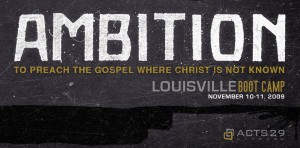
Ambition

I’ve been listening to the audio of sessions from Acts 29 Network’s 2009 Bootcamp: Ambition. While not everyone will find these talks of interest, I think they are challenging and stimulating for those of us in ministry and church leadership.

Ministry for the Long Haul & Ambition (Matt Chandler)

Decoding Your City & Ambition (Kevin Cawley)

Discipleship & Ambition (Bob Thune)

Preaching as Expository Exorcism (Russell Moore)

Leadership & Ambition (Darrin Patrick)

The Church & Ambition (Steve Timmis)

Church Planting & Ambition (Ed Stetzer)

The Gospel & Ambition (Dave Harvey)

My thanks to the folks at Sojourn Community Church, who have made all the above sessions available to be listened to online and/or downloaded. Click: Ambition Conference.

Acts 29 is a missional church planting network of Reformed Evangelicals.  Each year they hold Boot Camps to train and re-energize like minded church planters and church leaders.  Many of these, and other, talks are available on the Resource section of thier web page.

Pretentious Piety


The more things have changed, some things have remained the same.  Such is the case for Christians in a typical church.

When Samuel Blair assumed the pulpit of Faggs Manor Presbyteran Church in 1740 he found a congregation in a spiritual condition not uncommon even in our day. Blair wrote that when he came to the church he found many good religious people who performed their religious obligation rather well. Yet they were, in his estimation, somewhat formal and unenthusiastic:

If they performed these duties pretty punctually in their seasons and, as they thought, with good meaning, out of conscience, and not just to obtain a name for religion among men, then they were ready to conclude that they were truly and sincerely religious. A very lamentable ignorance of the main essentials of true practical religion, and the doctrines nearly relating thereunto very generally prevailed.  The nature and necessity of the new birth was but litle known or thought of, the necessity of a conviction of sin and misery, by the Holy Spirit’s opening and applying the law to the conscience, in order to a saving closure with Christ, was hardly known at all to most.  It was thought, that if there was any need of a heart-distressing sight of the soul’s danger, and fear of divine wrath, it wa only needed for the grosser sort of sinners; and for any others to be deeply exercised this way (as might in some rare instances observable), this was generally looked upon to be a great evil and temptation that had befallen those persons.  The common names for such soul-concern were, melancholy, trouble of mind, or despair.  These terms were common, so far as I have been acquainted, indifferently used as synonymous; and trouble of mind was looked upon as a great evil, which all persons that made any sober profession and practice of religion ought carefully avoid.  …There was scarcely any suspicion at all, in general, of any danger of depending upon self-righteousness, and not upon the righteousness of Christ alone for salvation.  Papists [Roman Catholics) and Quakers would be readily acknowldeged guilty of this crime, but hardly any professed Presbyterian. The necessity of being first in Christ by a vital union, and in a justified state, before our religious services can be well pleasing and acceptable to God, was very little understood or thought of; but the common notion seemed to be, that if people were aiming to be in the way of duty as well as they could, at they imagined, there was no reason to be much afraid.

[Source: The Forming of an American Tradition: A Re-Examination of Colonial Presbyterianism, by Leonard J. Trinterud; Westminster Press, 1959; pp. 77-78]

Manhattan Declaration

From time to time a new and faithful expression of faith is necessary. I am not speaking of a new faith, or of new doctrines, but of the historic Christian faith prophetically applied to current and world events.  Such a statement of faith has recently been produced: The Manhattan Declaration.

The Manhattan Declaration is a collective affirmation of fundamental Truths shared by Evangelicals, Roman Catholics, and Eastern Orthodox Christians living in the United States. In particular, this declaration addresses:

  • Sanctity of Human Life
  • Sanctity of Marriage
  • Rights of Conscience and Religious Liberty

Some may question why believers who hold some vastly different perspectives would join together and unite their voices to address these social issues.  On the other hand, why would they not?  These issues that both result from and contribute to our social decay are intolerable and need to be addressed.  Francis Schaeffer referred to such joint operations as “co-beligerence”.

This afternoon I signed my name to this declaration. While I don’t presume anyone really cares what I sign, or even what I think, it was a way for me to lend my voice to an effort that needs to be heard.  I invite you to check it out – and sign-on, if you share the concerns and agree to these solutions.

Manhattan Declaration(.doc)

A Time for Work, A Time for Worship

Wondering Which

A woman walked into our church building during the service this past Sunday morning. I did not see her, but reportedly she was rather rough looking, even intimidating.  She was seeking financial assistance, and she was clear and determined in her objective. 

The lady from our congregation who got up to greet her would not ordinarily be considered a timid soul.  She is seasoned in ministry and has met all kinds of people.  But she admitted later to feeling ill at ease with this stranger.  Perhaps her discomfort was because of the woman’s gruff exterior and demeanor.  Perhaps it was because she remembered that the writer of Hebrews tells us sometimes we entertain angels disguised as the poor.  (Hebrews 13.2)  But I suspect there may have been other factors at play.

I believe most of us want to be helpful, though we don’t always know how. This may be particularly true when we are dealing with the underprivileged.  And  I wonder if, because of both the renewed emphasis of the importance of mercy ministry and the proliferation of political exploitation of the poor, some of us are not prone to feel a twinge of guilt on occasions when we are not prepared to address a need.

In my opinion the incident at our church this past weekend was handled appropriately.  The woman from our church invited our visitor to join us in worship, and told her  that after the service she was sure one of our deacons would be happy to meet with her to discuss her situation.  The woman declined and walked out of the building. 

Why do I believe it was handled appropriately, when no assistance was given?

1. Those in Need will always be around. 

Jesus told us: “You will always have the poor with you”.  In other words, no matter how effective we are, individually and collectively, we will not entirely alleviate poverty.  We may minimize it but we will not eliminate it.

Some have used this fact as an excuse to do little or nothing to address poverty and minister to the poor.  And that is wrong.

But that is not the case for our church. 

Our deacons regularly meet with people in need, both members of our church and people from outside it. We have budgeted a fair percentage of church income to be distributed for benevolence. Our deacons give toward needs as they are finanically able.  Individual members of our church are known to give to others as they are aware of needs. Our church also partners with and supports other organizations, such as Bristol Faith in Action and Harbor of Light, who minister mercy to people who have had no contact with our church. 

We have put structures in place to guide us in our benevolence. These structures and guidelines are not implemented to minimize what we give. They were designed to help us be more effective in our giving. They enable us to truly be more merciful because we are able to meet real needs.  We are not just trying to make ourselves feel better by giving, but actually trying to provide help to those in need.

While we still have room to grow, charity and grace are characteristics of the congregation and leaders of Walnut Hill Church. 

While we may be inclined to feel bad that we cannot meet all needs, if we are faithful in extending mercy we have no reason to feel ashamed or embarrassed on those occasions we truly are unable or when it would be unwise.

2. This was a Mary moment. 

Solomon tells us: “For everything there is a season, and a time for ever matter under heaven.” (See Ecclesiastes 3.1-8)

Jesus adds another application to Solomon’s insight. 

During a time when he was visiting his dear friends, Martha and Mary, Martha was acting the busy homemaker while Mary was just visiting with the company.  Martha, frustrated by the lack of help her sister was providing, complained to Jesus in an attempt to get him to get Mary to kick in instead of continuing to kick back. 

Jesus said to Martha: “Martha, Martha… You are uptight and worried about so many things. But only one thing is worth concerning yourself like that; only one thing is really necessary.  Mary has chosen wisely. What she has chosen cannot be taken away from her.” (See Luke 10.38-42)

What Jesus tells us, essentially, is that there is a time to work and a time to worship; a time to serve and a time to enjoy God. 

When we are gathered for worship it is not a time to deal with ordinary demands and needs. It is not that those needs are not important. It is just that worship is a priority that ought not be neglected nor interupted, even for important things.

So, in short, while the lady from our congregation may have second guessed herself and felt a little guilty, I don’t think she has any need to feel that way. She acted wisely.  Our church is committed to extending compassion and mercy.  But when it is time to worship… everything else gets put on the back burners.

Navigating the Narrow Path Between the Gospel and Politics

Golden Path

It is a constant tension for me.  How do I juggle my personal political views with my responsibility to remain faithful to the Gospel? How do I strive to keep the Gospel message pure and not pollute my teaching with  political biases interjected?

It is a difficult dilemma. Many political issues have moral roots, and can be informed by theological reflection.  At the same time God is not partisan. No party, nor candidate, can claim God’s endorsement.  All are flawed to some degree – some more obvious tha others. None sufficiently reflect the character and commands of God.

In fact, the Gospel itself creates somewhat of a tension. It simultaneously compels us to be both conservative and liberal.  It leads toward conservatism in the sense that it compels us to recognize that there is absolute truth, there is right and wrong, righteousness and evil.  God calls us to seek truth and to walk in the light of truth.  Yet the heart of the message of the Gospel has a very liberal emphasis: God gives graciously and lavishly to those who do not deserve what they receive.  We are to seek justice and to show mercy, two words often associated more with classical liberalism yet are reflections of the character of God.

Rejecting the notion that there can be a pure Church-State, a theocracy, in this era between ancient Israel and the future Kingdom, I am left with the realization that we are to discern wisdom in order to govern effectively, and to address contemporary problems.  Wisdom is discerned from God’s Word. But specific application of wisdom to lifes various issues is not always spelled out by God’s Word.  That leaves room for good people to disagree about solutions, and sometimes even about the nature of the problems.

I cringe whenever I hear Christians indiscriminately integrate a party platform with the true Faith, as if it is an undeniable marriage, making it impossible to distinguish or separate one from the other; or that to choose an opposing party is akin to spiritual adultery.  In my circles, which tends to lean right, even far right,  I hear stupid things said – including from some pulpits – such as: “I don’t see how anyone can be a Democrat and a Christian”.  I try to stay as far away from such inane rhetoric as I can. But I suspect sometimes I try too hard, and therefore stand too far away.

I want to be clear: Such sentiments are not only wrong, they are EVIL.  To attach partisan politics to the Gospel is a distortion of the Gospel. It keeps people from understanding, and sometimes embracing, the only hope we have, which is God’s grace received through faith in Christ.  It prevents some from thinking outside the box of strict conservatism, and therefore may rob our society of possible solutions for very real problems, that just may be both Biblical AND “liberal”.  All of these are, in my estimation, evil consequences, no matter how well intentioned the rationale behind it.

But lacking wisdom about how to navigate the narrow path beween politics and the Gospel, my tactic has been to forgo engaging in political discussion at all, except in close circles where I am sure not to offend.  I am becomming convinced that this is not really wisdom, it is wimpy-ness on my part.

I have very definite political views. I have strong opinions about many of the issues that are plaguing our society and world; and which divide people.  If I refrain from partaking in the conversation I offer nothing toward the solutions. I want to re-enter the discussion.

Here are a few things I will need to do to keep my balance on this narrow path:

1. I will continue to refrain from bringing my partisan views into the pulpit.  This includes not only avoiding stupid comments like the one I previously mentioned, but personal or partisan allusions that could reasonably alienate or offend people of either political leanings. The pulpit is for the proclamation of the Gospel. If the Gospel is not proclaimed from the pulpit, not only is it an abuse of the purpose of the pulpit, but it is to deny the people the Gospel. If the Gospel is not proclaimed in the pulpit, it will not be proclaimed anywhere else.

2. I need to grow in my ability to clearly communicate the  various aspects of the Gospel, and affirming the tension it creates for those who follow Jesus.  The Gospel is an offense. It is like a stone that makes man stumble, a rock that causes them to trip and fall.  If I am faithful and articulate I should become an equal-opportunity offender, causing discomfort to people on both the Left and the Right.

3. I will commit to pray for the good of those who are in positions of authority, especially the President, whether I agree with them or not; whether I even like them or not.  God has commanded that we do this. My personal preferences cannot mitigate God’s clear command. (See Presidential Prayer Team

4. I will be diligent to dilineate political views in such a way that I give no occasion for anyone to infer that I am making them a basis of  Christian fellowship.  Somehow I must learn how to enter the discussion without attaching Gospel authority to my political perspective.  In other words, I want to learn how to dialogue yet affirm that those who differ may well still be more godly than I am – whether they are wrong and I right or I am wrong and they are right.  Fellowship is rooted in what Christ has done, PERIOD.

None of this is profound, I know.  But I just need to wrestle through it to guide me if and when I address any political issues.  If anyone has other suggestions, I’m all ears.

Characteristics of a Missional Church

As our church begins to explore what it means to be a missional church, it might be helpful to hear the insights of one of the most effective practitioners and proponents of the missional approach to ministry.  In the above video Tim Keller, of Redeemer Church in Manhattan, explains some of the key characteristics of a missional church.

Some might ask: What’s the difference between a Missional Church and an Evangelistic Church? Is this just a new label? 

The answer to the latter question is “No. It’s not just a label.”  It is a different way of thinking about the church. Rooted in the understanding that God is himself on mission (missio dei) a missional church seeks to become engaged in God’s mission in the very place(s) God has sovereignly placed the church and the church members. 

Reggie McNeal, in his book, The Present Future, provides some insights about the differences between a Missional Church and an Evangelistic Church that will help answer the former question. McNeal says a missional church stresses:  

> community transformation over growing the church

> turning members into missionaries over turning members into ministers

> recovering Christian mission over doing church better

In Constant Prayer

 Prayer Posture

Here is a challenging insight from Robert Benson, taken from his book In Constant Prayer:

Our modern church has some distinct advantages over the early church. Or at least I suspect it does.  We have better youth programs and better acoustics and finer buildings. We have better literature that is more easily available to our flocks, most of whom happen to be literate. We have some pretty fair preachers, or at least we have some who are more fun to listen to than the blessed Saint Augustine. (Have you ever actually attempted to read Augustine?)

We have better choirs, I suspect, and we can put on a Sunday morning service with more art and more dignity and more beauty than ever before. We have mailing lists and newsletters and Web sites. We have educational buildings and discipleship classes and Bible study groups where students bring their own Bibles.  We have Sunday School buses and youth lock-ins and Christian rock-and-roll bands.

What we do not have so much of sometimes, it seems to me, is the depth of spirit and of devotion and of piety – now, there is a scary word – that marked the life of the faithful in the hundreds and thousands of years before us, the centuries that produced the Church we built our buildings and programs around in the first place.

It is worth noting, I believe, that this tradition of daily prayer is one of the practices our modern church does not do that the ancient Church did.  We preach sermons, study the Scriptures, gather to worship on the Sabbath, teach our children the faith, and fellowship with one another – but we do not say our prayers.

Core Values of Walnut Hill Church

Walnut Hill Logo

I recently finished a series unveiling the Core Values of Walnut Hill Presbyterian Church.   The Elders of our church worked on these for several months, as we tried to discern the characteristics that define and drive our church.

Leadership expert Aubrey Malphurs calls Core Values “the qualities that make up and establish an organizations character, and that character determines how the organization conducts its ministry or business…” 

In short you might say that the Core Values reflect the DNA of a church or organization.  While other things my change, such as worship style, ministries, etc, the Core Values should remain pretty much intact.  In the fae of a changing surrounding culture, or the addition of new members, the Core Values themselves do not change. Only the ways that the values are expressed should change.

So what are those Core Values that make Walnut Hill unique?

God’s Global Glory 

Authentic Spirituality

Gospel Transformation

Kingdom Advancement

Relational Vitality

Contagious Joy