Hope for Humility

dwarfed-by-mount-robson

I’ve heard Steve Brown offer this amusing anecdote:

“I was given a pin by my club for being the most humble member.  They took it away because I wore it.”

I have much to be humble about.  But, if I was in Steve Brown’s club, no one would have ever given me a pin in the first place.  No one who knows me would consider me a model of humility.  Despite all the reasons I should be, being humble is just not something that comes easily for me. 

I live an irony. I have studied the subject of humility at some depth, especially over the past couple years. Yet I find it all too easy to become proud about what I’ve learned – even as my study reveals what I lack!  Nevertheless, as a work in progress I continue the pursuit that, for me, seems almost an inigma.

Tim Keller tackles the topic of humility in a brief, but insightful, article: Advent of Humility.  In the opening paragraph Keller notes:

When Jesus himself tried to summarize why people should take up the yoke of following him, he said it was because he was meek and humble (Matt. 11:29). Seldom, however, do we explore the full implications of how Jesus’ radical humility shapes the way we live our lives every day.

As Keller explores the importance, the grounds and the necessity of humility, he also observes some of the hindrances.   Interestingly, in the end, Keller points us to the only hope we have of becomming humble, even as he acknowledges that he has no practical solutions for those who, like me, are in desperate need of growing and living in humility.

To read, click: Advent of Humility

Dynamics of the Spiritual Life

Christians who are no longer sure that God loves and accepts them in Jesus, apart from their present spiritual achievements, are subconsciously radically insecure persons – much less secure than non-Christians, because they have too much light to rest easily under the constant bulletins they receive from their Christian environment about the holiness of God and the righteousness they are supposed to have.  Their insecurity shows itself in pride, a fierce defensive assertion of their own righteousness and defensive criticism of others… They cling desperately to legal, pharisaical righteousness, but envy, jealousy and other branches on the tree of sin grow out of their fundamental insecurity…

[I]t is often necessary to convince sinners (even sinful Christians) of the grace and love of God toward them, before we can get them to look at their problems.  Then the vision of grace and the sense of God’s forgiving acceptance may actually cure most of the problems.

This may account for Paul’s frequent fusing of justification and sanctification.  

~ Richard Lovelace, Dynamics of Spiritual Life

Enduring Aroma of the Gospel

painters-cup

People don’t earn God’s approval or receive life and salvation because of anything they’ve done. Rather, the only reason they receive life and salvation is because of God’s kindness through Christ. There is no other way.

Many Christians are tired of hearing this teaching over and over. They think that they learned it all long ago. However, they barely understand how important it really is. If it continues to be taught as truth, the Christian church will remain united and pure — free from decay. This truth alone makes and sustains Christianity. You might hear an immature Christian brag about how well he knows that we receive God’s approval through God’s kindness and not because of anything we do to earn it. But if he goes on to say that this is easy to put into practice, then have no doubt he doesn’t know what he’s talking about, and he probably never will. We can never learn this truth completely or brag that we understand it fully. Learning this truth is an art. We will always remain students of it, and it will always be our teacher.

The people who truly understand that they receive God’s approval by faith and put this into practice don’t brag that they have fully mastered it. Rather, they think of it as a pleasant taste or aroma that they are always pursuing. These people are astonished that they can’t comprehend it as fully as they would like. They hunger and thirst for it. They yearn for it more and more. They never get tired of hearing about this truth.

– Martin Luther

Sharing the Father’s Welcome

Tim Keller’s new book, The Prodigal God: Recovering the Heart of the Christian Faith, will be released in a few weeks, on October 31. In the book Keller presents a powerful expression of the gospel, rooted in the parable of the Prodigal Son.  Having heard Keller teach from this parable, I am looking forward to the written form.

But Keller’s insights were not developed in a vacuum.  They were cultivated by careful and thoughtful study and prayer. They were built upon a foundation of those who had walked before him, like Edwards and Chalmers. And they were influenced by the wisdom of those who invested in him. Among them, Dr. Ed Clowney, former president of Westminster Seminary, whom Keller credits in the Introduction of this upcoming book as having provided the inspiration: 

Many excellent studies have been written on this Biblical text over the last several years, but the foundation for my understanding of it was a sermon I heard preached over thirty years ago by Dr. Edmund P. Clowney. Listening to that sermon changed the way I understood Christianity. I almost felt I had discovered the secret heart of Christianity.  (Click: article.)

Crossway Books has made available Clowney’s sermon, Sharing the Father’s Welcome.  I hope it not only whets you appetite for Keller’s upcoming book, but that it opens your eyes to see how high and wide and long and deep is the love of God for we, his children.

(NOTE: My thanks to Justin Taylor of Between Two Worlds for tipping me off about this.)

Respectable Sins

One of the books on my bedside table is Respectable Sins, by Jerry Bridges.  The subtitle of the book is: Confronting the Sins We Tolerate. The theme becomes self explanatory. 

In his preface Bridges explains the motive behind the book:

“The motivation for this book stems from a growing conviction that those of us whom I call conservative evangelicals may have become so preoccupied with some of the major sins of society around us that we have lost sight of the need to deal with our own more “refined” or subtle sins.”

I think Bridges is correct.  The whole notion of sin seems to have been lost on our society, and confused in our churches. 

Conservatives often lament the absence of any sense of, or concern about, sin reflected in our society.  In this glaring absence in our collective cultural conscience we have seen the arrival of government sanctioned killing through abortion and euthanasia; the crumbling of the family due to divorce, rampant pornography, and the redefining of it to embrace homosexuality as an acceptable norm; and a widespread apathy toward God. Those who speak out about such matters are right to be concerned.  The problem is that while we talk about those things that are infecting others, we are failing to address the very real sin in our own lives.  And we are therefore seen to be hypocrites – and probably rightly so.

Jesus instructed his followers to “first take the plank out of you own eye, then worry about the speck in the eye of another.”  I am not suggesting that those sins that are freely expressed in our society are minor specks.  They are not. They are serious.  And I am convinced that if we heed Jesus’s perscriptive counsel we will again experience the moral authority to speak. 

More serious than even the loss of our moral authority, many Evangelicals are confused about how we relate to God.  We have become disconnected from our own need of the Gospel, and our need of it every day. We fail to see the subtle, yet serious, ways we function as “unbelievers” and tolerate cancerous sin in our own hearts and relationships.  In fact, as the title of Bridges’ book suggests, we have not merely tolerated these things, but have functionally elevated them to a level of respectability.

Recognizing our sin, despite how it may seem, is not an entirely ugly proposition.  It is important to our spiritual vitality.  And makes practical sense. 

Let me explain it this way: We should be at least as concerned about our spiritual vitality as we are about our computers. 

I regularly receive updates from McAfee, and I run a scan on my computer at least a few times a week. Why? Because I have experienced the slow down, the unresponsiveness, and even a crash when I failed to have my computer checked for viruses that can infect it.  Once McAfee has performed a scan, if it has identified any potential threats I am able to deal with it. I either delete it, or in some cases quarantine the file. But either way, my computer functions much better because I have taken the time to perform this taks.

Sin in our lives, even that which seems minor, infects our hearts, our perceptions, our relationships, even our productivity.   We need to “scan” our hearts and lives regularly to see if there is anything there that may cause problems down the road. (This is what the Psalmist is advocating in Psalm 139)  Once we determine if there is anything there we can deal with it accordingly. In taking the appropriate precaustions we prevent problems because we are more able to keep things from spreading over and infecting other areas of our lives.

Despite what you may suspect due to my ranting thus far, this book is actually very positive, practical, and encouraging. 

In chapters 1-4 Bridges does a wonderful job explaining the Gospel, its practical importance, and its important practicality.

Chapter 5 discusses the Power of the Holy Spirit, and expalins how the Spirit is at work in the Gospel.

Chapter 6, titled: Directions for Dealing with Sins, serves as a practical preface to the rest of the book.  This chapter alone would be worth the price of the book, because it shows us how we can practice preaching the Gospel to ourselves. 

Chapters 7-20 deal with specific “acceptable” and “respectable” sins.  I have deeply appreciated Bridges’ talent for defining words of our Christian jargon that have at times confused me, or words that I’ve generally understood yet was still somewhat fuzzy about.  This understanding has been helpful in identifying some of the sin I carry around in my heart, and how it expresses itself in my life and in relationships..

The final chapter, chapter 21, simply asks the question: Where Do We Go from Here?

Each chapter is short and easily readable.  My intention is to read a few chapters a week over the next month or two so that I can digest Bridges’ insight, and deal with my own heart.  I may even journal my insights here on my blog. I haven’t decided yet.

But one thing I have decided to do. My friend, David Zavadil, has been working through this book and posting his observations on his blog, By His Grace.  Whether I develop my own posts or not, I will join the discussion David has started. I invite you to join me over there.

The Gospel in 6 Minutes

What is the Gospel? 

While in many ways this should be a simple question to answer, experience has taught me that many people are confused about what the Gsopel is.  Most agree that the Gospel is something good.  But they are confused about what particularly defines the Gospel. 

Some see the Gospel as merely that message necessary to receive salvation, but have no idea it has a huge impact on how we live our lives even after becomming Christians. Some associate it with a style of music often found in a rural church.  Some view at is as a synonym for “Truth”.  Others simply think of the whole Bible, or at least the New Testament, as being the Gospel. 

While the latter statement is true in a sense, there is a particular message that runs throughout the Bible that is most properly seen as the Gospel; and by which the entirely of Scripture can be said to be Gospel. This message is at times more detectable than  at other times.  It may be said to be like a stream that runs both above and under ground. Even when it is not obvious, if you look closely its presence can be seen.

Getting the Gospel right is essential to a healthy and vibrant spiritual life.  Many problems experienced by Christians in their spiritual and emotional lives, and in evangelsim and mission, can be traced to a misunderstanding or masapplication of the Gospel.  That’s why I want to take every opportunity to clearly declare and define the Gospel.

John Piper succinctly explains this vital message in this brief video.  (It is well worth the few minutes.)

Thoughts About the Resurrection

That the resurrection is an essential aspect of Christianity seems to me to be a ‘no brainer’.  But recently I had a dialogue with an individual who does not share this view.  As I have thought about that dialogue I have come to realize that this person is not entirely wrong, though still, I think, confused.

Let me explain.

The resurrection is necessary to Christianity. Without the resurrection we would have no assurance that the death of Christ satisfied the justice of God.  We would have no way of knowing if Christ’s death paid the price of the debt of our sin or not. We would not know if he was a mere man or not.  Therefore, we would live, at best, with a presumptive hope, but no faith, no actual trust, that we had been reconciled to God. 

Actually, had Jesus not been raised from the tomb we would have serious reason to doubt anything positive had happend at all, since Jesus predicted his own resurrection. (See Matthew 12.40-41 & Luke 11.29-32).   Had he not raisen, he would have been shown to have been wrong.  And as good as he may have been otherwise, had he been wrong about this he would not have been perfect.  In fact, he would have himself been guilty of sin by making claims about himself – and about God – that just were not true. (That’s called blasphemy.)  And if he had sinned, even in this one instance, he could not have been God.   And if Jesus is not God, and was in fact himself a sinner, he could not reconcile us to God.  He would not even have been able to reconcile himself to God!

So, without ther Resurrection there is no Gospel.

The resurrection is so essential to the Christian Faith that the Apostle Paul wrote:

If Christ has not been raised, our preaching is useless and so is your faith.  More than that, we are then found to be false witnesses about God, for we have testified about God that he raised Christ from the dead… If Christ has not been raised, your faith is futile; you are still in your sins.

If only for this life we have hope in Christ, we are to be pitied more than all men.

Clearly the Resurrection is an aspect of the Gospel essential to Christianity.

Why, then, you may ask, did I say that the person who does not consider the Resurrection to be an essential part of Christianity is “not entirely wrong”? 

What that person sees, I suspect, is the beauty of the life and teaching of Christ. Even if the resurrection had not occured, the life Jesus lived, and the life that lives in conformity to his teaching, is beautiful.  That is somethng I have to concede. And in that sense what some might call Christianity, even without the resurrection, has value. 

The Christian Gospel is not only the promise of forgiven sin, but also the promise of the power to grow to become more Christ-like. In other words the Gospel includes the power, subsequent to being forgiven, to live a more and more beautiul life. These truths are like two lanes of the same highway.

Sadly, it seems too many who call themselves Christians are willing to embrace the saving grace of the Gospel, but fail to take seriously – who don’t even really desire to adorn themselves with – the beauty of a life lived in accordance with the model & teaching of Jesus.  And I suspect that glaring absence is what leads some to embrace, what I will call, a Gospel-less Christianity.  

If some are willing to accept that Christianity can be salvation apart from a correspondng holiness, I suppose it is not diificult to understand why others would assume it OK to accept morality without a corresponding redemption to also be Christianity.  Both have simply divided the highway.

But that is as far as I am capable of going with this thought.  Because beautiful or not, Paul is right, Christianity without the resurrection is futile. It is a mere fragment, and not Christianity.  Christianity is the whole revelation of Christ. It is the whole Gospel, or it becomes something entirely different. To pick out bits and pieces is inauthentic, even if well-intentioned. 

Let me illustrate it this way: If my house is disassembled for some reason, and someone attempts to rebuild it using materials from the orignal, yet does not use all the material, and build it according to the same design, it is not my house any longer.  It may have many of the same pieces, but it is not the same thing.

Likewise, a Christianity rooted in the moral principals and example of Christ, but that does not include the redemption accomplished by Christ through his death and resurrection, may look nice, but it is not Christianity. 

The resurrectionis essential.

But while I was thinking about this, something struck me.  What Paul is emphasizing in 1 Corinthians 15 is not only the resurrection of Christ, but the promise of the resurrection to come.  It is the promise of our resurrection!  In fact, it could be, should be, said, that our future resurrection is an essential element to Christianity.  

That’s just awesome!  It is the promise of Heaven!

Hard Grace

“Even though we are now in faith, the heart is always ready to boast itself before God and say: ‘After all, I have preached the law, and lived so well and done so much that surely He will take this into account ‘.  

We even want to haggle with God to make Him regard our life, but it cannot be done. With men you may boast: ‘I have done the best I could… If anything is lacking, I will still try to make recompense.’  But when you come before God, leave all that boasting at home.  Remember to appeal from justice into grace. 

But let anybody try this and he will see and experience how exceedingly hard and bitter a thing it is for a man who, all his life, has been marred and has worked righteousness to pull himself out of it with all his heart, to rise up through faith in the one mediator.

I myself have been preaching and cultivating it through reading and writing for almost twenty years and still feel the old clinging dirt of wanting to deal so with God that I may contribute something so that He will give me His grace in exchange for my holiness. Still I cannot get it into my head that I should surrender myself completely to sheer grace. 

Yet I know that this is what I should and must do.”  

– Excerpted and edited from Martin Luther, Commentary on Galatians

The A-to-Z of the Christian Life

“The gospel shows us that our spiritual problem lies not only in failing to obey God, but also in relying on our obedience to make us fully acceptable to God, ourselves and others.

Every kind of character flaw comes from this natural impulse to be our own savior through our performance and achievement. On the one hand, proud and disdainful personalities come from basing your identity on your performance and thinking you are succeeding. But on the other hand, discouraged and self-loathing personalities also come from basing your identity on your performance and thinking you are failing.

Belief in the gospel is not just the way to enter the kingdom of God; it is the way to address every obstacle and grow in every aspect. The gospel is not just the “ABCs” but the “A-to-Z” of the Christian life.

The gospel is the way that anything is renewed and transformed by Christ — whether a heart, a relationship, a church, or a community. All our problems come from a lack of orientation to the gospel. Put positively, the gospel transforms our hearts, our thinking and our approach to absolutely everything.”

– Timothy Keller

Share this:

Following Jesus in Different Directions?

I’ve been pondering the following assertion from Ron Sider‘s Living Like Jesus:

“Still, the modern church prefers to accept only half of Jesus. They willingly accept him either as model or as mediator – but not both.  Some urge us to follow his example of love and social concern, but they forget about the cross. Others emphasize his death for our sins, but fail to imitate his actions. But Christianity is strong only when we embrace the whole Christ.”

I Want to Walk Free, But I Still Hear the Chains Rattling

As a pastor I frequently encourage people to embrace the Gospel. It is not just to unbelievers that I present that challenge, but to believers as well – even to some who have been Christians for decades. 

We all need to grow in grace, and live by grace day by day. But as easy as it sounds, I sometimes have to stop and realize that it may be far easier to say than it is to live out. Many people – many good people – struggle with how to let go of our propensity toward legalism and embrace the freedom found in Christ.

For that reason I find the following article by Richard Pratt, of Reformed Theological Seminary & Third Millenium Ministries, to be particularly pertinent. And it is as entertaining as it is insightful – at least, I think so.

The story behind it, as I understand, is that Pratt had been encouraged by fellow RTS prof, Steve Brown (Old While Guy), to write a book about the experience of freedom found in the Christian life.  “I Want to Walk Free, But Still hear the Chains Rattling” is Pratt’s response to Brown’s prodding.

Continue reading

Scarlett Letter Today

Inspired by an analysis of Nathaniel Hawthorne’s Scarlett Letter, on NPR’s All Things Considered, my friend Nathan Lewis probes beyond the literary and sociologic interests offered from the program.  Nathan asks two striking questions:

  • “Have we learned from Hawthorne’s scathing presentation of hypocrissy?”
  • “Would Hester [Prynne] be welcome in our community of faith?”

I want to think through both of these questions.

Continue reading

The Mark of the Christian (part 5)

by Francis Schaeffer

When Christians Disagree

What happens, then, when we must differ with other brothers in Christ because of the need also to show forth God’s holiness either in doctrine or in life? In the matter of life, Paul clearly shows us the balance in I and II Corinthians. The same thing applies in doctrine as well.

First, in 1 Corinthians 5:1-5 he scolds the Corinthian church for allowing a man in the midst of fornication to stay in the church without discipline. Because of the holiness of God, because of the need to exhibit this holiness to a watching world, and because such judgment on the basis of God’s revealed law is right in God’s sight, Paul scolds the church for not disciplining the man.

After they have disciplined him, Paul writes again to them in 2 Corinthians 2:6-8 and scolds them because they are not showing love toward him. These two things must stand together.

I am thankful that Paul writes this way in his first letter and his second, for here you see a passage of time. The Corinthians have taken his advice, they have disciplined the Christian, and now Paul writes to them, “You’re disciplining him, but why don’t you show your love toward him?” He could have gone on and quoted Jesus in saying, “Don’t you realize that the surrounding pagans of Corinth have a right to say that Jesus was not sent by the Father because you are not showing love to this man that you properly disciplined?”

A very important question arises at this point: How can we exhibit the oneness Christ commands without sharing in the other man’s mistakes? I would suggest a few ways by which we can practice and show this oneness even across the lines where we must differ.

Regret

First, we should never come to such difference with true Christians without regret and without tears. Sounds simple, doesn’t it? Believe me, evangelicals often have not shown it. We rush in, being very, very pleased, it would seem at times, to find other men’s mistakes. We build ourselves up by tearing other men down. This can never show a real oneness among Christians.

There is only one kind of man who can fight the Lord’s battles in anywhere near the proper way, and that is the man who by nature is unbelligerent. A belligerent man tends to do it because he is belligerent; at least it looks that way. The world must observe that, when we must differ with each other as true Christians, we do it not because we love the smell of blood, the smell of the arena, the smell of the bullfight, but because we must for God’s sake. If there are tears when we must speak, then something beautiful can be observed.

Second, in proportion to the gravity of what is wrong between true Christians, it is important consciously to exhibit a seeable love to the world. Not all differences among Christians are equal. There are some that are very minor. Others are overwhelmingly important.

The more serious the wrongness is, the more important it is to exhibit the holiness of God, to speak out concerning what is wrong. At the same time, the more serious the differences become, the more important it becomes that we look to the Holy Spirit to enable us to show love to the true Christians with whom we must differ. If it is only a minor difference, showing love does not take much conscious consideration. But where the difference becomes really important, it becomes proportionately more important to speak for God’s holiness. And it becomes increasingly important in that place to show the world that we still love each other.

Humanly we function in exactly the opposite direction: In the less important differences we show more love toward true Christians, but as the difference gets into more important areas, we tend to show less love. The reverse must be the case: As the differences among true Christians get greater, we must consciously love and show a love which has some manifestation the world may see.

So let us consider this: Is my difference with my brother in Christ really crucially important? If so, it is doubly important that I spend time upon my knees asking the Holy Spirit, asking Christ, to do his work through me and my group, that I and we might show love even in this larger difference that we have come to with a brother in Christ or with another group of true Christians.

Costly Love

Third, we must show a practical demonstration of love in the midst of the dilemma even when it is costly. The word love should not be just a banner. In other words, we must do whatever must be done, at whatever cost, to show this love. We must not say, “I love you,” and then — bang, bang, bang!

So often people think that Christianity is only something soft, only a kind of gooey love that loves evil equally with good. This is not the biblical position. The holiness of God is to be exhibited simultaneously with love. We must be careful therefore, not to say that what is wrong is right, whether it is in the area of doctrine or of life, in our own group or another. Anywhere what is wrong is wrong, and we have a responsibility in that situation to say that what is wrong is wrong. But the observable love must be there regardless of the cost.

The Bible does not make these things escapable. 1 Corinthians 6:1-7 reads,

If any of you has a dispute with another, dare he take it before the ungodly for judgment instead of before the saints? Do you not know that the saints will judge the world? And if you are to judge the world, are you not competent to judge trivial cases? Do you not know that we will judge angels? How much more the things of this life! Therefore, if you have disputes about such matters, appoint as judges even men of little account in the church! I say this to shame you. Is it possible that there is nobody among you wise enough to judge a dispute between believers? But instead, one brother goes to law against another — and this in front of unbelievers! The very fact that you have lawsuits among you means you have been completely defeated already. Why not rather be wronged? Why not rather be cheated?

What does this mean? The church is not to let pass what is wrong; but the Christian should suffer practical, monetary loss to show the oneness true Christians should have rather than to go to court against other true Christians, for this would destroy such an observable oneness before the watching world. This is costly love, but it is just such practicing love that can be seen.

Paul is talking about something which is observable, something that is very real: The Christian is to show such love in the midst of a necessary difference with his brother that he is willing to suffer loss — not just monetary loss (though most Christians seem to forget all love and oneness when money gets involved) but whatever loss is involved.

Whatever the specifics are, there is to be a practical demonstration of love appropriate to a particular place. The Bible is a strong and down-to-earth book.

A fourth way we can show and exhibit love without sharing in our brother’s mistake is to approach the problem with a desire to solve it, rather than with a desire to win. We all love to win. In fact, there is nobody who loves to win more than the theologian. The history of theology is all too often a long exhibition of a desire to win.

But we should understand that what we are working for in the midst of our difference is a solution — a solution that will give God the glory, that will be true to the Bible, but will exhibit the love of God simultaneously with his holiness. What is our attitude as we sit down to talk to our brother or as group meets with group to discuss differences? A desire to come out on top? To play one-up-manship? If there is any desire for love whatsoever, every time we discuss a difference, we will desire a solution and not just that we can be proven right.

The Difference of Differences

A fifth way in which we can show a practicing, observable love to the world without sharing in our brother’s mistake is to realize, to keep consciously before us and to help each other be aware, that it is easy to compromise and to call what is wrong right, but that it is equally easy to forget to exhibit our oneness in Christ. This attitude must be constantly and consciously developed — talked about and written about in and among our groups and among ourselves as individuals.

In fact, this must be talked about and written about before differences arise between true Christians. We have conferences about everything else. Who has ever heard of a conference to consider how true Christians can exhibit in practice a fidelity to the holiness of God and yet simultaneously exhibit in practice a fidelity to the love of God before a watching world? Whoever heard of sermons or writings which carefully present the practice of two principles which at first seem to work against each other: (1) the principle of the practice of the purity of the visible church in regard to doctrine and life and (2) the principle of the practice of an observable love and oneness among all true Christians?

If there is no careful preaching and writing about these things, are we so foolish as to think that there will be anything beautiful in practice when differences between true Christians must honestly be faced?

Before a watching world an observable love in the midst of difference will show a difference between Christians’ differences and other men’s differences. The world may not understand what the Christians are disagreeing about, but they will very quickly understand the difference of our differences from the world’s differences if they see us having our differences in an open and observable love on a practical level.

That is different. Can you see why Jesus said this was the thing that would arrest the attention of the world? You cannot expect the world to understand doctrinal differences, especially in our day when the existence of true truth and absolutes are considered unthinkable even as concepts.

We cannot expect the world to understand that on the basis of the holiness of God we are having a different kind of difference because we are dealing with God’s absolutes. But when they see differences among true Christians who also show an observable unity, this will open the way for them to consider the truth of Christianity and Christ’s claim that the Father did send the Son.

As a matter of fact, we have a greater possibility of showing what Jesus is speaking about here in the midst of our differences, than we do if we are not differing. Obviously we ought not to go out looking for differences among Christians: There are enough without looking for more. But even so it is in the midst of a difference that we have our golden opportunity. When everything is going well and we are all standing around in a nice little circle, there is not much to be seen by the world. But when we come to the place where there is a real difference and we exhibit uncompromised principles but at the same time observable love, then there is something that the world can see, something they can use to judge that these really are Christians, and that Jesus has indeed been sent by the Father.


Are We Declaring a Defective Gospel?

by Rick Wood, Managing Editor

Mission Froniers Magazine

U.S. Center for World Mission 


Is the Gospel message that hundreds of thousands of missionaries are proclaiming around the world defective?  Have hundreds of millions of people bought into a message that is, at its heart, unbiblical?   If true, this would be like Bill Gates sending out the latest Microsoft operating system which after installed for a year deletes all the files on the computer. To say the least, it would be a disaster, a catastrophe, and an apocalyptic nightmare all in one. But some are claiming that we are in fact proclaiming a defective, unbiblical Gospel.


Could this be one reason that so many are leaving their faith behind and the once vibrant Evangelical awakenings in Britain and America are but distant memories? The implications for world evangelization are immense. If the Gospel we proclaim will self destruct once installed on the hard drives of people’s hearts, then much of our work among un-reached peoples could be in danger of collapse as it has in much of Europe. Vishal Mangalwadi warns of this danger in his home country of India in his article, Pursuit of Knowldege & Truth: Key to a New Reformation.


Hundreds of millions of people have likely read the Four Spiritual Laws, the booklet written by Bill Bright and published by Campus Crusade for Christ. The first law in this little booklet says, “God loves you and has a wonderful plan for your life.” This sounds great and it is just the kind of message that people want to hear. Many are eager to accept such a message and justifiably so. Who would not want this to be true in their lives. They say, “Wow, I would love to have a loving God on my side to make my life wonderful, to make my life complete.”


This message is proclaimed in books, songs and sermons across the world.


But what if this message is not true – at least not true in the way that most people want it and expect it to be true? Don’t get me wrong, I have the greatest respect for Bill Bright and the ministry of Campus Crusade, but this focus of our Gospel presentation can be misunderstood by, and misleading to, a whole generation of people who want to add God to their lives to make their lives complete. In all fairness, the Four Spiritual Laws does go on to identify sin as the problem and to provide the proper solution.


But what kind of expectations are we providing to people when we say, “Come to Christ and God will reveal to you a wonderful plan for an abundant life?” Are we setting people up with false expectations of what God will do for them? Are we promising more than what God has promised to deliver? Are we trying to market the Gospel to a generation of self centered people who really don’t understand their desperately lost state before a holy God and are therefore not really saved? Have millions of ‘believers” simply hired God to make their lives complete?


Ray Comfort in his book, The Way of the Master says,


“[t]he enemy has very subtly diverted our attention away from our core message. Instead of proclaiming the Good News that sinners can be made righteous in Christ and escape the wrath to come, we have settled for a “gospel” that implies that God’s primary purpose in saving us is to unfold a “wonderful plan” for our lives to solve our problems, make us happy in Christ, and rescue us from the hassles of this life.” (p.19)


Is that the central purpose of the Gospel we preach, to give us an abundant, full and rewarding life? Many have sadly bought into this and are disillusioned when everything does not go according to plan.


One dedicated missionary family I know had their daughter brutally murdered. The very first house they ever owned after years of faithful overseas service burned to the ground just days after they moved in along with a lifetime of possessions. They did not even have a chance to unpack their boxes. Then the wife dies of cancer after a long battle.


The husband of another missionary couple I know developed Multiple Sclerosis and spent years bedridden and unable to speak until his death left his wife with four kids to raise by herself. Are these the exceptions to the wonderful, abundant Christian life that we have been promised? There seems to be a disconnect here between what the “wonderful plan” Gospel message promises and the reality of our life experiences in Christ.


This disconnect between the promise and the reality has all sorts of ramifications for our spiritual lives. As Ray Comfort explains,


“Those who come to faith through the door of seeking happiness in Christ will think that their happiness is evidence of God’s love. They may even think that God has forsaken them when trials come and their happiness leaves. But those who look to the Cross as a token of God’s love will never doubt His steadfast devotion to them. (p. 44)


Certainly many of those who have walked away from their faith have done so because the reality of their lives does not match up with the promised wonderful plan that their loving Heavenly Father has for them.


When the Church presents Jesus as the one who came to “solve our problems” and “make us happy” then we attract only those who have problems or are unhappy and those are the kinds of people who will then fill our churches. If they do not repent of their sins then they are false converts and they are not new creatures in Christ. As unsaved people who claim to be Christians, they have simply brought their sins and problems into the church. This overworks the pastors, hobbles the outreach of the Church and its mission, and defames the name of Christ when supposed Christians continue in their sins. The irony is that these will also be the people who will be most likely to leave when Jesus does not solve all their problems or make them happy. They become disillusioned and bitter because they were not presented with the true Gospel in the first place (Comfort, p.36).


The Gospel is a promise of the righteousness of Christ for all who will repent of their sins and trust Christ as their Savior. To have a right relationship with God, people must come to the understanding that they are lost and doomed to suffer the wrath of God unless they repent of their sins and trust Christ for their salvation. This must be at the heart of our Gospel message. The Gospel is not a promise of a happy, problem-free life-just the opposite.


When someone comes to genuine faith in Christ and seeks to live a life of obedience, he becomes an active soldier in the ongoing battle between God and Satan. His faith in Christ essentially puts a target on his back and makes him an object of Satan’s wrath. That person becomes an active threat to Satan and his hold on power. Satan will then take every opportunity to take any genuine believer out of action.


But if people who come to Christ are not told of this spiritual reality then there will be tremendous confusion and disillusionment when the truth of this unknown spiritual reality breaks in upon their lives.


It is like a person who buys a vacation package to the French Riviera expecting a wonderful time of fun and relaxation only to discover upon his arrival that there is open warfare taking place with bombs going off , bullets flying and the wounded littering the sandy beaches. Such a person would naturally think: “What is going on here? This is not what I signed up for.”


Until we realize that we are in a war for our lives, we will be sitting ducks for Satan’s attacks and schemes. We will continue to lose those people who were never adequately prepared for battle. We must proclaim a true Gospel of grace and forgiveness of sin and stop trying to market the Gospel as the solution to all of our problems. It is already the greatest gift anyone can receive.


For a .pdf copy of this article click: a-defective-gospel?


Gospel Advancement & World Perspective

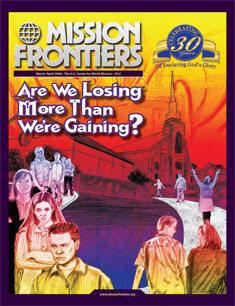
 The March/April 2008 edition of Mission Frontiers magazine addresses a very important issue effecting the contemporary American and European church.   While the Gospel is advancing wildly in several parts of the world, many formerly active church members are walking away from the church – and often Christianity – across North America and in Western Europe.  


It was not long ago that these regions were the strongholds of Evangelical Christianity, and the seemingly inexhaustible source for mission sending and support for generations to come.  But no longer is this the case.  Now these giant of faith are themselves mission fields.


MF Editor Rick Wood suggests the problem is the Gospel.  It is not that the Gospel itself is defective.  Instead Wood observes that what is often presented as the Gospel deficient and misleading.  And practically speaking, what we present as the church is often the only Gospel that most people know and understand. 


What is the result of a compromised Gospel?


1. Ineffectiveness. 


Once people realize that what they thought they bought into is not what they get in reality, inevitably they grow frustrated, distrusting of the church, and finally chuck it all.  That’s what Wood sees happening.


In the long run we are losing ground in the “home-front” at the very time we are seeing the Kingdom advanced on the frontiers. 


2. Impotence. 


The Gospel alone is the power that transforms lives.  The Apostle Paul was adamant about this. He challenged the Galatian believers because they were embracing a Gospel that was “no gospel at all”. 


As Evangelicals, if we proclaim a message that distorts the Gospel, simply for the purpose of getting people to easily join us, we will see our churches full of unchanged members.  Our churches will be composed of those who are spiritually unhealthy, self-absorbed, and consumer oriented, not those who seek first the Kingdom and glory of God, and who are committed to faithful discipleship and service. 


Sadly, I think Wood is dead-on right.  I’ve had a number of conversations with those who have expressed similar sentiments. They feel misled. They are understandably skeptical and disenchanted. And while not all have walked away entirely from their faith, I’ve found many no longer see any value in being part of the visible church. 


Because I believe Wood’s article offers a radically important perspective, I will publish it in a subsequent post.  It is worth reading for anyone who is missions-minded, theologically oriented, or if you or someone you know has grown disenchanted with contemporary Evangelicalism.