Numbering the Sheep on the Ranch

Counting Sheep

Blogger Tim Challies is at the Together for the Gospel Conference, surrounded by other church leaders.  No surprise then that he is hearing this common question all around him: “How many people go to your church?”  And apparently Challies, whose primary vocation is writer not pastor, has some concerns about this question:

I’d like to make the same two-part proposal I made a few years back: Let’s stop asking, “How many people go to your church?” And when someone asks us that question, let’s not feel obliged to give a direct answer.

Challies understands the heart challenge for the pastor in those moments when that question is posed:

For the pastor this can be a moment of pride or humility, freedom or shame…

While not presently prone to the tugs toward embellishment, I am not sure whether it is because of personal growth or just that my external circumstances have changed.  I serve a good-sized congregation, with an excellent staff, in a desirable locale.  But I know those feelings well.  On occasions in the past I’ve felt the temptation to exaggerate, such as to cite Easter attendance as if that were the norm. (I know others who have also considered that one.)  The obvious reason for the temptation is embarrassment about the reality, as if the number in attendance is somehow a precise indicator of the abilities or worth of a pastor or congregation, or of God’s pleasure in either.

Challies writes:

We all pay lip service to the reality that we cannot necessarily measure the health of a church by its size. We all know that some of the biggest churches in the world are also some of the unhealthiest churches in the world. The history of Christianity has long-since shown that it is not all that difficult to fill a building with unbelievers by just tickling their ears with what they want to hear. We also know that the Lord is sovereign and that he determines how big each church should be and we know that in some areas even a very small church is an absolute triumph of light over darkness. And yet “How big is your church?” is one of the first questions we ask.

Why is this?

I don’t know all the reasons but I’d suggest at least two. First, I think our question betrays us and shows that in the back of our minds we equate size and health. Somewhere we make the connection between big and healthy, between big and blessing. We exacerbate the problem when we ask and answer this too-easy question. Second, we just haven’t taken the time and made the effort to form better questions. Instead, we gravitate to the easy one.

So what might be some better questions to ask?  I appreciate Challies’ suggestions:

  • How have you seen the Lord working in the lives of the people in your church?
  • What evidences of the Lord’s grace has your church experienced in the last few months?
  • What are you excited about in your church right now?
  • Who are you excited about in your church right now?
  • What has the Lord been teaching you?
  • Who have you been discipling recently?
  • Tell me about some of the future leaders at your church.

These are much better to get a sense of the story in any congregation.

And inevitably when asked: “How many people go to your church?” Challies suggests answering something like this:

  • As many as the Lord has determined we can care for at this time.
  • Enough that we are actively working toward planting a church.
  • I don’t know, but let me tell you about a few of them…

Interest in numbers is not wrong.  Numbers tell us things.  But just what numbers tell us is not always readily clear.  Numbers are not wrong, it is the fascination with numbers that is problematic.  Numbers just do not tell a story.  Much more valuable is the number of stories of how God is at work in any congregation.

To read Challies’ post, click: How Many People?

Is Church Membership Really Required?

Concepts

by Ricky Jones

This month we will be inducting new members into the most honored body the world has ever known: the church of Jesus Christ. The initiation fee for this club is so high that no human could have ever paid it; God himself had to pick up the tab. The benefits of the club never expire. The fellowship of the club is unmatched; you receive intimate access to the Lord himself (John 17:23).

With such benefits, you’d think church membership would be held in infinitely high esteem. But for many reasons, Christians seem to think less of it than ever before. If you’re one who looks upon church membership lightly, then I invite you to reconsider.

When we hear the word membership, we immediately think of a club. A member pays dues, comes to meetings, and fulfills the obligations of a club member. When you move, or no longer have time for the club, you simply withdraw your membership and move on.

The Bible says membership is much more intimate. “For no one ever hated his own flesh, but nourishes and cherishes it, just as Christ does the church, because we are members of his body” (Eph. 5:29-30).

To be a church member means we are a member of Christ’s body—just like your finger is a member of your body. His blood runs through us. His Spirit animates us. His will moves us. He feels our pain, cleanses us when we get dirty, nurses our wounds, and cherishes us with pride.

Leaving the church is not simply leaving a club. When you walk away, you dismember yourself from the body. Jesus and the rest of the body sorely miss you, and bleed after your departure. You cut yourself off from your only source of life and nourishment. Like an amputated hand, you will slowly bleed out, wither, and die.

Not Possible, Biblical, or Healthy

I hear you complaining already. My, he’s being a bit dramatic. I’m a member of Christ; I just can’t find a local church I like. I’m a member of the universal church, just not of any one in particular.

I want you to understand that being a part of the universal church without submitting to a local church is not possible, biblical, or healthy.

First, it’s simply not possible. To imply you can be part of the greater community without first being 
part of the smaller is not logical. You cannot be part of Rotary International without also being part of a local chapter. You cannot be part of the universal human family without first being part of a small
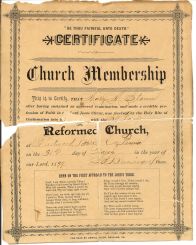
immediate family.Membership Certificate

Second, it’s not biblical. Every letter in the New Testament assumes Christians are members of local churches. The letters themselves are addressed to local churches. They teach us how to get along with other members, how to encourage the weak within the church, how to conduct ourselves at church, and what to do with unrepentant sinners in the church. They command us to submit to our elders, and encourage us to go to our elders to pray. All these things are impossible if you aren’t a member of a local church. (See 1 and 2 Corinthians, James, Ephesians, 1 and 2 Timothy, and 1 Peter for references.)

Asking where the Bible commands you to be a church member is like asking where the USGA rulebook for golf insists you be a human. The whole book is addressed to the church.

Finally, living without church membership is not healthy. Independence—the desire to choose for yourself what’s right and wrong—is at the heart of sin. You need the humility lesson of submitting to flawed elders. You need the encouragement of sharing victories with your church. You need the fellowship of sharing sufferings with your church.

You need to know we’re all in this life together, and we won’t walk away from you just because you let us down or we disagree. Together we build each other up into the image of Christ; no one can make it alone. I encourage you to rethink the importance of church membership. Our fellowship may be an affliction, but we are a glorious affliction. And we will walk into glory together.

***

NOTE: This article originally appeared at the RiverOaks Presbyterian Church blog; and also on The Gospel Coalition.

Ricky Jones is lead pastor of RiverOaks Presbyterian Church in Tulsa, Oklahoma. You can follow him on Twitter

Happier Elsewhere: Singing ‘Happy Trails’ to … Some

On a Soap Box

I appreciate the practical wisdom Ed Stetzer provides in a post titled: Why I Have No Difficulty Helping “Issue Christians” to Move On.  Few seem to think this way in our consumerist church culture, where numbers are the only measuring stick of success, and faithfulness is but a tool to… well, numerical success – so long as it works.  Pastors are under so much pressure to produce measurable “progress” that it is difficult for many to watch any living, breathing, potentially financial supporting body depart.  Not so much for me – anymore.  I’ve learned, through the pain of many mistakes, some folks just cost too much to keep around.

Does that sound heartless?  Sometimes it still feels that way.  But nevertheless, it is true. Not just for my sanity as a pastor, but for the unity and the peace, and the health of the church,,, some people should move on.

The people I mean are not the poor, or the unkempt, or the socially awkward or even outcastes.  It is not my place to shew them from Christ’s church.  Though the world may see no benefit of having such people around, these are exactly the kind of folks Jesus expressly instructs us he wants to be made at home in any church that belongs to him. The ones I have in mind are not the outcastes, but the self righteous: those who have stumbled upon the one “key” to resolve the worlds problems – and the churches – if only enough people would buy into their one key.  What is the key? Who knows.  I’ve seen all sorts of different sure-fire “answers”.  Sadly, for such folks, “Christ and him crucified”, is never the key.  (See 1 Corinthians 2.2)  Their issue, whatever it may be, is their substitute for the gospel – or at the very least a supplement to the gospel.  (See Romans 1.16; Galatians 1.6-8)

My one caveat about encouraging folks to move on is when the gospel is at stake.  Like Stetzer, if it appears evident that person does not understand the gospel, I am hesitant to have them move on before I (or someone) has opportunity to explain it to them.  Whether the person is not a Christian or a professing Christian who seems to have adopted some issue(s) in addition to or instead of Christ as their identity, their passion, their assurance, I want to make sure the gospel has been made clear.  Once the gospel has been clearly presented, then I go on to explain that our church is passionate about the gospel, and living out the implications and demands of the gospel, that we want no other issue to drive our church.  I invite them to stay IF, now that they understand, they want to grow in this understanding and expression of the Christian faith; but tell them if that is not their desire that they’d be “happier elsewhere”.  (That “happier elsewhere” phrase is one I used to mock when I was in college, when learned that sororities – including the one my wife was in – used this as a polite “line” to cut less-than-desired pledges.  And now I have adopted it. Except… I mean it as no mere polite line.)

Stetzer provides sage advice that I encourage young pastors, and all church leaders to consider, and to appropriately apply.  You will find that in the end you gain from it far more than you lose – both in numbers and in peace.

Evangelistic Worship

Hymn Number

by Tim Keller

THE WORSHIP WARS

One of the basic features of church life in the U.S. today is the proliferation of worship and music forms.  This in turn has caused many severe conflicts both within individual congregations and whole denominations. Most books and articles about recent worship trends tend to fall into one of two broad categories.

  • “Contemporary Worship” (hereafter CW) advocates often make rather sweeping statements, such as “pipe organs and choirs will never reach people today.”
  • “Historic Worship” (hereafter HW) advocates often speak similarly about how incorrigibly corrupt popular music and culture is, and how they make contemporary worship completely unacceptable.

Contemporary Worship: Plugging In?

One CW advocate writes vividly that we must ‘plug in’ our worship in to three power sources: “the sound system, the Holy Spirit, and contemporary culture.”  But several problems attend the promotion of strictly contemporary worship.

First, some popular music does have severe limitations for worship. Critics of popular culture argue that much of it is the product of mass-produced commercial interests. As such, it is often marked by sentimentality, a lack of artistry, sameness, and individualism in a way that traditional folk art was not.

Second, when we ignore historic tradition we break our solidarity with Christians of the past. Part of the richness of our identity as Christians is that we are saved into a historic people. An unwillingness to consult tradition is not in keeping with either Christian humility or Christian community. Nor is it a thoughtful response to the post-modern rootlessness which now leads so many to seek connection to ancient ways and peoples.

Finally, any worship that is strictly contemporary will become ‘dated’ very, very quickly. Also, it will necessarily be gauged to a very narrow ‘market niche.’ When Peter Wagner says we should ‘plug in’ to contemporary culture, which contemporary culture does he mean? White, black, Latin, urban, suburban, ‘Boomer,’ or ‘GenX’ contemporary culture? Just ten years ago, Willow Creek’s contemporary services were considered to be ‘cutting edge.’ Today, most younger adults find them dated and ‘hokey.’

Hidden (but not well!) in the arguments of contemporary worship enthusiasts is the assumption that culture is basically neutral. Thus there is no reason why we cannot wholly adapt our worship to any particular cultural form. But worship that is not rooted in any particular historic tradition will often lack the critical distance to critique and avoid the excesses and distorted sinful elements of the particular surrounding, present culture. For example, how can we harness contemporary Western culture’s accessibility and frankness, but not its individualism and psychologizing of moral problems?

Historic Worship: Pulling Out?

HW advocates, on the other hand, are strictly ‘high culture’ promoters, who defend themselves from charges of elitism by arguing that modern pop music is inferior to traditional folk art.  But problems also attend the promotion of strictly traditional, historic worship.

First, HW advocates cannot really dodge the charge of cultural elitism. A realistic look at the Christian music arising from the grassroots folk cultures of Latin America, Africa, and Asia (not commercially produced pop music centers) reveals many of the characteristics of contemporary praise and worship music–simple and accessible tunes, driving beat, repetitive words, and emphasis on experience.   In the U.S., an emphasis on strictly high culture music and art will probably only appeal to college educated elites.

Second, any proponent of ‘historic’ worship will have to answer the question – ‘whose’ history? Much of what is called ‘traditional’ worship is rooted in northern European culture. While strict CW advocates bind worship too heavily to one present culture, strict HW advocates bind it too heavily to a past culture. Do we really believe that the 16th century Northern European approach to emotional expression and music (incarnate in the Reformation tradition) was completely Biblically informed and must be preserved?

Hidden (but not well!) in the arguments of traditional worship advocates is the assumption that certain historic forms are more pure, Biblical, and untainted by human cultural accretions. Those who argue against cultural relativism must also remember the essential relativity of all traditions. Just as it is a lack of humility to disdain tradition, it is also a lack of humility (and a blindness to the ‘noetic’ effects of sin) to elevate any particular tradition or culture’s way of doing worship. A refusal to adapt a tradition to new realities may come under Jesus’ condemnation of making our favorite human culture into an idol, equal to the Scripture in normativity (Mark 7.8-9)  While CW advocates do not seem to recognize the sin in all cultures, the HW advocates do not seem to recognize the amount of (common) grace in all cultures.

Bible, Tradition, and Culture

At this point, the reader will anticipate that I am about to unveil some grand ‘Third Way’ between two extremes. Indeed, many posit a third approach called “Blended” worship.  But it is not so simple as that. My major complaint is that both sides are equally simplistic in the process by which they shape their worship.

CW advocates consult a) the Bible and b) contemporary culture, while HW advocates consult a) the Bible and b) historic tradition. But we forge worship best when we consult a) the Bible, b) the cultural context of our community, and c) the historic tradition of our church. 10 The result of this more complex process will not be simply a single, third “middle way.” There are at least nine worship traditions in Protestantism alone. 11 That is why the book you are reading provides examples of culturally relevant worship that nonetheless deeply appreciates and reflects its historic tradition.

This more complex approach is extremely important to follow. The Bible simply does not give us enough details to shape an entire worship service. When the Bible calls us to sing God’s praises, we are not given the tunes nor the rhythm. We are not told how repetitive the lyrics are to be or not to be, nor how emotionally intense the singing should be. When we are commanded to do corporate prayer, we are not told whether those prayers should be written, unison prayers or extemporary prayers. 12 So to give any concrete form to our worship, we must “fill in the blanks” that the Bible leaves open. When we do so, we will have to draw on a) tradition, b) the needs, capacities and cultural sensibilities of our people, and c) our own personal preferences. Though we cannot avoid drawing on our own preferences, this should never be the driving force. (cf. Romans 15.1-3) Thus, if we fail to do the hard work of consulting both tradition and culture, we will – wittingly or unwittingly – just tailor music to please ourselves.

THE SEEKER-SENSITIVE WORSHIP MOVEMENT

Sally Morgenthaler’s interview with young pastors (Chris Seay, Mark Driscoll, Ron Johnson, Doug Pagitt, Clark Crebar) in Worship Leader (May/June 1998) “Authentic Worship in a Postmodern Culture” and Fernando Ortega’s interview in Prism in Nov/Dec 1997 are indications of some major cracks in the foundation of evangelical assumptions about what kind of services will reach ‘secular’ people.

The crisis (that is here? coming?) in the church growth movement due to the fact that the attack on seeker-sensitive worship is coming from inside, that is, from the pastors of fast growing ‘mega-churches’ (though the name and category is eschewed) filled with under-30’s. These pastors claim that the Willow Creek inspired services supposedly adapted for the unchurched were calibrated for a very narrow and transitory kind of unchurched person: namely, college educated, white, Baby Boomers, suburbanites. The increasingly multi-ethnic, less rational/word-oriented, urban oriented and more secular generations under the age of 35 are not the same kind of ‘unchurched’ people. The critique is that Willow Creek ‘over-adapted’ to the rational, a-historical ‘high modern’ world-view.

The younger pastors say that Willow Creek services do several things that alienate the seekers of their generations:

a) It removed transcendence from its services by utilizing light, happy music and tone, complete accessibility of voice, using dramatic sketches that create a nightclub or TV-show atmosphere. But their generations hunger for awe.

b) It ditched connection to history and tradition and went completely contemporary in all cultural references, from sermon illustrations to decoration to antiseptic ‘suburban mall/office building’ setting.But their generations hunger for rootedness, and love a pastiche of ancient and modern.

c) It emphasized polish and technical excellence and slick professionalism and management technique, while their generations hunger for authenticity and community rather than programs.

d) It emphasizes rationality and practical ‘how-to’ maps, while their generations hunger for narrative and the personal.

A SOLUTION: EVANGELISTIC WORSHIP

Two models, with problems

The most thoughtful members of the Seeker Friendly Service movement agree that the straight “seeker service” is not really worship, and therefore new believers are brought out of the seeker service into a weekly worship service for believers. The critics, on the other hand, generally see the worship service as the place for renewing and edifying believers who then go out into the world to do evangelism. The two models then, seem to be:

  • Seeker service (evangelism)  –> Worship service (edification)
  • Worship service (edification)  –> World (evangelism)

There are pragmatic problems with both models. The SFC model is financially very expensive, it is hard to assimilate new Christians out of seeker services into real worship services. And if the main worship service is very oriented toward seekers, the Christians often feel under-fed.  On the other hand the critics cannot avoid the charge that they are not proposing any alternative to the current evangelistically ineffective church. One critic is very typical when he writes: “”While we [the seeker-friendly church] try to entice the world to come to church to hear the Gospel, the New Testament proclaims a powerful church worshipping God going out into the world in order to reach the lost (cf. The book of Acts.) True revivals have historically proved…that a revived and healthy church reaches a dying and lost world through its own awakened people.”  This view says, “evangelism will take care of itself as long as we have great worship”. But the history of revivals also shows us innovations in outreach.

The Great Awakening was marked by two men who were remarkable innovators – George Whitefield in evangelism and John Wesley in organization. Many criticize seeker services because they are “not worship” and contain many elements of “entertainment”. Often they call us to look, instead at the revivals of the past. But they do not criticize George Whitefield for attracting huge crowds to his own “seeker programs”. He drew people into open air meetings with a kind of preaching that was unparalleled at the time in its popular appeal – his humor, his stories, his dramatically acted-out illustrations, and his astounding oratorical gifts drew tens of thousands.  At the time he was labeled an “entertainer”. His meetings were not worship nor did they replace worship, but they were certainly critical to the revival. They provided Christians with a remarkable place to do friendship evangelism. His meetings were all over the city on virtually every day of the week. Whitefield’s evangelism was enormously aggressive and passionate. His preaching was racy and popular yet pointed toward the transcendent and holy God. Yet his public meetings shared many of the characteristics (and criticisms) of seeker services today.

Whitefield and Wesley did not become instruments of revival by simply being great expository preachers and renewing historic worship.

My main problem with the two models, however, is theological. They both assume that worship cannot be highly evangelistic. I want to show that this is a false premise. Churches would do best to make their “main course” an evangelistic worship service, supplemented by both a) numerous, variegated, creative, even daily (but not weekly) seeker-focused events, and b) intense meetings for Bible study and corporate prayer for revival and renewal.

Theological basis

God commanded Israel to invite the nations to join in declaring his glory. Zion is to be the center of world-winning worship. (Isaiah 2.2-4; 56.6-8) “Let this be written for a future generation, that a people not yet created may praise the Lord…so the name of the Lord will be declared in Zion, and his praise in Jerusalem when the peoples and the kingdoms assemble to worship the Lord”. (Psalm 102.18) Psalm 105 is a direct command to believers engage in evangelistic worship. The Psalmist challenges them to “make known among the nations what he has done” (v.1.) How? “Sing to him, sing praise to him; tell of his wonderful acts” (v.2) Thus believers are continually told to sing and praise God before the unbelieving nations. (See also Psalm 47.1; 100.1-5.) God is to be praised before all the nations, and as he is praised by his people, the nations are summoned and called to join in song.

Peter tells a Gentile church, “But you are a chosen people, a royal priesthood, a holy nation, a people belonging to God, that you may declare the praises of him who called you out of darkness into his marvelous light.” (1 Peter 2.9) This shows us that the church is challenged to the same witness that Israel was called to – evangelistic worship. A key difference: in the Old Testament, the center of world-winning worship was Mt. Zion, but now, wherever we worship Jesus in spirit and in truth (John 4.21-26) we have come to the heavenly Zion. (Hebrews 12.18-24) In other words, the risen Lord now sends his people out singing his praises in mission, calling the nations to join both saints and angels in heavenly doxology. Jesus himself stands in the midst of the redeemed and leads us in the singing of God’s praises (Hebrews 2.12), even as God stands over his redeemed and sings over us in joy. (Zephaniah 3.17)

Biblical cases

1 Corinthians 14.24-25

Paul is addressing the misuse of the gift of tongues. He complains that tongues speaking will cause unbelievers to say they are out of their minds (v.23.) He insists that the worship service must be comprehensible to them. He says that if an unbeliever ” or unlearned one” (an uninitiated inquirer) comes in, and worship is being done “unto edification” , “he will be convinced by all that he is a sinner and will be judged by all” (v.24.) Of what does this conviction consist? “The secrets of his heart will be laid bare” (v.25.) It may mean he realizes that the worshippers around him are finding in God what his heart had been secretly searching for, but in the wrong ways. It may mean the worship shows him how his heart works. The result: “so falling on his face, he will worship God, exclaiming, ‘God is really among you’” (v.25.)

Acts 2

When the Spirit falls on those in the upper room, a crowd gathers (v.5) because a) they are hearing the disciples praising God (“we hear them declaring the wonders of God” v.11), an d b) and also because this worship is “in our own tongues” (v.11.) As a result, they are first made very interested (“amazed and perplexed they asked one another, ‘what does this mean’” v.11), and later they are convicted deeply (“they were cut to the heart and said…’Brethren, what shall we do?’” v.37.)

Comparison

There are obvious differences between the two situations. 1 Corinthians 14 pictures conversion happening on the spot (which is certainly possible.) In Acts 2 the non-believers are shaken out of their indifference (v.12), but the actual conversions (v.37-41) occurred at the end of an “after meeting” in which Peter explained the gospel (v.14-36) and showed them how to individually receive Christ (v.38-39.) It is often pointed out that the tongues in the two situations are different. But students usually are looking so carefully at what the two passages teach about tongues and prophecy that they fail to note what they teach about worship and evangelism. We can learn this:

1. Non-believers are expected to be present in Christian worship. In Acts 2 it happens by word-of-mouth excitement. In 1 Corinthians 14 it is probably the result of personal invitation by Christian friends. But Paul in 14.23 expects both “unbelievers” and “the unlearned” (literally “a seeker”– “one who does not understand”) to be present in worship.

2. Non-believers must find the praise of Christians to be comprehensible. In Acts 2 it happens by miraculous divine intervention. In I Corinthians 14 it happens by human design and effort. But it cannot be missed that Paul directly tells a local congregation to adapt its worship because of the presence of unbelievers. It is a false dichotomy to insist that if we are seeking to please God we must not ask what the un-churched feel or think about our worship.

3. Non-believers can fall under conviction and be converted through comprehensible worship. In 1 Cor 14 it happens during the service, but in Acts 2 it is supplemented by “after meetings” and follow-up evangelism. God wants the world to overhear us worshipping him. God directs his people not to simply worship, but to sing his praises “before the nations.” We are not to simply communicate the gospel to them, but celebrate the gospel before them.

Three practical tasks

2. Getting unbelievers into worship.

The numbering is not a mistake. This task is actually comes second, but nearly everyone thinks it come first! It is natural to believe that they must get non-Christians into worship before they can begin “doxological evangelism”. But the reverse is the case. Non-Christians do not get invited into worship unless the worship is already evangelistic. The only way they will have non-Christians in attendance is through personal invitation by Christians. Just as in the Psalms, the “nations” must be directly asked to come. But the main stimulus to building bridges and invitation is the comprehensibility and quality of the worship experience.

Christians will instantly sense if a worship experience will be attractive to their non-Christian friends. They may find a particular service wonderfully edifying for them, and yet know that their non-believing neighbors would react negatively. Therefore, a vicious cycle persists. Pastors see only Christians present, so they lack incentive to make their worship comprehensible to outsiders. But since they fail to make the adaptations, Christians who are there (though perhaps edified themselves) do not think to bring their skeptical and non-Christian friends to church. They do not think they will be impressed. So no outsiders come. And so the pastors respond only to the Christian audience. And so on and on.  Therefore, the best way to get Christians to bring non-Christians is to worship as if there are dozens and hundreds of skeptical onlookers. And if you worship as if, eventually they will be there in reality.

1. Making worship comprehensible to unbelievers.

Our purpose is not to make the unbeliever “comfortable”. (In 1 Corinthians. 14.24-25 or Acts 2:12 and 37 – they are cut to the heart!) We aim to be intelligible to them. We must address their “heart secrets” (1 Corinthians 14.25) That means we must remember what it is like to not believe; we must remember what an unbelieving heart is like. How do we do that?

a) Worship and preaching in the “vernacular”. It is hard to overstate how ghetto-ized our preaching is. It is normal to make all kinds of statements that appear persuasive to us but are based upon all sorts of premises that the secular person does not hold. It is normal to make all sorts of references using terms and phrases that mean nothing outside or our Christian sub-group. So avoid unnecessary theological or evangelical sub-culture “jargon”, and explain carefully the basic theological concepts, such as confession of sin, praise, thanksgiving, and so on. In the preaching, showing continual willingness to address the questions that the unbelieving heart will ask. Speak respectfully and sympathetically to people who have difficulty with Christianity. As you write the sermon, imagine an particular skeptical non-Christian in the chair listening to you. Add the asides, the qualifiers, the extra explanations necessary. Listen to everything said in the worship service with the ears of someone who has doubts or troubles with belief.

b) Explain the service as you go along. Though there is danger of pastoral verbosity, learn to give 1 or 2 sentence, non-jargony explanations of each new part of the service. “When we confess our sins, we are not groveling in guilt, but dealing with our guilt. If you deny your sins you will never get free from them.”  It is good to begin worship services as the Black church often does, with a “devotional”– a brief talk that explains the meaning of worship. This way you continually instruct newcomers in worship.

c) Directly address and welcome them. Talk regularly to “those of you who aren’t sure you believe this, or who aren’t sure just what you believe.” Give them many asides, even expressing the language of their hearts. Articulate their objections to Christian living and belief better than they can do it themselves. Express sincere sympathy for their difficulties, even when challenging them severely for their selfishness and unbelief. Admonish with tears (literally or figuratively.) Always grant whatever degree of merit their objections have. It is extremely important that the unbeliever feel you understand them. “I’ve tried it before and it did not work.” “I don’t see how my life could be the result of the plan of a loving God.”  “Christianity is a straightjacket.” “It can’t be wrong if it feels so right.” “I could never keep it up.” “I don’t feel worthy; I am too bad.” “I just can’t believe.”

d) Quality aesthetics. The power of art draws people to behold it. Good art and its message enters the soul through the imagination and begins to appeal to the reason, for art makes ideas plausible. The quality of music and speech in worship will have a major impact on its evangelistic power. In many churches, the quality of the music is mediocre or poor, but it does not disturb the faithful. Why? Their faith makes the words of the hymn or the song meaningful despite its artistically poor expression, and further, they usually have a personal relationship with the music-presenter. But any outsider who comes in, who is not convinced of the truth and who does not have any relationship to the presenter, will be bored or irritated by the poor offering. In other words, excellent aesthetics includes outsiders, while mediocre or poor aesthetics exclude. The low level of artistic quality in many churches guarantees that only insiders will continue to come. For the non-Christian, the attraction of good art will have a major part in drawing them in.

e) Celebrate deeds of mercy and justice. We live in a time when public esteem of the church is plummeting. For many outsiders or inquirers, the deeds of the church will be far more important than words in gaining plausibility. The leaders of most towns see “word-only” churches as costs to their community, not a value. Effective churches will be so involved in deeds of mercy and justice that outsiders will say, “we cannot do without churches like this. This church is channeling so much value into our community through its services to people that if it went out of business, we’d have to raise everybody’s taxes.” Mercy deeds give the gospel words plausibility (Acts 4.32 followed by v.33.) Therefore, evangelistic worship services should highlight offerings for deed ministry and should celebrate through reports and testimonies and prayer what is being done. It is best that offerings for mercy ministry be separate, attached (as traditional) to the Lord’s Supper. This brings before the non-Christian the impact of the gospel on people’s hearts (it makes us generous) and the impact of lives poured out for the world.

f) Present the sacraments so as to make the gospel clear. Baptism, and especially adult baptism, should be made a much more significant event if worship is to be evangelistic. There may need to be opportunity for the baptized to offer personal testimony as well as assent to questions. The meaning of baptism should be made clear. A moving, joyous, personal charge to the baptized (and to all baptized Christians present) should be made. In addition, the Lord’s Supper can become a converting ordinance. If it is explained properly, the unbeliever will have a very specific and visible way to see the difference between walking with Christ and living for oneself. The Lord’s Supper will confront every individual with the question: “are you right with God today? now?” There is no more effective way to help a person to do a spiritual inventory. Many seekers in U.S. churches will only realize they are not Christians during the fencing of the table after an effective sermon on the meaning of the gospel. (See below for more on addressing unbelievers during communion.)

g) Preach grace. The one message that both believers and unbelievers need to hear is that salvation and adoption are by grace alone. A worship service that focuses too much and too often on educating Christians in the details of theology will simply bore or confuse the unbelievers present. For example, a sermon on abortion will generally assume the listener believes in the authority of the word and the authority of Jesus, and does not believe in individual moral autonomy. In other words, abortion is “doctrine D”, and it is based on “doctrines A, B, and C.” Therefore, people who don’t believe or understand doctrines ABC will find such a sermon un-convicting and even alienating. This does not mean we should not preach the whole counsel of God, but we must major on the “ABC’s” of the Christian faith.  If the response to this is “then Christians will be bored”, it shows a misunderstanding of the gospel. The gospel of free, gracious justification and adoption is not just the way we enter the kingdom, but also the way we grow into the likeness of Christ. Titus 2.11-13 tells us how it is the original, saving message of “grace alone” that consequently leads us to sanctified living: “For the grace of God that brings salvation has appeared to all men. It teaches us to say ‘no’ to ungodliness and worldly passions, and to live self-controlled, upright and godly lives in the present age, while we wait for the blessed hope – the appearing of our great God and savior Jesus Christ.” Many Christians are “defeated” and stagnant in their growth because they try to be holy for wrong motives. They say “no” to temptation by telling themselves “God will get me” or “people will find out” or “I’ll hate myself in the morning” or “it will hurt my self-esteem” or “it will hurt other people” or “it’s against the law – I’ll be caught” or “it’s against my principles” or “I will look bad”. Some or all of these may be true, but Titus tells us they are inadequate. Only the grace of God, the logic of the gospel will work. Titus says it “teaches” us, it argues with us.

Therefore, the one basic message that both Christians and unbelievers need to hear is the gospel of grace. It can then be applied to both groups, right on the spot and directly. Sermons which are basically moralistic will only be applicable to either Christians OR non-Christians. But Christo-centric preaching, preaching the gospel both grows believers and challenges non-believers. If the Sunday service and sermon aim primarily at evangelism, it will bore the saints. If they aim primarily at education, they’ll bore and confuse unbelievers. If they aim at praising the God who saves by grace they’ll both instruct insiders and challenge outsiders.

3. Leading to commitment

We have seen that unbelievers in worship actually “close with Christ” in two basic ways. Some may come to Christ during the service itself. (1 Corinthians 14.24-25) Others must be “followed up” very specifically.

a) During the service. One major way to invite people to receive Christ during the service is as the Lord’s Supper is distributed. We say: “if you are not in a saving relationship with God through Christ today, do NOT take the bread and the cup, but, as they come around, take Christ. Receive him in your heart as those around you receive the food. Then immediately afterwards, come up here and tell an officer or a pastor about what you’ve done, so we can get you ready to receive the Supper the next time as a child of God.” Another way to invite commitment during the service is to give people a time of silence after the sermon. A “prayer of belief” could be prayed by the pastor (or printed in the bulletin at that juncture in the order of worship) to help people reach out to Christ.  Sometimes it may be good to put a musical interlude or an offering after the sermon but before the final hymn. This affords people time to think and process what they have heard and offer themselves to God in prayer. If, however, the preacher ends his sermon, prays very briefly, and moves immediately into the final hymn, no time is given to people who are under conviction for offering up their hearts.

b) After meetings. Acts 2 seems to show us an “after meeting.” In v.12 and 13 we are told that some folks mocked upon hearing the apostles praise and preach, but others were disturbed and asked “what does this mean?” Then Peter very specifically explained the gospel, and, in response to a second question “what shall we do?” (v.37), explained very specifically how to become Christians. Historically, it has been found very effective to offer such meetings to unbelievers and seekers immediately after evangelistic worship. Convicted seekers have just come from being in the presence of God, and they are often most teachable and open. To seek to “get them into a small group” or even to merely return next Sunday is asking a lot of them. They may be also “amazed and perplexed” (Acts 2.12), and it is best to “strike while the iron is hot”. This is not to doubt that God is infallibly drawing his elect! That knowledge helps us to 16 relax as we do evangelism, knowing that conversions are not dependent on our eloquence. But the Westminster Confession tells us that God ordinarily works through secondary causes, normal social and psychological processes. Therefore, to invite people into a follow-up meeting immediately is usually more conducive to “conserving the fruit of the Word.”

After meetings may consist first of one or more persons who wait at the front of the auditorium to pray with and talk with any seekers who come forward to make inquiries right on the spot. A second after meeting can consist of a simple question-and-answer session with the preacher in some room near the main auditorium or even in the auditorium (after the postlude.) Third, after meetings should also consist of one or two classes or small group experiences targeted to specific questions non-Christians ask about the content, relevance, and credibility of the Christian faith. After meetings should be attended by skilled lay evangelists who can come alongside of newcomers and answer spiritual questions and provide guidance as to their next steps.

***

To download this paper in .pdf form, including footnotes: Click:  Evangelistic Worship-Keller

Ministering to Missing Millennials

Long Road

Why are Millennials walking away from our churches? Why are a number of our own kids walking out the doors?  Why does the church seem impotent to change the direction of this rising tide?

While my wife and I are blessed to have all of our kids active in church, including our two college aged sons, who live six hours away, these are not unimportant questions to me.  I feel the blow every time I hear of the child of a friend, or church member, walking away.  They do not usually walk away angry.  Perhaps it might be better if they did.  All too often they walk away indifferent.  The faith of their fathers makes little difference to their lives – or so they feel.

There is no lack of suggestions. Most of those I hear involve, in one way or another, changing the church to meet the demands of the consumers the church desires to attract, or win back.  It works for McDonald’s, so why not the church?  But while there are things that the church can and should do better, the problem with suggestions toward such radical change is that it mistakes the mission of the church.  The church does not exist to cater to consumers.  The church should certainly not create consumers – though for the better part of the past couple generations that is exactly what we have done.  And now we are paying the price.  “Have it your way…” worked for Burger King. But the same message has left the church impotent to reach the present rising generation.

So how do we reach those who no longer see the value of the church?  That is a complex question.  But one thing we ought to do before deciding any course of action is to listen to some from this generation who have not left the church, and yet who love their peers.

A recent article I read titled Why the Church Isn’t Reaching My Un-churched Friends offers a refreshingly honest and thoughtful perspective.  Written by a twenty-something young lady from Louisville, Kentucky, she offers some candid critiques of both the cultural dilemma and the foolish things some – many – churches are trying in response.  Her criticisms are sharp, but not unnecessarily hurtful.  Her solutions: Authenticity. Christ.

While I do not propose to have the definitive answers, her suggestions are a great place to start.

Gospel-centered Church

Centered

At Grace Covenant we talk a lot about being gospel-centered as a church, and we encourage gospel-centered living among our people. From time to time we get asked by our newcomers, “What exactly does that mean? What does it look like?” Here is a brief explanation.

The Gospel

Before we jump into gospel-centeredness we need to be clear about the gospel itself. In the simplest of terms the gospel is the life, death and resurrection of Jesus that accomplishes redemption and restoration for all who believe and all of creation. In his life Jesus fulfilled the law and accomplished all righteousness on behalf of sinners who have broken God’s law at every point. In his death Jesus atones for our sins, satisfying the wrath of God and obtaining forgiveness for all who believe. In his resurrection Jesus’ victory over sin and death is the guarantee of our victory over the same in and through him. Jesus’ saving work not only redeems sinners, uniting them to God, but also assures the future restoration of all creation. This is the gospel, the “good news,” that God redeems a fallen world by his grace.

Gospel-Centered: The Big Picture

Therefore, to be gospel-centered means that that the gospel – and Jesus himself – is our greatest hope and boast, our deepest longing and joy, and our most passionate song and message. It means that the gospel is what defines us as Christians, unites us as brothers and sisters, changes us as sinner/saints and sends us as God’s people on mission. When we are gospel-centered the gospel is exalted above every other good thing in our lives and triumphs over every bad thing set against it.

The Gospel-Centered Life

More specifically, the gospel-centered life is a life where a Christian experiences a growing personal reliance on the gospel that protects him from depending on his own religious performance and being seduced and overwhelmed by idols. The gospel centered life produces:

Confidence  (Heb. 3:14; 4:16) When the gospel is central in our lives, we have confidence before God – not because of our achievements, but because of Christ’s atonement. We can approach God knowing that he receives us as his children. We do not allow our sins to anchor us to guilt and despair, but their very presence in our lives compels us to flee again and again to Christ for grace that restores our spirits and gives us strength.

Intimacy  (Heb. 7:25; 10:22; James 4:8) When the gospel is central in our lives, we have and maintain intimacy with God, not because of our religious performance, but because of Jesus’ priestly ministry. We know that Jesus is our mediator with God the Father and that he has made perfect peace for us through his sacrifice allowing us to draw near to God with the eager expectation of receiving grace, not judgment.

Transformation   (2 Cor. 3:18; 1 Thess. 5:23; 2 Thess. 2:13) When the gospel is central in our lives, we experience spiritual transformation, not just moral improvement, and this change does not come about by our willpower, but by the power of the resurrection. Our hope for becoming what God designed and desires for us is not trying harder, but trusting more – relying on his truth and Spirit to sanctify us.

Community   (Heb. 3:12, 13; 10:25; 2 Tim 3:16, 17) When the gospel is central in our lives, we long for and discover unity with other believers in the local church, not because of any cultural commonality, but because of our common faith and Savior. It is within this covenant community, if the community itself is gospel-centered, that we experience the kind of fellowship that comforts the afflicted, corrects the wayward, strengthens the weak, and encourages the disheartened (- which is all of us at one time or another, and to varying degrees).

The Gospel-Centered Church

A gospel-centered church is a church that is about Jesus above everything else. That sounds a little obvious, but when we talk about striving to be and maintain gospel-centrality as a church we are recognizing our tendency to focus on many other things (often good and important things) instead of Jesus. There are really only two options for local churches: they will be gospel-centered, or they will be issue(s) driven.

Issue-driven churches can be conservative or liberal, and come from any denominational tribe. A church can get the gospel “right” on paper and still not be gospel-centered in practice.

Some churches are driven by doctrinal purity. In the pursuit of the truth it is not uncommon for a church to be more about their theological heritage than the founder and perfecter of our faith. Some churches are driven by numbers. The desire to see as many people as possible trust in Christ can lead to a pragmatism that gives the nod to anything that results in more people in the front door. Some churches are driven by a desire to be culturally relevant, while other churches are focused on how culturally distinct they can remain. In both cases something other than the cross is capturing the attention of the congregation. Some churches are driven by social or spiritual works that, while good, begin to eclipse the point of all good works.

Gospel-centered churches do not forsake these things, but they are not driven by them. They are driven by a love for Jesus and his work on our behalf. Therefore gospel-centered churches are so focused on Jesus and the hope of redemption that they are passionate and articulate about their theology. Their desire to know and make known Jesus demands doctrinal precision and leads them to want and work toward as many people as possible repenting of sin and trusting in Christ. When the gospel is central in a church it leads them out into the world on mission, while preserving their counter-cultural character as the people of God. The gospel-centered church is driven by love (for God and others) and this leads to joyful obedience that points back to God.

In saying this we don’t want to suggest that here at Grace Covenant we do not struggle with being issue driven. That temptation is always present, and it is why we work hard to maintain gospel-centrality by keeping the gospel always before us in our work and worship.

Helpful reading on maintaining gospel-centrality: 

Feather Pen

Adapted from the work of Joe Thorn, Redeemer Fellowship, St. Charles, Ill, and used with his permission

Getting Through Challenges to Missional Community

Outward & Onward

As we have been encouraging the small groups in our church to add a more intentional outward face, I thought I would post this piece by Jonathan Dodson that provides a solid three-legged-base counsel concerning missional communities – which is what small groups embracing an outward face are in transition toward becomming.

***

The popularity of missional community is rising among evangelicals, and yet, the American church is nowhere near a missional tipping point. I’ve faced missional highs and missional lows. Along the way, I’ve considered a number of things that are absolutely necessary for us to endure the transition to missional church. How should we respond to the challenges of missional community? Here are three things to keep in mind as you lead in God’s mission (and thanks for doing so).

1. Building Missional Community Requires Stretched Grace.

We need more than a drop of grace to get us going on God’s mission. We need an ocean of grace to swim in to continue on God’s mission together. Do you remember when you knew nothing about “missional church”? That’s where many people are. Do you recall how long it took you to process, assimilate, and live out the principles of missional community? This probably took a couple of years, and if you’re a leader, you are in it “full time”. When leading others in missional community, remember the slowness in your own story and extend others the same grace and patience King Jesus extended you. After all, the kingdom of God is slow, and thank God for that! We need more than a drop of grace to get us going on God’s mission. We need grace stretched across the length of our lives and depth of our missional failures and successes. Jesus secured this grace, so revel in it and splash it on others.

Leader Tip: Try to avoid making mission a new benchmark of religious performance. Instead, motivate people with grace. Grace preached and grace embodied. Embody the grace of Christ, who has put up with our missional fumblings for centuries, as you lead others on mission. When it comes to mission, it’s not perfection overnight but progress over a lifetime.

2. Community is What You Make of It.

In order to make progress with your community, remind them that community is what you make it. Community isn’t an idea; its real people, awkward, struggling, weird, different, funny, slow, arrogant, sheepish, humble, curious, skeptical, excitable. You get the idea. Jesus didn’t die to make cliques; he died and rose to form diverse communities. Diverse and different is hard. It requires love, effort, and patience. Community doesn’t just magically appear in a church. In fact, churches don’t have community at all; they are community. The question is, “What will you make of the community?” I’m falling in love with real community, which is really messy, with people who are so different from me and yet so alike in Jesus. There’s nothing like pursuing difficult people, being loved by different people, serving alongside a diverse people. What a display of grace (nothing else could hold us together). 

Leader Tip: In a highly consumeristic, individual-centered society, it will take at least a generation to get back to the biblical notion of community. And even then, we will need more than community to sustain community. Let’s all agree to shatter our ideal of community and enter the real community of people God has placed in our lives. Let’s lift Christ higher than the community. Jesus is head not the body. He’s lord of the church. He’s the hope of the community, not the community itself. Community needs a center deeper than connection and a purpose greater than comfort. It needs the Lord of Community, Jesus Christ, to knit unlikely people together as a display of our common need for grace. Insist on this.

3. Labor for the Lord of Mission not the Fruit of Mission.

With all the missional hype, our faith can easily slip from trusting in the Lord of the Harvest to trusting in the fruit of our labors. I’ve had several deep relationships with non-Christians dissolve over the past year and a half. This came after spending a lot of time with them over meals, out for philosophy discussions, in our home for counseling, and with our family doing fun stuff. They were loved and heard the gospel in ways that were profoundly relevant to their own fears, struggles, and hopes…and they walked away. They walked away from Jesus and created distance from us. That’s hard. If I’m putting faith in the fruit of my missional labors (at least at what I can see), then I’m discouraged. But if I’m putting faith in the Lord of the Harvest, I can be confident that he has been lifted up and that he is in charge of all salvation. He has endured much more to witness friends walk away from his costly sacrifice. He’s not only a model of missional endurance; he’s the hope for missional endurance.

Leader Tip: Put your faith in the Lord of Mission not the fruit of mission. It can be easy to congratuate ourselves when mission is high and berate ourselves when mission is low. That’s a sign that we’ve misplaced our faith. We put it in ourselves or our “fruitfulness.” Come back to the gospel every single day and ask the Spirit to put Jesus highest among your affections and greatest among your hopes. Keep repenting and putting your faith in Jesus and he will take care of the mission.

Western Theology

Flying W Ranch Wagon

There are two visions of life, two kinds of people. The first see life as a possession to be carefully guarded. They are called settlers. The second see life as a wild, fantastic, explosive gift. They are called pioneers. These two types give rise to two kinds of theology: Settler Theology and Pioneer Theology.

According Wes Seeliger in his book Western Theology, the first kind, Settler Theology, is an attempt to answer all the questions, define and housebreak some sort of Supreme Being, establish the status quo on golden tablets in cinemascope. Pioneer Theology is an attempt to talk about what it means to receive the strange gift of life. The Wild West is the setting for both theologies.

In Settler Theology, the church is the courthouse. It is the center of town life. The old stone structure dominates the town square. Its windows are small and this makes things dark inside. Within the courthouse walls, records are kept, taxes collected, trials held for the bad guys. The courthouse is the settler’s symbol of law, order, stability, and — most important — security. The mayor’s office is on the top floor. His eagle eye ferrets out the smallest details of town life.

In Pioneer Theology, the church is the covered wagon. It is a house on wheels, always on the move. The covered wagon is where the pioneers eat, sleep, fight, love, and die. It bears the marks of life and movement — it creaks, is scarred with arrows, bandaged with bailing wire. The covered wagon is always where the action is. It moves toward the future and doesn’t bother to glorify its own ruts. The old wagon isn’t comfortable, but the pioneers don’t mind. They are more into adventure than comfort.

In Settler Theology, God is the mayor. He is a sight to behold. Dressed like a dude from back East, he lounges in an over-stuffed chair in his courthouse office. He keeps the blinds drawn. No one sees him or knows him directly, but since there is order in the town, who can deny that he is there? The mayor is predictable and always on schedule. The settlers fear the mayor, but look to him to clear the payroll and keep things going. Peace and quiet are the mayor’s main concerns. That’s why he sends the sheriff to check on pioneers who ride into town.

In Pioneer Theology, God is the trail boss. He is rough and rugged, full of life. He chews tobacco, drinks straight whiskey. The trail boss lives, eats, sleeps, fights with his people. Their well-being is his concern. Without him the wagon wouldn’t move; living as a free man would be impossible. The trail boss often gets down in the mud with the pioneers to help push the wagon, which often gets stuck. He prods the pioneers when they get soft and want to turn back. His fist is an expression of his concern.

In Settler Theology, Jesus is the sheriff. He’s the guy who is sent by the mayor to enforce the rules. He wears a white hat, drinks milk, and outdraws the bad guys. The sheriff decides who is thrown into jail. There is a saying in town that goes: Those who believe that the mayor sent the sheriff, and follow the rules, they won’t stay in Boot Hill when it comes their time.

In Pioneer Theology, Jesus is the scout. He rides out ahead to find out which way the pioneers should go. He lives all the dangers of the trail. The scout suffers every hardship, is attacked by the Indians. Through his words and actions he reveals the true intentions of the trail boss. By looking at the scout, those on the trail learn what it means to be a pioneer.

In Settler Theology, the Holy Spirit is the saloon girl. Her job is to comfort the settlers. They come to her when they feel lonely, or when life gets dull or dangerous. She tickles them under the chin and makes everything okay again. The saloon girl squeals to the sheriff when someone starts disturbing the peace.

In Pioneer Theology, the Holy Spirit is the buffalo hunter. He rides along with the covered wagon and furnishes fresh meat for the pioneers. Without it they would die. The buffalo hunter is a strange character—sort of a wild man. The pioneers never can tell what he will do next. He scares the hell out of the settlers. He has a big, black gun that goes off like a cannon. He rides into town on Sunday to shake up the settlers. You see, every Sunday morning, the settlers have a little ice cream party in the courthouse. With his gun in hand the buffalo hunter sneaks up to one of the courthouse windows. He fires a tremendous blast that rattles the whole courthouse. Men jump out of their skin, women scream, dogs bark. Chuckling to himself, the buffalo hunter rides back to the wagon train shooting up the town as he goes.

In Settler Theology, the Christian is the settler. He fears the open, unknown frontier. His concern is to stay on good terms with the mayor and keep out of the sheriff’s way. “Safety first” is his motto. To him the courthouse is a symbol of security, peace, order, and happiness. He keeps his money in the bank. The banker is his best friend. The settler never misses an ice cream party.

In Pioneer Theology, the Christian is the pioneer. He is a man of daring, hungry for new life. He rides hard, knows how to use a gun when necessary. The pioneer feels sorry for the settlers and tries to tell them of the joy and fulfillment of life on the trail. He dies with his boots on.

In Settler Theology, the clergyman is the banker. Within his vault are locked the values of the town. He is a highly respected man. He has a gun, but keeps it hidden in his desk. He feels that he and the sheriff have a lot in common. After all, they both protect the bank.

In Pioneer Theology, the clergyman is the cook. He doesn’t furnish the meat. He just dishes up what the buffalo hunter provides. This is how he supports the movement of the wagon. He never confuses his job with that of the trail boss, scout, or buffalo hunter. He sees himself as just another pioneer who has learned to cook. The cook’s job is to help the pioneers pioneer.

In Settler Theology, faith is trusting in the safety of the town: obeying the laws, keeping your nose clean, believing the mayor is in the courthouse.

In Pioneer Theology, faith is the spirit of adventure. The readiness to move out. To risk everything on the trail. Faith is obedience to the restless voice of the trail boss.

In Settler Theology, sin is breaking one of the town’s ordinances.

In Pioneer Theology, sin is wanting to turn back.

In Settler Theology, salvation is living close to home and hanging around the courthouse.

In Pioneer Theology, salvation is being more afraid of sterile town life than of death on the trail. Salvation is joy at the thought of another day to push on into the unknown. It is trusting the trail boss and following his scout while living on the meat provided by the buffalo hunter.

The settlers and the pioneers portray in cowboy-movie language the people of the law and the people of the Spirit. In the time of the historical Jesus, the guardians of the ecclesiastical setup, the scribes and Pharisees and Sadducees, had ensconced themselves in the courthouse and enslaved themselves to the kw. This not only enhanced their prestige in society, it also gave them a sense of security. Man fears the responsibility of being free. It is often easier to let others make the decisions or to rely upon the letter of the law. Some men want to be slaves. After enslaving themselves to the letter of the law, such men always go on to deny freedom to others. They will not rest until they have imposed the same oppressive burdens upon others. Jesus described them this way: “They tie up heavy loads and put them on men’s shoulders, but they themselves are not willing to lift a finger to move them” (Matthew 23.4).

Jesus wanted to liberate His people from the law — from all laws. Under His Word we become free, people of the Spirit; and the fellowship of free people grows up, as in the New Testament, beyond all kinds of theological disagreement. Paul writes in Galatians 5.1, “It is for freedom that Christ has set us free. Stand firm, then, and do not let yourselves be burdened again by a yoke of slavery.” If we are not experiencing what Paul calls in Romans 8.21 “the glorious freedom of the children of God,” then we must acknowledge that His Word has not taken sovereign possession of us, that we are not fully under the sway of His Spirit.

***

This post was taken from Western Theology by Wes Seeliger, as summarized by Brennan Manning in his essay Freedom Under the Word.

Western Theology

Qualities of Christian Community

Quality Community

Dietrich Bonhoeffer, in his classic book, Life Together, makes this observation that should be pondered by many in the church, especially those discontented with the relational dynamic in their particular congregation:

“The people most in love with community are in danger of destroying community.”

In other words, there are people who have made such an ideal of “Christian Community” that they are easily dissatisfied with the real thing.

No doubt there is much room for relational improvement in many churches – perhaps even most of them.  But Bonhoeffer’s point is still valid.  Sometimes it may be a “You” problem, or a “Me” problem, more than it is a “Them” problem.

Yet, as Brad Watson points out in an excellent short article for Gospel-Centered Discipleship, titled Our Hunger For Community:

“Broken families, broken relationships, and an epidemic of loneliness has created a ravenous hunger for community in this generation.”

This is true.  And our churches and Christian communities must be aware of this hunger, and need to be prepared to provide such a haven for all who are seeking it.  But Watson also points out a problem common to both those hungering for community and those who are anxious to provide it:

 “But our flesh can seek our idea of community more than we seek Jesus. Our souls, it seems, are ready to settle for a sit-com style of friendship instead of striving for the spirit-led family of God purchased and created by his son’s death and resurrection.”

I think this is a very real issue. And I suspect this mindst feeds the discontent that Bonhoeffer warned about.  When we put so too much weight on friendships, when our expectations of others is as heavy as what we should only expect of God, stress fractures are almost certain to eventually occur – and with them, emotional pain, and senses of disappointment and alienation, which often leads to difficulty of trusting others, with the ultimate consequence of inability to cultivate and sustain healthy relationships.

Bonhoeffer warns:

Those who want more than what Christ has established between us do not want Christian community. They are looking for some extraordinary experiences of community that were denied them elsewhere…Those who love their dream of a Christian community more than the Christian community itself become destroyers of that Christian community even though their personal intentions may be ever so honest, earnest, and sacrificial…Christian community is not an ideal we have to realize, but rather a reality created by God in Christ in which we may participate.

In response to this common concern about Christian community, Watson has noted 6 Misunderstanding of Community and suggests 7 Components of Gospel-centered Community.

6 Misunderstadnings of Commuinity

  1. Community is NOT “Everyone is My Best Friend”
  2. Community is NOY a Spiritual/Morality Club
  3. Community is NOT a Book Club
  4. Community is NOT a Meeting or Event
  5. Community is NOT Easy
  6. Community is NOT “Everyone Gets Along”

7 Components of Gospel-centered Community

  1. Generous Hospitality
  2. Influence Earned thru Serving
  3. Accountable & Repentant
  4. Led by Qualified Leaders
  5. On Mission
  6. Active in Culture
  7. Diverse

Whether you are one who is hungering for community that seems lacking, or one who is committed to cultivating community within your group or church, I hope you will give some thought to these premises; and benefit from Watson’s article:  Our Hunger for Community

He-Man Woman Haters Club

There was a time when I wondered if at least some in my denomination ought to start wearing t-shirs with a picture bearing the image of Alfafa from the old Our Gang/Little Rascals’ shorts from the ’30’s & ’40’s.  Alfalfa was a founder and president of the He-Man Woman Haters Club. Now, I know that this was an unfair characterization of most – the clear majority – of my fellow churchmen.  But when discussing the role of women in the church, in the home, and in the world at large, sometimes statements were offered up that made me pause – and cringe.

I believe in the inherent equality of men and women.   But I am no feminist.  In fact, I would not even qualify as an Egalitarian.  Instead, I am more aligned among the Complimentarians.  But much to my chagrin, sometimes those of us in the Complimentarian camp are mistaken for being among the initiates of the He-Man Woman Haters Club.

Some time ago Rachel Miller, on her blog A Daughter of the Reformation,  wrote a very insightful piece, titled What’s Wrong With Biblical Patriarchy?.  In her post she distinguishes us Complimentarians from the more chauvinistic Modern Patriarchy movement, with whom we Complimentarians are often lumped.  (Rachel notes that proponents of this patriarchal position like to refer to themselves as “Biblical Patriarchy”, but I don’t want to equate them as being biblical.  As the article astutely observes and notes, those folks base their positions on some biblical principles but then mix them up with some very Victorian notions.)

While I know throwing around such terms as Complimentarian, Egalitarian, etc., is not likely to excite many readers, nevertheless, I think what Rachel Miller has to say is worth considering as you think biblically about this polarizing issue; and maybe just a little less important, to distinguish guys like me from the ecclesiastical Alfalfas.

***

Reblogged from A Daughter of the Reformation:

As a homeschooling family, we come in contact with people from a wide variety of backgrounds and beliefs. One of the groups that is fairly common within the homeschooling community is the modern patriarchy movement, or as they refer to it “Biblical Patriarchy.” Some of the big names in this group include, R.C. Sproul, Jr., Doug Phillips of Vision Forum, and Doug Wilson of Credenda Agenda magazine.

Read more… 2,203 more words

Here AND There

Church Scattered

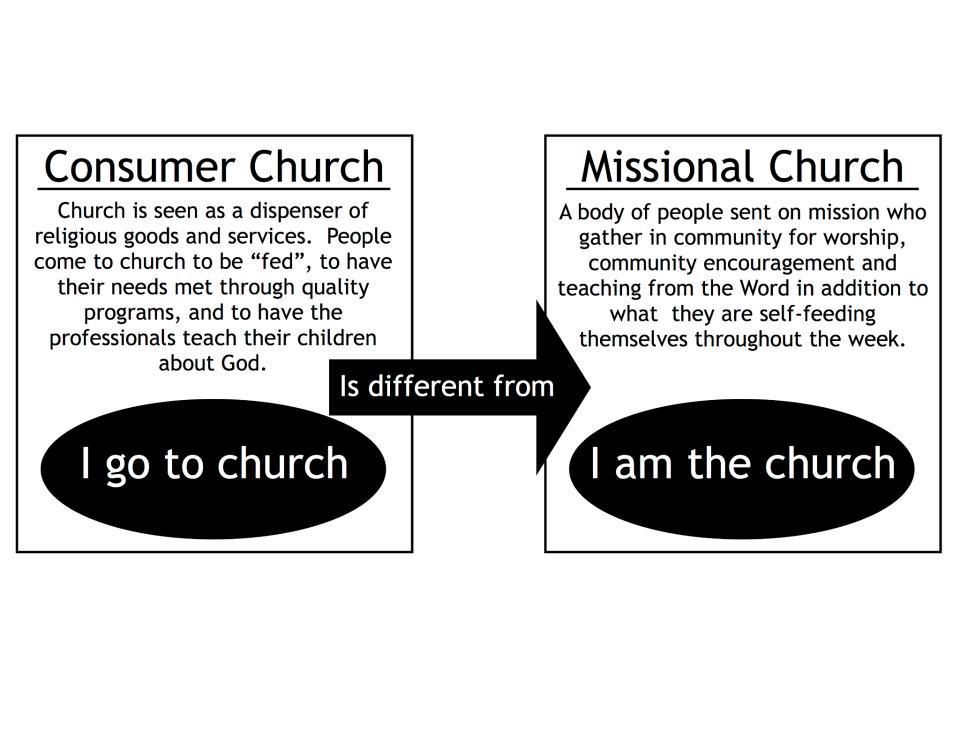
We don’t just go to church, we ARE the church …sent out by the power of the Spirit to BE the church.

This illustration above represents two aspects of being a faithful church:

Attractional – those elements of a particular congregation that draw people into the church community. Among these would be the quality of music, the substance and winsomeness  of the teaching, the variety and sufficiency of programs offered, and the friendliness of the members.

Missional – this is the sending of the church members into the community, and to the Nations, in order to make a positive and kingdom impact.  While this is often neglected, missional is not optional.

  • The mission of the church, and her members, is rooted in the nature of God who seeks and sends. (Isaiah 55.5; Isaiah 60.3; John 4.23; John 20.21)
  • Intentionally serving the community is faithfulness to the Covenant God cut with Abraham.  (i.e. Genesis 12.2)  If you look carefully at the Covenants of Scripture you will notice that there are always two dimensions, what I call a Top Line and Bottom Line.  the top line is God’s promise to bless those with whom he has entered into Covenant, evidenced by such promises as “I will be your God and you will be my people”.   The Bottom Line is is consistent with such expectant promises as “You will be a blessing”.   Both dimensions are reflected in every covenant.  Therefore, intentional mission to our community and world is not optional, or part of some deluxe package of being a Christian. If one follows Jesus, he or she does not have the option to choose the arrangement that does not require mission.
  • Mission is a is a clear mandate.  (Matthew 28.18-20; Luke 24.46-49; John 20.21; Acts 1.8; Jeremiah 29.7)

BOTH Attractional and Missional are necessary to be a healthy church. If we are not going, we are not faithful. And if no one is coming, well… the implications are pretty obvious.

The Missional Puritan: On Mission With God

Hey, this Missional thing is nothing new!  Listen to what the old English Puritan, John Owen, wrote in the 17th Century:

God has work to do in this world; and to desert it because of its difficulties and entanglements, is to cast off His authority. It is not enough that we be just, that we be righteous, and walk with God in holiness; but we must also serve our generation, as David did before he fell asleep. God has a work to do; and not to help Him is to oppose Him.

Missional may be a relatively new term coined to challenge an apathetic or directionless church, but it is not new.  It is the living out our biblical mandate.  God has work to do in this world – and in this community.  If we are in Christ we are enlisted to be as seeds scattered wherever our Sovereign God determines to send us, to take root and bless our generation.  (See Jeremiah 29.4-7)

Center Church

I picked up Tim Keller‘s newest book, Center Church.  It hit the bookstore shelves this morning.  I have as yet read only a few chapters. But as expected it is an excellent expression of holistic gospel-centered ministry.  In short it is a book about forming a Theological Vision for ministry, and living out that vision faithfully in whatever context one may live and serve in such a way as to be fruitful.

In particular I appreciate how from the outset Keller explains the difference and navigates between the two common ministry measuring sticks, success & faithfulness.  It seems to me that too many act as if we should assume these are mutually exclusive  – as if either is a sufficient goal or gauge.  Keller instead prefers fruitfulness, seeing both benefits and limitations of success and faithfulness as the simple objectives.  Fruitfulness is the end result of the complex web of faithfulness, competence, and the work of God’s Spirit. Success, whatever that really is, is not eschewed, but seen in light of the components of fruitfulness within a particular social context.

Now while I have not read the entire book, I did have one criticism from the outset.  While the book is less than 400 pages, and the chapters are easily readable (in other words, one need not be a theological scholar to follow along), the size of the book has the odd dimensions of a textbook.  This will look strange among most of the other books on my shelf.  But, I guess, if that remains my chief gripe, there is not much to complain about.