Missional Church
Is “Missional” the Same as “Seeker”?
The Calling of the Church

The calling of the church in every culture is to be mission. That is, the work of the church is not to be an agent or servant of the culture. The churches’ business is not to maintain freedom or to promote wealth or to help a political party or to serve as the moral guide to culture. The church’s mission is to be the presence of the kingdom… The church’s mission is to show the world what it looks like when a community of people live under the reign of God.
– Robert Webber, The Younger Evangelicals
To Be Or Not To Be Missional

Dave Harvey is an expert church planter and an astute observer of trends in church leadership. At the Spring 2007 Leadership Conference of Sovereign Grace Ministries Harvey assessed the strengths and weakness of the missional movement in an address titled Watch Your Mission: To Be or Not to Be Missional.
One observation Harvey offers is that sometimes missional practitioners muddy the Cross-centered focus of the Church.
Here is a sketch outline of Harvey’s message:
What are the Strengths of Missional Churches?
- Missional Churches Have a Commendable Passion for Evangelism.
- Missional Churches Have a Laudable Commitment to Engaging Culture.
- Missional Churches Have a Profitable Impulse for Reexamining Church Tradition.
- Missional Churches Possess an Admirable Devotion to Social Impact.
What are the Weaknesses of [Some] Missional Churches?
- Missional Churches Tend to Be Mission-Centered Rather Than Gospel-Centered.
- Missional Churches Tend to Have a Reductionistic Ecclesiology.
- Missional Churches Tend to Confuse Culture Engagement with Cultural Immersion.
- Missional Churches Tend to Downplay the Institutional and Organizational Nature of the Church.
- Missional Churches Tend to Have an Insufficient Understanding of Apostolic Ministry.
As one who desires to be both Gospel-centered and Misisonal, I take Harvey’s cautions seriously. I think he has a valid point. I would say that while being Missional does not inherently make one guilty of this, I would have to concede that many who are Missional are guilty of this.
I suspect this results from an imbalance with the Prophet, Priest, and King tri-perspective. Too much emphasis is placed on the role and influence of the King. This seems only to be natural since, afterall, one of the important principles recovered by the missional movement is that our mission matters; our mission is as much an expression of who we are as is our theology.
So what is the solution? Uncompromising Tri-Perspectivalism.
Read Harvey’s full outline here; Download the mp3 for FREE and listen to the audio here.
Note: Thanks to Tony Reinke of Miscellanies for the links.
Being Missional
What If Church Was Different?
Community is Identity

From Tim Chester:
The church is not a building you enter. Nor is it a meeting your attend. It is not what you do on a Sunday. To be a Christian is to be part of God’s people and to express that in your life through belonging to a local Christian community.
Our Belonging
We belong to one another (Romans 12:5). If a car belongs to me then I am responsible for it and I decide how it should be used. If a person belongs to me them I am responsible for them and I am involved in their decisions.
Our Home
Peter says Christians are ‘foreigners’ = ‘without home’ in the world (1 Peter 2:11). But we are being built into an alternative ‘home’ (1 Peter 2:5).
Our Family
Families eat together, play together, cry together, laugh together, raise child together provide for one another. Families argue and fight, but they do not stop being families and they don’t join other families because they have different tastes in music or reading. With family you can take off your shoes and put your feet on the sofa. They provide identity and a place of belonging.
Family is one of the most common New Testament images for the church. So try re-reading the paragraph above, substituting the word ‘church’ for ‘family’…
Our Community
The New Testament word for community is used to describe sharing lives (1 Thessalonians 2:8), sharing property (Acts 4:32), sharing in the gospel (Philippians 1:5; Philemon 6) and sharing in Christ’s suffering and glory (2 Corinthians 1:6-7; 1 Peter 4:13). Helping poor Christians is an act of ‘community’ (Romans 15:26; 2 Corinthians 9:13). Christians are people who share their lives with one another.
Our Joy
How would you answer this question: ‘For what is our hope, our joy, or the crown in which we will glory in the presence of our Lord Jesus Christ when he comes?’ Paul says to the church in Thessalonica, ‘Is it not you?’ (1 Thessalonians 2:19)
Implication: ‘We’ not ‘I’
We need to say not ‘I am planning to …’ or ‘this is my ministry’, but ‘we are planning to …’ and ‘this is our ministry’. We need to say not ‘you need to … or ‘the church doesn’t meet my needs’, but ‘we need to …’ and ‘why don’t we do this’.
Externally Focused Quest
Most churches have a subtle, perhaps even unspoken, objective. It is driven by the question:
“How can we be the best church in our community?”
How a church answers that question determines the approach to membership, staffing, budget, etc.
In a book I am now reading, Externally Focused Quest, authors Eric Swanson & Rick Rusaw ask an entirely different, more poignant, question:
“How can we be the best church for our community?’
The difference between the two questions dramatically influences the way we approach ministry, approach our community, and relate to other churches. Those driven by this question are inclined to be highly attractional, may tend to view neighbors as being placed by God so that they can be harvested for the growth and benefit of the church. And while many people would be gracious enough to realize that there are enough people to go around, and that no one church can monopolize all the people in an area, this question inherently promotes a sense of competion between churches.
Perhaps even more significant, the differences between these two questions radically reveals our view of God and what we believe to be God’s purpose for the church. The church that wants to know how they can be the best for the community understands that God is on a mission and invites us – even demnds for us – to engage in it. It is a church that recognizes God has placed His church in the community primarily to benefit the city and it’s people (see Jeremiah 29.7 & Proverbs 11.10), and consequently to draw people to himself. While some may ask this question and still posess an unhealthy competitiveness, the question itself does not inherently demand competiton. To be the best for the community means to play the roles needed in the community. There is room for more than one church to play various roles.
Being Sent

This past Sunday I offered a brief exposition of John 17.6-21 & John 20.21, explaining what it means to be “sent” into our community and world in the same way God the Father sent Jesus into our world. These texts demand that we understand, as John Stott says: “Our God is a missionary God.” They also demand that we continually ask ourselves:
- In what way was Jesus sent?
- How am I responding to/reflecting being sent?
While in no way exhaustive, I offered 5 simple observations for us to put into practice:
- More Incarnational than Attractional
- Focus More on Building Bridges than Building Walls
- Prioritize Service > “Serve Us”
- Move Beyond Fellowship to Functional Unity
- Measure Our Effectiveness More by Our Impact than Our Attendance.
Deep Church & Ordinary Means
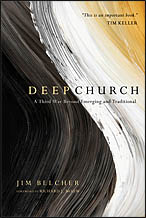 Unbeknownst to me when I posted earlier today, two of my long-time friends interviewed Jim Belcher, author of Deep Church, earlier this year for their podcast: Ordinary Means.
In this interview Jim introduces and discusses his book with two guys, Matt Bohling & Shaun Nolan, who unhesitatingly identify themselves with the Traditional Church.
Great discussion…
To listen click: Deep Church.
The Deep Church

At the suggestion of a friend, I recently read Jim Belcher’s Deep Church. I was not disappointed. This is thoughtful and thought-provoking book.
The subtitle really captures the theme of this book: A Third Way.
With all the discussions about “how” to do church, and the polemic approaches of the Traditionalists and the Emerging/Emergent, some of us find ourselves caught somewhere in the middle. I see strengths and weakness in both movements.
Belcher offers understanding of both worlds. With his understanding he offers honest reflections. Belchers experience and research are helpful for bringing clarity about the issues of the debate and the players doing the debating. I especially appreciated his dilineation of the “protests” being offered by the Emergning/Emergents against the practices of traditional church:
- Captivity to Enlightenment Rationalism
- A Narrow View of Salvation
- Belief Before Belonging
- Uncontextualized Worship
- Ineffective Preaching
- Weak Ecclesiology
- Tribalism
Honestly, I share these collective frustrations – though I cannot endorse the Emergent solutions.
More than just offering perspective, Belcher offers his thought process as he wrestles with the strengths and weaknesses of both the Emerging/Emergent and Traditionalist arguments. He does not seem to be trying to convince anyone to embrace his positions, only sharing the insights of his personal and spiritual leadership journey. I found this helpful. It was almost as if I had someone to talk with about these issues as I contemplate my own positions, questions, and inclinations.
Most important, at no point does Belcher compromise by seeking the “middle way”. Instead, listening to both sides of the debate, he searches and wrestles with Scripture to find “A Third Way”.
The Bereans would be proud.
Won’t You Be My Neighbor

A group of pastors invited the mayor of their city to discuss his dream for the city, along with the issues that were hindering that dream from becoming a reality. The mayor came with a list of pervasive issues that the pastors in this group were eager to address: at-risk kids, elderly shut-ins, dilapidated housing, and hunger.
But before addressing these issues the mayor said to the gathered pastors:
“After thinking about all of these things, it occurred to me that what our city really needs are good neighbors….The majority of the issues our community is facing would be eliminated or drastically reduced if we could just become a community of people who are great neighbors.”
To this statement one pastor responded:
“Here we are asking the mayor what areas of the city are most in need, and he basically tells us that it would be great if we could just get our people to obey the second half of the Great Commandment.”
Is “Missional” Just “Evangelistic”?
In his book The Present Future, Reggie McNeal reveals the contrasts in the different ways leaders can think about the church and its ministry. McNeal reveals the different paradigms that pastors can have as they fulfill their ministry in the church. Being missional is first a shift in thinking about the nature of the church. Once a missional understanding is adopted, the way we do church begins to change.
- A missional church stresses community transformation over growing the church.
- A missional church strives to turn members into missionaries over turning members into ministers.
- A missional church focuses on recovering Christian mission over doing church better.
In the above video, Tim Keller also offers some insights about the missional church. Keller explains why this label – Missional – is not just new slang for being Evangelistic.
For those who want to explore a little more, let me suggest reading Timothy Corwin’s blog post Being Missional: Is There Really a Difference? Tim is pastor of The Rock Church of Saint Louis, and has written several thoughtful pieces about the missional church.
A Missional Church IS…

A missional church is rooted in the purpose of God, and understands that God is on a mission to reclaim a People for himself and restore a Creation to it’s orignal beauty. This is known as missio dei – Mission of God.
A missional church recognizes that our culture in North America is no longer an expression of Christendom.
Christendom was a period in history when Christianity was the prevailing religion. During this time Christian thought, directed by the Bible, provided the lense through which people evaluated the world.
We can no longer assume that:
- People are part of a congregation. In the past, most people had some affiliation with a church. Now, most people have no connection with a church, increasing numbers of people have never even been in a church.
- People define Right vs. Wrong based upon some understanding of God’s Standard.
- People necessarily care what the Bible says, much less that most people have any understanding of what it teaches.
Consequently:
- The church can no longer serve as chaplain to a culture, and a People, as if they only need encouragement along Life’s Journey.
- Each congregation must engage the culture(s) in the community where God has sovereignly placed us in the same way that a missionary must engage a foreign culture:
- Learning to understand before trying to be understood.
- Presuming our neighbors have no previous understanding of God and the Gospel – or at best they have a fragmented and distorted understading.
- Look for Redemptive Analogies – stories from within the culture that reflect the truths of God and the Gospel.
- Loving a People who may reject us, and even hate and harm us.
The church must:
- Grow inwardlay strong yet Outwardly Focused.
- Be MORE Incarnational than Attractional
- Evaluate all ministries with a missional lense.
In summary: A Missional Church pours itself out on the community, seeking cultural transformation more than its own prosperity.
Reflecting Jesus in Christ’s Church

If, as most Christians profess, Jesus is indeed the only Head of the Church, it seems reasonable that Christ’s Church should reflect His personality in it’s ministries and structure.
One way that Jesus is reflected in the ministry of faithful churches has been the recovery of a balanced Word & Deed holistic ministry. By balanced I am in no way suggesting a compromise. Instead I am referring to churches that are uncompromising BOTH in their pursuit of sound Biblical and theological instruction AND in thier practice of meeting the real – spiritual and tangible – needs of their neighbors.
This only makes sense, since Jesus is himself the Word Incarnated and the one who “came to serve, not to be served”. (See Mark 10.45) Jesus’ service was expressed through miraculous practical, provision and help. And Jesus is the one who said to his disciples: “Just as the Father has sent me, I am sending you.” (See John 20.21) Traditionally churches have structured their leadership into the offices of Elder and Deacon, in accord with Biblical directive, to reflect Word & Deed. (Elders = Word; Deacons = Deed)
But I am increasingly becoming convinced that there is another, an additional, way that the personality of Jesus should be expressed in the Church. This additional way, often referrred to as Tri-Perspectivalism or Multi-Perspectivalism, should be expressed in the Leadership Structure and in the ministry of the church. In fact, I am convinced that it needs to be the guage by which we evaluate the faithfulness of our congregations.
The Bible teaches that Jesus exercised three distinct offices:
- Prophet
- Priest
- King
Each of these offices carry a significance. In exercising these three offices Jesus also reveals aspects of his personality.
The Westminster Shorter Catechism summarizes for us how Jesus exercised each of these offices:
Q. 24. As a Prophet, Christ reveals the Will of God to us for our salvation by His Word and Spirit.
Q. 25. As a Priest, Christ offered himself up once as a sacrifice for us to satisfy divine justice and to reconcile us to God; and He continually intercedes for us.
Q. 26. As a King, Christ brings us under His power, rules and defends us, and restrains and conquers all his and our enemies.
Another way of looking at these distinct roles is:
Prophet is concerned with understanding and communicating God’s Truth, and applying it to every aspect of life.
Priest is concerned with the Spiritual Renewal and Transformation of all Christ’s People. The Priest is concerned not only for the conversion and intial reconcilation of the Believer to God, but also that all our lives be increasingly lived out in the joy and freedom that the Gospel secures and applies to us.
King is concerned with the advancement of Christ’s Kingdom, with both the Future fulfillment and Present Realities in mind. In that sense, the King is concerned about both the mission and the structures of his Church.
What I have discovered is that each of these offices offers a unique perspective for leadership and ministry. Each is equally important. Each must be equally considered. If all three are not equally considered the ministry of the church is unbalanced. In fact, if all three aspects, or perspectives, are not equally considered the ministry is not only unbalanced it is unfaithful. It is not faithful to reflect the whole person of Christ, who is not only the Head but also the Model. Continue reading
 GRACE & PEACE
