The Responsibility of the Church

Lesslie Newbigin, in his book The Reunion of the Church, challenged the Church to be on mission:

“The responsibility of the church is to declare to each generation what is the faith… This is always a fresh task in every generation… No verbal statement can be produced which relieves the Church of the responsibility continually to re-think and re-state its message. No appeal to creeds and confessions can alter the fact that the Church has to state in every new generation how it interprets the historic faith, and how it relates it to the new thought and experience of its time… Nothing can remove from the Church the responsibility for stating now what is the faith. It belongs to the essence of a living church that it should be able and willing to do so.”

NOTE: Those unfamiliar with Newbigin may appreciate this article by Bruce Ashford: How A Man Named Lesslie Changed the Way I Think.

Christianity in Our Current Cultural Context

In March 2019, noted church leader Tim Keller delivered this keynote address at The Hendricks Center Gala. In this address Keller identifies some of the ways that ministering in our present cultural context may be different from ministering in the past. Whether one agrees with Keller’s assessments or not, all would be wise to at least consider the issues he raises, while considering the particular contexts in which we each live and serve.

Race & the Church RVA: The Church’s Commission

The third gathering of Race and the Church in Richmond, Virginia took place on Saturday May 14.  Featured speaker Leonce Crump addressed the diverse crowd on the subject of The Church’s Commission.

Leonce Crump’s bio, from the Race and the Church RVA web page:

Originally from Louisiana and raised Catholic, Léonce began following Jesus at age 16. Always an athlete and a talker, Léonce outran his first mall security guard (and pregnant mother) at age 3, and spent most of his grade school years talking with his principals on the subject of public speaking during class. He has been in ordained ministry for 9 years, is a graduate of the University of Oklahoma; and holds Masters degrees in Criminal Justice, with a focus on Case Law, from the University of Tennessee, Missional Leadership from the now defunct Resurgence Theological Training Center, an; is currently finishing his Masters of Divinity at Reformed Theological Seminary.

At Oklahoma he was an All-American wrestler and played a short while on the Sooner football team. He experienced an extended time of rebellion and running from God during college, but after 22 months of living as though he were not a Christian he surrendered to Jesus and ultimately to God’s calling into ministry. After college Léonce competed to make the world team in wrestling, played professional football for the New Orleans Saints and coached collegiate wrestling.

Prior to planting his present church, Léonce had served in 3 churches, starting and leading 3 college and young adult ministries. In 2006 he felt called to plant a church and settled on the under-served area of downtown Atlanta; and in early 2008 he and his wife began the process of planting Renovation Church, in partnership with  Acts 29 and Perimeter Church.

A prodigious reader and engaging speaker, Léonce regularly speaks and preaches across the country at conferences and churches of all denominations. Léonce enjoys boxing and MMA, studying theology, history, leadership, church structure and poetry. He likes Soul music, jazz/standards, and Bossaniva. He also loves to lift, keep up with wrestling, football, and rugby, playing with his kids, hanging with the homeless dudes.

To view the first two gatherings of Race and the Church RVA:

Culture Shaping Power of the Church

Potter's Hands

Os Guinness, in his excellent book, Renaissance, concerning the church in midst of the present challenges unprecedented in Western Culture, notes the culture changing and culture shaping power of the gospel, when the gospel is both declared by God’s People and is actively shaping God’s People.  When many of our churches are caving in pursuit of “relevance”, which is hoped will cause people to “like” the church, so we can keep our numbers up, I think Guinness offers a both prophetic and strategic word:

What we have here in the teaching of Jesus and the Scriptures, and amplified in Augustine, is the very heart of the secret of the culture-shaping power of the gospel in the church. When the church goes to either of two extremes, and is so “in the world” that it is of the world and worldly, or so “not of the world” that it is otherworldly and might as well be out of the world altogether, it is powerless and utterly irrelevant.  But when the church, through its faithfulness and its discernment of the times, lives truly “in” but “not of” the world, and is therefore the City of God engaging the City of Man, it touches off the secret of its culture-shaping power. For the intellectual and social tension of being “in” but “not of” the world provides the engagement-with-the-critical-distance that is the source of the church’s culture-shaping power.

In short, the decisive power is always God’s, through his Word and Spirit. But on her side the church contributes three distinct human factors to the equation: engagement, discernment, and refusal.

First, the church is called to engage and to stay engaged, to be faithful and obedient in that it puts aside all other preferences of its own and engages purposefully with the world as the Lord commands.

Second, the church is called to discern, to exercise its spiritual and cultural discernment of the best and worst of the world of its day, in order to see clearly where it is to be “in” and where it is to be “not of” that world.

Third, the church is called to refuse, a grand refusal to conform to or comply with anything and everything in the world that is against the way of Jesus and his kingdom.

Illustration of a Healthy Church

Church on Mission

If our congregation were to be a church with the gospel, plus a group that enjoys being together in community, but we were not on mission to reach out to our neighbors and the Nations, for the sake of advancing Christ’s Kingdom, then we would just be another social club for people to attend.

Gospel + Community – Mission = Club

If we were to be a church with the gospel, and we were actively engaged in mission to our neighbors, but not together in community, then we would  be like a bunch of silos that aren’t truly showing off the body of Christ. We could not be considered like a city on a hill.

Gospel + Mission – Community = Para-Church

If we were to become a church actively on mission, serving together in community with one another, but we had no gospel, or we were careless about the truths of the gospel, we would then merely be just another non-profit organization.

Community + Mission – Gospel = Non Profit

To be the church, to be what Jesus calls us to be, what he created us to be, is a Gospel-centered, missional, gathering of people living life together, sharing one another’s joys and pains, serving together in various ways for the good of our city, expecting nothing in return, all for the glory of Jesus, the joy of being together, and love for our neighbors.

We must be a church that is gospel centered, on mission in community so that we can be the organism, the family, the church that Christ gave the Spirit to empower, and of which he said could not be stopped. (Matthew 16.13-18)

Gospel + Community + Mission = Church

Bounded-Set vs Centered-Set

Bounded-vs-Centered-Set

Some time back I posted a piece titled Numbering Those On the Ranch, exploring the concept of what missiologist Alan Hirsch refers to as a “centered-set” metric for evaluating a church.  More recently I stumbled across a post by Bob Thune, of Coram Deo Church in Omaha, explaining his understanding of Centered-Set verses the more traditional Bounded-Set metric. I appreciated what Thune had to say, so I wanted to post it, even if primarily for my own benefit, as a resource for future use.

***

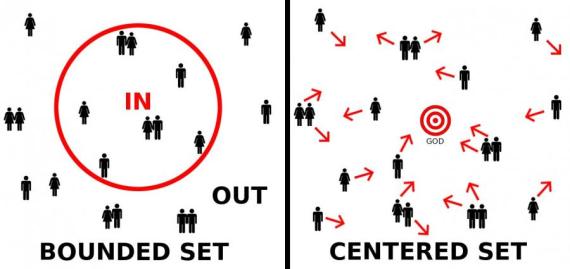
There are two ways of thinking about social groupings: centered-set and bounded-set. These terms come to us from the field of mathematics (set theory). In recent years they’ve been applied more broadly by sociologists and missiologists. The fountainhead of most of this thinking in the Christian church was Paul Hiebert, a missiologist at Fuller Seminary.

Hiebert suggested that our minds categorize people according to either “bounded set” or “centered set” thinking:

Bounded Sets

  •  are formed by defining the boundaries – the essential qualities which separate something inside the set from something outside. Heibert’s classic example is “apples.” Either a fruit is an apple, or it isn’t.
  • Maintaining the boundary is crucial to maintaining the category.
  • Bounded sets are static sets – they don’t change, they only add or lose members.
  • The important thing is to “cross the boundary” to be part of the set.

Centered Sets

  •  are formed by defining a center. The set is made up of all objects moving toward that center. As an everyday example: “bald men.”
  • While a centered set does not focus on the boundary, a boundary does indeed exist. The boundary is clear so long as the center is clear.
  • The objects within a centered set are not categorically uniform. Some may be near the center and others far from it, even though all are moving towards the center.

Hiebert asserts that Americans tend to think almost exclusively in bounded-set categories. And this affects our understanding of Christian discipleship. We tend to “stress evangelism as the major task — getting people into the category. Moreover, we… see conversion as a single dramatic event — crossing the boundary between being a ‘non-Christian’ and being a ‘Christian’” (Hiebert, 1978).

Hiebert argues instead for a “centered-set” way of thinking about Christian conversion:

A Christian would be defined in terms of a center—in terms of who is God. The critical question is, to whom does the person offer his worship and allegiance? …Two important dynamics are recognized. First there is conversion, which in a centered set means that the person has turned around. He has left another center or god and has made Christ his center. This is a definite event—a change in the God in whom he places his faith. But, by definition, growth is an equally essential part of being a Christian. Having turned around, one must continue to move towards the center. There is no static state. Conversion is not the end, it is the beginning. We need evangelism to bring people to Christ, but we must also think about the rest of their lives. We must think in terms of bringing them to Christian maturity in terms of their knowledge of Christ and their growth in Christlikeness.

Theologically, I find some aspects of Hiebert’s argument poorly nuanced. He would do well to differentiate regeneration (the invisible, immediate work of the Holy Spirit on the soul, which is in fact a decisive event) from conversion (our experience of that event, which often feels more like a “process” than like a decisive moment). Those who have applied Hiebert’s set theory to individual salvation (Brian McLaren, for instance) have tended to drift in fuzzy doctrinal directions.

But I find Hiebert’s insights immensely helpful when applied to ecclesiology. This is where I first encountered the set-theory rubric, as applied by Alan Hirsch and Michael Frost in their 2003 book The Shaping of Things to Come. Frost and Hirsch argued for viewing the church as a centered set rather than a bounded set. Why not build a church by defining the center rather than patrolling the boundaries? Why not place the gospel of Jesus Christ at the center of the church’s life and practice, inviting everyone to reorient their lives around Him? In this way, we continually invite Christians into deeper and deeper discipleship, while also inviting non-Christians to deal with the claims of Jesus on their lives. As Hiebert himself acknowledges, this does not mean there is no boundary; there is just “less need to play boundary games and to institutionally exclude those who are not truly Christian. Rather, the focus is on the center and pointing people to that center” (Hiebert, 1978).

It is my personal conviction that: a) this is what the New Testament church did (see, for example, Galatians 1:6-9; Colossians 1:6; Romans 1:13-15); b) this is what it truly means to be a “gospel-centered” church; and c) this is the only way to have a truly missional church, where non-Christians are treated with true Christian hospitality AND are regularly being converted to faith in Jesus.

In Spirit Produced Corporateness

Naval Academy Rowing Team

As I reflect upon the need of our church to constantly cultivate community among those within our congregation, as well as between those already part of the congregation and those who have newly arrived, I am pondering the poignancy of this statement by Stanley Grenz, from his book Theology for the Community of God:

“Only in our Spirit-produced corporateness do we truly reflect to all creation the grand dynamic that lies at the heart of the triune God. As we share together in the Holy Spirit, therefore, we participate in relationship with the living God and become the community of Christ our Lord.”

Turning Consumers Into Missionaries

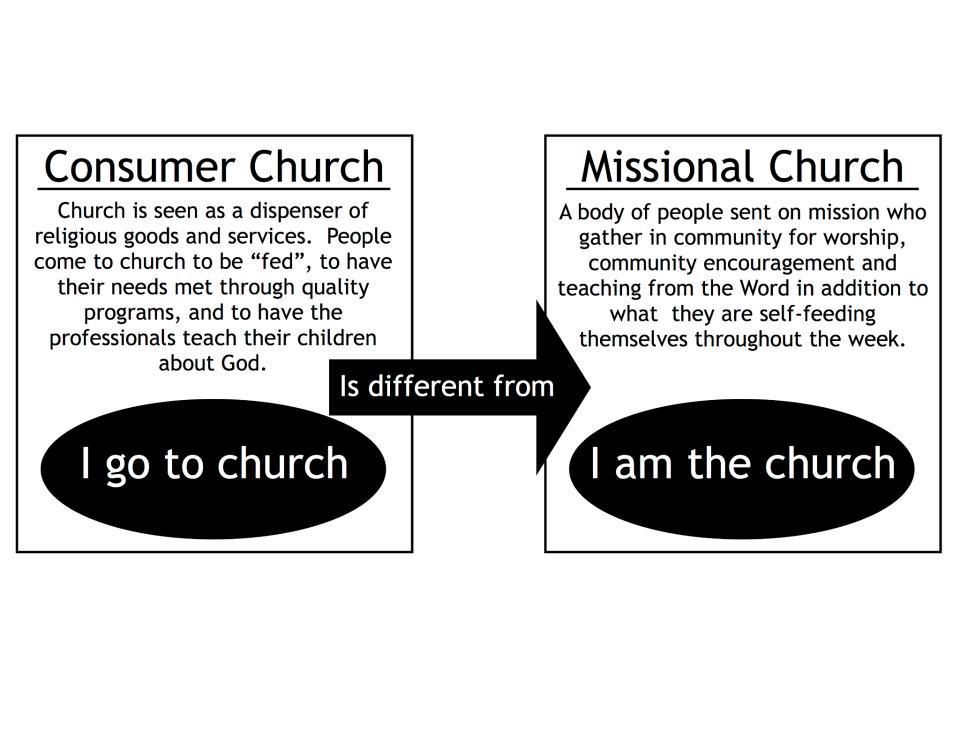
In this video, Hugh Halter offers some helpful suggestions about turning church consumers into people who live on mission for and with Christ. While this is a long video, in the current climate of American church culture, I found it worth taking the time to consider.  I broke it up into viewing sections – watching 15-20 minutes at a time, making note of the point at which I stopped, and picking up again as I had time.  While I don’t embrace all of Halter’s ecclesiology (i.e. ways we govern and do church), I am hungry to chew on any ideas in-line with the compelling mission of the gospel.  Halter has proven to have both an appreciation of the gospel and good ideas for missional mobilization.

Being the Church in the World: Distinctiveness

In this video John Stott discusses what he calls one of the most neglected themes in the Bible: Distinctiveness.

With all the clamoring for church to be seen as relevant in our culture, perhaps we – the Church – have lost sight of the call to be different.  Not different for the sake of being different, but different nevertheless.  Christians are to be different because, rather than being conformed to the principles of this world, we are more-and-more to be conformed to the likeness of Christ – in character, in passions, and in perspective.  We are to be formed by the Word, and consequently we become different from those around us.

Relevance has it’s place.  There is no merit in being irrelevant – and even less in just being weird.  But relevance must be considered as only one item, and it must be understood alongside with how we are also to be different from the world around us, and distinct in the communities where we live.

Here AND There

Church Scattered

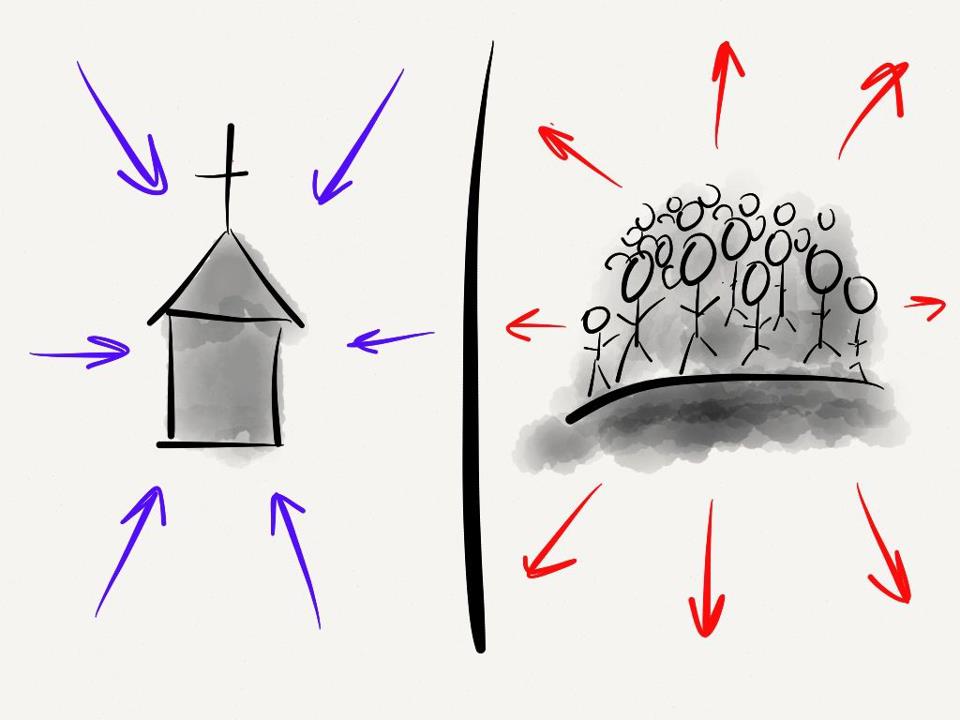
We don’t just go to church, we ARE the church …sent out by the power of the Spirit to BE the church.

This illustration above represents two aspects of being a faithful church:

Attractional – those elements of a particular congregation that draw people into the church community. Among these would be the quality of music, the substance and winsomeness  of the teaching, the variety and sufficiency of programs offered, and the friendliness of the members.

Missional – this is the sending of the church members into the community, and to the Nations, in order to make a positive and kingdom impact.  While this is often neglected, missional is not optional.

  • The mission of the church, and her members, is rooted in the nature of God who seeks and sends. (Isaiah 55.5; Isaiah 60.3; John 4.23; John 20.21)
  • Intentionally serving the community is faithfulness to the Covenant God cut with Abraham.  (i.e. Genesis 12.2)  If you look carefully at the Covenants of Scripture you will notice that there are always two dimensions, what I call a Top Line and Bottom Line.  the top line is God’s promise to bless those with whom he has entered into Covenant, evidenced by such promises as “I will be your God and you will be my people”.   The Bottom Line is is consistent with such expectant promises as “You will be a blessing”.   Both dimensions are reflected in every covenant.  Therefore, intentional mission to our community and world is not optional, or part of some deluxe package of being a Christian. If one follows Jesus, he or she does not have the option to choose the arrangement that does not require mission.
  • Mission is a is a clear mandate.  (Matthew 28.18-20; Luke 24.46-49; John 20.21; Acts 1.8; Jeremiah 29.7)

BOTH Attractional and Missional are necessary to be a healthy church. If we are not going, we are not faithful. And if no one is coming, well… the implications are pretty obvious.

Center Church

I picked up Tim Keller‘s newest book, Center Church.  It hit the bookstore shelves this morning.  I have as yet read only a few chapters. But as expected it is an excellent expression of holistic gospel-centered ministry.  In short it is a book about forming a Theological Vision for ministry, and living out that vision faithfully in whatever context one may live and serve in such a way as to be fruitful.

In particular I appreciate how from the outset Keller explains the difference and navigates between the two common ministry measuring sticks, success & faithfulness.  It seems to me that too many act as if we should assume these are mutually exclusive  – as if either is a sufficient goal or gauge.  Keller instead prefers fruitfulness, seeing both benefits and limitations of success and faithfulness as the simple objectives.  Fruitfulness is the end result of the complex web of faithfulness, competence, and the work of God’s Spirit. Success, whatever that really is, is not eschewed, but seen in light of the components of fruitfulness within a particular social context.

Now while I have not read the entire book, I did have one criticism from the outset.  While the book is less than 400 pages, and the chapters are easily readable (in other words, one need not be a theological scholar to follow along), the size of the book has the odd dimensions of a textbook.  This will look strange among most of the other books on my shelf.  But, I guess, if that remains my chief gripe, there is not much to complain about.

What If We Omitted Gospel, Community, or Mission?

The refrain from an old song says: “Two out of three ain’t bad.”  But would this be true for a church, or a Christian, who incorporates 2 out of 3 of the core values: Gospel, Community, Mission?

Consider these thoughts, framed as a mathematical equation:

Gospel + Community – Mission

If we have a Gospel Community, without the mission or ‘sent’ aspect in our DNA, then we become a church that is all about ourselves.  We may love the gospel, and love that the good news has impacted our minds, and even desire to live that out with other people like us.  But living as ‘sent ones’ to our neighborhood seems too difficult.  When this happens a Christian ghetto surrounds the church, and an “us vs them” mentality is created.  This misses the entire point of the “go” in Christ’s great commission. (Matthew 28.17-21)

Such communities of believers are often very good at living as gospel families.  They take care of each other well: they provide for one anothers’ needs, and they draw very close to one another. But the lack of  engagement with the world, and and absence of multiplication,  is  vividly evident.  Sometimes such an inward focus is even worn as a badge of honor, since it may be believed by our isolation we are not being ‘polluted’ by the world.

Such communities usually have a heavy emphasis on bible studies, men’s groups, women’s group, children’s programs, etc.  The groups will usually have an “open invitation” to those on the outside. But because they don’t believe they are “sent” to their community, they rarely see disciples made of the un-churched people around them.   Numerical growth typically comes from like-minded people moving into their area, or through having children, or stealing the members from other churches that may offer fewer activities or which may be going through some turbulent times.  Rarely will they be faced with the general public pushing into the Kingdom, because they never engage general public with the gospel message outside the walls of their church building.

The overall goal is usually to prompt a great understanding of the Word and theology, but it is often intellectually gluttonous and missionally starved… because the reason for the Word and theology is to drive us to glorify God and show us our role in God’s redemptive drama.  If it’s not being used towards that end then it’s being misused.

Continue reading