Work of Prayer

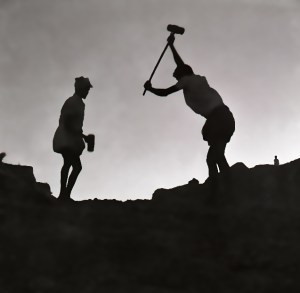
Prayer is work.  To be effective in prayer takes discipline and diligence, both of which are necessary ingredients in any successful endeavor.  If we suggest prayer is not work then I think we deceive people, and perhaps ourselves.  We may enjoy praying, as we might our jobs, but it is work nevertheless.

But prayer also works.  I don’t mean this as a simple cliche.  I have in mind the power and effectiveness that results from the labor of prayer. 

I was reminded of this a few weeks ago when I passed by an adult bookstore semingly too close to a local elementary school.

I wondered: How much effort would it take for one person to clean out an adult bookstore, or a seedy bar, and turn it into something useful and beneficial?  How much actual labor?  One would have to go in and discard all the inventory. That would certainly be hours and hours of work, to haul that stuff to a rented dumpster or the back of a pick-up truck.  If someone was undertaking this project on his spare time, it is reasonable that this initial phase alone could take days, or even spread out over a few weeks.  Then would come the need to clean up (which might even come first).  Everything would need to be scrubbed down and sanitized.  I imagine that would be several more hours, at least.  Then comes the fix-up, when painting and other details are put in place…

You get the idea.  To make a dent, even in a small facilty, would take hours and hours of backbreaking work.  Obviously, the time and energy would be cut down if others help in this project. 

It strikes me that effective intercessory prayer is like that. 

Let me explain:

God, in his sovereignty and providence, has placed his people (the Church) in particular places at particular times in history in order that we might be living expressions of the Kingdom of God. Our goal should not be to merely carve out a niche within our neighborhoods but the transformation of the whole community where God has placed us. (See Jeremiah 29.7)  To be satisfied with having a safe place within the community seems to me like just cleaning out one room in that adult bookstore and leaving the rest in tact.

Such transformation takes time and diligent effort.  But little by little things change and can shape up. However, it is God who does the heavy lifting for what would be back-breaking work for us. In many cases this work would be impossible for us.

Our work is to be diligent in prayer, focused and clear about what we see needing to be accomplished in a particualr place, or in a specific life.  We are not always certain about the amount of work that really needs to be done, or how much time it might take; and we may not find those things out until the work is underway. Change takes time, but it comes.  And if we are assisted by others who partner with us in intercession, the job is a little easier, and more enjoyable.

Prayer is the work we do.  And prayer works.
Mundane is Glorious

Mark Altrogge is a name some may recognize as the author of such worship songs as I Stand in Awe and I’m Forever Grateful.  Most probably won’t recognize the name or the songs.  Mark is also a pastor in Western Pennsylvania, affiliated with the Sovereign Grace Ministries network.

Mark has written a recent post, Mundane is Glorious, that touches on something the Lord is – and has been – teaching me.  I’m a slow learner. But Mark’s post is encouraging.  It helps me deal with my glaring lack of greatness.  He reminds me that it is not greatness that necessarily honors God, but faithfulness:

[God is] no more glorified by the pastor preaching to thousands than he is by the Mom trying to get her one-year-old to eat his Gerber peas for the hundredth time.

[God is] no more blessed by the man who leads thousands in worship than by the dad who runs a high lift all day, plays catch with his kids after dinner, and falls asleep reading a Bible story to his kids before bed.

If you ever wrestle with wonder about how God can, and does, view a life that is common, ordinary, and seemingly unremarkable, check out Mark’s post.  It is is a refreshing, and godly, perspective.

Prayer at the Plate

The World Series begins tonight, and I’ve been thinking about prayer. What do those things have in common?  Perhaps not much. But consider:

We all like home runs. We like to watch them. And if we are playing, we like to hit them.  But if a player goes to the plate trying to hit a home run with every swing, he will usually strike out and end up on the bench.  Effectiveness is found in making contact, and usually hitting a lot of singles that add up to runs.  

I think this is where baseball and prayer might connect. 

In prayer we also like the home runs – those things that are so amazing that we stand in awe when we see God at work and our prayers answered.  Even if we are not the one who offered the prayer, we like to watch and hear stories of others who had prayers answered in a BIG way.  We seem to admire those who are gifted for prayer, and may even be a little envious.  But the fact is, when we pray most of the time we will not hit homers.  Many times the situation does not even call for it. Yet faithful singles add up.  If we understand this we are less prone to get frustrated or disappointed.  And occasionally a surge of power will amaze us.

By the way: Go Phillies!!

Prayer: A Way to Take Your Spiritual Pulse

We may judge the state of our hearts by the earnestness of our prayers.  You cannot make a rich man beg like a poor man; you cannot make a man that is full cry for food like one that is hungry.  No more will a man who has a good opinion of himself cry for mercy like one who feels that he is poor and needy.

The symptoms of spiritual decline are like those which attend the decay of bodily health. It genreally commences with a loss of appetite and a disrelish for spiritual food: prayer, reading the Scriptures and devotional books. Whenever you perceive these symptoms, be alarmed, for your spiritual health is in danger. Apply immediately to the Great Physician for a cure.

The best means of keeping near to God is the [prayer] closet. Here the battle is won or lost.

If a man begins to be impatient because his prayers for any blessings are not answered, it is a certain proof that a self-righteous dependence on his own merits prevails in his heart to a great extent; for the language of impatience is: “I deserve the blessing; I had a right to expect that it would be bestowed, and it ought to have been bestowed ‘ere this.” 

It is evident that a man who feels that he deserves nothing will never be impatient because he receives nothing; but will say: “I have nothing to complain of, I receive as much as I deserve.” 

Again, when a man wonders, or thinks it strange, that he does not receive a blessing for which he has prayed, it shows he relies on his own merits. The language of such feeling is: “It is very strange that I, who have prayed so well and so long, and had so much reason to expect a blessing, do not receive it.” 

Persons who feel truly humble, on the contrary, are surprised, not when blessings are withheld, but when they are bestowed.  It appears very strange and wonderful to them that God should bestow any favors on creatures so unworthy as themselves, or pay any regard to prayers so polluted as their own. 

This is the temper to which every person must be brought before God will answer his prayers.

***

This is a reflection from Dr. Edward Payson, 19th Century Evangelical from Portland Maine. 

While Payson is largely unknown today, during the first half of the 19th Century he was among the most well known in America, and was referred to as ‘Praying Payson from Portland Maine’.  Payson’s writings, though a couple hundred years old, are refreshing, and contemporary in both thought and style. There is none of the stilted language often associated with writers from previous centuries. 

I plan to add more of Payson’s reflections in the weeks and months ahead.

Sharing the Father’s Welcome

Tim Keller’s new book, The Prodigal God: Recovering the Heart of the Christian Faith, will be released in a few weeks, on October 31. In the book Keller presents a powerful expression of the gospel, rooted in the parable of the Prodigal Son.  Having heard Keller teach from this parable, I am looking forward to the written form.

But Keller’s insights were not developed in a vacuum.  They were cultivated by careful and thoughtful study and prayer. They were built upon a foundation of those who had walked before him, like Edwards and Chalmers. And they were influenced by the wisdom of those who invested in him. Among them, Dr. Ed Clowney, former president of Westminster Seminary, whom Keller credits in the Introduction of this upcoming book as having provided the inspiration: 

Many excellent studies have been written on this Biblical text over the last several years, but the foundation for my understanding of it was a sermon I heard preached over thirty years ago by Dr. Edmund P. Clowney. Listening to that sermon changed the way I understood Christianity. I almost felt I had discovered the secret heart of Christianity.  (Click: article.)

Crossway Books has made available Clowney’s sermon, Sharing the Father’s Welcome.  I hope it not only whets you appetite for Keller’s upcoming book, but that it opens your eyes to see how high and wide and long and deep is the love of God for we, his children.

(NOTE: My thanks to Justin Taylor of Between Two Worlds for tipping me off about this.)

Frontline Prayer


 Jack Miller, in his book Outgrowing the Ingrown Church, makes a distinction between two types of prayer meetings: Maintenance and Frontline. Miller confesses to having led both kinds in churches he  pastored. 

Here is how Miller describes each:

The Maintenance meeting was largely designed to maintain the the existing life and ministry of our congregation. Believers came to be edified by a Bible study that took up most of the hour and to pray for the internal needs of the church.  Expectancy seemed to be at a low ebb among the attenders, evidenced by the fact that none of us bothered to keep a record of prayers offered and answered. I also do not think that Christians came to this prayer meeting expecting to meet God in a life-changing encounter.”

“…The conception and format were designed more to preserve the status quo…” 

In other words, Miller is saying that people came to the meeting, perhaps out of a sense of duty, and perhaps a sincere priority. They may have acknowledged that God was present because, afterall, God said he would be. But they were not in any way effected because of God’s presence. And the prayers offered were probably from the sick list, and for some generic “blessing” on various ministries and programs.

On the other hand,

“By contrast, people came to the Frontline prayer meeting to be changed. They discovered what Augustine had emphasized, that man’s chief need is to fellowship with God, to find fulfillment in Him, and to experience the abiding presence of Jesus. (Psalm 27.4; Psalm 36.7-9; John 14.18-23; John 15.1-10)  So they came to be changed, and they were changed because Jesus kept his promise to be wherever two or three gather in his name. (Matthew 18.19-20)  From him they received grace to confess and forsake their sins, to be touched with his compassion for the lost, and to go forth to ‘put feet on their prayers’ through witnessing by words and deeds of love.”

“…The Frontline prayer assembly has a revolutionary purpose.  The prayer of those who attend it is summarized in the words: ‘Thy Kingdom Come’.  Their spirit imparted desire is to see the power of God’s kingdom revealed and to see the social segregation of the ‘turned-in’ church replaced by a welcoming community of faith and love.

Having spent most of his pastoral ministry leading the maintenance oriented church, and despearate to experience the presence of God, Miller “began to pray for the Spirit’s presence… with almost everything I did.  I especially began to pray with shameless boldness for his working in our prayer meeting.  I asked God to give us His Spirit that we would know how to pray, that our hearts would be surrendered to His missionary will, and that we would leave the prayer meeting freed of guilt and fear and ready to witness fearlessly for Christ.”

Frequently Miller asked God to visit the church and equip the people with three things:

1. His self-forgetting love for others.

2. his wisdom for praying specifically and intelligently

3. His boldness for prayer and risk-taking witness.

Miller says a Frontline Prayer Meeting itself becomes an expression of kingdom power when the following conditions are met:

1. Faith/Expectancy

A minimum of two or three believers gathered together to devote themsleves to prayer and confidently claim Jesus’ promise to be present with them. (Matthew 18.20; Acts 1.13-14; Acts 2.42)

2. Oneness of Purpose

A seeking of “agreement” (Matthew 18.19) or “one-mindedness” (Acts 1.14; Acts 2.1; Acts 4.24; Romans 15.5-6) on key subjects for prayer.

3. Authority

A humble but bold claiming of the authority of Jesus’ name in making requests of the Father. (Matthew 18.20; John 15.16; John 16.24)

4. Commitment

A surrender to the will of Christ as revealed in the Great Commission, and a willingness to take “risks” in obeying that will.  (Acts 1-4)

As our church, Walnut Hill Prebyterian, ventures into 40 Days of Prayer, on our journey toward becoming a House of Prayer, we would be wise to learn from Jack Miller’s insight and experience.

Lord, be gracious to us, and shine your face upon us.”

Becoming a House of Prayer

Jesus said:

My house shall be called a House of Prayer for all Nations.”

It is my dream for our church, Walnut Hill Presbyterian, to become a House of Prayer.  That dream is shared by the Elders of the church, and by several members. 

Don’t get me wrong. Walnut Hill is, in many respects, a praying church.  We have a number of faithful & powerful prayer warriors among our number.  Wednesday evenings were set apart for a service of prayer long before I arrived on the scene a little over a year ago.  And each Saturday morning the Elders meet at the church at 7:30am to pray for our members and our community. (This is another practice that was already in place before I returned to Tennessee.) 

I don’t know how one would gauge such a thing, but I suspect that Walnut Hill would rank among the upper percentiles for prayer among churches in the USA.

But still, that is not what I am hoping for.  It is not the same thing.  There is a difference between a praying church and a House of Prayer. In fact, Cheryl Sacks, in her book The Prayer Saturated Church, lists several differences:

1. A church that prays may have a limited number of people involved in a prayer ministry; A House of Prayer involves the entire congregation.

2. In a praying church there may be little, or even no, regular emphasis from the pulpit about the ministry of prayer; A House of Prayer regualarly teaches and emphasizes the priority of prayer from the pulpit.

3. In a praying church very little training is offered to people to prepare them for prayer. It may be assumed that prayer is easy, and people already know how to pray.  In a House of Prayer it is recognized that prayer can be hard work, and many people feel inadequate about their prayer life. Therefore classes, seminars, and other opportunities for prayer and training in prayer are offered.

4. In a praying church it may be that only a few leaders attend prayer meetings, with no regular commitment. In a House of Prayer ALL leaders, and staff, have a burden for prayer, and have made it a priority in their lives to participate in the prayer meetings.

5. In praying churches groups or committees open with prayer as an item on the docket or agenda. In a House of Prayer groups spend time praying together, pray at regular or spontanious times throughout the meeting, and set times of prayer in addition to regular meetings. 

6. In a church that has a prayer ministry, there may still be something that is lacking in the atmosphere because prayer may be feeble. In a House of Prayer there is a fresh flowing of the presence of the Holy Spirit that permeates the atmosphere of the church. 

7. In churches that pray members have the freedom to pray; In a House of Prayer there is a natural flow of prayer going on throughout the church.

8 In a church that prays, having a ministry staff person is not recognized as a viable part of the church staff. In a House of Prayer a prayer coordinator is an essential member of the staff, and may even be a paid staff member.

These are just some of the distinctions. Some are subtle, while others are glaring, differences.  (Click to read Slacks actual and complete list: God’s Standard.)

Another difference between a church that prays and a House of Prayer is the focus and substance of the prayers offered.  Jack Miller, in his book Outgrowing the Ingrown Church, makes the distinction between two types of prayer meetings: Maintenance or Frontline. Miller confesses to having led both kinds in churches he had pastored.  I will offer more insight about what Miller says about these in another post, but here is the essence of each: 

Maintenace prayer meetings focus on perpetuating the status quo. Prayers are offered with little expectancy, and usually from the hosptial list and for some generic ‘blessing’ on the ministries and programs of the church.

Particiapnts in the Frontline prayer meetings expect to encounter God, and to be changed as a result of that encounter.  The prayers offered are specific expressions of “Thy Kingdom come. They Will be done…”  In other words, the purpose is, by God’s grace and power, to advance Christ’s Kingdom. 

There are a number of reasons why many churches are not as effecive in prayer as they might hope to be.  Chief among these reasons are probably:

1. Prayer is hard work.

2. People don’t know how to pray.

You might be surprised that I suggest people don’t know how to pray.  But you shouldn’t be.  This disciples, who were mentored by Jesus, didn’t know how. That’s why thay asked: “Lord, teach us to pray.” (Luke 11.1)   Apparently effective prayer is something that needs to be learned. It takes work.

We want to take some steps toward becoming a House of Prayer. 

Beginning Sunday October 5, Walnut Hill Church will participate in 40 Days of Prayer. During these next eight weeks we will coordinate our Sunday School classes with our morning messages; and we will encourage one another to make prayer a more focused part of our daily lives.

While effective prayer will always be hard work, to alleviate some of the practical difficulties that often hinder people from getting started we will: 1) supply church members with some tools to assist them in prayer; 2) introduce new opportunites to pray for our neighbors and community through PrayerWalking. (If this is a new concept to you, click: Practical PrayerWalking, to read a brief introduction by WayMakers.  Also click on What is PrayerWalking? and How to PrayerWalk on the WayMakers page.)  

If you are a part of the Walnut HIll family, we ask that you join us on this journey.  Whether you are part of Walnut Hill or just someone who stumbled on this page, we ask that you pray for us: that God, by his grace, and for his glory, would transform us into a House of Prayer.