Valley of Vision


My friend David Zavadil has begun posting the beautiful prayers from The Valley of Vision, a collection of Puritan prayers & devotions.  Inspired by his example I want to do the same thing. 

I don’t plan to make this a regular practice, but one prayer, the one giving the title to the book, has always been particularly moving to me.  I also think it is appropriate, both spiritually and geographically, for Walnut Hill, the church I serve as pastor.  Take a moment to read and reflect.  And I invite you to pray this for our church:

Lord, High and Holy, Meek and Lowly, You have brought me to the valley of vision, where I live in the depths but see you in the heights; hemmed in by mountains of sin I behold your glory.

Let me learn by paradox: that the way down is the way up, that to be low is to be high, that the broken heart is the healed heart, that the contrite spirit is the rejoicing spirit, that the repenting soul is the victorious soul, that to have nothing is to posess all, that to bear the Cross is to wear the crown, that to give is to receive, that the valley is the place of vision.

Lord, in the daytime stars can be seen from the deepest wells, and the deeper the wells the brighter your stars shine; Let me find your light in my darkness, your life in my death, your joy in my sorrow, your grace in my sin, your riches in my poverty, your glory in my valley. 

Pastors & REAL People

My friend Nathan Lewis has written a profoundly heartfelt, insightful post titled: Why So Many Pastors Don’t Get Close to Church Members.

Nathan is an excellent writer, and has a broad spectrum of interests, so that he has written a good post is no surprise.  But the theme he dares to address treads into sensitive territory: the relationships between church members and pastors.  And this post will be beneficial to those in both categories.

It is important for pastors because he expresses the pains and vulnerabilities that all pastors – and their families – have to live with.  There is a sort of catharsis in knowing that someone understands.  While not wishing the pain on anyone else, it is nice to know you are not alone -and that it is not just you!

But I think it would also be beneficial for the average church member to read Nathan’s post, and consider his reflections.  Why? Because I don’t think most church members have any idea about this dynamic; this tension that pastors, and their families, have to live with.  I think it would be helpful if you understood.  It might answer some questions you have about the way your pastor, or former pastors, have related to you.  It might give you some insight about the psyche of your pastor and his wife.  At the very least it will help you to know how to pray for your pastor.

Like Nathan, I have always chosen to befriend instead of keeping a distance. And like Nathan I have experienced the pain of rejection that accompanies the departure of a friend.  Still, I cannot imagine functioning any other way.

Whether you are a pastor or a REAL person, take a moment to read Nathan’s post.

10 Practical Preparations for Hearing the Word of God on Sunday Mornings

1. Pray that God would give you a good and honest heart.
The heart we need is a work of God. That’s why we pray for it. Ezekiel 36:26, “I will give you a new heart.” Jeremiah 24:7, “I will give them a heart to know Me.” Let’s pray, “O Lord, give me a heart for you. Give me a good and honest heart. Give me a soft and receptive heart. Give me a humble and meek heart. Give me an fruitful heart.”

2. Meditate on the Word of God.
Psalm 34:8, “O taste and see that the LORD is good.” On Saturday night read some delicious portion of your Bible with a view to stirring up hunger for God. This is the appetizer for Sunday morning’s meal.

3. Purify your mind by turning away from worldly entertainment.

James 12:1, “Putting aside all filthiness and all that remains of wickedness, in humility receive the word implanted, which is able to save your souls.” It is astonishing  how many Christians watch banal, empty, silly, trivial, titillating, suggestive, immodest TV shows. This makes us small, weak & worldly, and inauthentic in worship. Instead, turn off the television on Saturday night and read something true and great and beautiful and pure and honorable and excellent and worthy of praise (Philippians 4:8). Your heart will unshrivel and be able to feel greatness again.

4. Trust in the truth that you already have.
The hearing of the word of God that fails during trial has no root (Luke 8:13). What is the root we need? It is trust. Jeremiah 17:7-8 says, “Blessed is the man who trusts in the LORD and whose trust is the LORD. For he will be like a tree planted by the water, that extends its roots by a stream.” Trusting in the truth you already have is the best way to prepare yourself to receive more.

5. Rest long enough Saturday night to be alert and hopeful Sunday morning.
1 Corinthians 6:12, “All things are lawful for me, but I will not be enslaved by anything.” I am not laying down any law here. I am saying there are Saturday night ways that ruin Sunday morning worship. Don’t be enslaved by them. Without sufficient sleep, our minds are dull, our emotions are flat, our proneness to depression is higher, and our fuses are short. So decide when you must get up on Sunday in order to have time to eat, get dressed, pray and meditate on the Word, prepare the family, and travel to church; and then compute backward eight hours and be sure that you are in bed 15 minutes before that. Read your Bible in bed and fall asleep with the Word of God in your mind.                                                                                                                                   

NOTE: Parents, teach teenagers that Saturday is NOT the night to stay out late with friends. If there is a special late night, make it Friday. It is a terrible thing to teach children that worship is so optional that it doesn’t matter if you are exhausted when you come.

6. Forebear one another Sunday morning without grumbling and criticism.
Psalm 106:25, “They grumbled in their tents; they did not listen to the voice of the LORD.” Sunday morning grumbling and controversy and quarreling can ruin a worship service for a family. When there is something you are angry about or some conflict that you genuinely think needs to be talked about, forebear. Of course if you are clearly the problem and need to apologize, do it as quickly as you can (Matthew 5:23-24). But if you are fuming because of children or spouse delinquency, forebear – that is, be slow to anger and quick to listen (James 1:19). In worship open yourself to God’s exposing the log in your own eye. It may be that all of you will be humbled and chastened so that no conflict is necessary.

7. Be meek and teachable when you come.
James 12:1 “In meekness receive the word implanted, which is able to save your souls.” Meekness and teachability are not gullibility. You have your Bible and you have your brain. Use them. But if we come with a chip on our shoulder and a suspicion of the preaching week after week, we will not hear the Word of God. Meekness is a humble openness to God’s truth with a longing to be changed by it.

8. Be still as you enter the room and focus your mind’s attention and heart’s affection on God.
Psalm 46:10, “Be still, and know that I am God.” As we enter the sanctuary, let us come on the lookout for God and leave on the lookout for people. Come with a quiet passion to seek God and his power. We will not be an unfriendly church if we are aggressive in our pursuit of God during the prelude and aggressive in our pursuit of visitors during the postlude.

9. Think earnestly about what is sung and prayed and preached.
1 Corinthians 14:20, “Brethren, do not be children in your thinking; yet in evil be infants, but in your thinking be mature”. So Paul says to Timothy, “Think over what I say, for the Lord will give you understanding in everything” (2 Timothy 2:7). Anything worth hearing is worth thinking about. If you would take heed how you hear, think about what you hear.

10. Desire the Truth of God’s Word more than you desire riches or food.
1 Peter 2:2 “Like newborn babies, desire the pure milk of the word, so that by it you may grow in respect to salvation.” As you sit quietly and pray and meditate on the text and the songs, remind yourself of what Psalm 19:10-11 says about the Words of God “More to be desired are they than gold, even much fine gold; sweeter also than honey and drippings of the honeycomb.

*Taken from John Piper’s Taste & See.

Making the Most of Worship

Worship is the most important activity that a believer participates in during any given week.  My purpose is not so much to make that case in this post as it is to offer some suggestions about how we might get the most out of the worship experience. 

In short, like anything else worth doing, it takes some preparations. 

The following suggestions, taken from Reverend Joseph “Skip” Ryan, former pastor of Park Cities Presbyterian Church in Dallas, Texas, are some that I’ve found particularly helpful:

1. RECOGNIZE:  Corporate worship grows out of personal worship.  Therefore, the most fundamental preparation for Sunday worship is that which flows from presenting yourself as a living sacrifice to God (Romans 12:1-2) and having a broken and contrite heart (Psalm 51:1-10).

DO:  Ask God for a heart of worship and brokenness each day.

2. RECOGNIZE:  You cannot expect to rush into church after an exhausting Saturday night and “be worshipful.”  A late Saturday night may be necessary and fun, but if you always get less sleep than you need and are tired in church, can you be alert and attentive to the majesty and presence of the Lord?

DO: Get a good night’s sleep before Sunday worship.

3. RECOGNIZE:  You must have a fertile heart Sunday morning.

DO:  Spend time alone with the Lord Sunday morning before coming to church (Psalm 5:3).

4. RECOGNIZE:  You cannot prepare adequately just before worship if you are late.  If you are parking the car, you have missed the beginning of worship.

DO:  Plan to be in your seat at least five minutes before the service starts.

5. RECOGNIZE:  God is in our presence when we gather for worship; He constitutes us as a worshipping assembly (Hebrews 12:23).

DO:  Come, conscious that God is present.

6. RECOGNIZE:  There is a healthy balance between greeting friends and being quiet before the service starts.

DO:  Be quiet before worship, pray or read a psalm, the prayer at the top of the program, the responsive reading or a creed.

7. RECOGNIZE:  Worship centers around the Word read, preached, and heard, for the Word is God’s living voice speaking His will to us.

DO:  Listen carefully to the Word read and preached; give the sermon full attention; pray to learn from it.

8. RECOGNIZE:  Worship is much more than hearing a sermon.  The first half of the service is not “window dressing” or a warm-up for a message.

DO:  Concentrate on the meaning of each part of the worship as it occurs.

9. RECOGNIZE:  Worship also centers around the Sacraments – ordinances instituted by Christ for the benefit of the believers.

DO:  Participate in the Sacraments:  Baptism – reaffirm and “improve upon” your own baptism.  Communion – attend and expect Christ to minister to you.

10. RECOGNIZE:  Worship should change us.

DO:  During the minute of silence following the benediction, resolve to do one concrete thing on the basis of your worship (Romans 12:2).

Tips That Change the Taste of Worship

  As a pastor I have come to understand that some people have difficulty concentrating throughout the Sunday message.  Sometimes it’s just me people can’t follow. But sometimes it is them.  It may be a short attentioon span, external distractions, or just the overwhelming wealth of insight being offered. (That last one is my favorite.) 

If you’ve ever found yourself to be one that occasionally experiences this problem, let me offer a few practical tips. These are far from perfect, and certainly not exhaustive, but I think they are helpful:

1. Write It Down

Many educators will tell you to write things down because it helps you focus and remember.  Often, after writing something down, you’ll find you don’t even need to go back to your notes to recall what you wrote. 

I find it interesting that in Deuteronomy 17.18 we learn that every time a new king was installed in Israel he was to write the entire Law of God out by hand. He had to write it himself. He could not delegate it to anyone else.  He could not dictate to his secretary.  But taking pen in hand, the new king had to transcribe the whole thing himself.  The expected result, we learn in v. 19, was that the new king would revere the Lord and follow the law carefully.  I suspect that what is also true, but has no need to be stated, is that the king will remember the Law. 

2. Pray It In

When you hear something that strikes you, if the Lord impresses something on you, during the course of the message, stop and pray right then.  Whether it is something that challenges you, encourages you, or even convicts you, ask the Lord to apply it to your life right then.  (This is also true during other parts of the service.  You may be struck by somethng in a hymn, or during a prayer. Pray it in.)

A church service is supposede to be more relational than academic.  The Lord promises his presence among his people.  It should be a time of interaction between you and God.  As he speaks to you, deal with it at that moment.

3. Give It Out

After you write it down and pray it in, don’t neglect to give it out. Tell someone about it. If you are married, share your insight with you spouse on the way home: “Honey, do you know what struck me today?” 

When you give it out it becomes part of your life.  Your insight may also prove benficial to the one you share it with.  And giving it out also promotes unity, a oneness, because you are opening up and sharing what God is doing in your heart and life.   

4. Move Around

No, I don’t mean you should get up in the middle of the message.  I mean, don’t always sit in the same place. 

While the first three are pretty simple, and probably will not receive much negative response, this  suggestion poses some risks. It may not only seem strange, but the very notion violates some long standing personal traditions.  I’m convinced that whole sanctuaries were built around some people – probably built while they were sitting in one particular spot! God have mercy on the visitor who sits in what he/she consider to be “MY” place.

But this suggestion is not as silly as it may at first seem. 

Studies have shown a direct correlation between academic success levels and where a student sits in the classroom. (I usually sat in the back, which probably says a lot.)  Perhpas it could also have some effect spiritually.

Now, I am not suggesting that those who sit up front are actually more spiritually mature than those in the back.  Spirituality has nothing to do with geographic location.  But there is an attitude that can creep in. Sitting in the same spot, week after week, year after year, things can become a little stale. 

Moving around every once in a while offers a new, refreshing perspective.  You see things from a different angle, which seems to stimulate the attention span. You are surrounded by different people, which not only creates a different worship environment, it is also a great way to expand unity within the church.

It’s amazing, but sitting in a different place almost makes it seem like a whole different church, regardless of the size of the sanctuary. 

So move around, and mix it up.

Pigs & Politics? Plee-aze, No More!


Let’s get some perspective.  I am chagrinned to see the current state of our election process.  Not enough substance, and too much knit-pickey junior highish rhetoric.  The most recent example of it this week being the accusations that Barrack Obama dissed Sarah Palin by calling her a pig.  I’m not an Obama supporter, but I don’t think so.

I saw the video of Obama’s speech in Lebanon, VA, where he said: “You can put lipstick on a pig, but it’s still a pig”, and really thought nothing of his comments. It was obvious that he was trying, yet again, to link John McCain with George W. Bush.  That’s fair game. To read anything else into it says more about the listener than the speaker.

But I will admit, when I saw it a second time, after people started making a big deal out of his “Pig in Lipstick” anaology, I did notice something.  The crowd seemed to infer something that Obama did not seem to intend.  Obama appears to have quickly recognized what they were reacting too. He may have even been somewhat amused by their reaction.  But all he did was finish his thought.  No slam. No sexist implications. Just politics. 

While I expect nothing of substance from the media, I am disappointed with the two campaigns.

The McCain people should have simply ignored it.  Perhaps more appropriate, Sarah Palin should have risen above it all, and released a statement that Obama was not talking about her.  I realize that this would have then become a missed opportuity at keeping the Obama people off their game. But that’s precisely the problem that causes me disappointment.  Both campaigns are treating this campaign like a game – a childish game.  And the presidency is not a game.

My disappointment in Obama is because of his response to the accusations.  I understand what it is like to be misunderstood, to have your words twisted and applied in a way that they were never intended. It is very frustrating. I understand that there are people out there just looking to take offense, and willfully look for every opportunity to do so.  And I believe, in this case, Obama has fallen to just that trap.  However, his response was shrill, and, I think, weak.  Rather than recognizing that even his own supporters inferred something, and then disarmingly and firmly reiterating his intended point, Obama moved back into the junior high level himself.  With a feaux bravado, he declared: “Enough!  I’ll not have another election stolen…” 

Mr. Obama, no election has been stolen. Recent elections have simply been lost. 

Why do I write about this? Well, because I’m praying for both of these guys who are running for president. And I’m praying for our country.  I’d like to see that these guys are taking seriously the problems and challenges facing the people they hope to lead.  It’s time that they get back to thinking and acting like grown-ups.  It’s time they act like leaders.

Respectable Sins

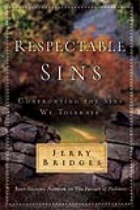
One of the books on my bedside table is Respectable Sins, by Jerry Bridges.  The subtitle of the book is: Confronting the Sins We Tolerate. The theme becomes self explanatory. 

In his preface Bridges explains the motive behind the book:

“The motivation for this book stems from a growing conviction that those of us whom I call conservative evangelicals may have become so preoccupied with some of the major sins of society around us that we have lost sight of the need to deal with our own more “refined” or subtle sins.”

I think Bridges is correct.  The whole notion of sin seems to have been lost on our society, and confused in our churches. 

Conservatives often lament the absence of any sense of, or concern about, sin reflected in our society.  In this glaring absence in our collective cultural conscience we have seen the arrival of government sanctioned killing through abortion and euthanasia; the crumbling of the family due to divorce, rampant pornography, and the redefining of it to embrace homosexuality as an acceptable norm; and a widespread apathy toward God. Those who speak out about such matters are right to be concerned.  The problem is that while we talk about those things that are infecting others, we are failing to address the very real sin in our own lives.  And we are therefore seen to be hypocrites – and probably rightly so.

Jesus instructed his followers to “first take the plank out of you own eye, then worry about the speck in the eye of another.”  I am not suggesting that those sins that are freely expressed in our society are minor specks.  They are not. They are serious.  And I am convinced that if we heed Jesus’s perscriptive counsel we will again experience the moral authority to speak. 

More serious than even the loss of our moral authority, many Evangelicals are confused about how we relate to God.  We have become disconnected from our own need of the Gospel, and our need of it every day. We fail to see the subtle, yet serious, ways we function as “unbelievers” and tolerate cancerous sin in our own hearts and relationships.  In fact, as the title of Bridges’ book suggests, we have not merely tolerated these things, but have functionally elevated them to a level of respectability.

Recognizing our sin, despite how it may seem, is not an entirely ugly proposition.  It is important to our spiritual vitality.  And makes practical sense. 

Let me explain it this way: We should be at least as concerned about our spiritual vitality as we are about our computers. 

I regularly receive updates from McAfee, and I run a scan on my computer at least a few times a week. Why? Because I have experienced the slow down, the unresponsiveness, and even a crash when I failed to have my computer checked for viruses that can infect it.  Once McAfee has performed a scan, if it has identified any potential threats I am able to deal with it. I either delete it, or in some cases quarantine the file. But either way, my computer functions much better because I have taken the time to perform this taks.

Sin in our lives, even that which seems minor, infects our hearts, our perceptions, our relationships, even our productivity.   We need to “scan” our hearts and lives regularly to see if there is anything there that may cause problems down the road. (This is what the Psalmist is advocating in Psalm 139)  Once we determine if there is anything there we can deal with it accordingly. In taking the appropriate precaustions we prevent problems because we are more able to keep things from spreading over and infecting other areas of our lives.

Despite what you may suspect due to my ranting thus far, this book is actually very positive, practical, and encouraging. 

In chapters 1-4 Bridges does a wonderful job explaining the Gospel, its practical importance, and its important practicality.

Chapter 5 discusses the Power of the Holy Spirit, and expalins how the Spirit is at work in the Gospel.

Chapter 6, titled: Directions for Dealing with Sins, serves as a practical preface to the rest of the book.  This chapter alone would be worth the price of the book, because it shows us how we can practice preaching the Gospel to ourselves. 

Chapters 7-20 deal with specific “acceptable” and “respectable” sins.  I have deeply appreciated Bridges’ talent for defining words of our Christian jargon that have at times confused me, or words that I’ve generally understood yet was still somewhat fuzzy about.  This understanding has been helpful in identifying some of the sin I carry around in my heart, and how it expresses itself in my life and in relationships..

The final chapter, chapter 21, simply asks the question: Where Do We Go from Here?

Each chapter is short and easily readable.  My intention is to read a few chapters a week over the next month or two so that I can digest Bridges’ insight, and deal with my own heart.  I may even journal my insights here on my blog. I haven’t decided yet.

But one thing I have decided to do. My friend, David Zavadil, has been working through this book and posting his observations on his blog, By His Grace.  Whether I develop my own posts or not, I will join the discussion David has started. I invite you to join me over there.